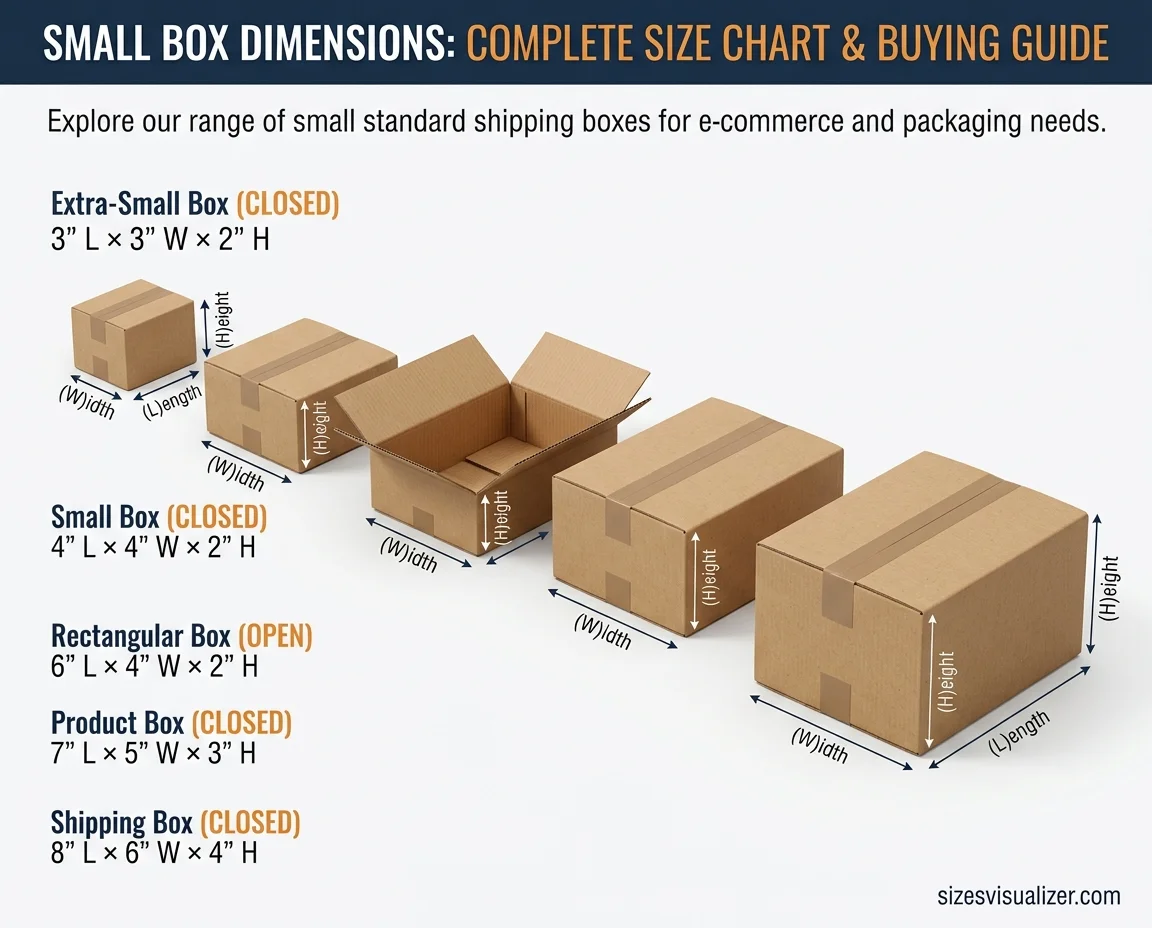
The wrong box size costs money. A box that is too big can trigger extra shipping fees. A box that is too small can crush your product.
This guide gives you the small box dimensions you need. You will get a size chart, carrier sizes, measuring tips and a simple buying checklist.
Table of Contents
What Are Small Box Dimensions and How Do You Measure Them?
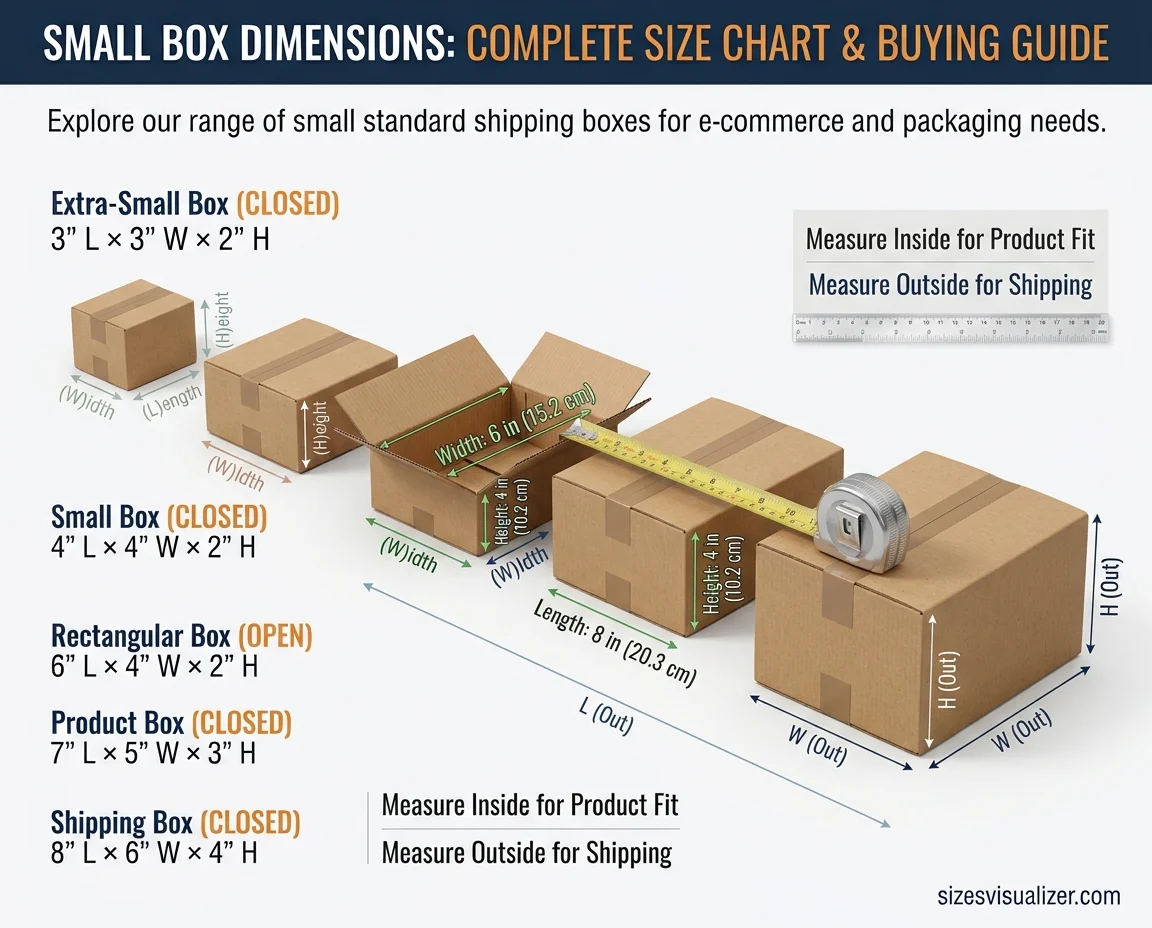
Small box dimensions are three numbers: length, width and height. You will often see them written as L × W × H. The first two numbers describe the base. The last one is the height.
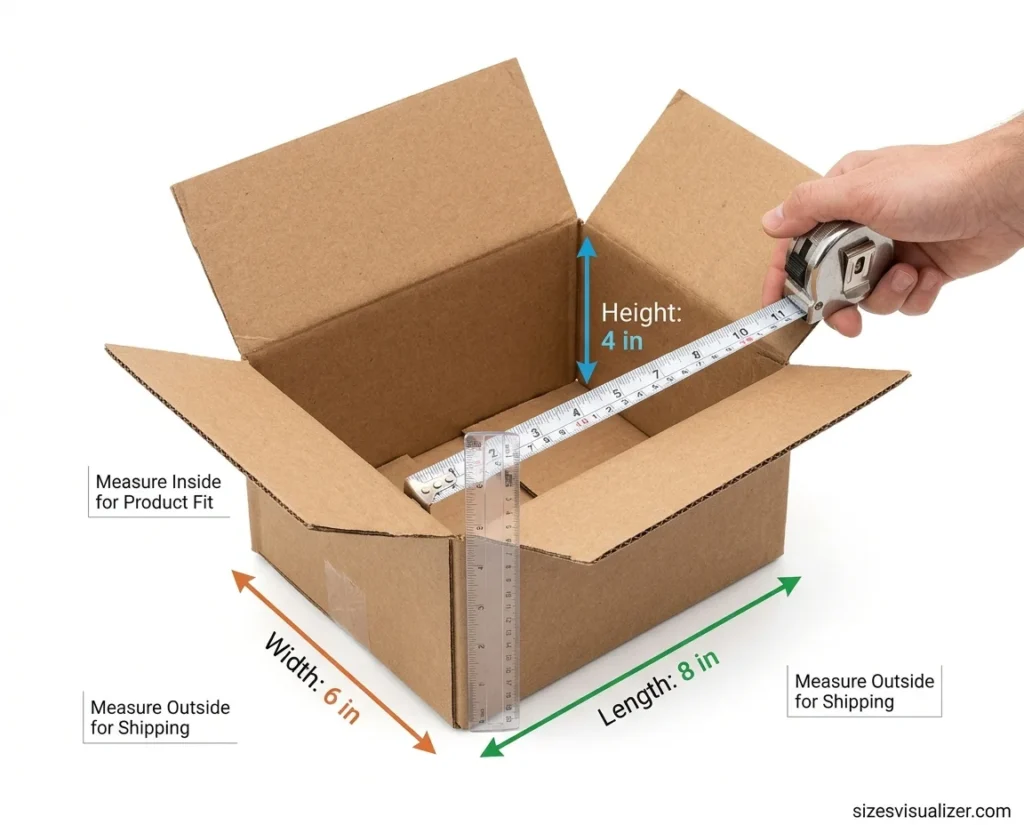
Follow these steps to measure a box:
- Length: the longest side of the opening.
- Width: the shorter side of the opening.
- Height: the distance from the base to the top.
Measure the inside if you want to know what fits. Measure the outside if you want to know what a carrier will charge. Corrugated walls add thickness. E-flute adds roughly 1/8 inch to each dimension. B-flute adds roughly 1/4 inch.
Two quick conversions help with every chart:
- Inches × 2.54 = centimeters
- Centimeters × 10 = millimeters
Volume matters too. Multiply L × W × H to get cubic inches. An 8 × 6 × 4 box holds 192 cubic inches.
Small Box Size Chart: Standard Small Box Sizes in Inches, CM and MM
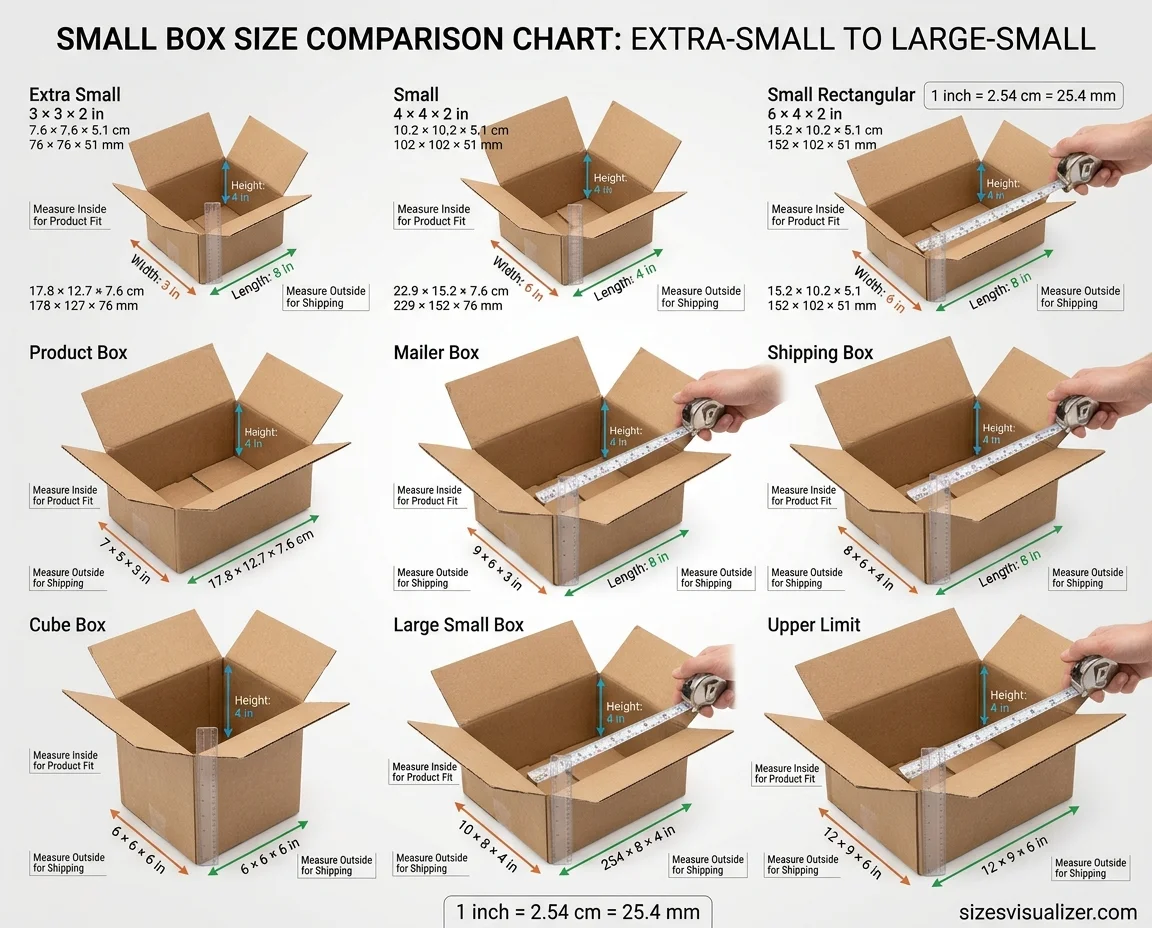
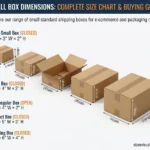
Here is a quick small box size chart with the most common standard small box sizes. Multiply any cm value by 10 to get mm.
| Box Type | Inches (L × W × H) | Cm (L × W × H) | Volume (in³) | Best For |
|---|---|---|---|---|
| Extra small | 3 × 3 × 2 | 7.6 × 7.6 × 5.1 | 18 | Rings, earrings |
| Small | 4 × 4 × 2 | 10.2 × 10.2 × 5.1 | 32 | Lip balm, small cosmetics |
| Small rectangular | 6 × 4 × 2 | 15.2 × 10.2 × 5.1 | 48 | Cables, cards, soap bars |
| Product box | 7 × 5 × 3 | 17.8 × 12.7 × 7.6 | 105 | Accessories, gadgets |
| Mailer box | 9 × 6 × 3 | 22.9 × 15.2 × 7.6 | 162 | Subscription items |
| Small shipping box | 8 × 6 × 4 | 20.3 × 15.2 × 10.2 | 192 | Everyday e-commerce orders |
| Cube box | 6 × 6 × 6 | 15.2 × 15.2 × 15.2 | 216 | Candles, small jars |
| Large small box | 10 × 8 × 4 | 25.4 × 20.3 × 10.2 | 320 | Books, apparel |
| Upper limit | 12 × 9 × 6 | 30.5 × 22.9 × 15.2 | 648 | Bundled orders |
Different products need different sizes. Here are typical small package dimensions by industry:
- Cosmetics: about 3 × 3 × 3 to 6 × 4 × 2 inches
- Jewelry: about 2 × 2 × 1 to 5 × 3 × 2 inches
- Candles: about 3.5 × 3.5 × 3.5 to 4 × 4 × 4 inches
- Supplement bottles: about 4 × 4 × 5 to 5 × 5 × 7 inches
Small Box Dimensions for USPS, UPS, FedEx and Amazon FBA
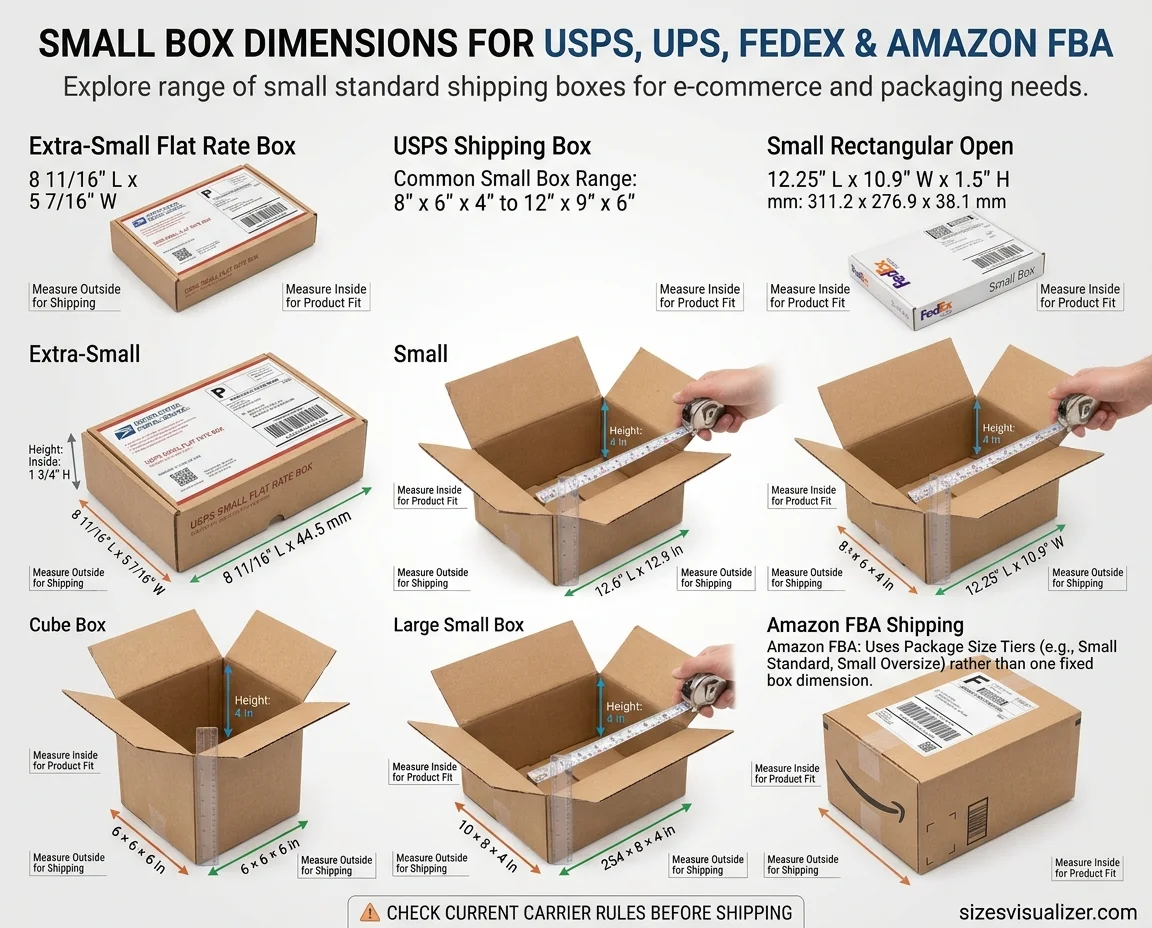
US carriers each have their own small shipping box dimensions. Here are the main ones.
USPS Small Flat Rate Box: The outside size is 8 11/16 × 5 7/16 × 1 3/4 inches. The usable inside space is about 8 5/8 × 5 3/8 × 1 5/8 inches. USPS says it is about as big as three stacked DVD cases. Use it for flat, dense items like jewelry or small electronics. You must use the official box to get the flat rate.
FedEx Small Box: The inside size is 12.25 × 10.9 × 1.5 inches, with a 20 lb limit. It suits documents, catalogs and thin items.
UPS: UPS has no single “small” size. Most sellers use boxes from 8 × 6 × 4 up to 12 × 9 × 6 inches.
Amazon FBA: Amazon uses size tiers, not fixed boxes. Check the current tier rules before you order.
Dimensional weight is the rule that catches many sellers. Carriers bill the higher of two numbers: actual weight or box size weight. The formula is L × W × H ÷ 139. Round each side up to the next whole inch first.
Since July 12, 2026, USPS uses the same 139 divisor as UPS and FedEx. USPS applies it only to packages over 1 cubic foot (1,728 cubic inches). Amazon’s divisor reportedly moved to 139 in January 2026 as well.
Here is an example. You ship a 2 lb candle in a 14 × 14 × 10 inch box.
- Volume: 1,960 cubic inches
- 1,960 ÷ 139 = 14.1, which rounds up to 15
- You pay for 15 lb, not 2 lb
A snug box would have cost far less. Always confirm current carrier rules before you ship.
If you’re evaluating cargo space across different vehicle types, understanding how smaller containers compare to standard truck bed sizes and dimensions can help you plan your loading capacity more effectively. Matching your payload volume to the right vehicle setup ensures you select the perfect crate or box size for every transport job.
How to Choose the Right Small Box Size: A Buying Guide
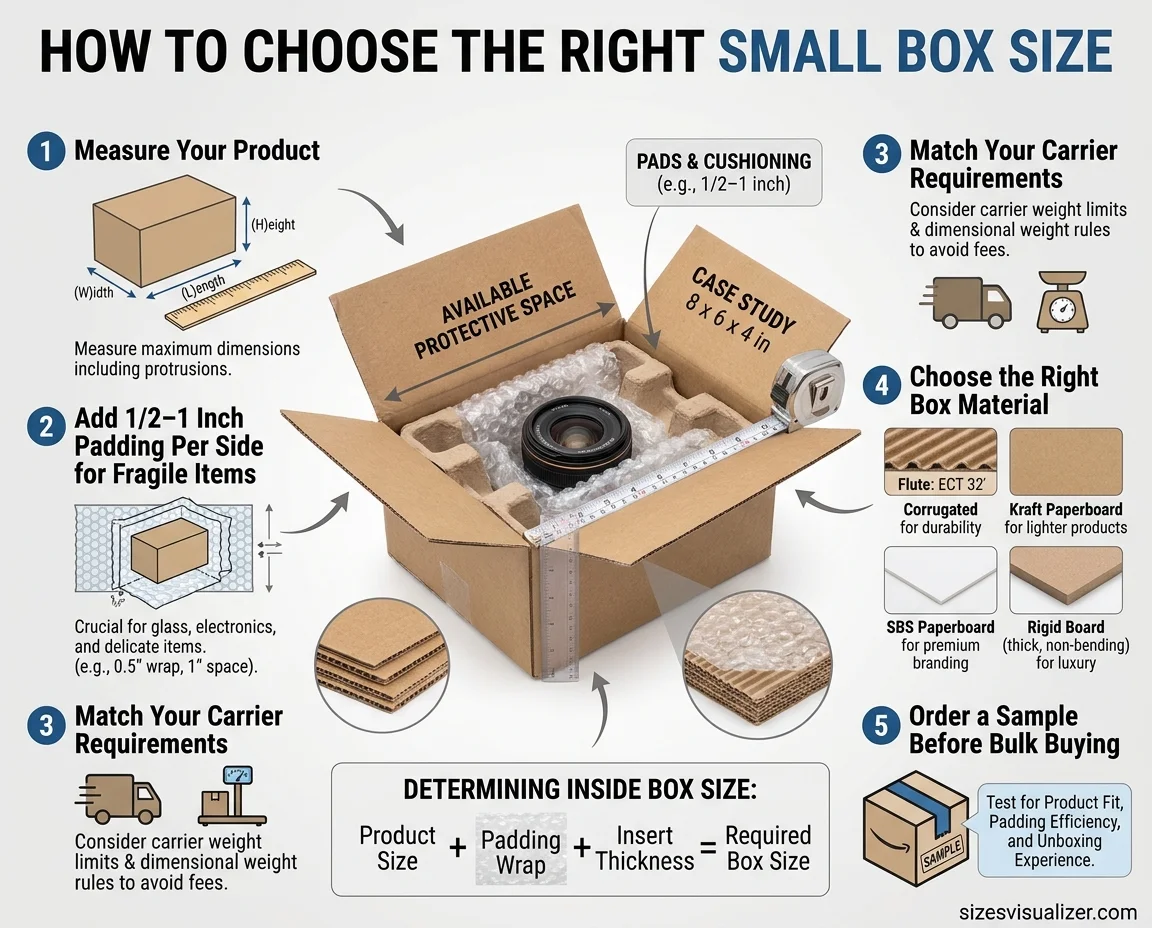
Use this simple formula for the right small box size:
Product size + padding + insert thickness = inside box size
Follow these five steps:
- Measure your product. Use its longest, widest and tallest points.
- Add padding. Leave about 1/2 to 1 inch per side for fragile items.
- Match your carrier. Check flat rate limits and dimensional weight.
- Pick the right material. Choose by weight and fragility.
- Order a sample. Test it with a real product before a full run.
Common materials include:
- Corrugated board: best for shipping and heavier items. A 32 ECT single-wall box commonly handles up to about 65 lb.
- Kraft paperboard: light, natural looking and recyclable.
- SBS paperboard (12pt to 24pt): smooth and ideal for retail boxes and cosmetics.
- Rigid board: premium feel for gifts and jewelry.
Avoid these mistakes:
- Ordering by outside size instead of inside size
- Forgetting insert thickness
- Choosing a box that is too big
- Skipping carrier rules
Standard sizes work for most products. Custom small boxes pay off when your item doesn’t fit a standard size. They cut filler, trim shipping costs and improve the unboxing experience.
Need a size that doesn’t exist yet? Our team makes custom small boxes in any dimension, with CMYK printing, premium finishes and wholesale pricing. [Request a free quote.]
FAQs
What is a standard small box size?
There is no single standard. Most fall between 6 × 4 × 2 and 12 × 9 × 6 inches. A very popular size is 8 × 6 × 4 inches.
What are D × W × H dimensions?
They stand for depth, width and height. Depth is the front-to-back side, also called length. Always list them in the same order.
How big is a 16×16×16 box?
It measures 16 inches (40.6 cm) on every side. Its volume is 4,096 cubic inches. That is a large box, not a small one.
How small is a small box?
Most small boxes run 4 to 12 inches long and 2 to 6 inches tall. The USPS Small Flat Rate Box is about 8.7 × 5.4 × 1.75 inches.
What is the size of a box?
It depends on the box type. Small boxes are under about 12 inches. A medium box is often near 18 × 12 × 9 inches. A large box is often near 24 × 18 × 12 inches.
How to make a mini box?
Try a 4 × 4 × 2 inch open box:
- Cut an 8 × 8 inch square of cardstock.
- Draw lines 2 inches from each edge to mark a 4 × 4 inch center.
- Cut out each 2 × 2 inch corner square.
- Fold the four sides up along the lines.
- Glue or tape the corners.
For a lid, repeat with a base about 1/8 inch larger.
Conclusion
The right small box size protects your products, saves packaging materials, and helps reduce shipping costs. Always measure length, width, and height carefully before choosing a box. Compare standard sizes, check carrier requirements, and select suitable materials. If standard boxes do not fit your needs, custom small boxes offer a practical solution.

Measurement Researcher, Size Comparison Writer & Content Specialist
Timmy Ahad is a dedicated content writer and research specialist at SizesVisualizer.com, where he focuses on creating accurate, easy-to-understand content about measurements, dimensions, size comparisons, and real-world object visualization.