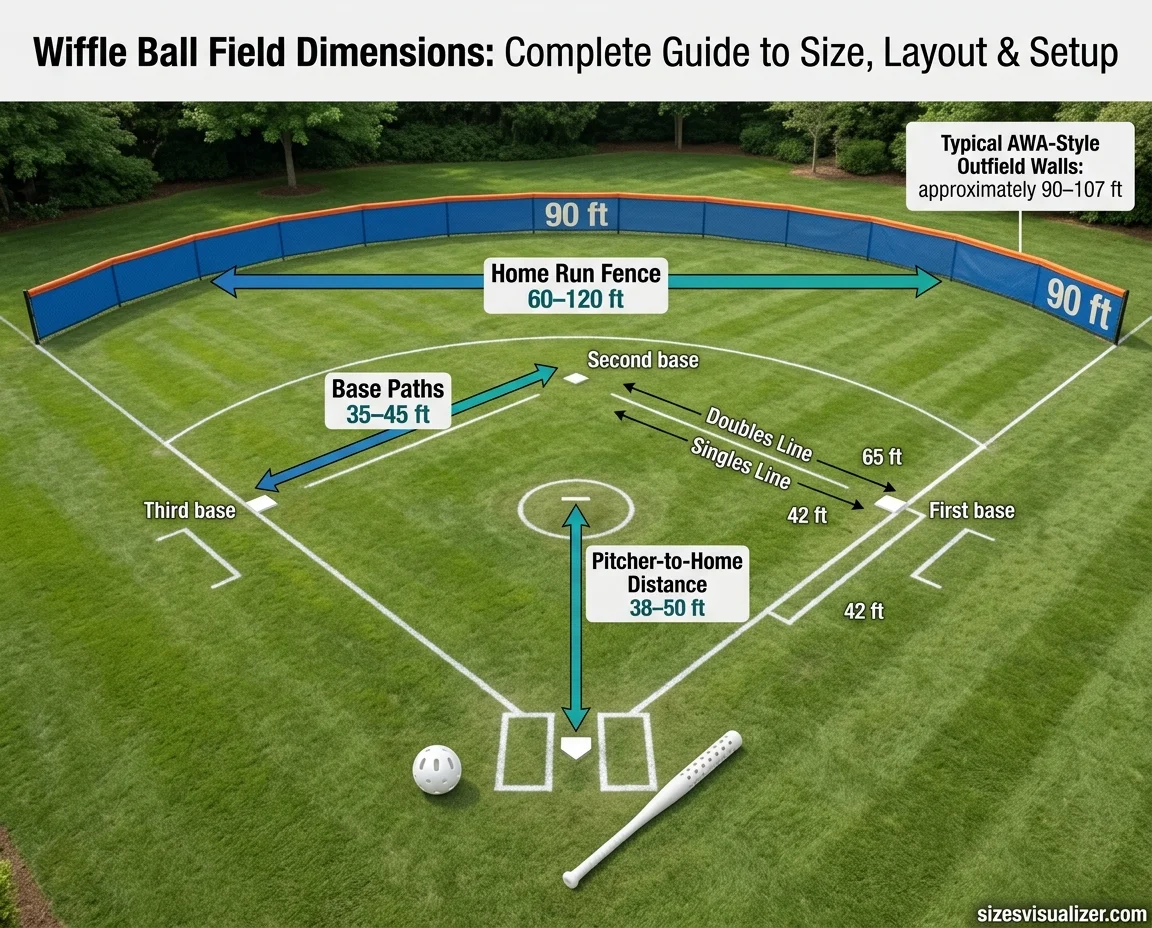
Wiffle ball field dimensions change from league to league. Most fields use bases 35 to 45 feet apart, a pitcher 38 to 50 feet from home, and fences 60 to 120 feet out.
This guide shows the common sizes, how to fit a field into your yard, and how to set it up the right way.
Table of Contents
Standard Wiffle Ball Field Dimensions (AWA and Tournament Sizes)
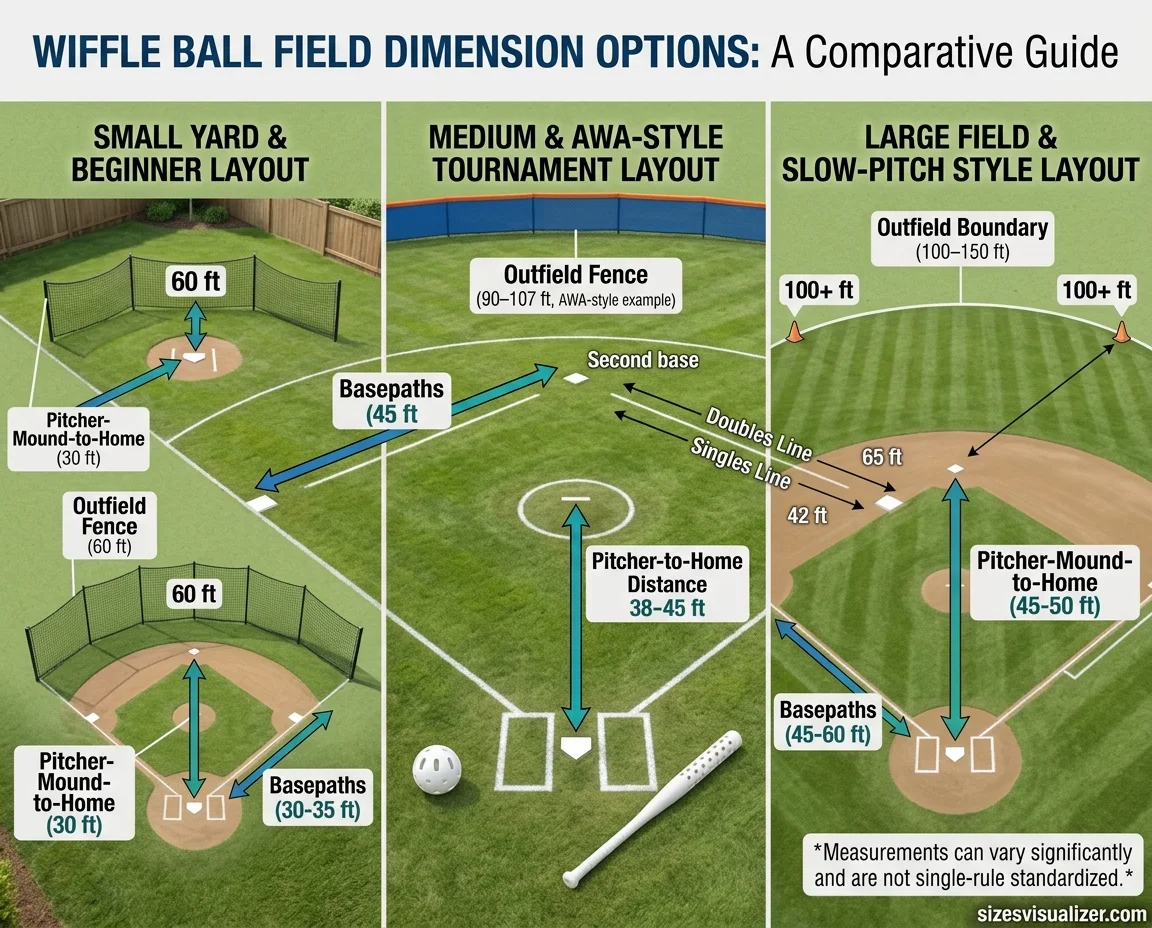
How big is a wiffle ball field? A standard wiffle ball field size is much smaller than a baseball diamond. The ball is light and hollow, so it doesn’t fly far. Wiffle ball began in 1953 in Fairfield, Connecticut, as a small-space version of baseball.
Here is a quick wiffle ball field dimensions chart:
| Field Part | Common Distance |
|---|---|
| Base paths | 35–45 ft |
| Pitcher’s mound to home plate | 38–50 ft |
| Home run fence | 60–120 ft |
| Singles line (tournament) | about 42 ft |
| Doubles line (tournament) | about 65 ft |
The American Wiffle Association (AWA) sets its own field rules for league play. One AWA-style setup puts the bases 45 feet from home plate and the mound at 38 feet. Its outfield walls run from about 90 to 107 feet.
The Twinsburg World Series of Wiffle Ball uses a singles line at 42 feet and a doubles line at 65 feet. Its home run fence is 90 feet away. Players ages 7 to 9 use a 75-foot fence, a 40-foot singles line and pitching box, and a 60-foot doubles line.
Why do the numbers differ? Ball type, bat, pitch speed and league rules all change the best size. Fast pitching needs more room. A slow-pitch game works well on a smaller field. Always check the current rulebook before a league season.
How does it compare with real baseball? Little League Minors use 60-foot bases and a 46-foot mound. High school and pro baseball use 90-foot bases and a 60.5-foot mound. A wiffle field is a scaled-down diamond.
Foul territory also works differently. Fair ground is a triangle that starts at home plate. A ball outside the lines is a foul ball. A game usually runs six innings or 60 minutes.
There is also Over the Line, a version with no runners and no bases. Players score by hitting the ball past a line.
Backyard Wiffle Ball Field Size: Small, Medium and Large Layouts
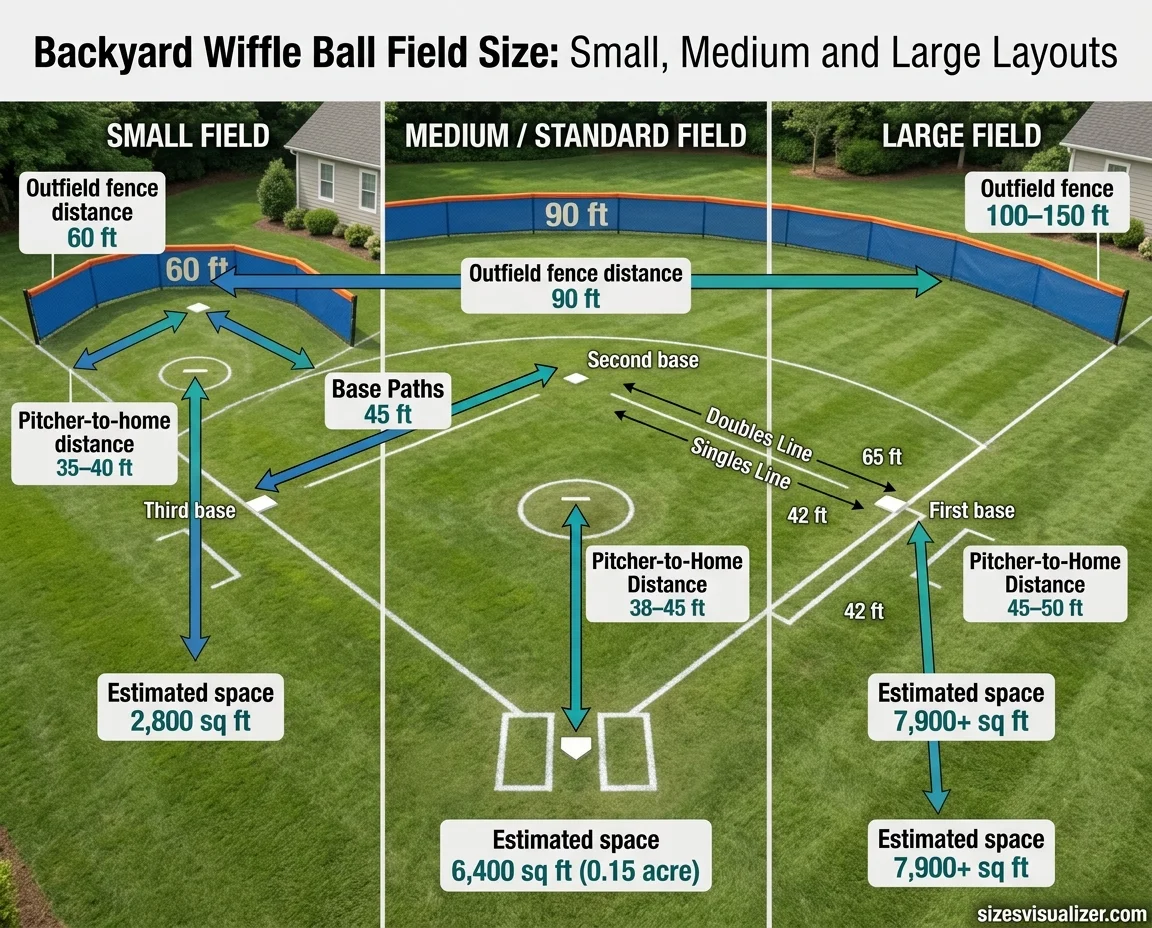
How much space do you need for a wiffle ball field? It depends on your fence distance. A fence arc covers a fan-shaped area, so a few quick numbers help:
- Small yard: 60-foot fence, 30 to 35-foot bases, 35 to 40-foot mound. This needs about 2,800 square feet.
- Standard yard: 90-foot fence, 45-foot bases, 38 to 45-foot mound. This needs about 6,400 square feet, or roughly 0.15 acre.
- Large yard: 100 to 150-foot fence, 45 to 60-foot bases, 45 to 50-foot mound. This needs 7,900 square feet or more.
These are common backyard wiffle ball field ranges, not strict rules. A full quarter acre is 10,890 square feet, so a standard layout fits with room to spare.
Add a few extra feet behind home plate and along the foul lines. Batters and catchers need space to move.
Trees, sheds and fences can help. A short right-field porch or a tall left-field wall makes the game more fun. Real parks do the same thing. Many fields copy features from famous parks, like a “Green Monster” wall.
For kids, shorten the base paths and mound distance. Shorter bases keep the game fair and give young fielders time to make a play.
How to Set Up a Wiffle Ball Field Layout Step by Step
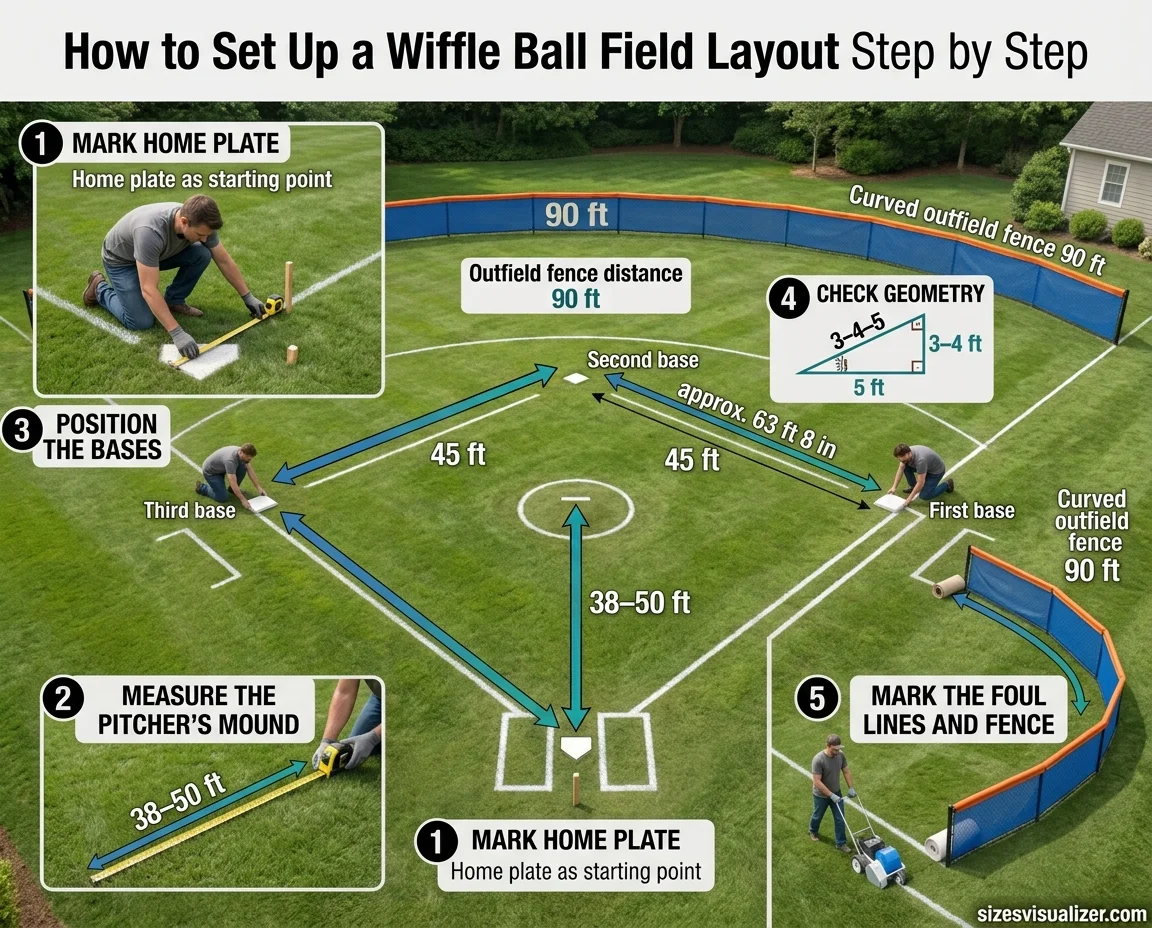
How do you set up a wiffle ball field? Start at home plate. Everything is measured from that point.
- Mark home plate. Use a rubber mat, a painted board or a flat plate.
- Measure the mound. Run a tape straight from home. Mark the spot with a stake or a small mat.
- Lay out the base paths. Use string and stakes. The bases form a square with home plate as one corner.
- Check the corners. Use the 3-4-5 triangle method. Measure 3 feet along one line and 4 feet along the other. The gap between the points should be 5 feet. Use 9-12-15 or 30-40-50 for bigger fields.
- Check the diagonal. On a 45-foot square, home to second base should be about 63 feet 8 inches. For 35-foot bases, it is about 49.5 feet.
- Mark the foul lines. Run them from home plate through first and third base. Use chalk or field paint.
- Set the fence. Walk the arc with a tape and place posts at even gaps.
Think about the sun. If it sits in the batter’s eyes, move the field. Check drainage too. A spot that puddles will turn to mud after rain.
Safety matters most. Clear rocks, sharp objects and roots. Pad trees or poles near the field. Keep the swing area free of people.
Designing a Wiffle ball field requires careful planning for space, drainage, and ground preparation to create a safe, playable area. Similar planning is essential for managing wastewater at home, so understanding 1000-gallon septic tank dimensions and installation requirements can help homeowners choose the right tank size and prepare their property effectively.
Best Turf, Fences and Gear for Your Wiffle Ball Field
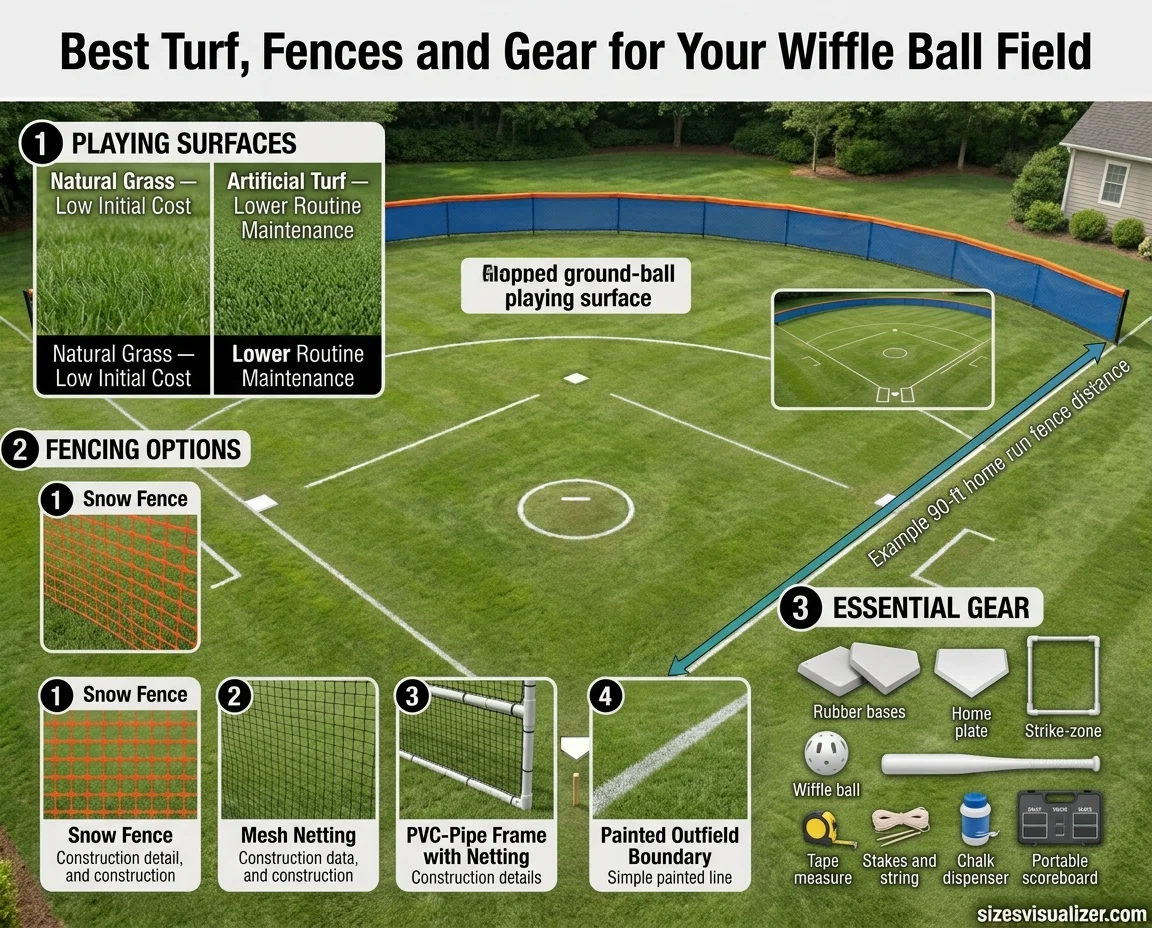
What is the best surface for a wiffle ball field? Natural grass is cheap and familiar. It needs mowing and wears down fast at the bases and mound.
Artificial turf lasts longer and needs little care. It works in all seasons and stays smoother for ground balls. Look at pile height, foam padding and infill needs. Indoor turf often needs no infill. A short pile gives a true ball roll.
For fences, popular choices include snow fencing, mesh netting, PVC frames with netting and plain painted lines on an existing wall. Posts can be T-posts, wood stakes or PVC pipe.
Other useful gear:
- Bases and home plate: rubber, painted wood or cut-down mats.
- Strike zone: a PVC frame, a net or a lawn chair.
- Scoreboard: a whiteboard or a simple chalkboard.
- Foul poles: extra poles that add a “real park” look.
- Lining kit: chalk or paint for crisp lines.
Start simple and upgrade later. A tape, string and a few stakes are enough for a first game.
FAQs
What size is a standard wiffle ball field?
Most fields use bases 35 to 45 feet apart, a mound 38 to 50 feet from home and a fence 60 to 120 feet out. Leagues set their own numbers, so check your rulebook.
How far is the pitcher’s mound in wiffle ball?
It is usually 38 to 50 feet from home plate. Tournament play often sits near the shorter end, and backyard games often use the longer end.
How far apart are the bases in wiffle ball?
Bases are commonly 35 to 45 feet apart. Backyard games stretch to 60 feet. Shorter paths suit kids.
How far is a home run fence in wiffle ball?
Tournament fences often sit near 90 feet. Youth fields use about 75 feet. Backyard fences range from 60 to 150 feet.
How much yard space do you need for a wiffle ball field?
A small field needs about 2,800 square feet. A standard 90-foot field needs about 6,400 square feet, or roughly 0.15 acre.
What is the best surface for a wiffle ball field?
Artificial turf gives the best mix of low upkeep, a true bounce and year-round use. Natural grass is the cheapest option.
Conclusion
Good wiffle ball field dimensions come down to a few key distances: base paths, pitcher’s mound and fence. Pick the size that fits your yard, check your corners and keep the field safe.

Measurement Researcher, Size Comparison Writer & Content Specialist
Timmy Ahad is a dedicated content writer and research specialist at SizesVisualizer.com, where he focuses on creating accurate, easy-to-understand content about measurements, dimensions, size comparisons, and real-world object visualization.