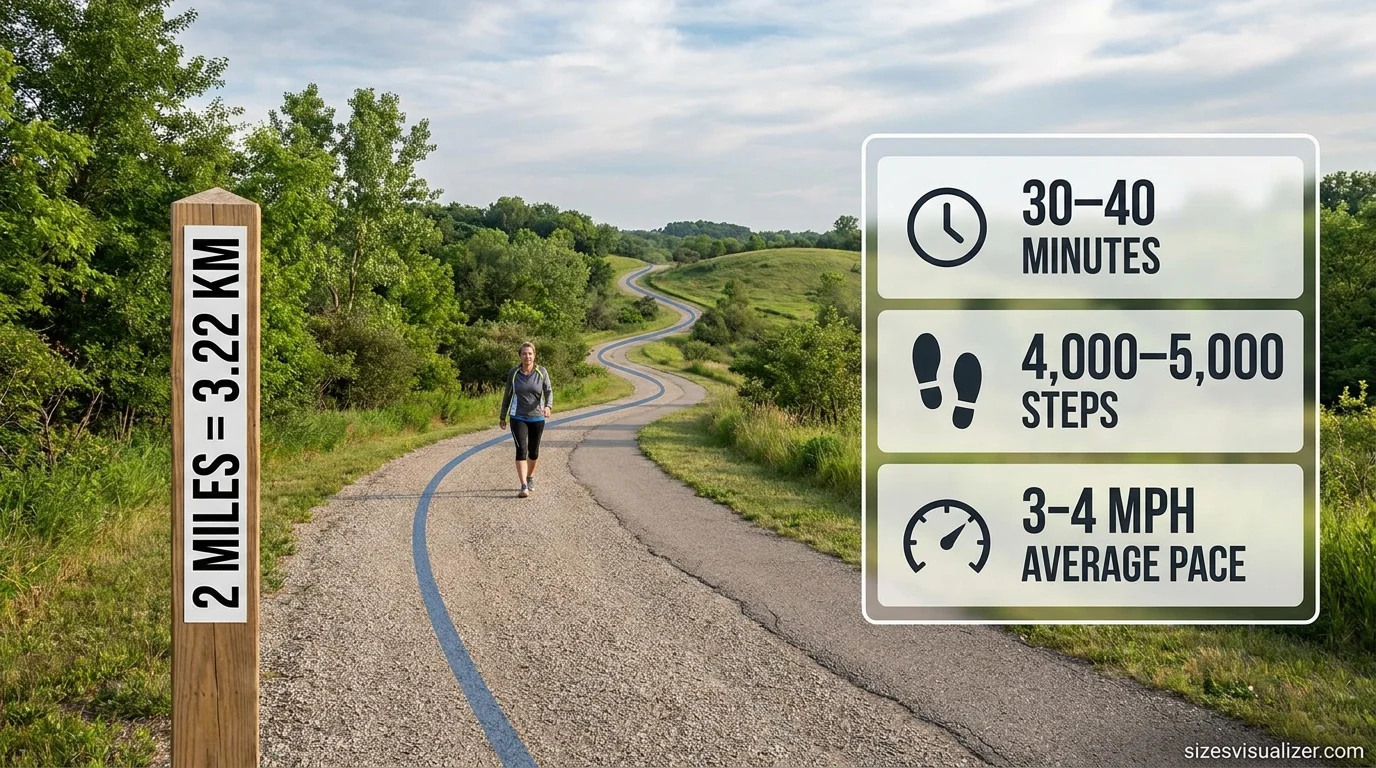
How long is 2 miles? Most adults walk 2 miles in 30 to 40 minutes. That’s the short answer. But your actual time depends on your walking pace, your fitness level, and the ground under your feet.
If you’re trying to plan a workout, hit a step goal, or just figure out how long a 2-mile trip will take, this guide breaks it all down — time, steps, pace, and distance — using real numbers you can actually use today.
Table of Contents
How Long Does It Take to Walk 2 Miles
The average person walks at 3 to 4 miles per hour. At that speed, a 2-mile walk takes somewhere between 30 and 40 minutes. Walk slower, and it stretches closer to an hour. Walk faster, and you can trim it down to 24 minutes or less.
Explore real-world dimensions with our Size Visualizer & Comparison Tool and compare objects, spaces, and measurements with ease.
Here’s how walking pace changes your 2-mile time:
| Walking Speed | Pace (per mile) | Time for 2 Miles |
|---|---|---|
| 2.0 mph (slow) | 30 min | 60 minutes |
| 2.5 mph (casual) | 24 min | 48 minutes |
| 3.0 mph (moderate) | 20 min | 40 minutes |
| 3.5 mph (brisk) | 17 min | 34 minutes |
| 4.0 mph (fast) | 15 min | 30 minutes |
| 5.0 mph (power walk) | 12 min | 24 minutes |
Moderate pace
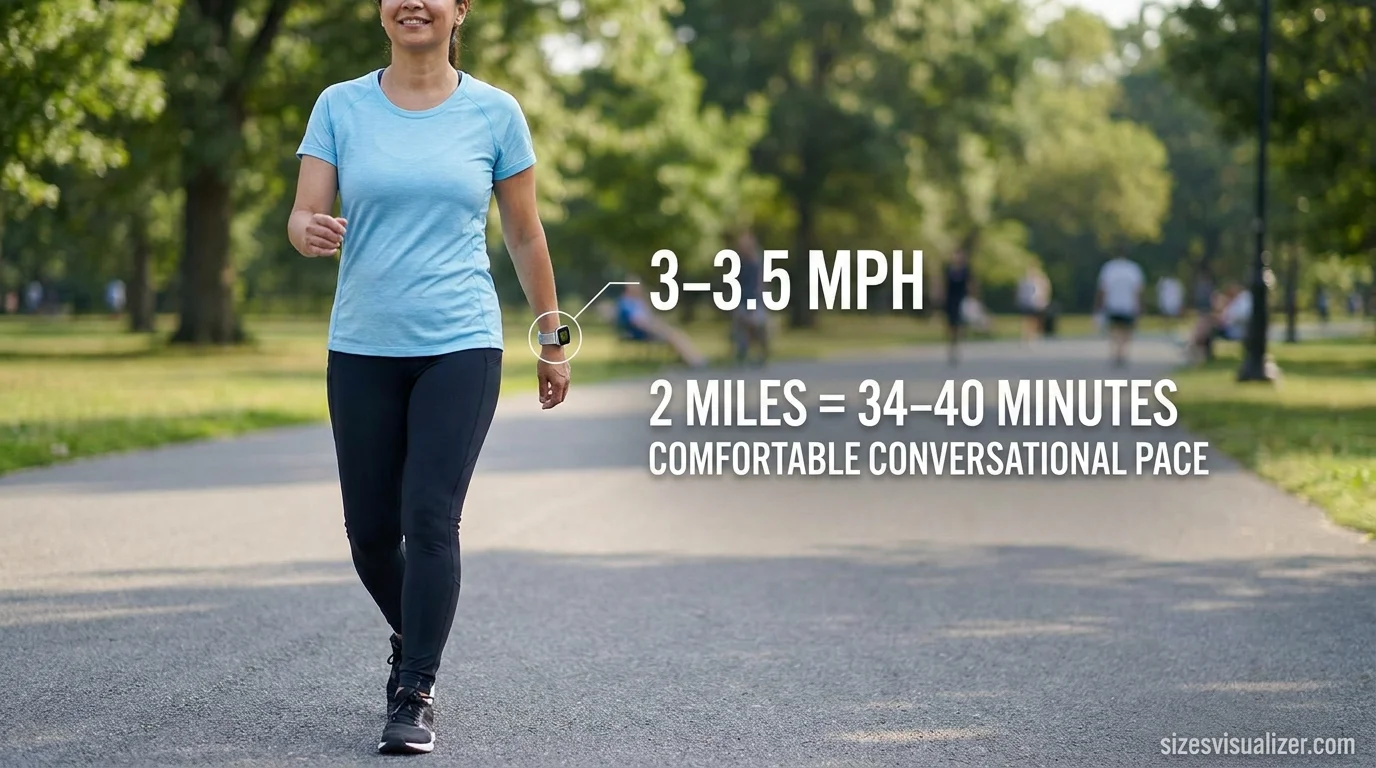
Moderate pace is where most people land — somewhere between 3 and 3.5 mph. That’s a walk where you can still talk comfortably but you’re clearly moving with purpose.
Walking on a treadmill

Walking on a treadmill? Time stays the same as walking outdoors at the same speed setting. The one thing that changes it is incline. Add just a 5% incline, and your pace can drop by 10 to 15%, since your legs are working against gravity the whole time. A steeper 10% grade can slow you down by nearly a third.
Age matters too
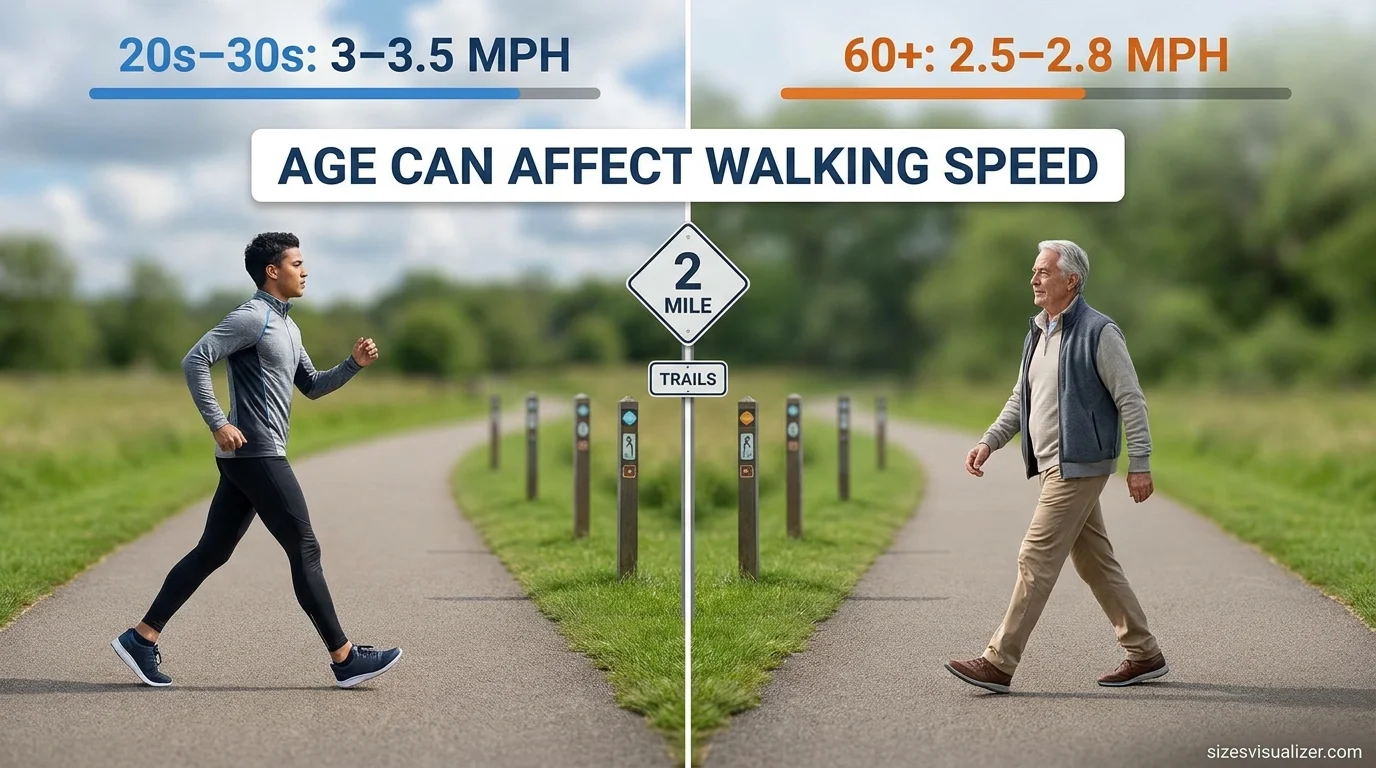
Age matters too. Adults in their 20s and 30s usually average 3 to 3.5 mph. Past 60, walking speed naturally eases to around 2.5 to 2.8 mph. This isn’t a red flag — it’s just a normal part of how muscle and joint mechanics shift over time, according to research published by the National Institute on Aging.
How Many Steps Is 2 Miles
On average, 2 miles equals about 4,000 to 5,000 steps. The exact number comes down to your stride length, which is closely tied to your height.
| Height | Approximate Stride | Steps for 2 Miles |
|---|---|---|
| Under 5’2″ | ~2.0 ft | ~5,300 steps |
| 5’3″ – 5’7″ | ~2.2 ft | ~4,800 steps |
| 5’8″ – 6’0″ | ~2.5 ft | ~4,200 steps |
| Over 6’0″ | ~2.7 ft | ~3,900 steps |
Shorter strides mean more steps per mile. Taller walkers cover more ground with each stride, so their step count naturally runs lower for the same distance.
To put this in a wider frame: 1 mile is roughly 2,000 to 2,500 steps. So doubling that gets you the familiar 4,000–5,000 step range for 2 miles. If you’re chasing the popular 10,000 steps a day goal, a 2-mile walk gets you close to halfway there in one session.
What Affects Your 2-Mile Walking Time
No two walks are identical, even over the exact same distance. A few factors quietly control your pace every single time you head out.
Terrain

Terrain is the biggest wildcard. Flat pavement lets you move at full speed. Sand, gravel, grass, or a rocky trail can slow you by 20% or more, since your feet sink or slip with every step, according to biomechanics research from the American Council on Exercise.
Fitness level
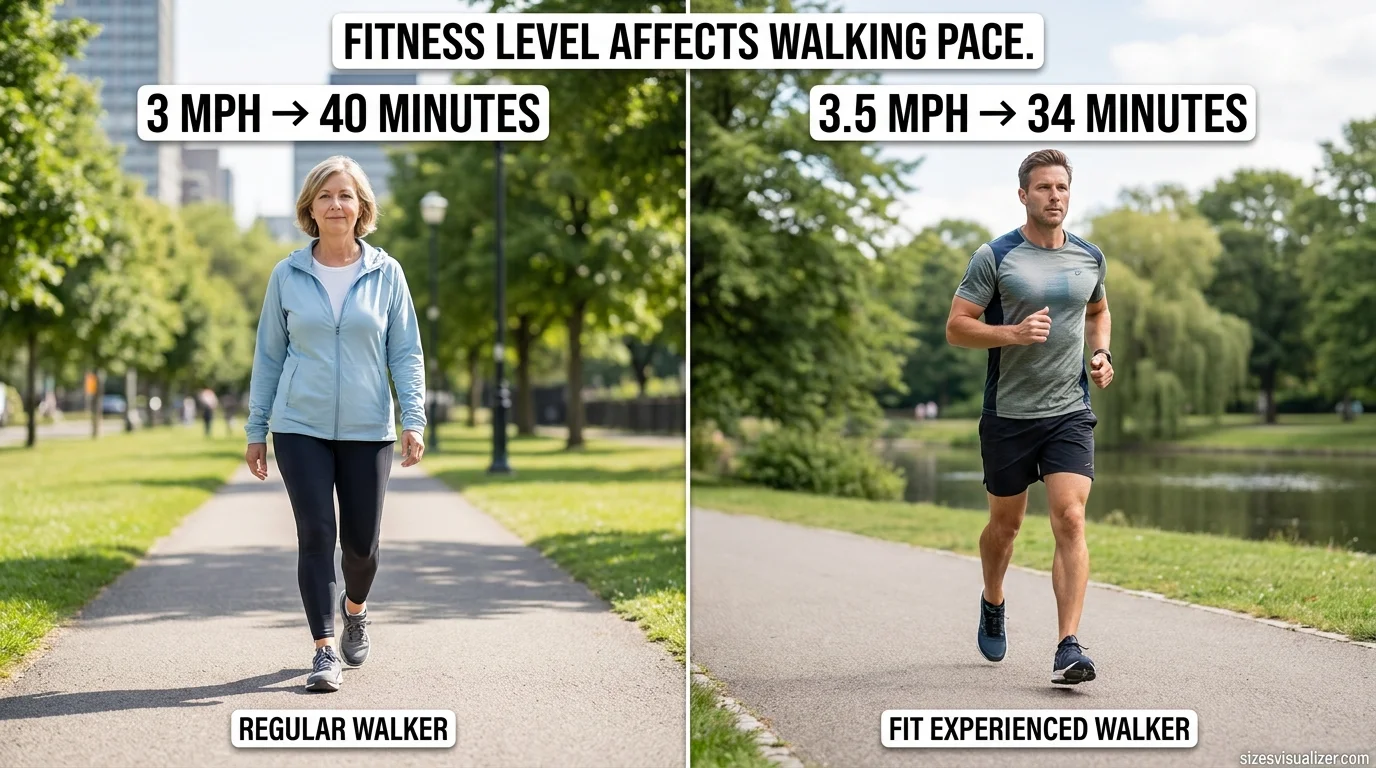
Fitness level shapes your baseline speed. Someone who walks regularly builds stronger leg muscles and better lung capacity, which naturally speeds up their walking pace over just a few weeks of consistent effort.
Weather

Weather plays a bigger role than most people expect. Heat and humidity force your heart to work harder just to cool your body, which can slow your pace even if your legs feel fine. Cold weather tightens muscles and joints, especially in the first ten minutes of a walk.
Body weight and gear
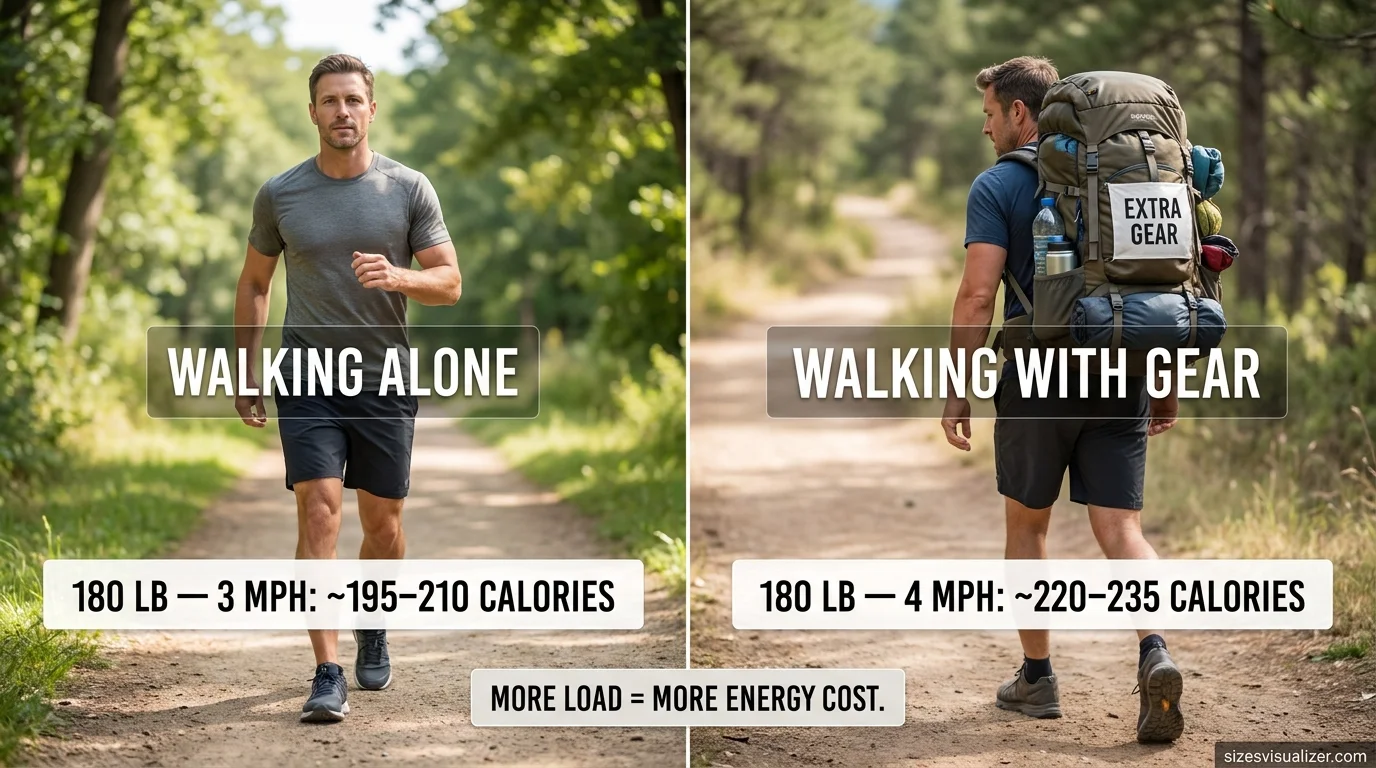
Body weight and gear also factor in. Carrying a backpack, groceries, or extra body weight increases the energy cost of each step, which can shave your speed down slightly — though it also means you burn more calories per mile.
Age
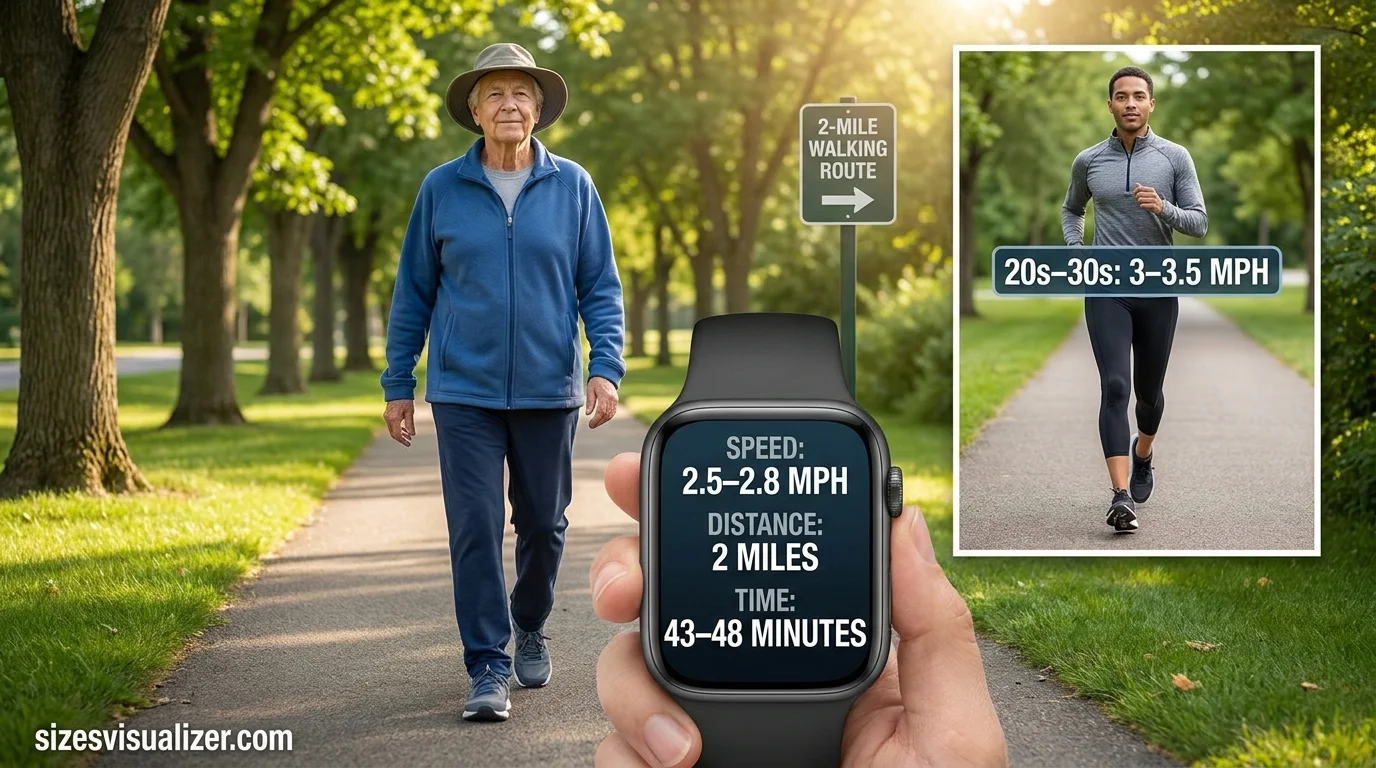
Age, as covered earlier, gradually lowers average pace, but consistent walking habits can offset much of that natural decline.
Must Visit: How Big Is a 10×10 Storage Unit? 100 Sq Ft Size, Dimensions & Layout Ideas
Calories Burned and Benefits of Walking 2 Miles a Day

Walking 2 miles burns roughly 150 to 250 calories, depending on your body weight and speed.
| Body Weight | Calories Burned (3 mph) | Calories Burned (4 mph) |
|---|---|---|
| 130 lbs | ~140–150 | ~160–170 |
| 155 lbs | ~165–180 | ~190–200 |
| 180 lbs | ~195–210 | ~220–235 |
| 200 lbs | ~215–230 | ~245–260 |
Do this daily, and the math adds up fast. Walking 2 miles a day burns somewhere between 1,000 and 1,750 calories a week. Since one pound of fat equals roughly 3,500 calories, that’s about 0.3 to 0.5 pounds a week from walking alone — a steady, sustainable pace of fat loss without crash dieting.
But the payoff goes beyond the scale. Regular walking lowers blood pressure and resting heart rate, according to the American Heart Association, which recommends at least 150 minutes of moderate activity per week — a goal a daily 2-mile walk meets almost on its own.
It’s also low-impact, meaning it strengthens the muscles around your knees and hips without the joint stress that running causes. And walking triggers the release of endorphins, which is why a short walk often clears your head just as much as it works your legs.
2 Miles Compared to Other Distances
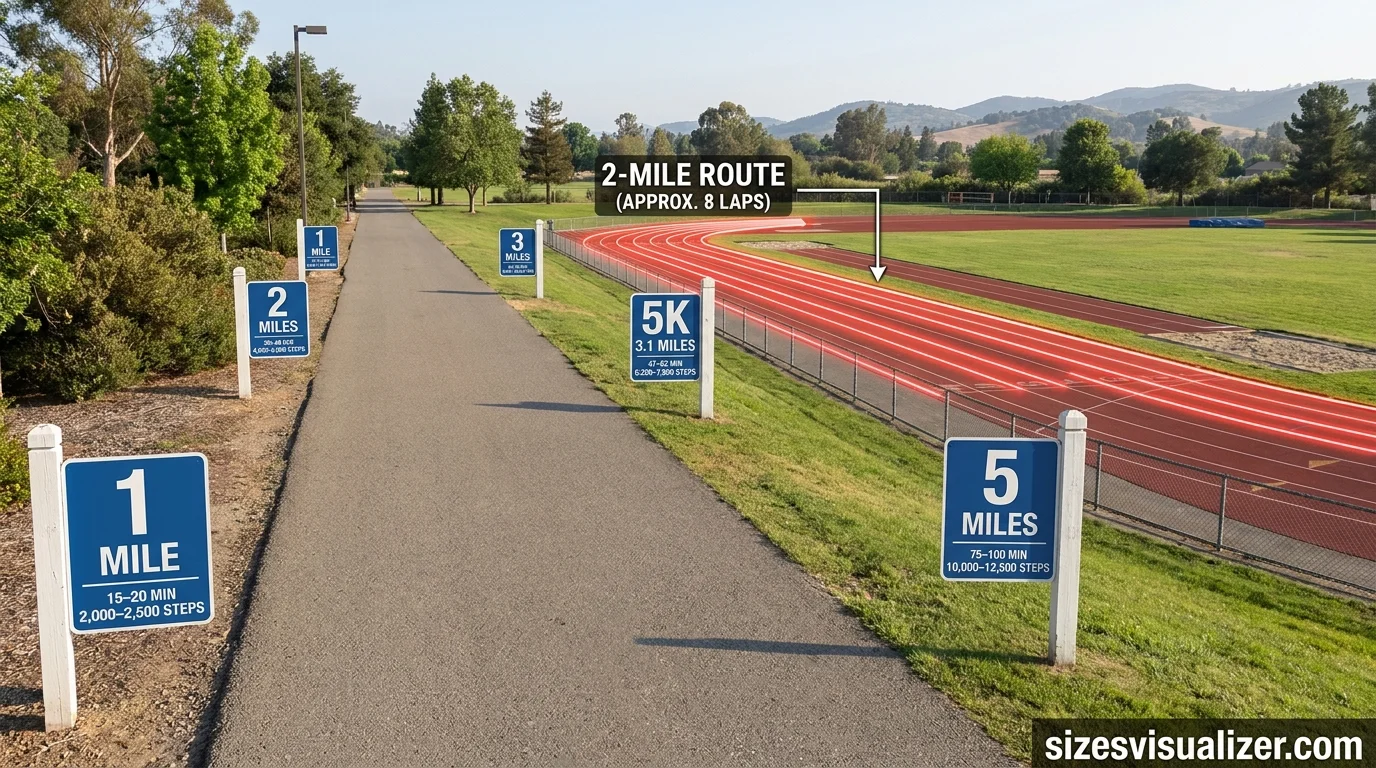
Seeing 2 miles next to other common distances makes the number easier to picture.
| Distance | Walking Time | Steps |
|---|---|---|
| 1 mile | 15–20 min | 2,000–2,500 |
| 2 miles | 30–40 min | 4,000–5,000 |
| 3 miles | 45–60 min | 6,000–7,500 |
| 5K (3.1 miles) | 47–62 min | 6,200–7,800 |
| 5 miles | 75–100 min | 10,000–12,500 |
If you want a real-world visual, 2 miles is close to eight laps around a standard outdoor track (each lap is 400 meters), or roughly 20 to 40 city blocks, depending on how a city lays out its grid. It’s also about the length of a comfortable 35-minute loop through a typical neighborhood or park.
Once 2 miles starts to feel easy, moving up to 3 miles is a natural next step for anyone building endurance.
FAQs
Does 2 miles equal 10,000 steps?
No. Two miles is closer to 4,000–5,000 steps. Reaching 10,000 steps typically means covering about 4 to 5 miles, depending on your stride length.
Can I walk 2 miles in 1 hour?
Yes, easily. Walking 2 miles in an hour only requires a 2 mph pace, which is slower than most people’s natural walking speed. This pace works well for beginners, seniors, or anyone easing back into activity.
Can walking 2 miles a day help you?
Yes. A daily 2-mile walk supports heart health, helps manage weight, strengthens joints, and can improve mood through the endorphins released during moderate exercise. It also covers most of the 150 minutes of weekly activity health experts recommend.
Can I walk 2 miles in 30 minutes?
Yes, but it requires a 4 mph pace, which counts as brisk to fast walking. Fit adults who practice regularly can usually maintain this pace. Casual walkers typically need closer to 35–40 minutes.
Can I lose weight by walking 10,000 steps a day?
Yes, when paired with a balanced diet. Walking 10,000 steps burns roughly 300–500 calories, depending on weight and pace. Over a week, that adds up to a meaningful calorie deficit that supports steady, healthy weight loss.
Is walking 3 miles a day enough to lose weight?
Yes, for most people. Walking 3 miles daily burns around 225–375 calories, and over a month that can total a 1–2 pound loss from walking alone, faster with dietary changes. Consistency matters more than speed here.
Conclusion
2 miles is a distance most people can comfortably finish in 30 to 40 minutes, using around 4,000 to 5,000 steps along the way. Your exact time shifts with pace, terrain, and fitness level, but the numbers above give you a solid, realistic baseline. Whether you’re tracking steps, planning a workout, or just curious, you now have the full picture — time, steps, pace, and distance — to make 2 miles work for your routine.

Measurement Researcher, Size Comparison Writer & Content Specialist
Timmy Ahad is a dedicated content writer and research specialist at SizesVisualizer.com, where he focuses on creating accurate, easy-to-understand content about measurements, dimensions, size comparisons, and real-world object visualization.