How big is a lacrosse field? A standard men’s field is 110 yards long and 60 yards wide. That is about 100.6 by 54.9 meters. The goals are 6 feet wide and 6 feet tall.
This guide covers the lacrosse field size, the zones, and every line on the grass. It also shows how fields change for women’s, youth, box, and pro play.
Table of Contents
Official Lacrosse Field Dimensions and Size
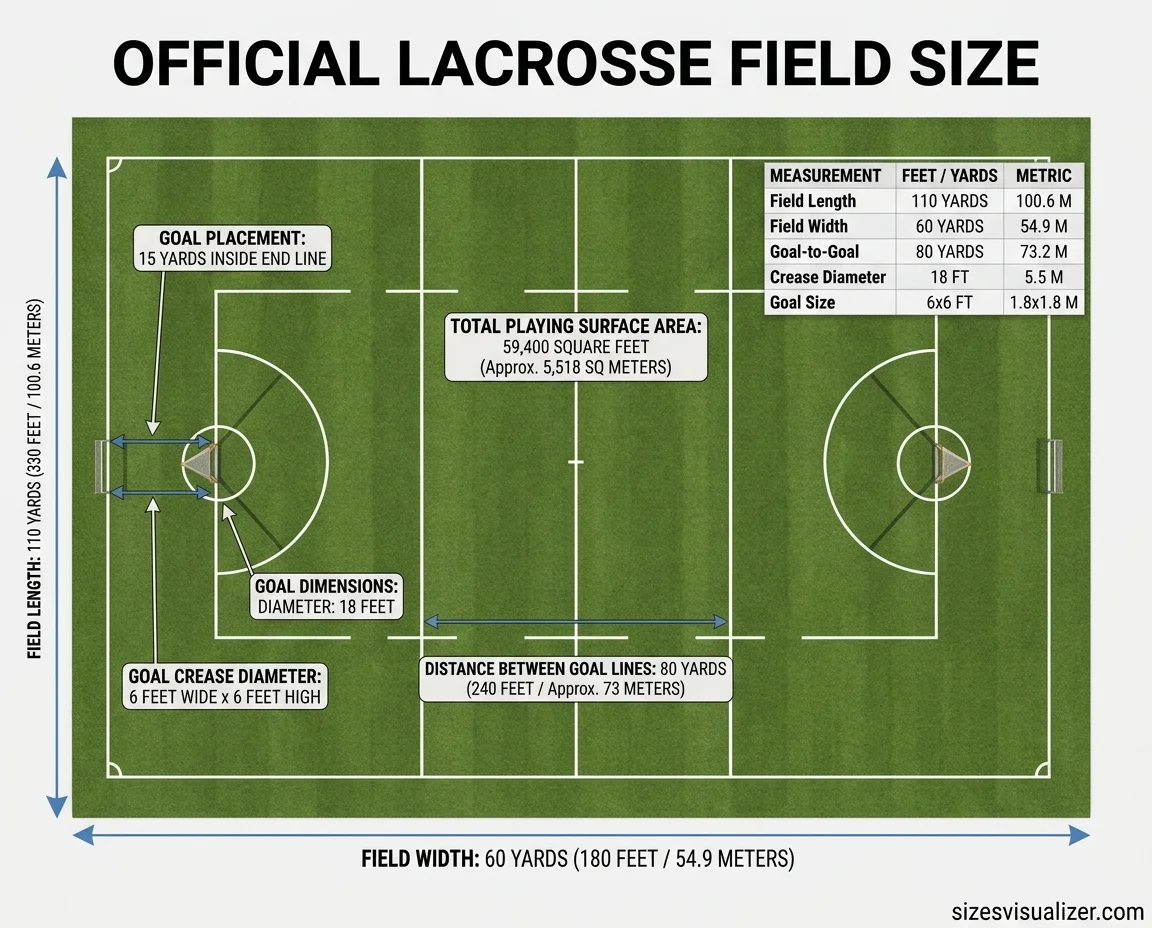
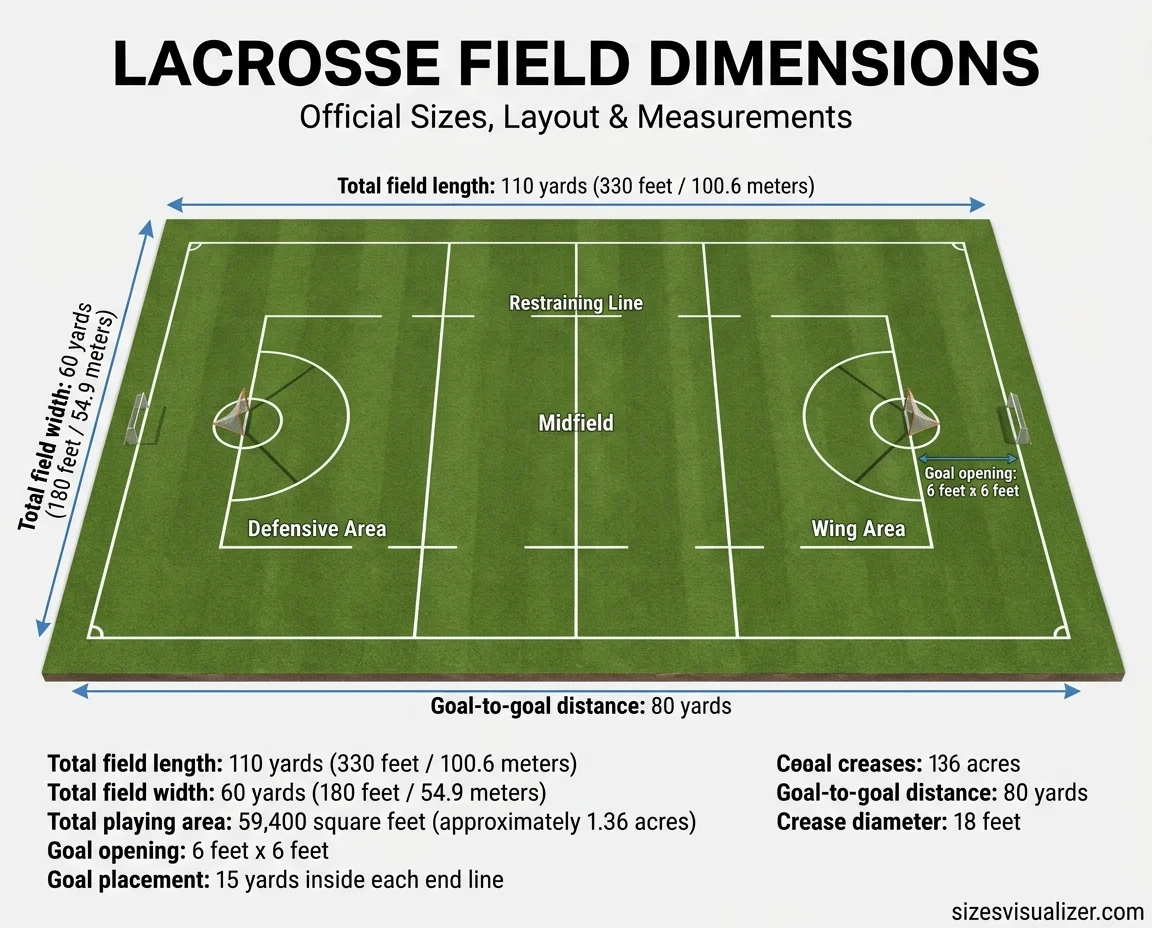
What are the dimensions of a lacrosse field? The official playing area measures 330 feet by 180 feet. That is 59,400 square feet, or about 1.36 acres. The rules are set by bodies like the NCAA and World Lacrosse, and most U.S. field lacrosse follows the same size.
Here is a quick lacrosse field size chart:
| Measure | Imperial | Metric |
|---|---|---|
| Field length (sideline) | 110 yards | 100.6 m |
| Field width (end line) | 60 yards | 54.9 m |
| Total area | 59,400 sq ft | about 5,518 sq m |
| Goal opening | 6 ft × 6 ft | 1.8 m × 1.8 m |
| Crease diameter | 18 ft | 5.5 m |
| Goal-to-goal distance | 80 yards | 73 m |
How long is a lacrosse field? 110 yards. How wide is a lacrosse field? 60 yards.
The goals do not sit on the end lines. Each goal stands 15 yards in, so players can cut, pass, and score from behind the cage. That space is what makes lacrosse feel different from most field sports.
Most fields use natural grass or synthetic turf. Give the field some run-off space too. About 6 yards on the sides and 5 yards at the ends is common, which keeps players safe near the boundary lines.
Lacrosse Field Layout and Zones
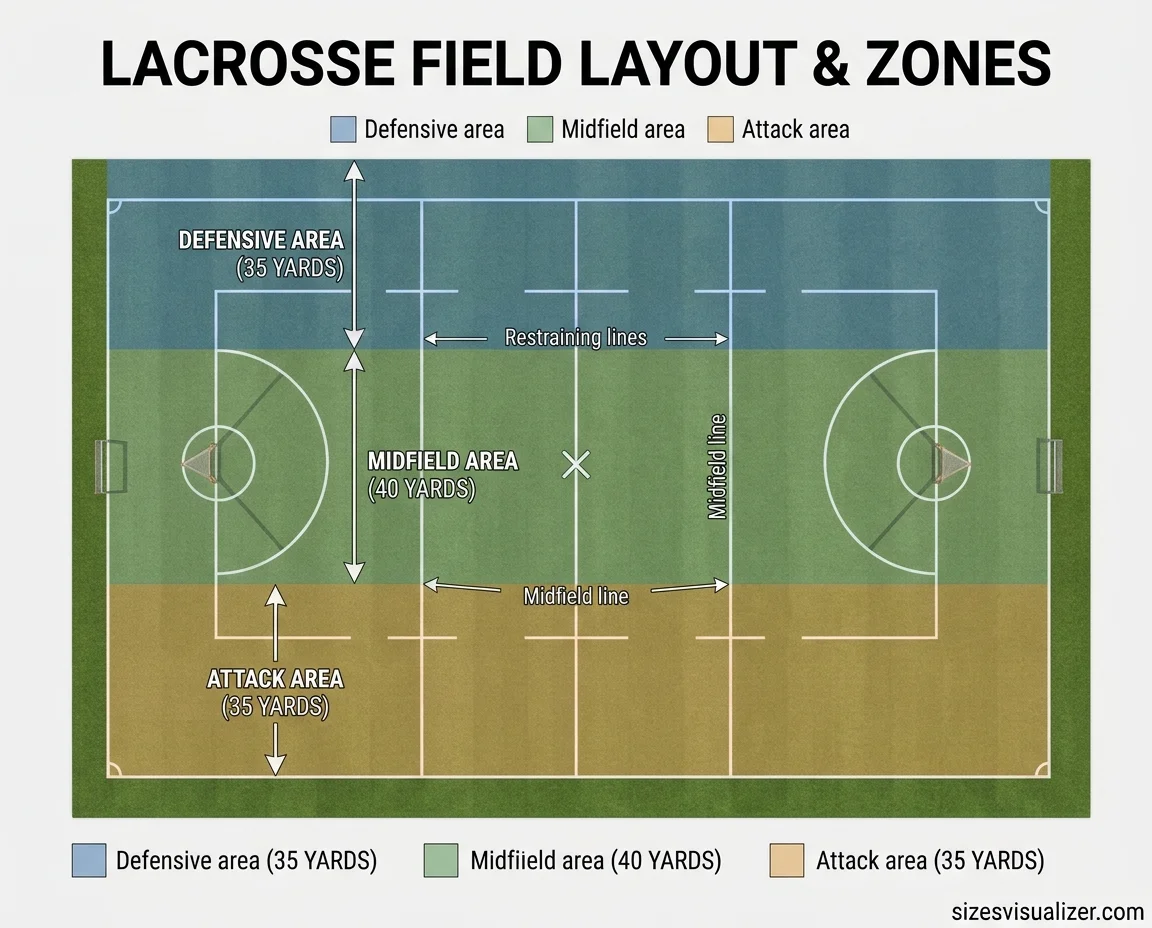
The lacrosse field layout splits the grass into three zones. The restraining lines cut the field into a defensive area, a midfield, and an attack area.
- Defensive area: the zone around your own goal. It is 35 yards deep and 60 yards wide.
- Midfield: the middle 40 yards. Midfielders can roam all of it.
- Attack area: the zone around the opponent’s goal, also 35 yards deep.
Why does the layout matter? Because the zones control how many players can stand where. A team must keep at least three players on its attacking side and four on its defensive side. If not, it is called offside.
A men’s team puts 10 players on the field. That is a goalkeeper, three defensemen, three midfielders, and three attackmen.
Three more spots are worth knowing:
- Wing areas sit on the midfield line, 10 yards from each sideline. They are where two midfielders line up for a faceoff.
- The restraining box is the zone near the goal where a team must keep the ball when it is stalling.
- The critical scoring area in women’s play is formed by an 8-meter arc and a 12-meter fan. Fouls inside it carry heavy penalties.
At midfield, men’s lacrosse uses a faceoff X. Women’s lacrosse uses a draw circle.
Lacrosse Field Line Markings Guide
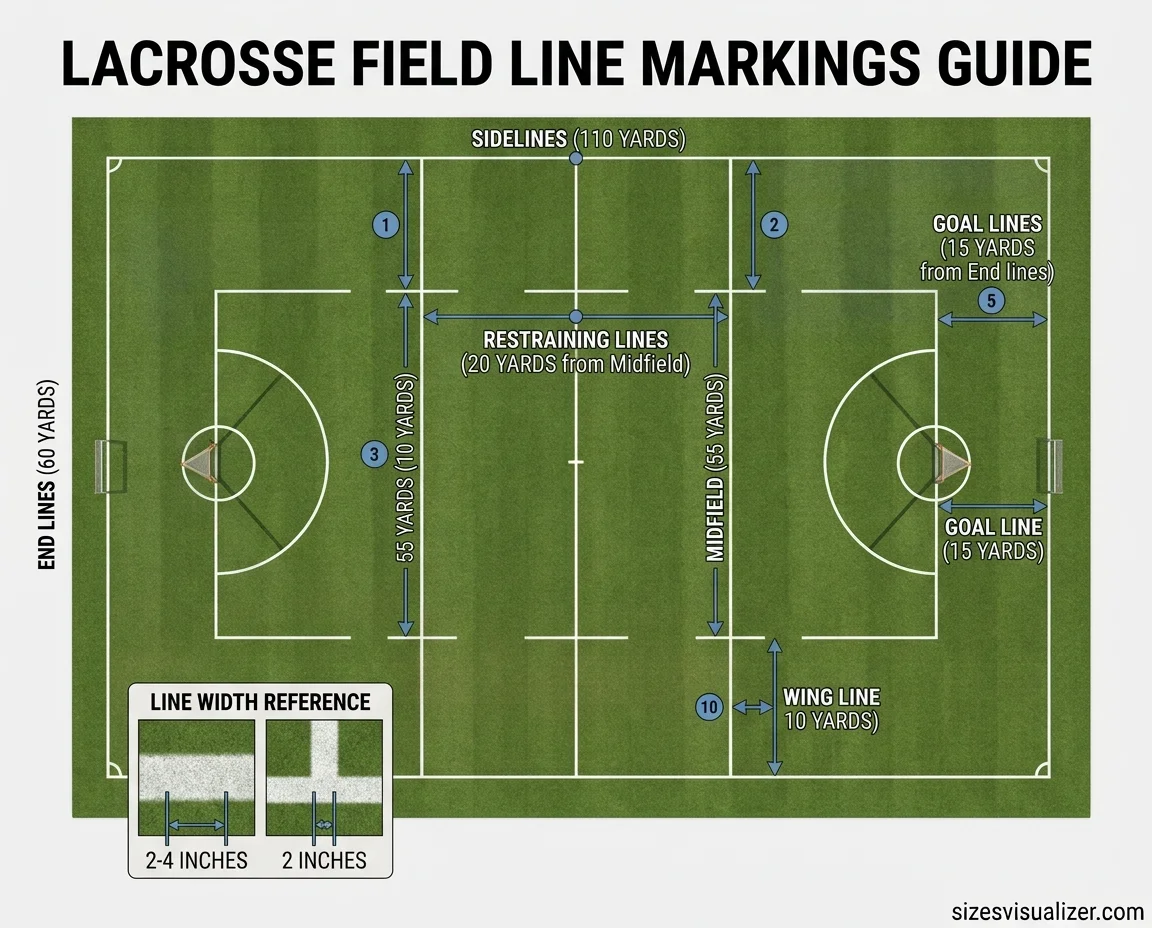
Every line on a lacrosse field diagram has a job. This table shows where each one goes:
| Line | Where it sits | What it does |
|---|---|---|
| Sidelines | 110 yards long | Mark the long edges of play |
| End lines | 60 yards long | Mark the short edges of play |
| Midfield line | 55 yards from each end line | Splits the field in half |
| Restraining lines | 20 yards from midfield | Limit players per zone |
| Goal line | 15 yards from the end line | Marks where the goal stands |
| Wing lines | 10 yards from each sideline | Show faceoff spots for midfielders |
| Restraining box lines | 10 yards in from the sidelines | Close the box near each goal |
The goal line extended (GLE) is an imaginary line. It carries the goal line across the field. Players use it as a map for offense and defense.
How wide are lacrosse field lines? They are 2 to 4 inches wide. The goal line is the exception at 2 inches.
Here are three tips for crews who mark a lacrosse field:
- Mark the midfield line first, then measure out from it.
- Use a tape measure and string lines, or a line-marking robot for speed.
- Re-check restraining lines against the goal lines. Wrong measurements are the most common marking mistake.
Planning a lacrosse field requires careful attention to dimensions, layout, and equipment logistics, especially when transporting goals, field-marking supplies, and maintenance gear. Understanding Mercedes-Benz Sprinter cargo dimensions and interior space can help teams and facility managers choose a practical vehicle for moving bulky equipment efficiently.
Lacrosse Field Size by Level: Men’s, Women’s, Youth, Box & Pro
Is every lacrosse field the same size? No. The size changes with the level, the league, and the format.

| Type | Typical size | Notes |
|---|---|---|
| Men’s field lacrosse (NCAA, high school) | 110 × 60 yards | The standard layout |
| Women’s lacrosse | About 110–120 yards long, 60–70 yards wide | Uses the 8-meter arc and 12-meter fan |
| Youth lacrosse | Often smaller, such as 60–80 yards long | Smaller goals for younger ages |
| Box lacrosse | 200 × 85 feet | Indoor, with boards like a hockey rink |
| Lacrosse sixes | Smaller field | Six players per team |
| Premier Lacrosse League | 10 yards shorter than standard | Same goal-to-end-line distance |
Women’s lacrosse has fewer pads and less body contact, so the spacing rules differ. Women’s goals are the same size as men’s, and the draw circle replaces the faceoff X.
Why is the youth field smaller? Smaller fields help kids learn skills. They also make play safer and keep the game moving.
Box lacrosse is played in hockey arenas. It uses a smaller goal and a fast, tight style of play.
Lacrosse sixes is the version coming to the 2028 Olympics in Los Angeles. The Premier Lacrosse League plays on a field 10 yards shorter than standard.
FAQs
What field is bigger, soccer or lacrosse?
Usually soccer. An international soccer field runs about 110 to 120 yards long and 70 to 80 yards wide. A lacrosse field is a fixed 110 by 60 yards. Many U.S. schools line a lacrosse field on top of a soccer field.
Why do girls have to wear skirts for lacrosse?
They don’t have to. The rules of the game do not require skirts. Kilts and skirts come from the sport’s early history and school tradition. Many teams now choose shorts.
How many laps around a lacrosse field is 1 mile?
About 5 laps. The playing field’s perimeter is 340 yards, and a mile is 1,760 yards. That works out to roughly 5.2 laps on the lines. Running the outer run-off edge takes a bit under 5.
Is a lacrosse field 100 yards?
No. A lacrosse field is 110 yards long. The number 100 comes from football, or from the field’s length in meters, which is about 100.6.
Why don’t girls wear pads in lacrosse?
Women’s rules limit body contact, so the gear is lighter. Players wear a mouthguard and eye protection. US Lacrosse also allows optional soft headgear that meets safety standards. Men’s lacrosse allows body checking, so those players wear pads and helmets.
Why do schoolgirls roll their skirts up?
It is mostly a teen fashion habit, and it has nothing to do with lacrosse rules. If you play on a team, follow your school’s dress code and uniform rules.
Conclusion
A standard lacrosse field is 110 yards long and 60 yards wide, with goals set 15 yards in from each end line. Women’s, youth, box, and pro fields change the numbers, but the zones and lines work the same way. Check your league’s rulebook before you mark a field.

Measurement Researcher, Size Comparison Writer & Content Specialist
Timmy Ahad is a dedicated content writer and research specialist at SizesVisualizer.com, where he focuses on creating accurate, easy-to-understand content about measurements, dimensions, size comparisons, and real-world object visualization.