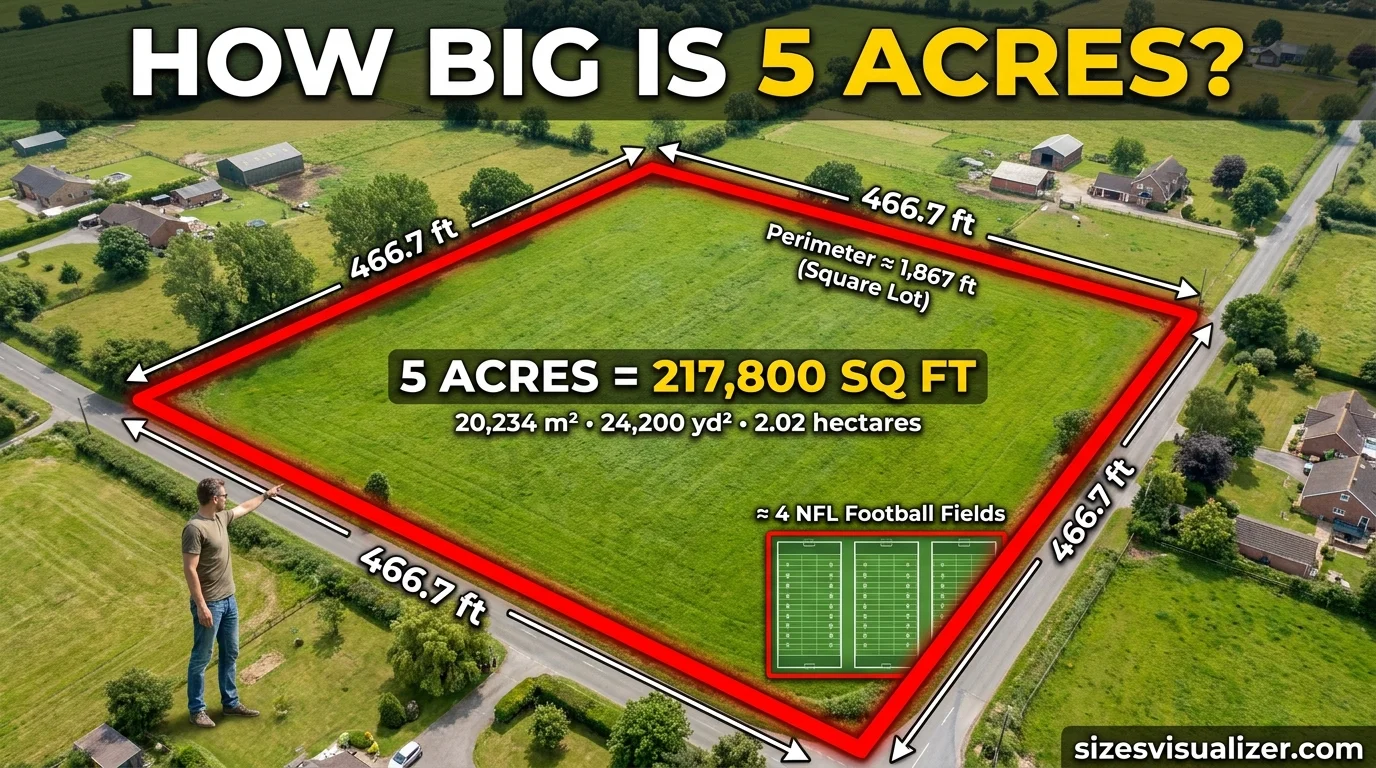
Land shopping starts with one question: “how big is 5 acres, really?” The short answer: 5 acres equals 217,800 square feet — close to four NFL fields lined up together.
Numbers alone rarely paint the picture. This guide covers the exact dimensions, square footage, perimeter math, and 15 real-life comparisons that make 5 acres easy to picture before you buy, build, or fence it in.
Table of Contents
How Big Is 5 Acres in Square Feet, Meters & Yards?
Every acre calculation starts with one fixed number: 1 acre = 43,560 square feet. The unit dates back centuries, originally tied to the ground a team of oxen could plow in a single workday.
Multiply that base figure by five, and 5 acres breaks down to:
- 217,800 square feet
- 20,234 square meters
- 24,200 square yards
- 2.02 hectares
American real estate listings, county tax records, and property deeds all use the U.S. survey acre. Metric conversions matter mostly for buyers comparing land internationally or working with foreign-trained architects.
One catch to remember: acreage measures area, not shape. A 5-acre parcel could be square, rectangular, or wildly irregular — which brings us to dimensions.
5 Acres Dimensions: Square, Rectangle & Perimeter Explained
An acre carries no fixed shape. It’s purely a unit of surface area, so 5 acres might form a tidy square, a long narrow strip, or an oddly angled lot that follows a creek or property line.
What are the dimensions of 5 acres as a square? Each side measures roughly 466.7 feet, producing a 466.7 ft x 466.7 ft parcel.
What about a rectangular version? A 300 ft x 726 ft rectangle still totals 5 acres, despite looking nothing like the square layout. Stretch that further into a quarter-mile-long strip, and the parcel becomes long and narrow instead.
How far is it to walk around 5 acres? Perimeter depends on shape, not size alone:
- A square 5-acre lot has a perimeter near 1,867 feet, or about one-third of a mile.
- A narrow rectangle covering the same 5 acres can push the perimeter past two miles.
This distinction matters most for fencing budgets. Compact, square parcels need less material per acre than long, thin ones — a rule surveyors call the isoperimetric principle. For a fixed area, a square always has the shortest possible boundary. Get a professional land survey before ordering fence panels or wire, so you know the true shape and boundary lines.
Use our Land Measurement Tool to accurately calculate and explore plots in multiple units, making property, parking, garage, and space planning faster and easier.
15 Real-Life Examples of How Big 5 Acres Is
Abstract square footage rarely sticks in memory. These 15 side-by-side comparisons turn 5 acres into something you can actually picture.
Football Fields
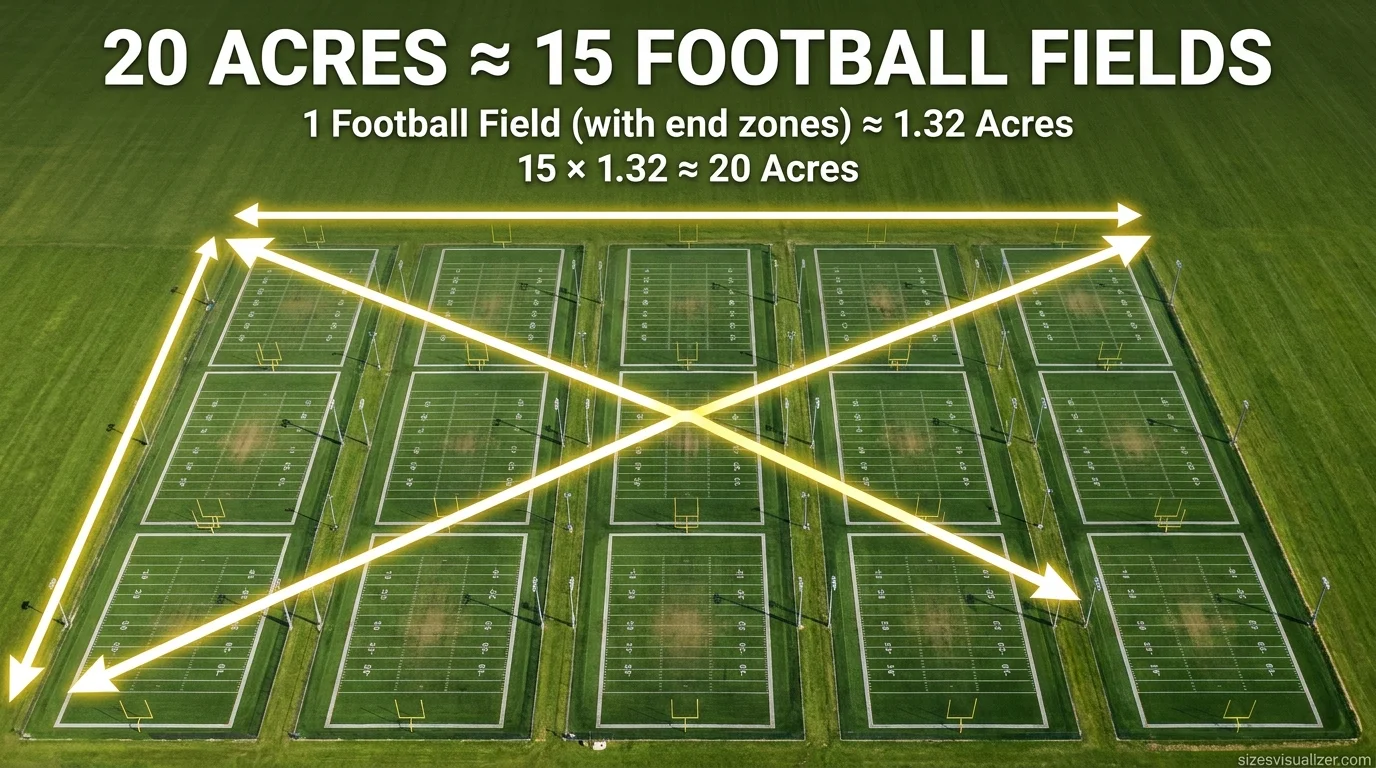
An NFL field, end zones included, covers about 1.32 acres. That puts roughly four full football fields inside a 5-acre lot — the most common benchmark used in real estate listings.
FIFA Soccer Pitches
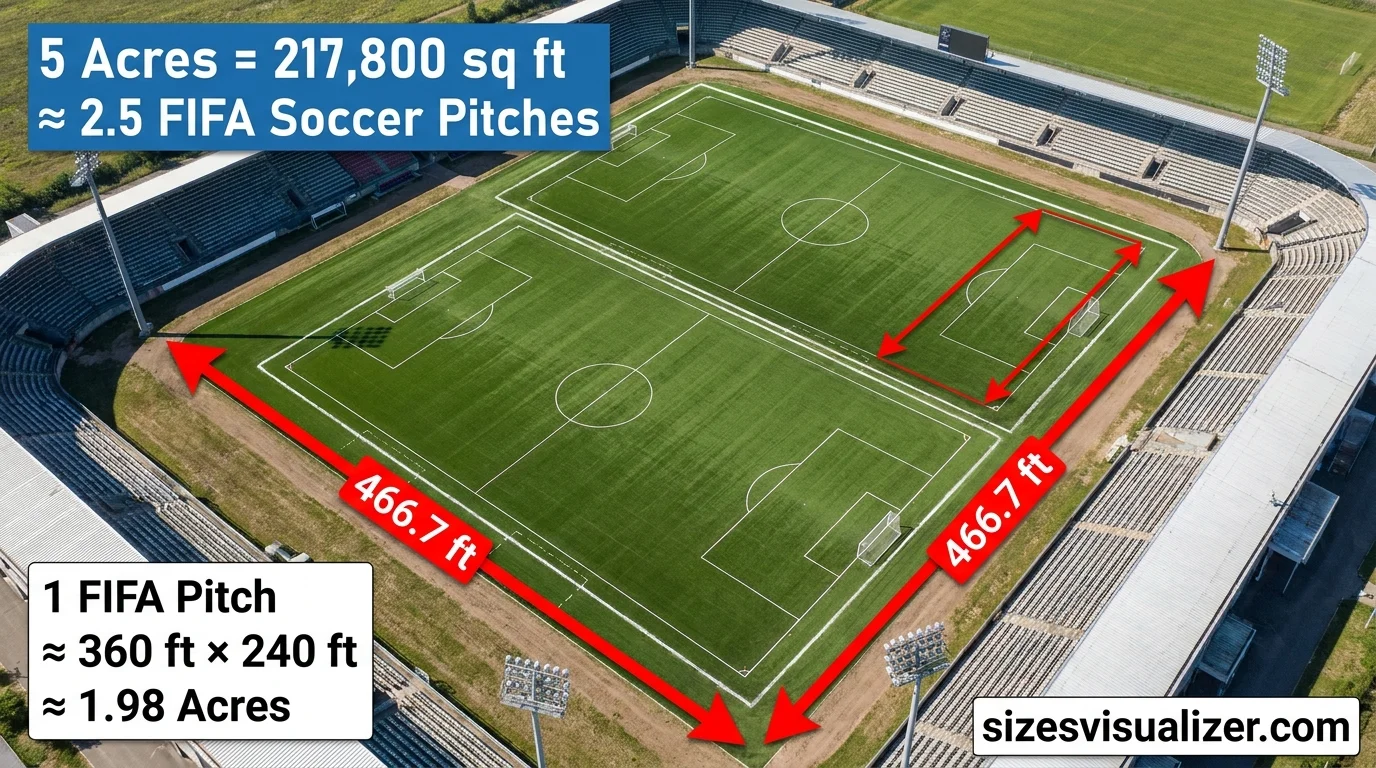
A regulation FIFA pitch runs larger than an NFL field, at roughly 360 by 240 feet, or about 1.98 acres. 5 acres holds about two and a half full-size soccer fields.
Doubles Tennis Courts
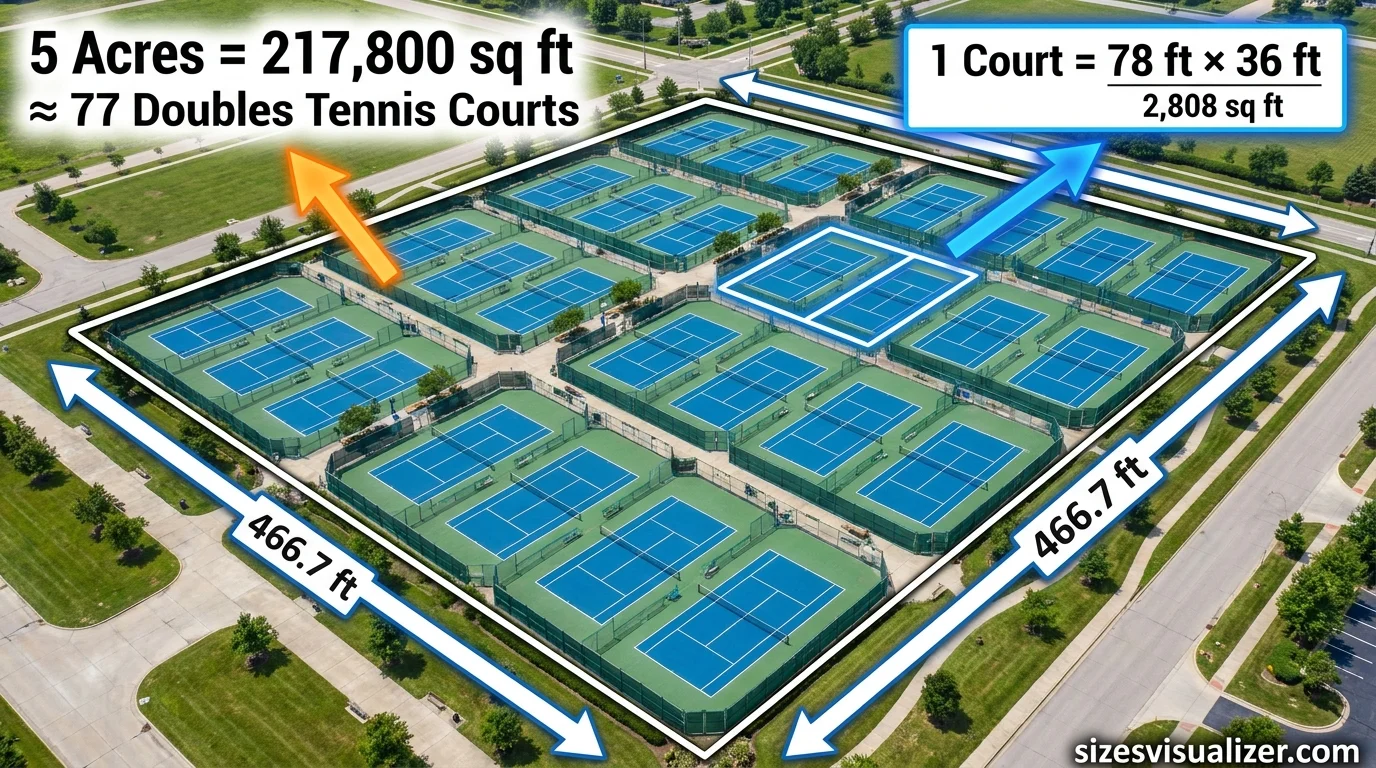
A doubles tennis court measures 78 by 36 feet, or 2,808 square feet. Divide that into 217,800 square feet, and 5 acres fits roughly 77 tennis courts.
Basketball Courts
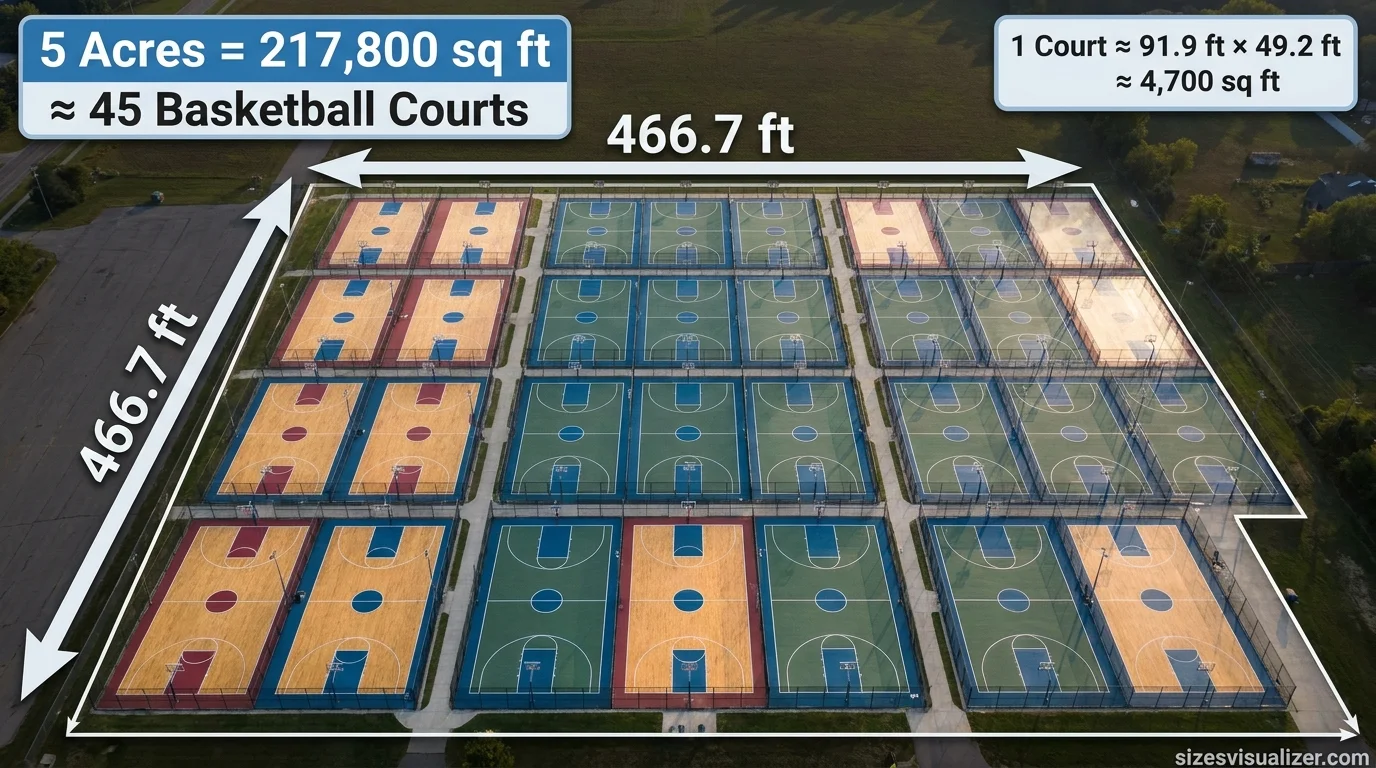
A full basketball court spans 91.86 by 49.21 feet, close to 4,700 square feet. That works out to about 45 basketball courts across a 5-acre parcel.
City Blocks
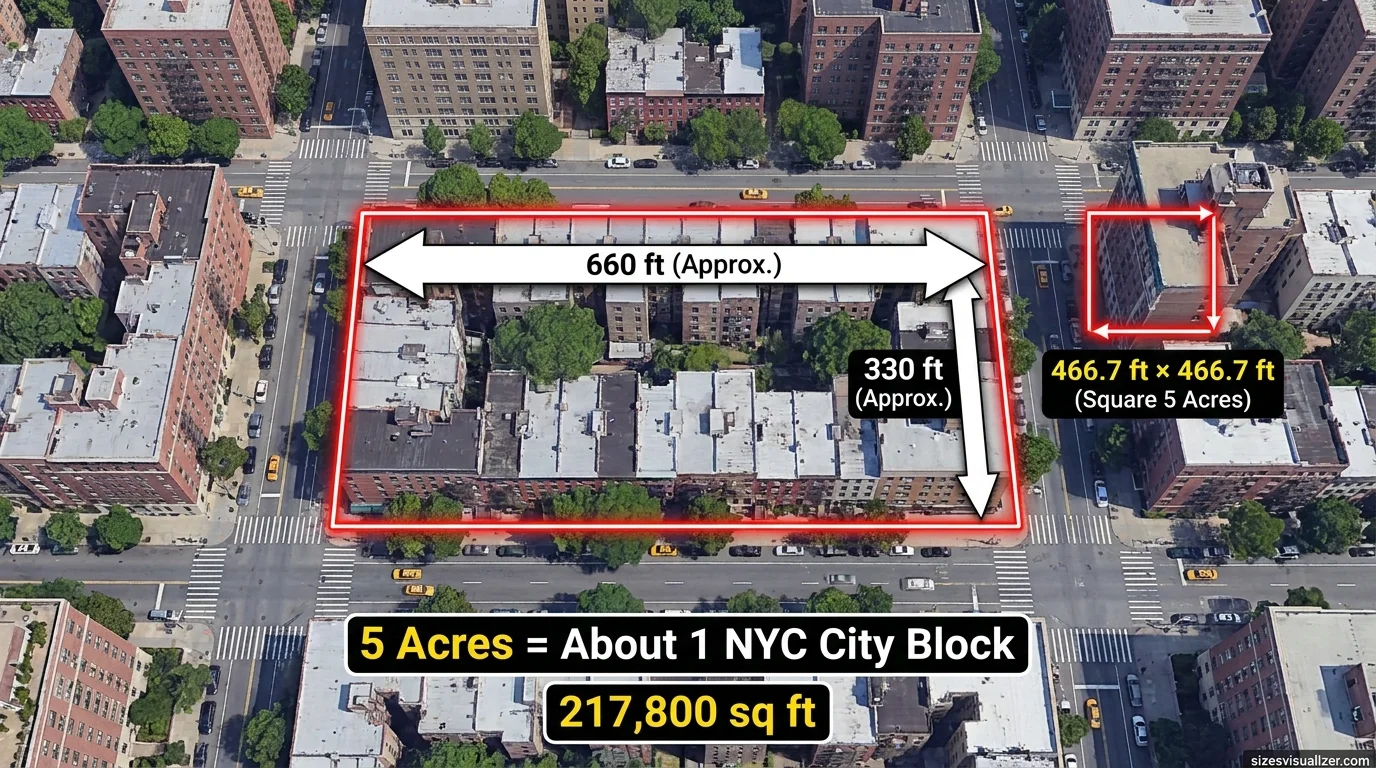
A classic Manhattan block, near 660 by 330 feet, covers almost exactly 5 acres on its own. So 5 acres roughly equals one standard NYC-style city block.
Parking Spaces
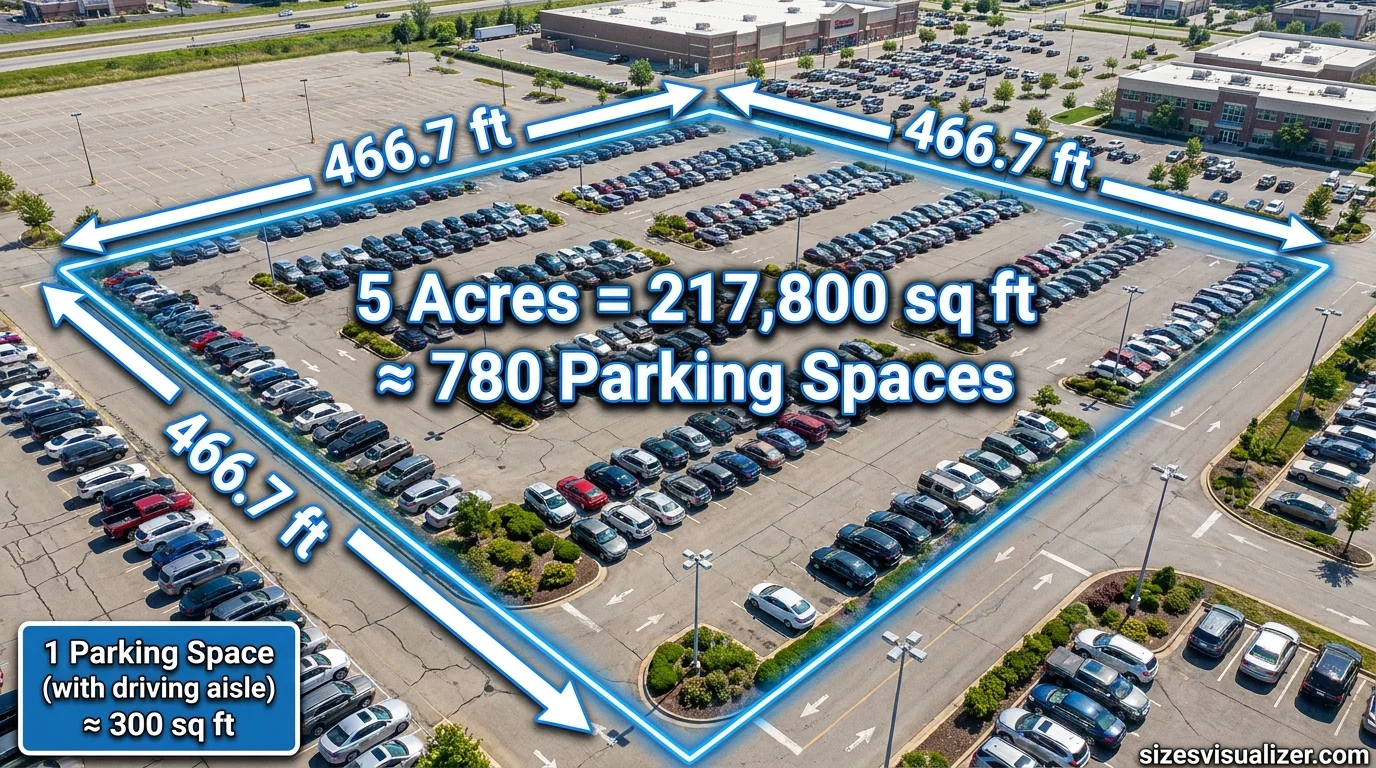
A standard parking space, including drive aisle allowance, needs about 300 square feet. That means a 5-acre lot could hold close to 780 parking spaces — relevant for anyone eyeing commercial development.
Baseball Diamonds
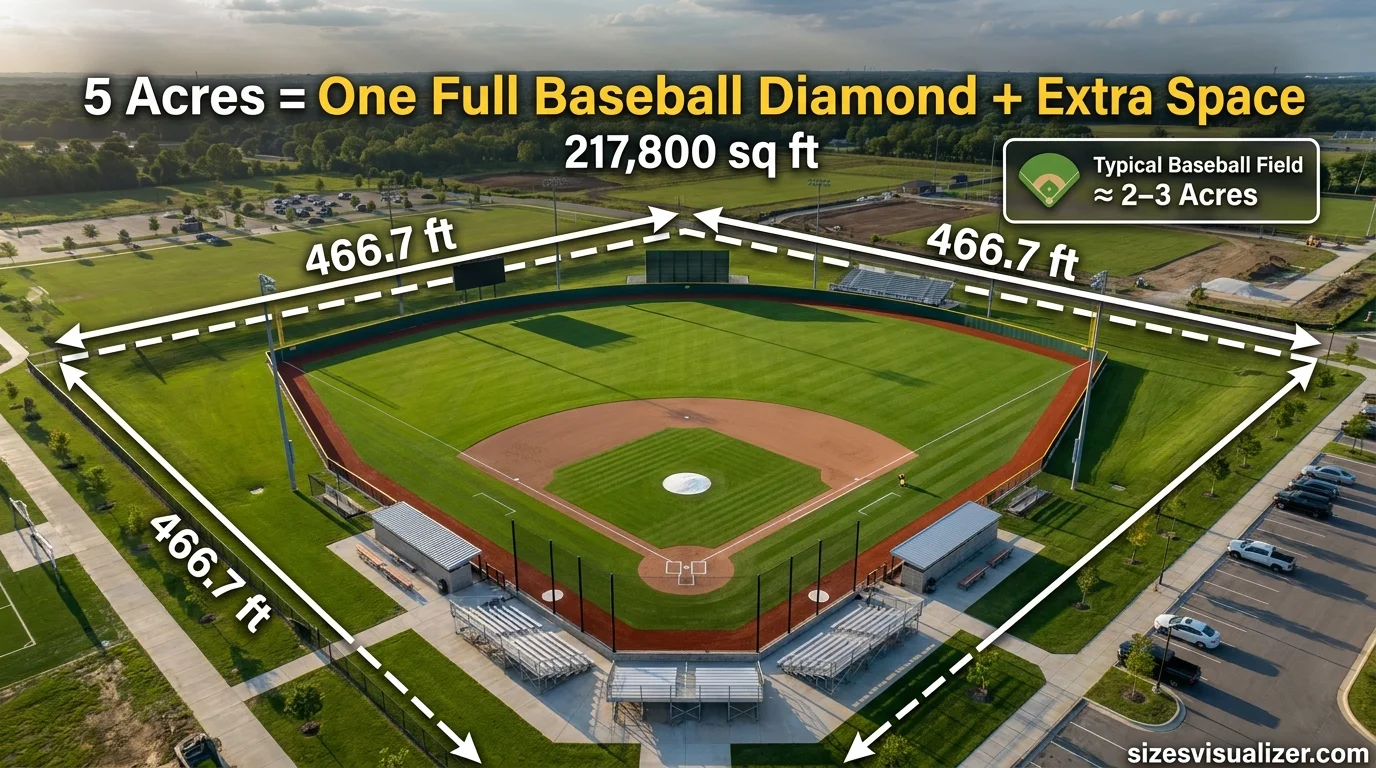
An MLB infield and outfield combined typically use around 2–3 acres, depending on the ballpark’s exact layout. 5 acres comfortably fits one full baseball field with room for dugouts and foul territory.
Median U.S. Single-Family Homes
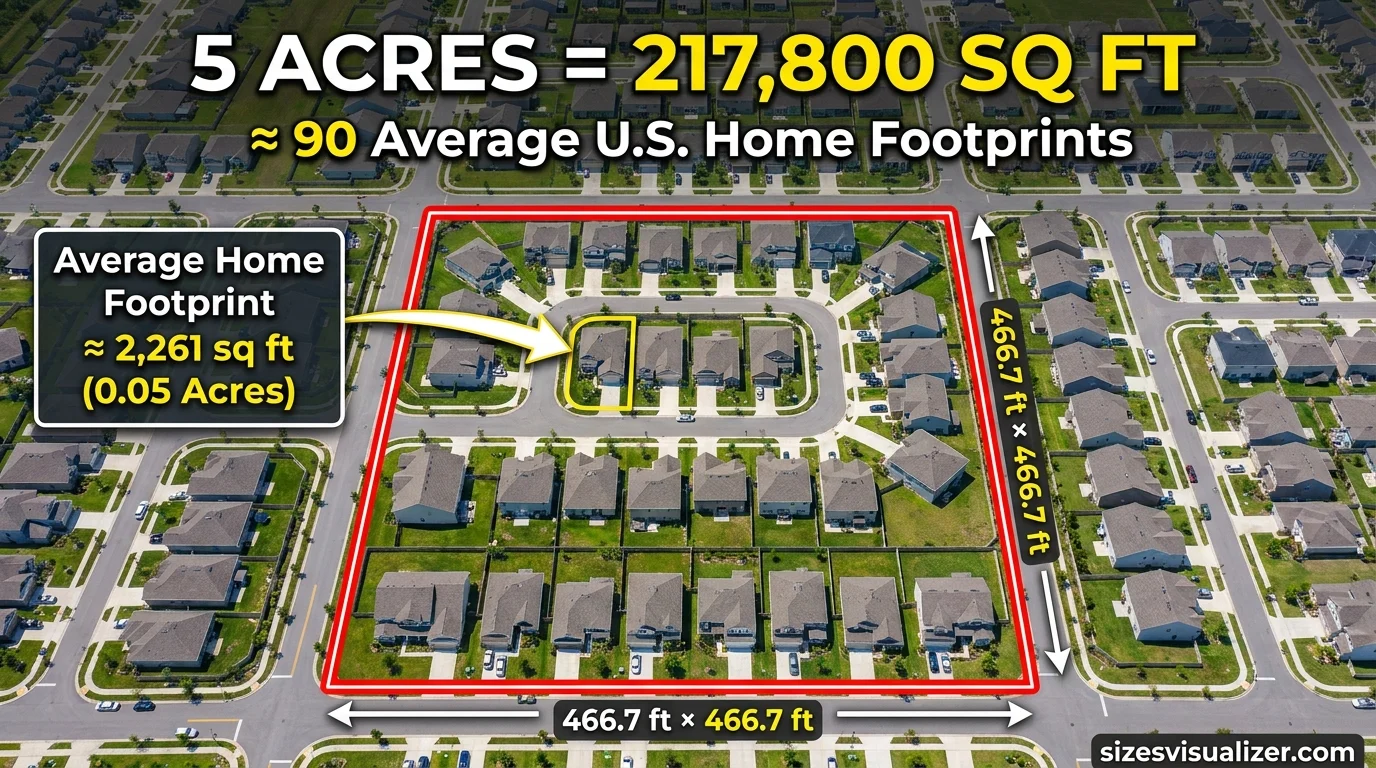
The average American home footprint sits near 2,261 square feet, or 0.05 acres, according to U.S. Census Bureau housing data. That means 5 acres could theoretically hold about 90 homes if subdivided for a small neighborhood.
Olympic Swimming Pools
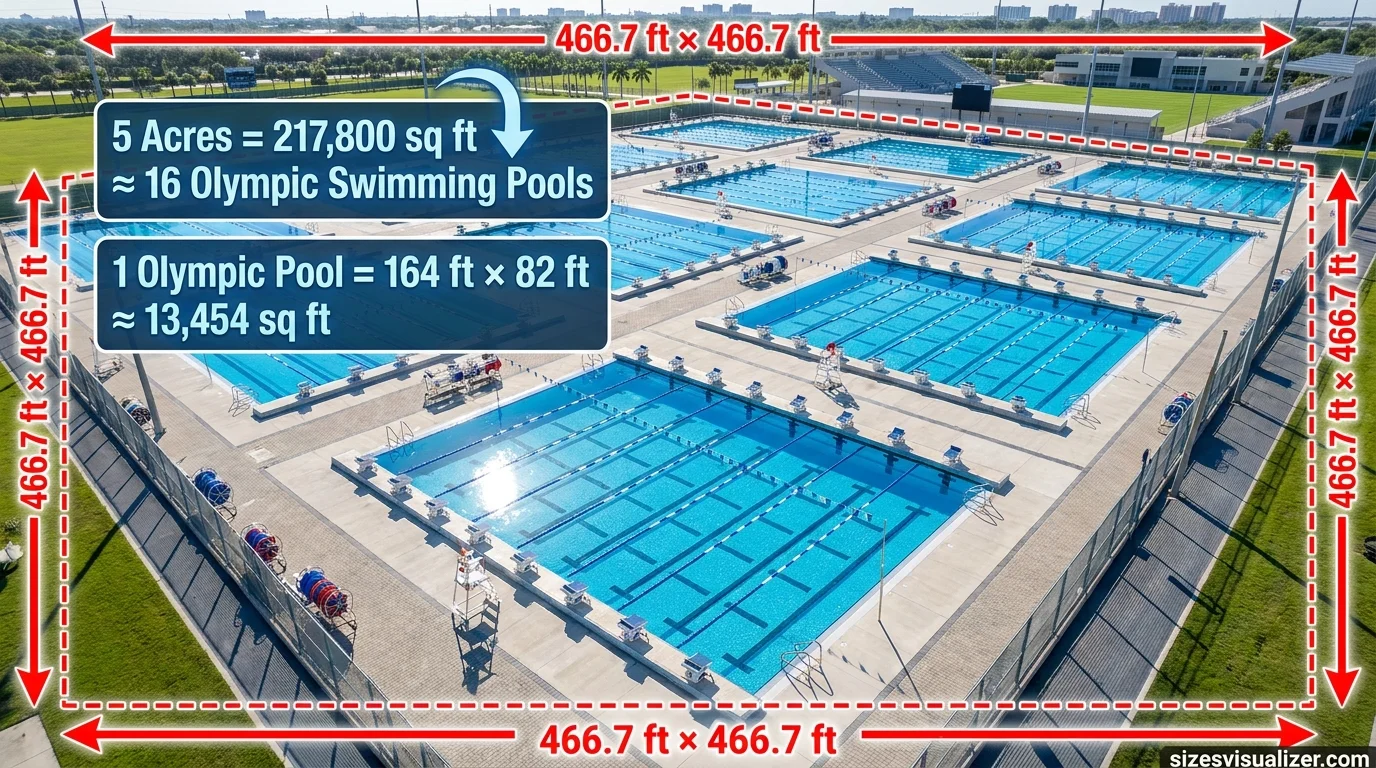
An Olympic-size pool measures 164 by 82 feet, or roughly 13,454 square feet — about 0.31 acres. 5 acres could fit around 16 Olympic pools, side by side.
Walmart Supercenters
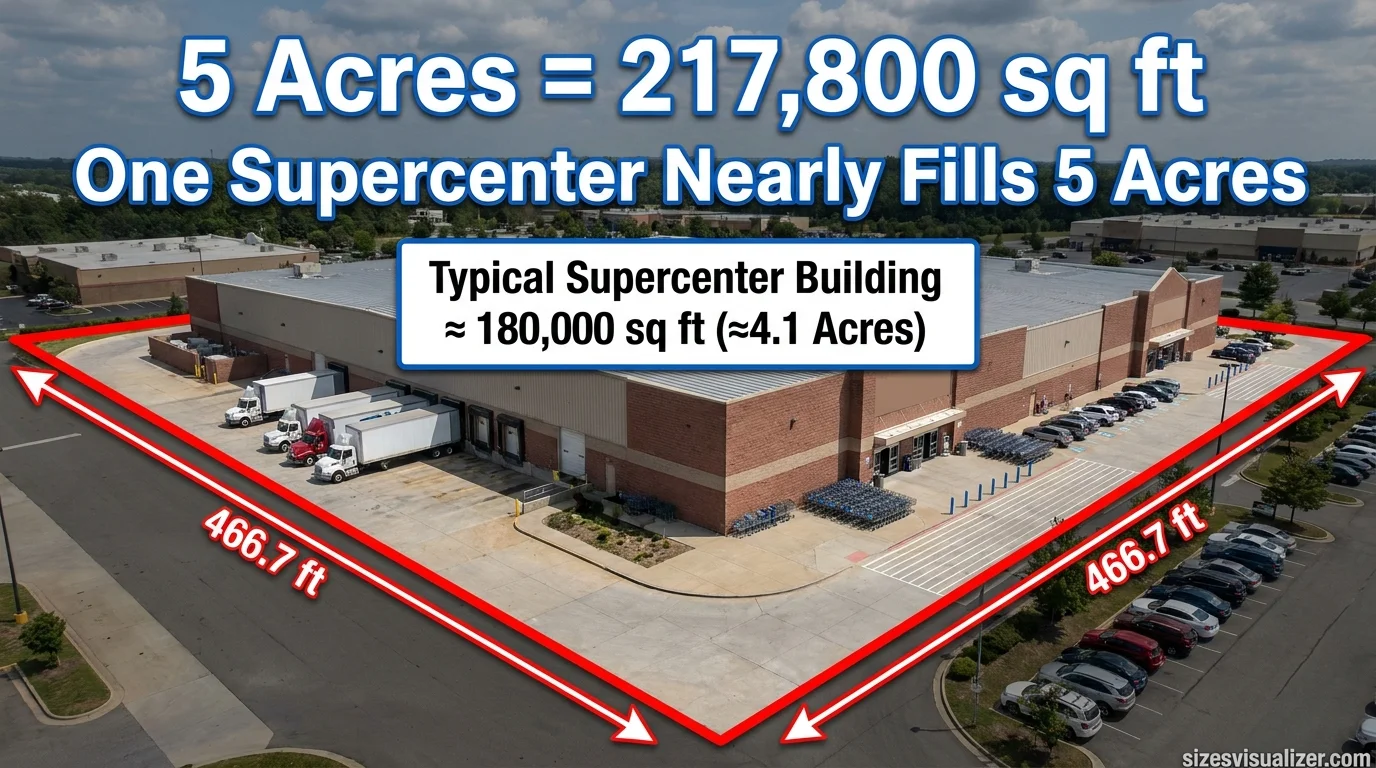
A typical Walmart Supercenter building covers about 180,000 square feet, or roughly 4.1 acres. A single supercenter alone nearly fills a 5-acre lot before parking is even factored in.
Hockey Rinks

An NHL rink measures 200 by 85 feet, totaling 17,000 square feet, or about 0.39 acres. 5 acres fits close to 13 hockey rinks.
American Football Practice Fields
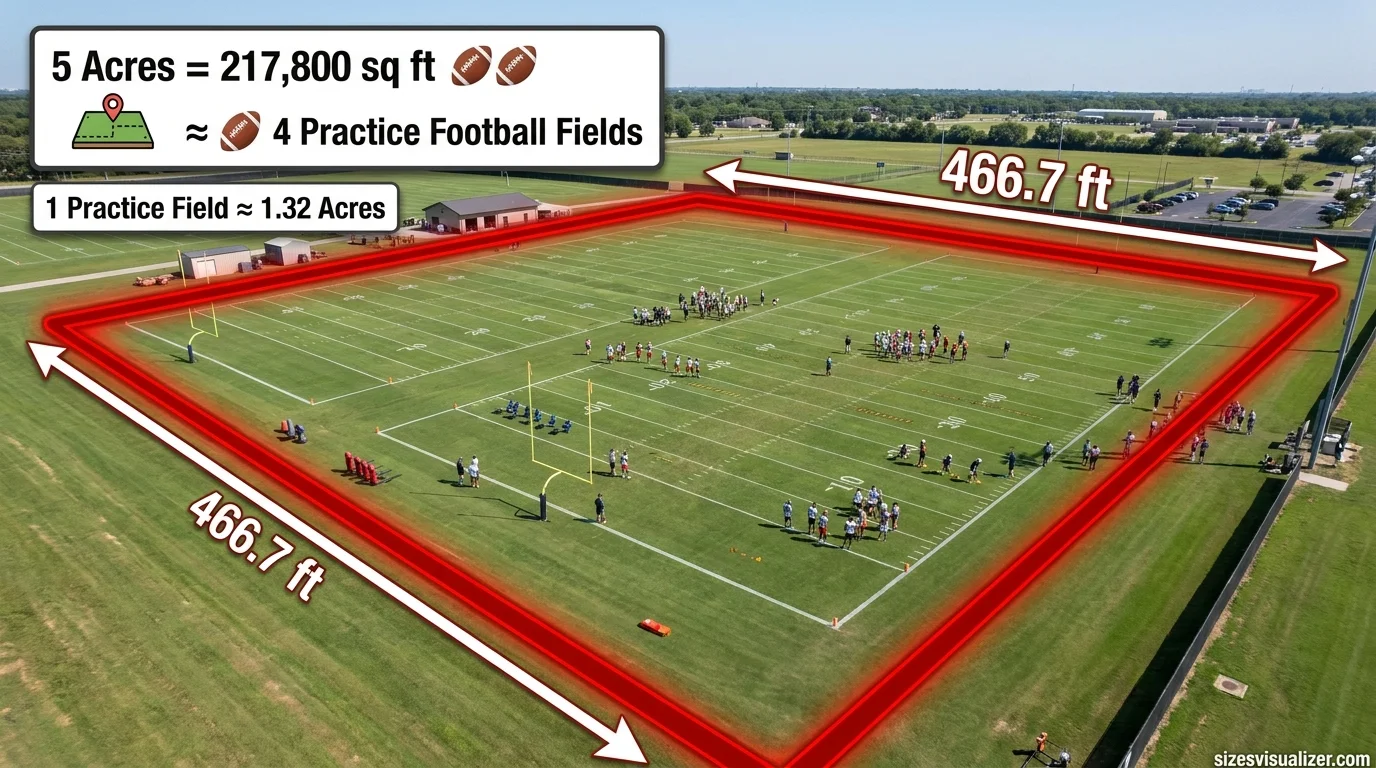
Practice fields, often built without full stadium seating, use roughly the same 1.32-acre footprint as a regulation field. This makes 5 acres ideal for a small sports complex with multiple practice areas.
Golf Driving Range Tee Boxes
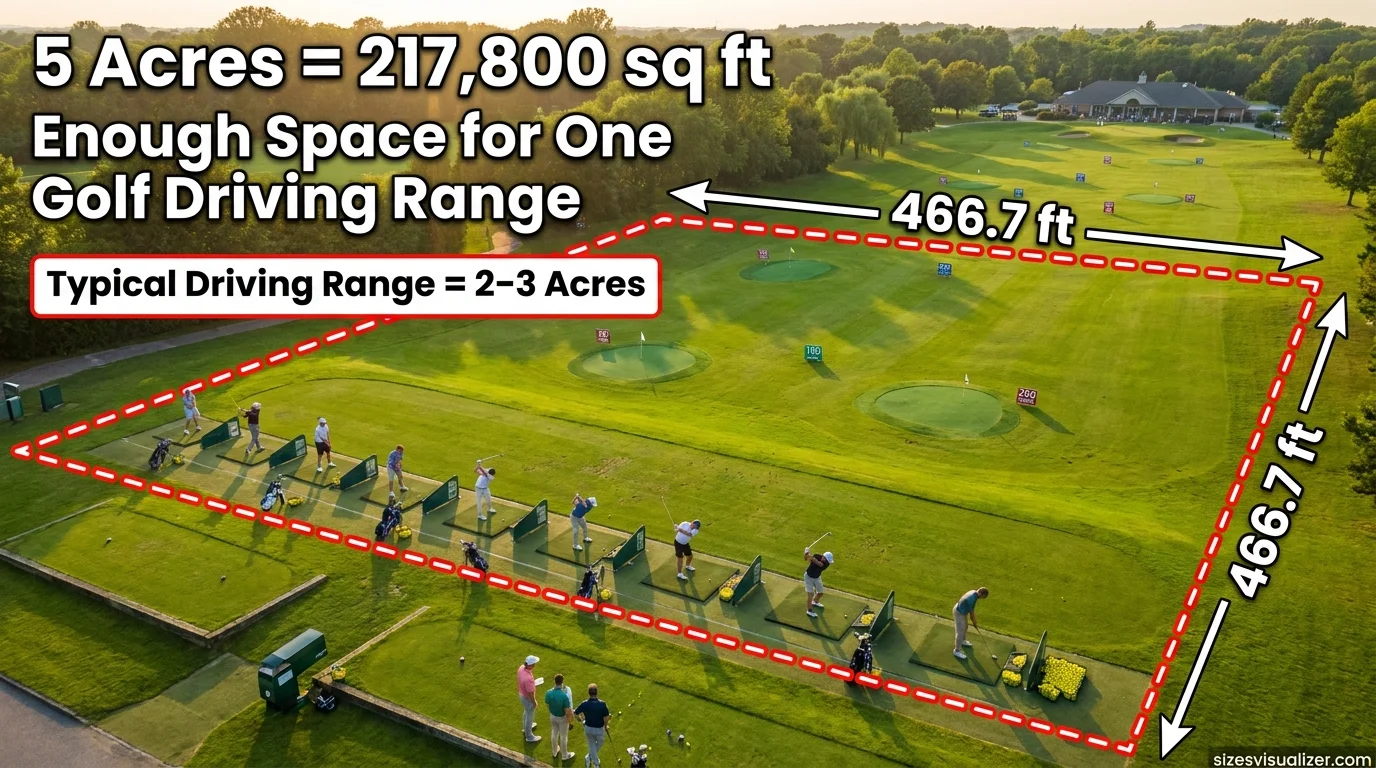
A single driving range tee box and landing zone can span 2–3 acres depending on shot distance requirements. 5 acres offers just enough room for one modest driving range.
Community Garden Plots
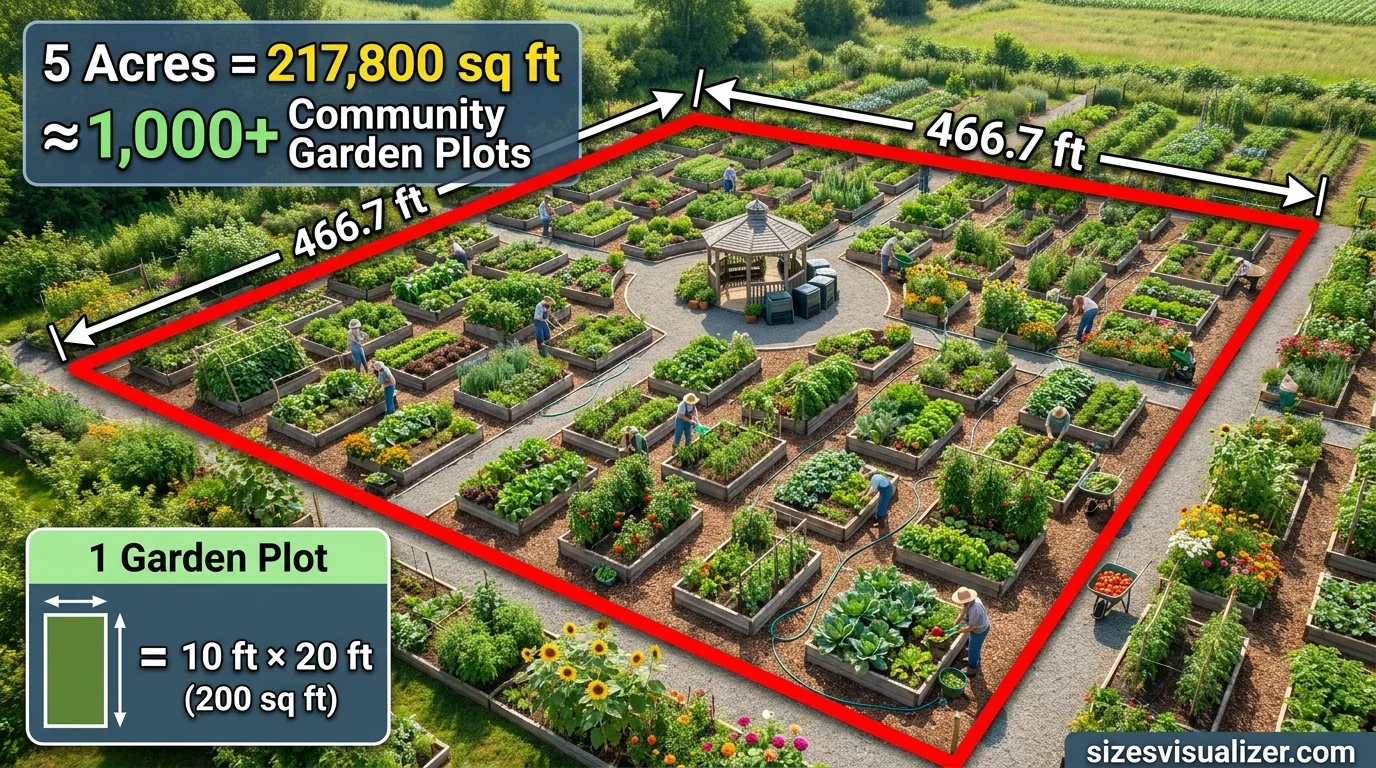
Standard community garden plots run 10 by 20 feet, or 200 square feet each. A 5-acre parcel could theoretically host over 1,000 individual garden plots — useful context for municipal planning projects.
Shipping Containers (Storage Yard Layout)
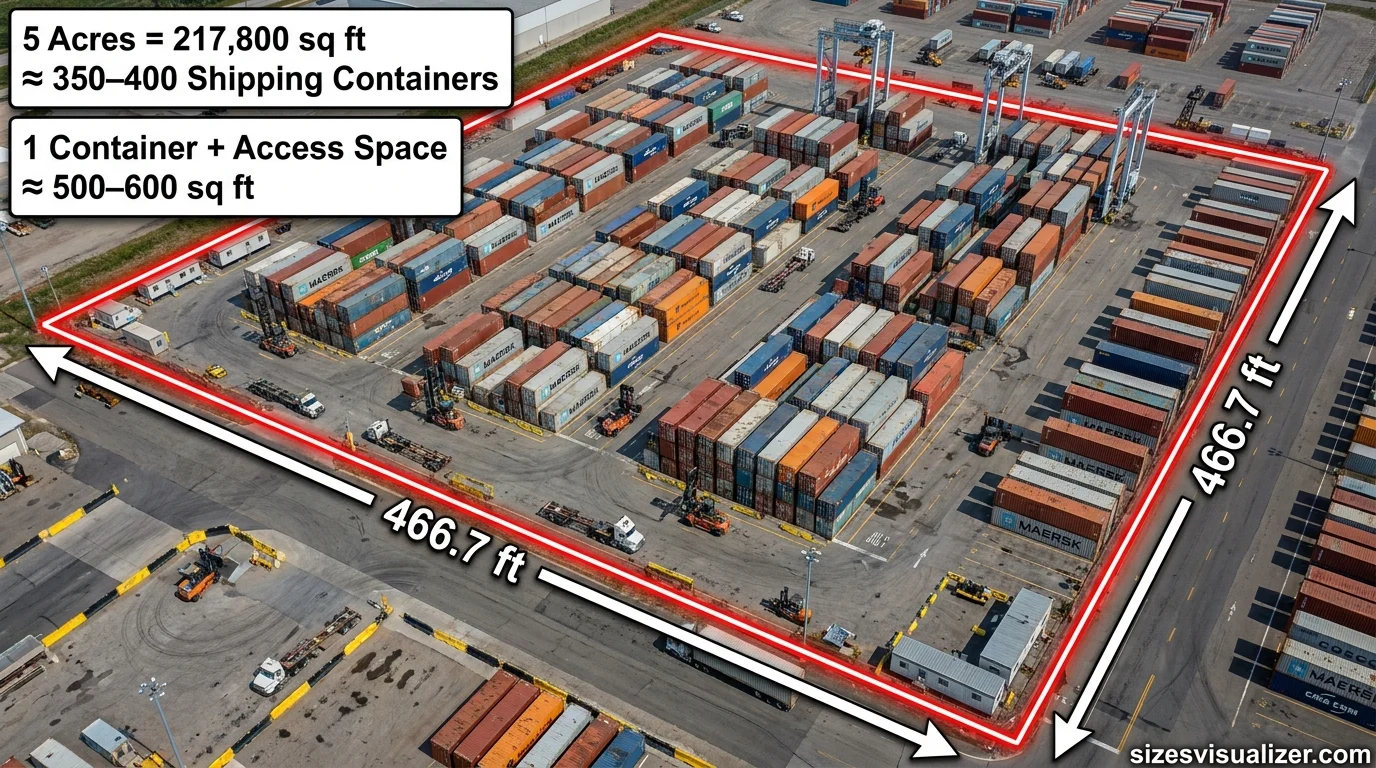
A standard 40-foot shipping container, plus access space, occupies roughly 500–600 square feet in a laid-out storage yard. 5 acres could accommodate somewhere between 350 and 400 containers, a detail relevant to logistics or self-storage development.
Must Visit: How Big Is 2 Acres? 15 Real-Life Examples to Help You Visualize It
Practical Uses for a 5-Acre Property
Five acres sits in a functional middle ground — big enough for meaningful projects, manageable enough for a single family or small crew to maintain without heavy machinery.
Common uses across the U.S. include:
- Homesteading and hobby farming — room for a garden, small orchard, chickens, goats, or a couple of horses
- A large single-family residence — house, detached garage, workshop, and real privacy buffer
- Light commercial development — storage facility, event venue, or small retail space, zoning permitting
- Recreational land — trails, a private pond, or hunting ground in rural counties
Zoning rules differ by county and municipality, so confirm allowed uses before closing. Restrictions on livestock, structures, or business activity can surprise buyers even on land that looks fully rural. A quick call to the local zoning or planning office clears this up fast.
What Does 5 Acres Cost in the USA (2026)?
Price per acre swings widely by region. Rural land in the Midwest or Southeast often runs $3,000–$10,000 per acre, putting a 5-acre lot around $15,000–$50,000. Land near growing suburbs or with utility access can climb to $20,000–$50,000+ per acre, pushing total cost well past $100,000.
Price drivers worth watching:
- Distance from cities and major roads
- Utility access — water, electric, septic feasibility
- Zoning category — agricultural, residential, or commercial
- Soil quality and topography
Budget for a land survey, title search, and perc test before closing. These add-on costs catch many first-time land buyers off guard, but skipping them tends to cost far more down the road.
FAQs
How many football fields are in 5 acres?
About four NFL fields, including end zones, fit inside 5 acres.
How far is it to walk around 5 acres?
A square-shaped 5-acre lot has a perimeter of roughly 1,867 feet, or about one-third of a mile. Elongated or irregular parcels can have a much longer walking distance around the border.
How many city blocks is 5 acres?
Roughly one standard city block — comparable to a typical Manhattan block.
How big is a football field to acres?
An NFL football field, end zones included, covers about 1.32 acres.
How many acres is a FIFA football field?
A FIFA soccer pitch covers approximately 1.98 acres, depending on stadium-specific dimensions.
Conclusion
Five acres gives enough room to build a home, start a hobby farm, or launch a small business — without the upkeep of a much larger property. Understanding the real square footage, dimensions, and zoning rules behind that number puts you in control before you sign anything or plant a single fence post.

Measurement Researcher, Size Comparison Writer & Content Specialist
Timmy Ahad is a dedicated content writer and research specialist at SizesVisualizer.com, where he focuses on creating accurate, easy-to-understand content about measurements, dimensions, size comparisons, and real-world object visualization.