If you’re building a court, coaching a team, or just settling a backyard argument, you need exact numbers — not vague estimates. This guide covers every official badminton court dimension, every line on the floor, and what it actually takes to set one up in the US.
Every measurement below follows the Laws of Badminton set by the Badminton World Federation (BWF), the sport’s global governing body. These numbers don’t change by country, skill level, or age group — a court in your garage follows the same geometry as one at the Olympics.
Table of Contents
Badminton Court Dimensions (Size in Feet & Meters)
A standard badminton court size is 44 feet long and 20 feet wide for doubles play. That’s 13.4 meters by 6.1 meters. This single rectangle serves both singles and doubles — the lines just shift slightly.
Standard Badminton Court Size — 44 ft x 20 ft (Doubles)

The doubles court uses the full width: 20 feet (6.1 m). This outer boundary is what most people picture when they think of a badminton court. Total marked area comes to 880 square feet (81.7 m²).
Singles Badminton Court Dimensions — 44 ft x 17 ft
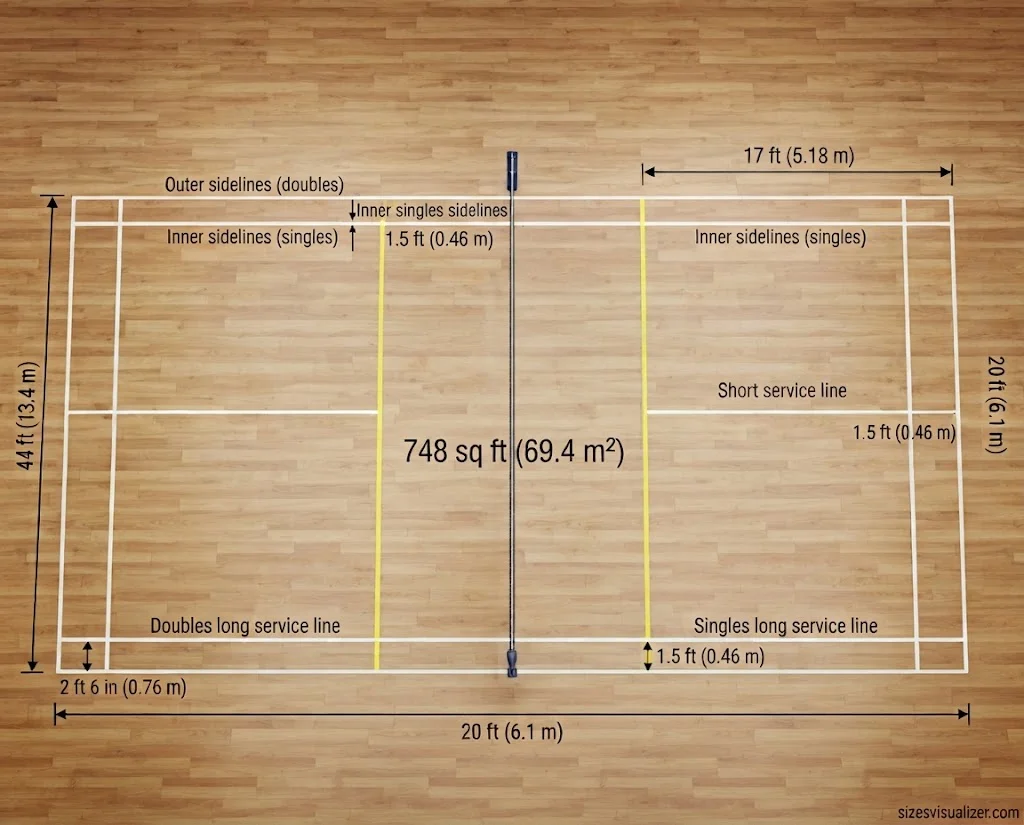
Singles matches use a narrower court — 17 feet wide (5.18 m) — while the length stays identical at 44 feet. Each side loses 1.5 feet, shrinking the sidelines inward. Surface area drops to 748 square feet (69.4 m²).
Badminton Court Area in Square Feet
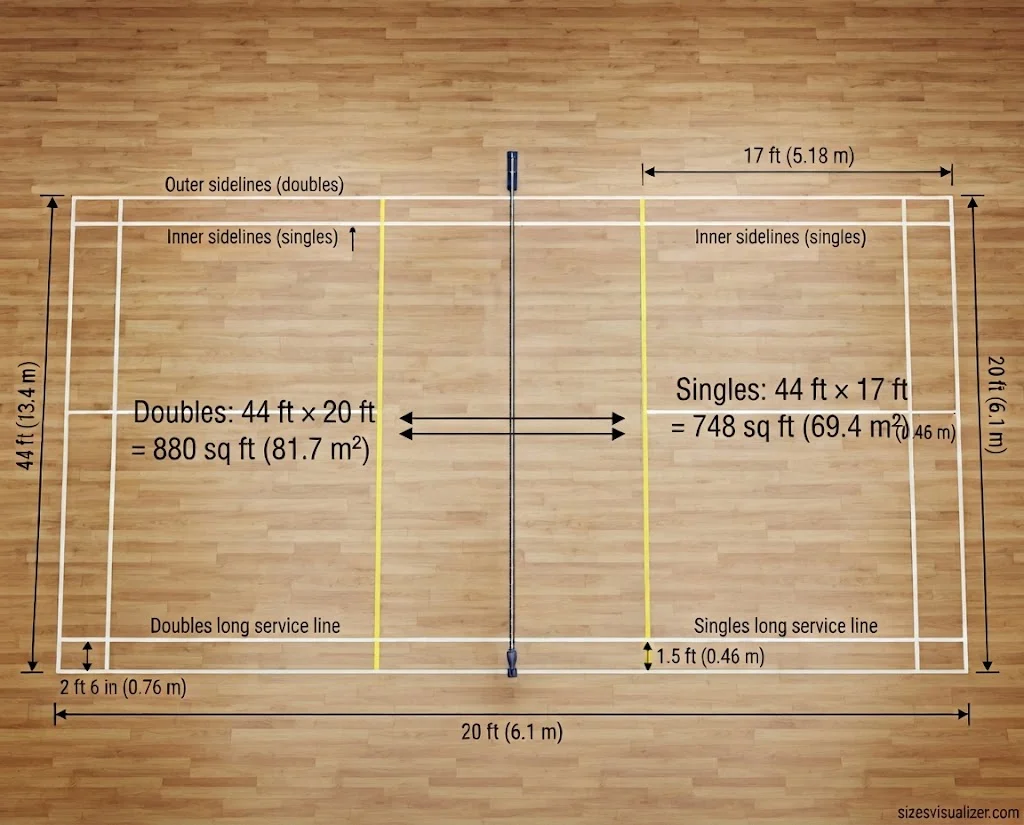
| Format | Length | Width | Area |
|---|---|---|---|
| Doubles | 44 ft | 20 ft | 880 sq ft |
| Singles | 44 ft | 17 ft | 748 sq ft |
Quick-Reference Dimensions Table
| Element | Feet | Meters |
|---|---|---|
| Court length | 44 ft | 13.4 m |
| Doubles width | 20 ft | 6.1 m |
| Singles width | 17 ft | 5.18 m |
| Net height (posts) | 5 ft 1 in | 1.55 m |
| Net height (center) | 5 ft | 1.524 m |
| Short service line | 6 ft 6 in from net | 1.98 m |
| Long service line | 2 ft 6 in from baseline | 0.76 m |
One detail that trips people up: net posts sit on the doubles sidelines, even during singles matches. The narrower singles court just plays inside that same net width.
Badminton Court Layout and Line Markings Explained
Understanding the badminton court layout means knowing what each line actually does — not just where it sits. Every line is part of active play; a shuttle landing on the line counts as in, according to BWF rules.
Outer Sidelines vs Inner Sidelines
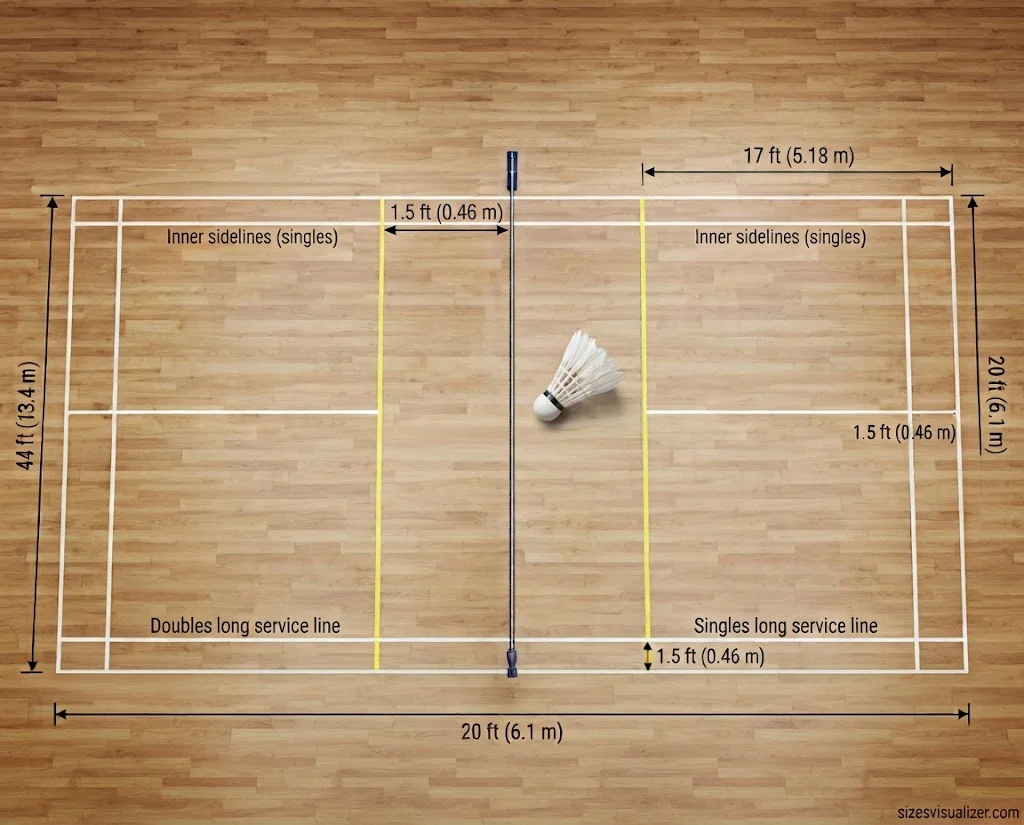
The outer sidelines mark the doubles boundary — the full 20-foot width. The inner sidelines, set 1.5 feet inward, mark the singles boundary. A shot landing between the two lines counts in doubles but out in singles. This is the single most common confusion for new players watching a match.
Baseline, Short Service Line & Long Service Line
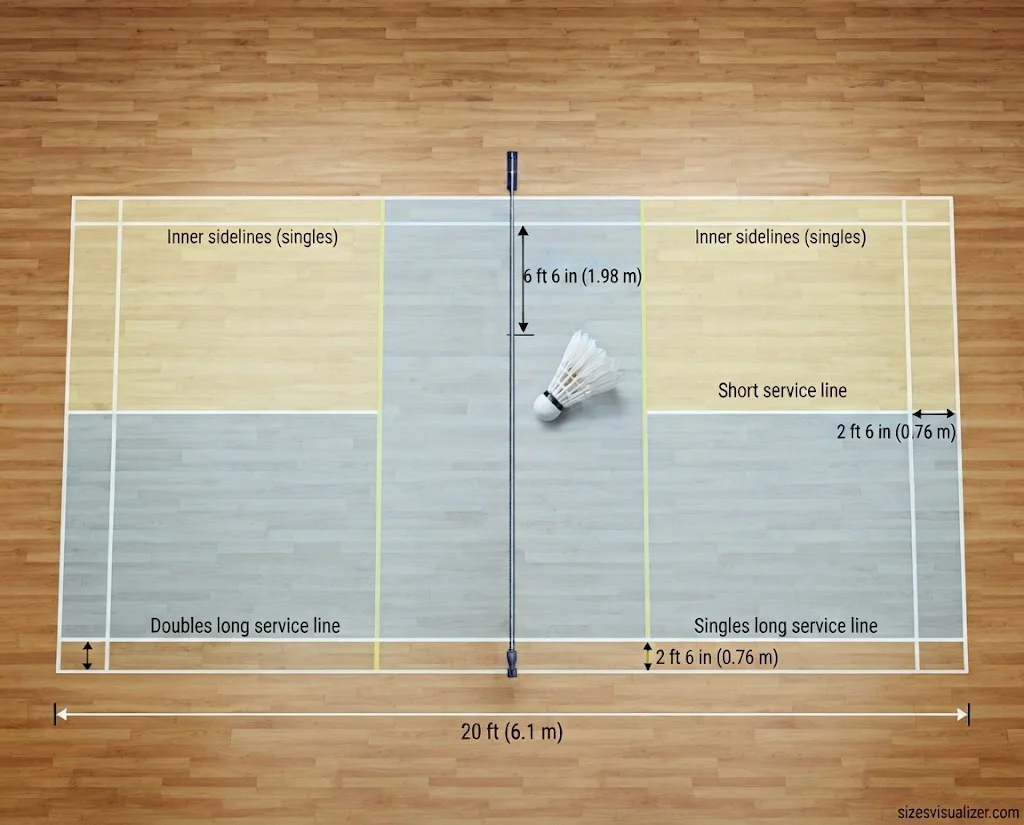
The baseline runs across each end of the court, marking the back boundary. Move toward the net and you’ll hit the short service line, positioned 6 feet 6 inches from the net — a serve landing before this line is a fault. The long service line, used only in doubles, sits 2 feet 6 inches inside the baseline, shortening the legal serving zone for doubles play.
Center Line and the Four Service Courts

The center line splits each half of the court into left and right service courts, running from the short service line back to the baseline. Together, these lines create four rectangular boxes — two per side — that determine where a serve must legally land based on the server’s score.
Net Height at the Post vs. Net Height at the Center
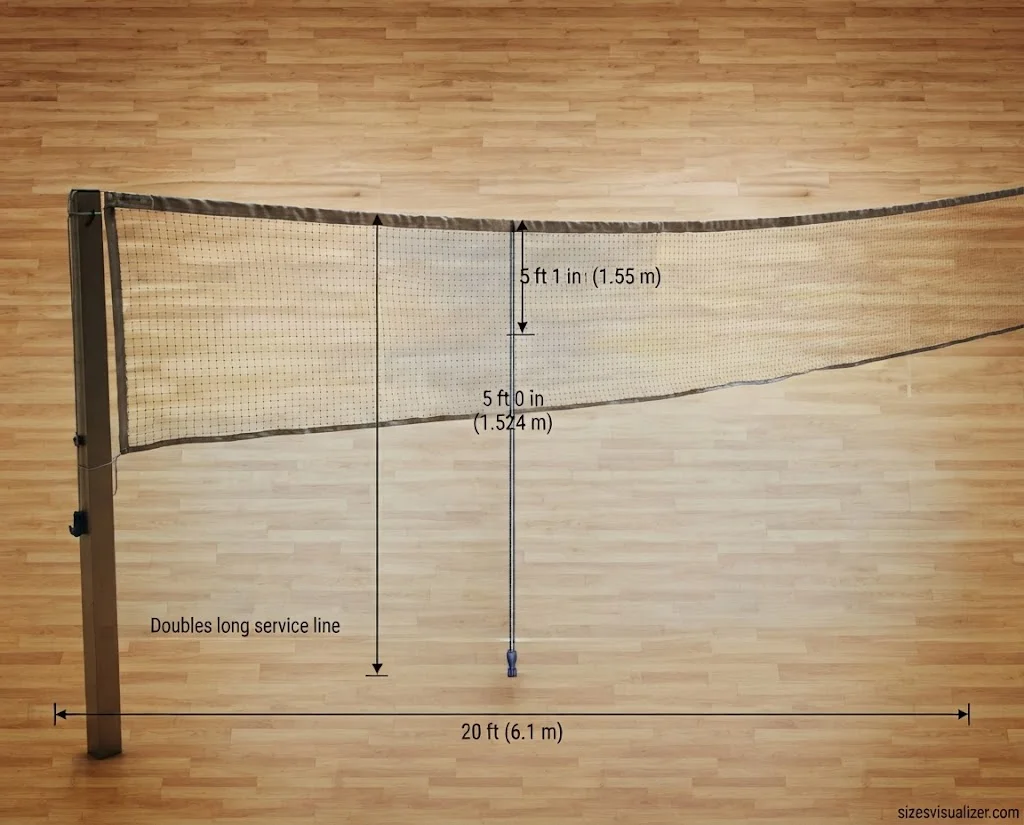
This is a spec many casual setups get wrong. The net sits 5 feet 1 inch (1.55 m) high at the posts but dips slightly to exactly 5 feet (1.524 m) at the center. That small sag is intentional, not a sign of a loose net. Check it with a tape measure at the middle — not the edges — when setting up.
Line Width, Color & BWF Marking Standards
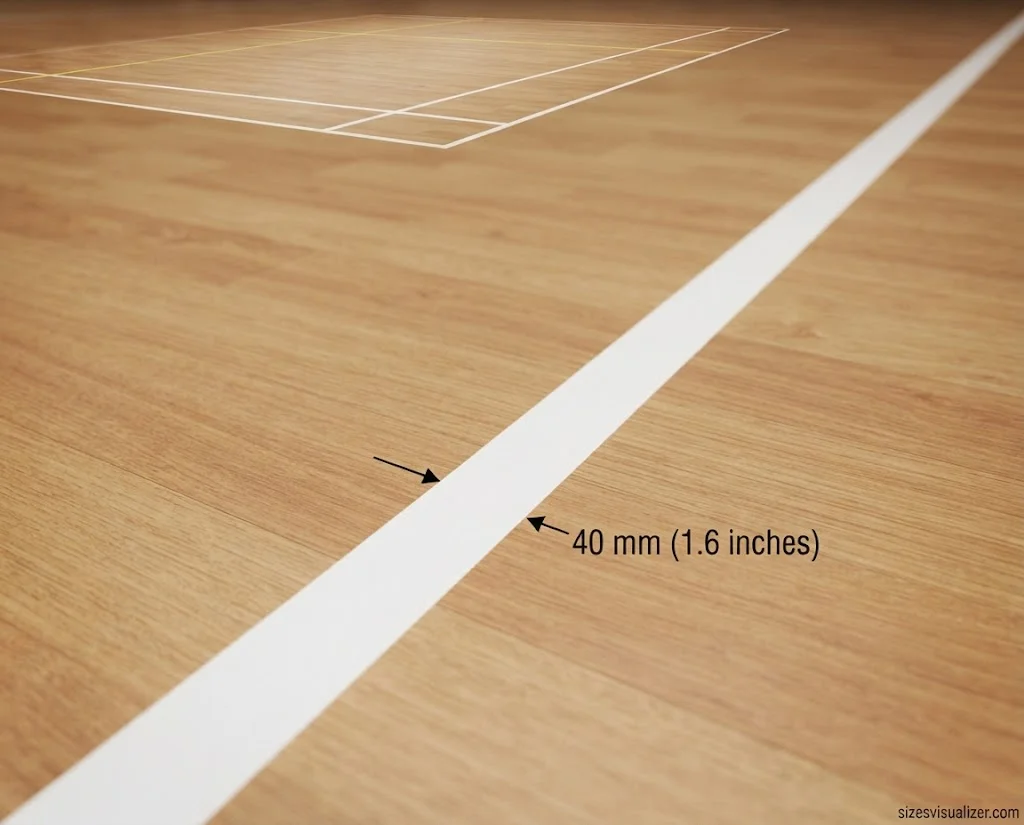
Regulation lines are 40 millimeters (1.6 inches) wide, painted in a color that stands out clearly against the floor — usually white or yellow. All court measurements are taken to the outer edge of the line, meaning the line itself is part of the playing surface, not outside it.
Badminton Court Setup Requirements (Space, Ceiling & Surface)
A badminton court setup needs more than the 44 x 20 rectangle. Real play requires room around the lines and clean air above them.
Minimum Surrounding Clearance
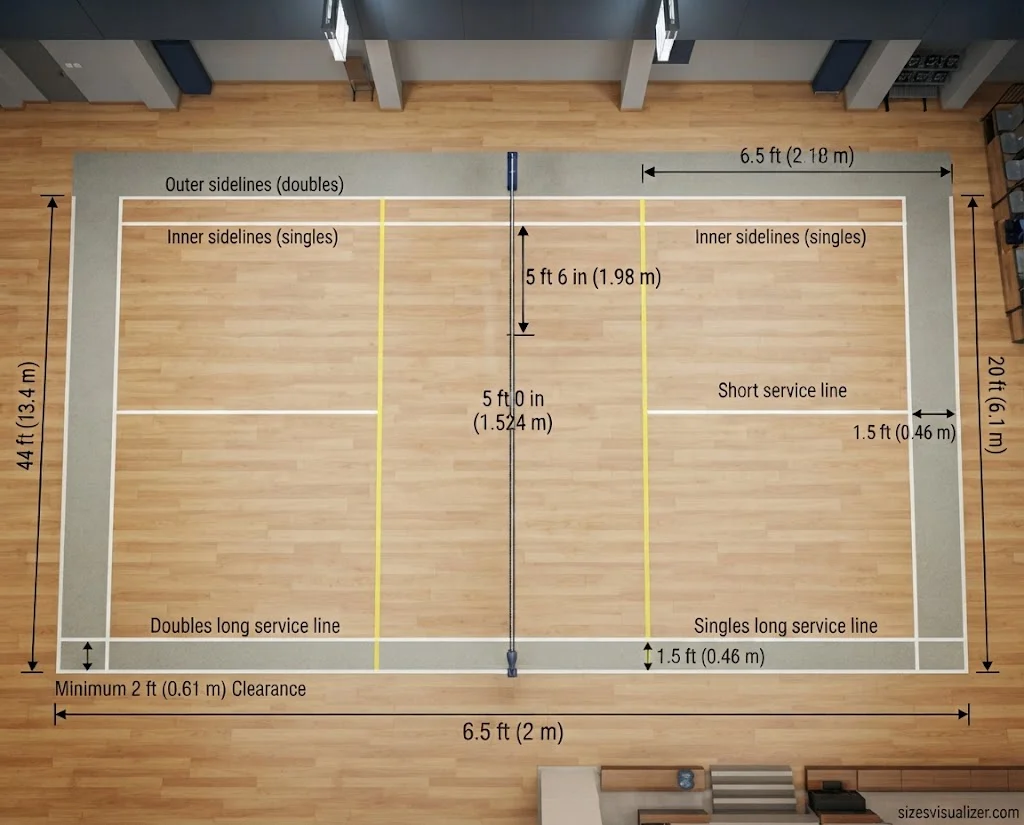
BWF specifies a minimum 2-foot (0.61 m) buffer around the entire court boundary — no wall, pillar, or obstacle should sit closer than that. Competitive venues go further, often building in 6.5 feet (2 m) of clear run-off space on every side so players can chase wide shots without hitting a barrier.
Ceiling Height Requirements — Recreational vs. Competitive Play
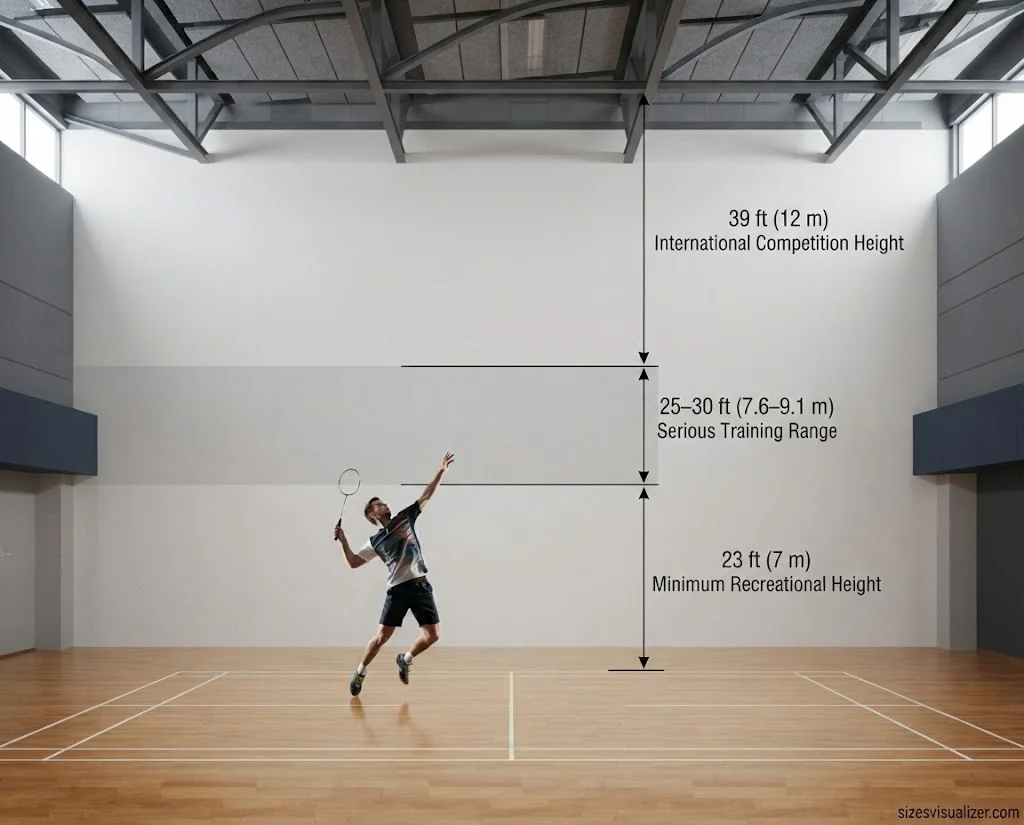
This is the number most home setups miss. A full-strength overhead clear shot can travel 25 to 30 feet into the air. Recreational play needs at least 23 feet (7 m) of unobstructed ceiling height. Serious training venues aim for 25 to 30 feet, and BWF international events require 39 feet (12 m). If your space has a low ceiling, expect the shuttle to clip beams, fans, or lights on every defensive lob.
Best Badminton Court Surfaces
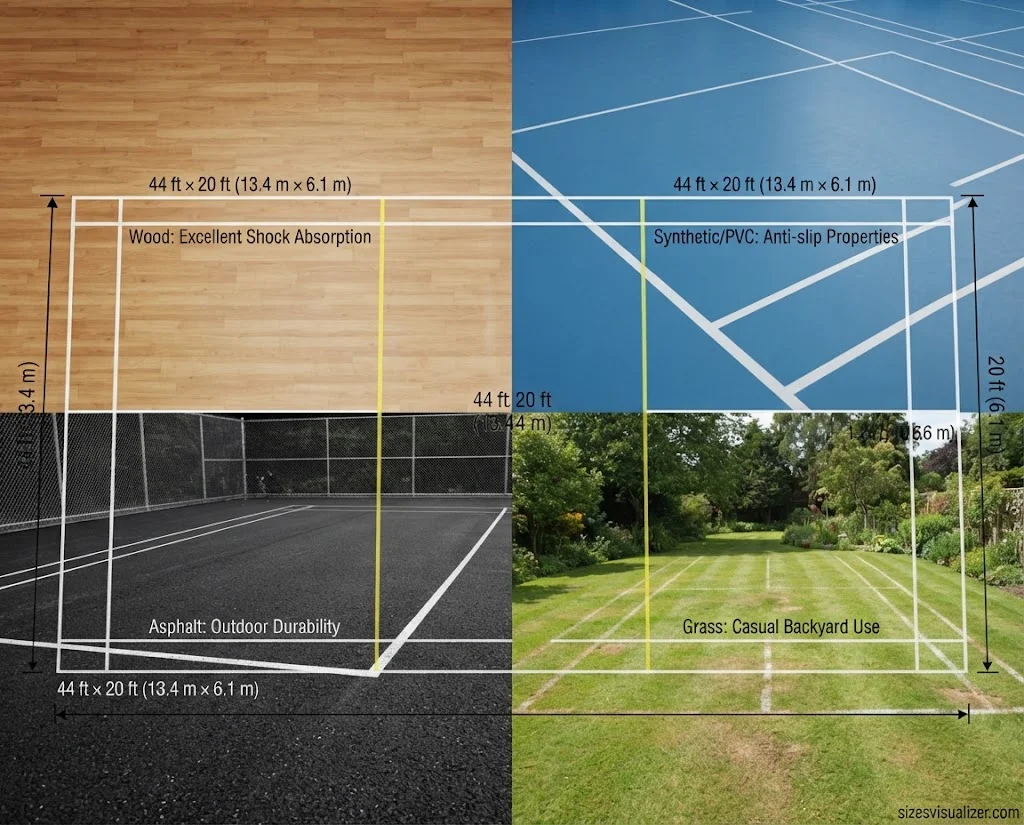
- Wood — the traditional standard, found in most gyms; strong grip and shock absorption for joints.
- Synthetic/PVC — the modern preference at most tournaments; anti-slip and easier to maintain than bare wood.
- Asphalt — common for outdoor conversions from tennis courts; durable but harder on the knees over time.
- Grass — fine for casual backyard games; inconsistent bounce makes it unsuitable for serious practice.
Indoor vs. Outdoor Setup Differences
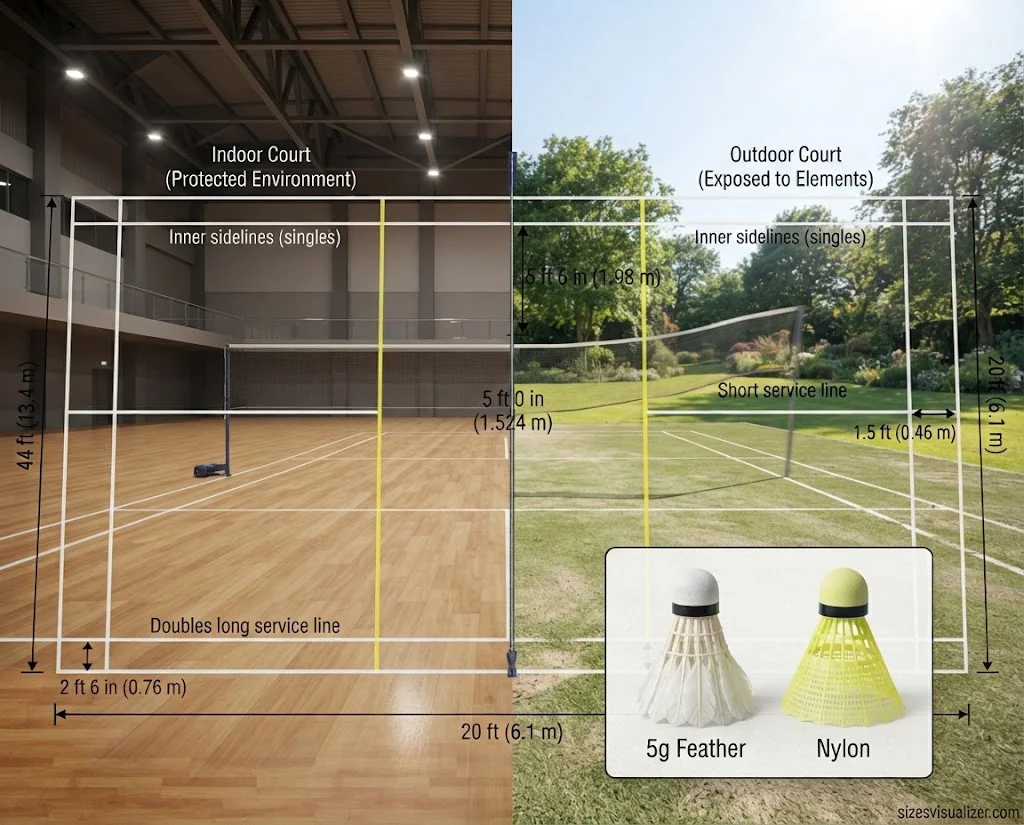
Indoor courts protect the shuttlecock from wind, which is critical since a feather shuttle weighs just 5 grams and drifts easily in a breeze. Outdoor setups should switch to a heavier nylon shuttlecock and expect shorter, less predictable rallies compared to indoor play.
Badminton Court vs. Other Court Sizes (Pickleball & Tennis)
People often ask if these sports share a footprint. They mostly don’t.
Is a Pickleball Court the Same Size as a Badminton Court?
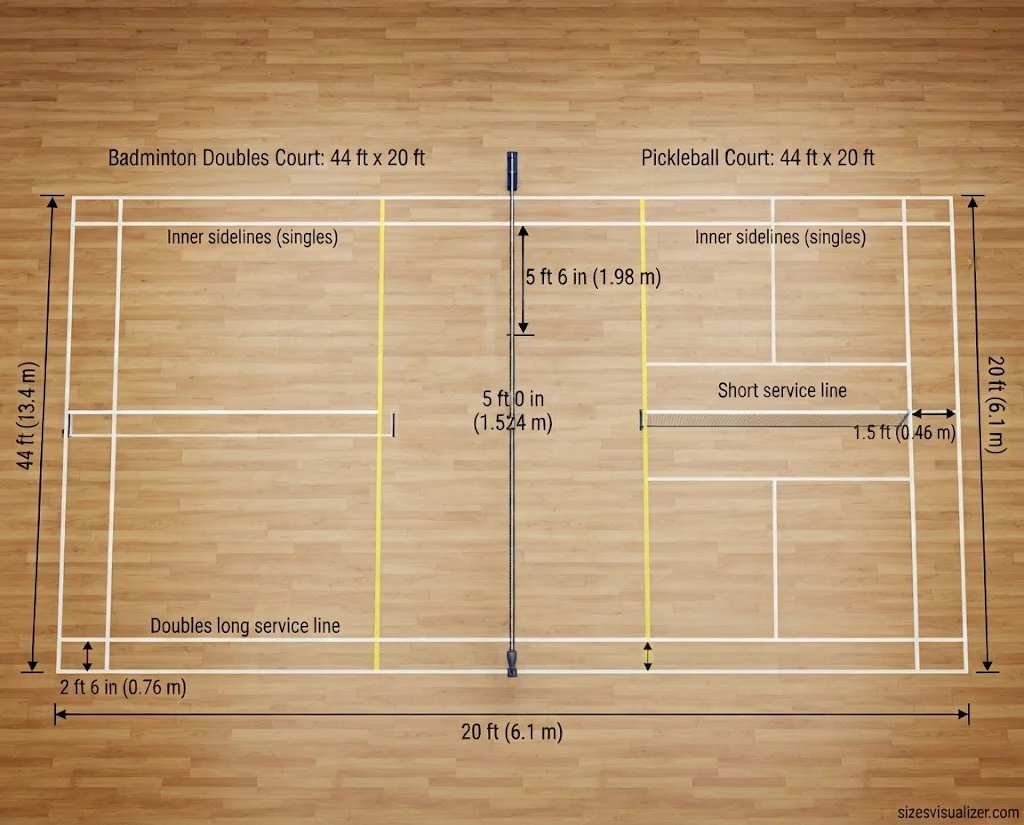
No. A regulation pickleball court measures 44 feet by 20 feet — wait, that’s actually identical to a doubles badminton court footprint. The confusion is real: pickleball courts and badminton doubles courts share the exact same outer dimensions. The difference is everything inside those lines — pickleball uses a shorter net (34 inches at the sidelines) and different service-box markings suited to a paddle sport, not a racket-and-shuttle game.
Badminton Court vs. Tennis Court Dimensions
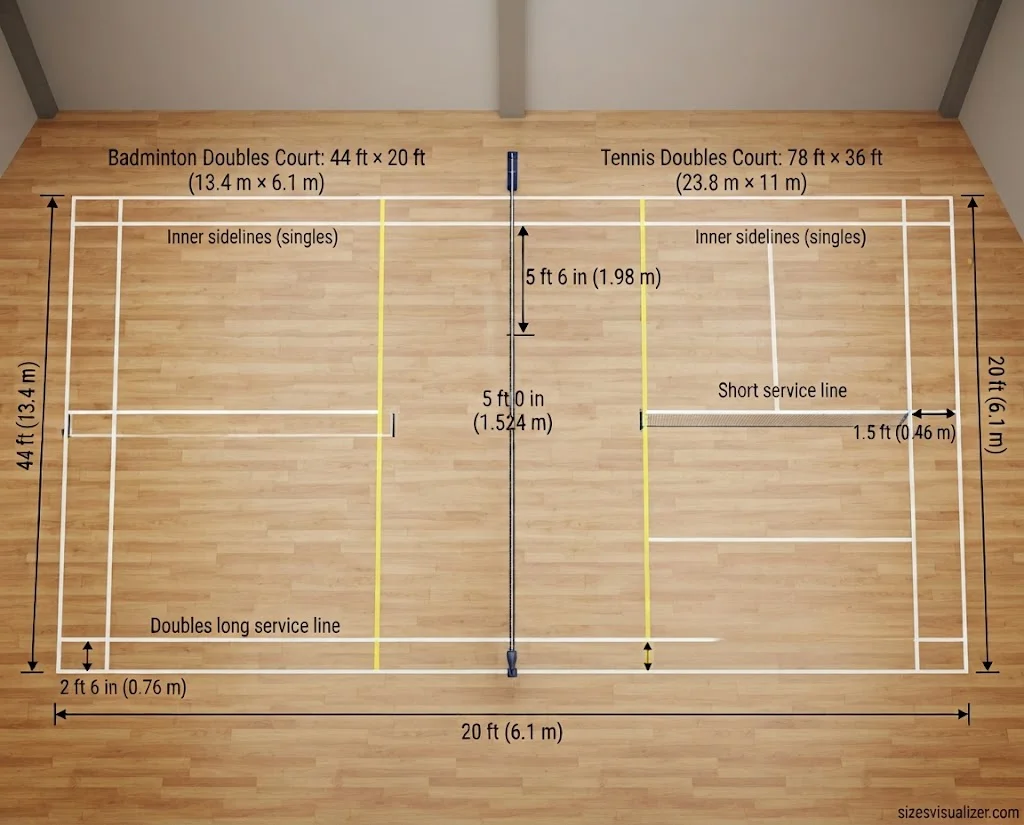
A tennis court is significantly larger — 78 feet long and 36 feet wide for doubles. That’s nearly double the length and roughly 80% more width than a badminton doubles court. This size gap is why tennis courts can’t simply be repainted for badminton without shrinking the playing zone.
Which Racket Sport Needs the Smallest Space?
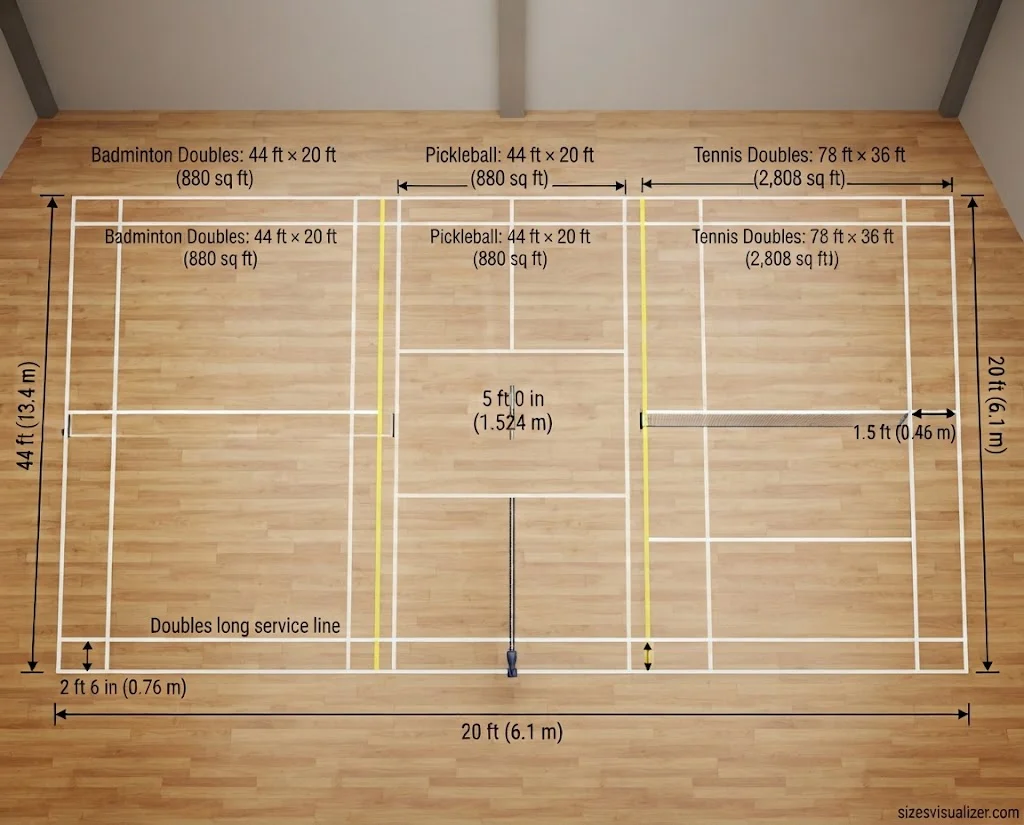
Among the three, badminton and pickleball share the smallest footprint at 44 x 20 feet, while tennis demands the most real estate by a wide margin. This makes badminton and pickleball far more practical for home, driveway, or small-facility setups.
Must Visit: Baseball Field Dimensions: Standard Measurements, Layout & Complete Size Guide
How to Mark and Build a Badminton Court at Home (US Guide)
Setting up your own badminton court doesn’t require a contractor — just accurate measuring and the right materials.
Tools & Materials Needed
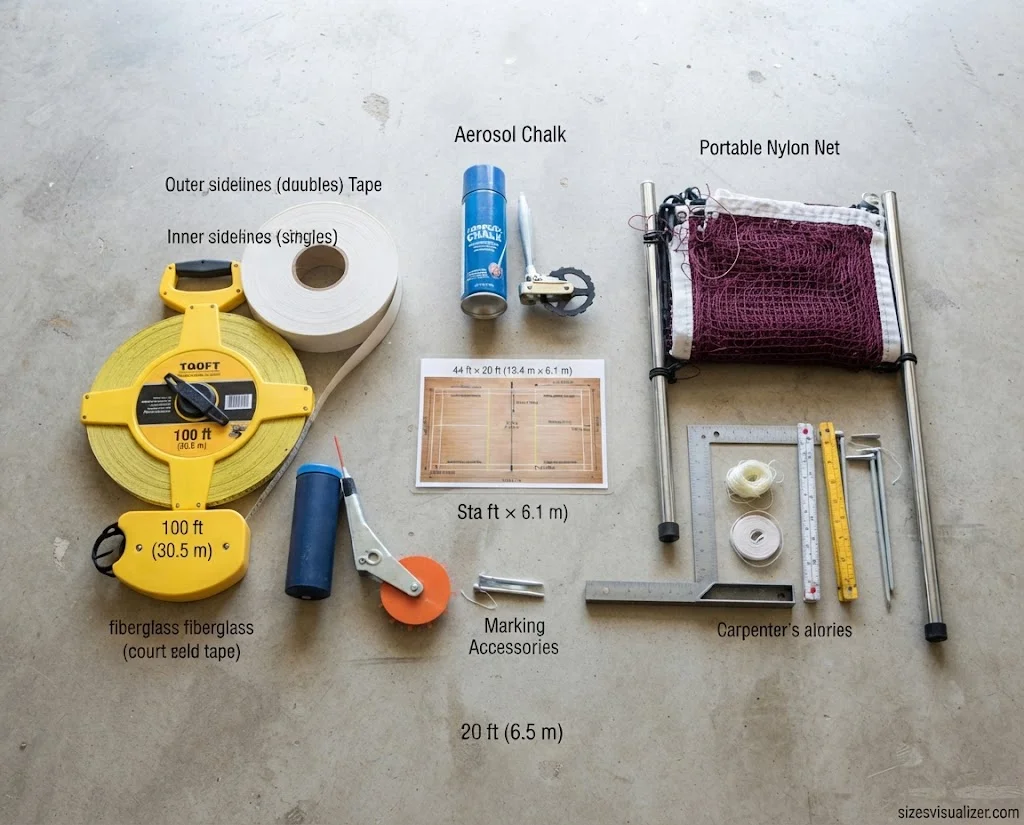
- A long tape measure (100 ft reel works best for accuracy)
- Court marking tape or chalk (2-inch width is standard)
- A badminton net with adjustable-height posts
- A square or right-angle tool to keep corners true
Step-by-Step Marking Guide
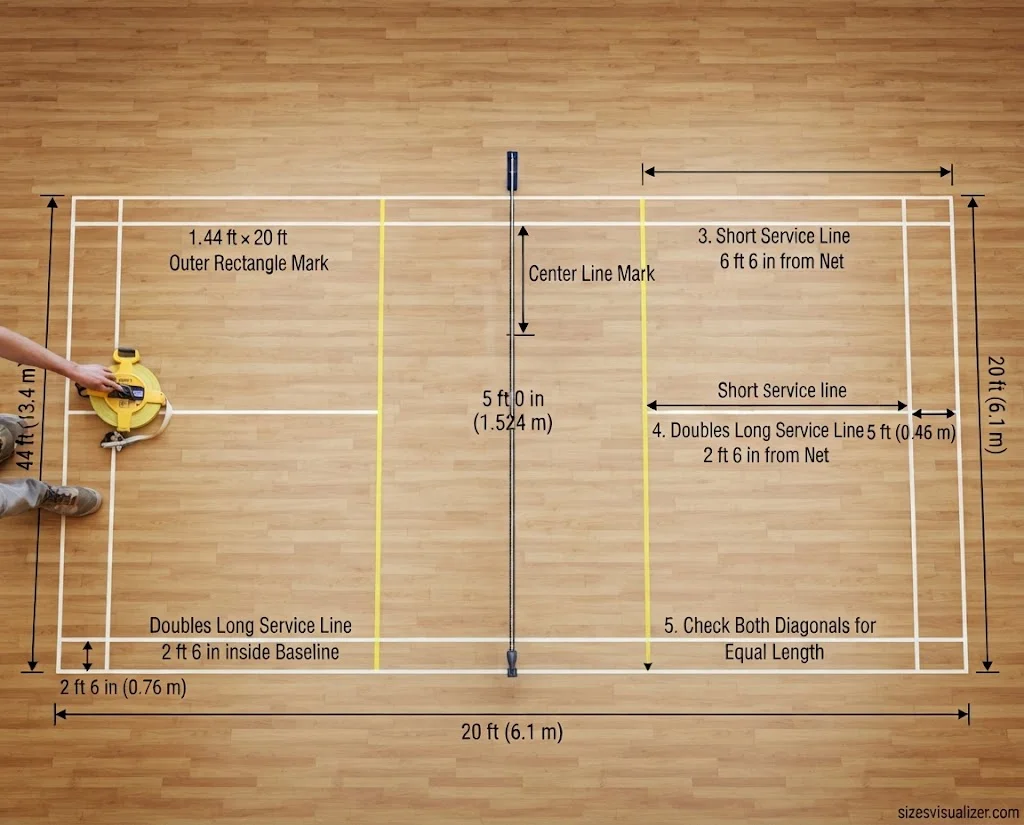
- Mark the outer 44 x 20 ft rectangle first.
- Measure and mark the center line, splitting the width evenly.
- Add the short service lines, 6 ft 6 in from where the net will sit.
- Mark the long service lines, 2 ft 6 in inside each baseline.
- Check both diagonals — they should measure identically. If they don’t, your rectangle isn’t square.
Backyard vs. Garage vs. Driveway Setup — Space Realities
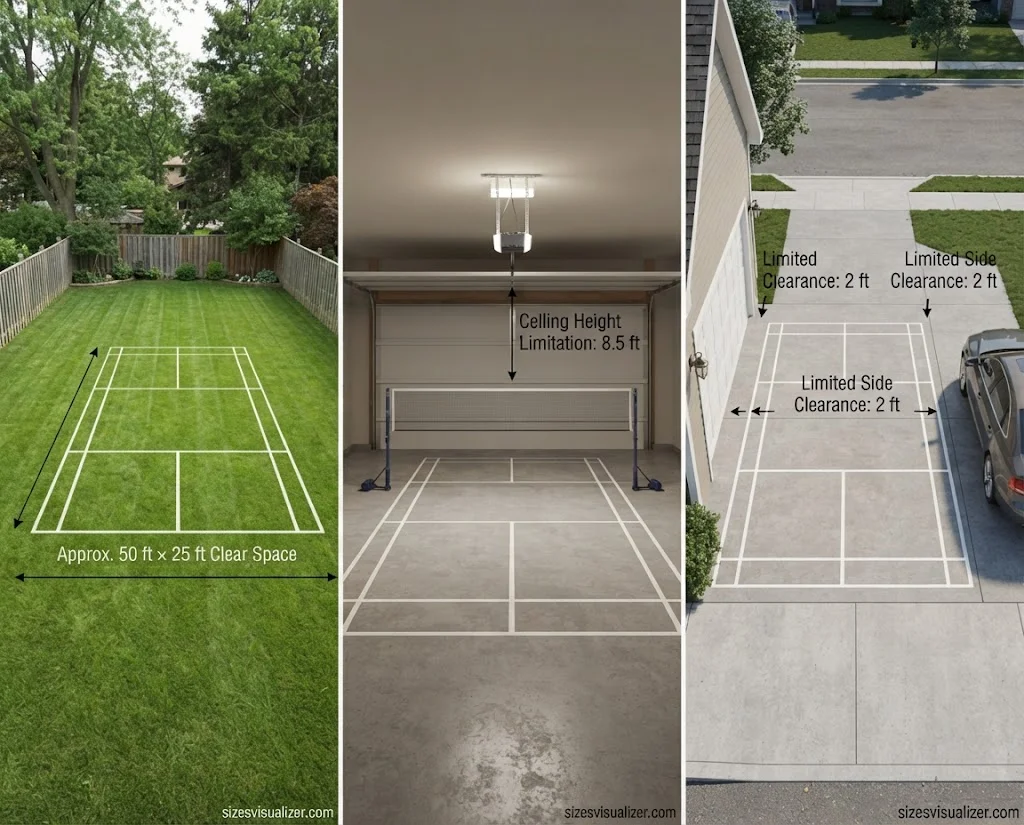
A backyard needs roughly 50 x 25 feet of flat, clear ground to fit the court plus safety margin. A garage rarely has the ceiling height for real overhead clears, so expect a modified game indoors. A driveway can work for casual doubles but often falls short on width once you account for clearance.
Estimated Cost to Set Up a Home Badminton Court in the US
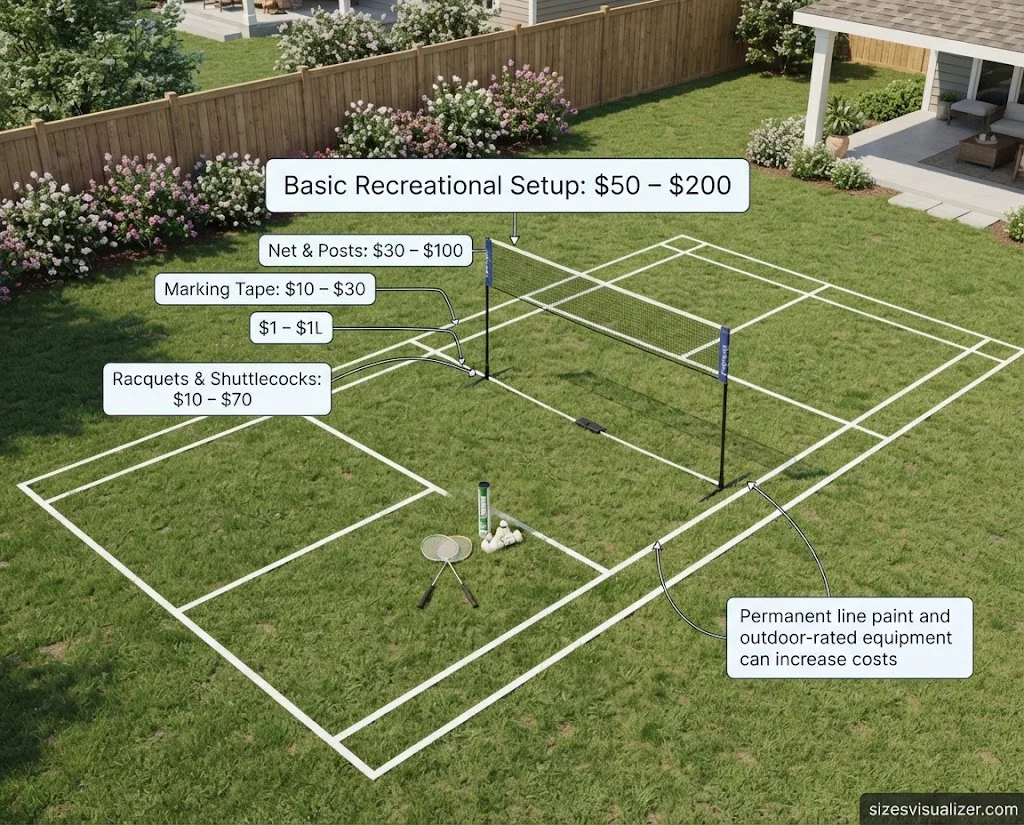
A basic backyard setup — net, posts, and marking tape — typically runs $50 to $200. Adding a proper outdoor-rated net system or permanent line paint pushes costs higher, but a functional recreational court doesn’t require a large budget.
FAQs
Is pickleball court size the same as badminton?
The outer footprint is identical — both use a 44 x 20 ft rectangle for doubles. But the net height, service box layout, and overall rules differ completely between the two sports.
What is the minimum height required for a badminton court?
Recreational play needs at least 23 feet (7 m) of clear ceiling height. Competitive and tournament venues require 25 to 39 feet, depending on the level of play.
What are 5 rules in badminton?
- A rally starts with a legal underhand serve that must land within the correct service court.
- Points are scored on every rally, regardless of who served (rally-point scoring).
- A shuttle landing on a boundary line is considered in.
- Matches are typically played to 21 points, best of three games.
- Touching the net with your racket or body during play results in a fault.
What are the dimensions of a badminton court in Australia?
The same as everywhere else. Badminton World Federation rules apply globally, so Australian courts use the identical 44 x 20 ft (13.4 x 6.1 m) doubles standard and 44 x 17 ft singles standard — no regional variation exists.
Is harder, pickleball or badminton?
This comes down to physical demand versus technical skill. Badminton generally requires more explosive movement, faster reflexes, and greater aerobic endurance due to the shuttle’s speed and the sport’s continuous rallying. Pickleball has a gentler learning curve and lower physical intensity, which is part of why it’s grown so quickly among older and beginner players in the US.
Which city banned pickleball?
Carmel-by-the-Sea, California, became the first California city to permanently ban pickleball at its public courts, following years of noise complaints from nearby residents. Other cities, including Cupertino and Denver, have introduced restricted hours or removed courts entirely over similar noise concerns.
Conclusion
Getting badminton court dimensions right — from the 44 x 20 ft boundary down to the exact net sag at center — is what separates a real, playable court from a rough approximation. Whether you’re marking a backyard or checking a facility’s build plan, these are the numbers the entire sport is built on.

Measurement Researcher, Size Comparison Writer & Content Specialist
Timmy Ahad is a dedicated content writer and research specialist at SizesVisualizer.com, where he focuses on creating accurate, easy-to-understand content about measurements, dimensions, size comparisons, and real-world object visualization.