Soccer fields are not one fixed size. That surprises a lot of people, especially fans coming from American football, where every field is exactly the same. A soccer field can legally range from 110 to 120 yards long and 70 to 80 yards wide, and the exact number depends on the level of play, the age group, and even which stadium you’re standing in.
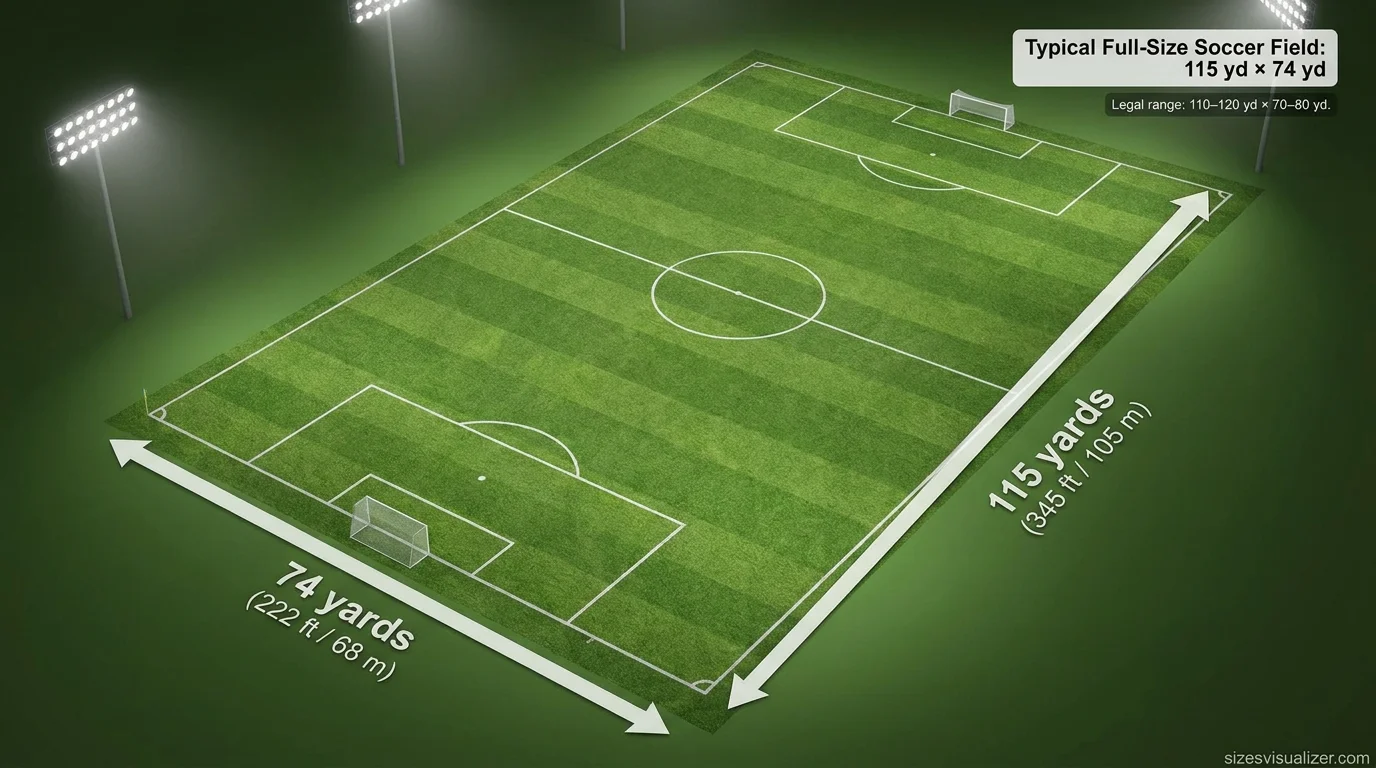
A full-size soccer field for adult, professional play sits close to 115 yards long and 74 yards wide, based on official recommendations from soccer’s global governing body. Younger players use much smaller fields. Below, we break down complete dimensions including every size tier, compare soccer fields to fields you already know, and answer the most common questions people search for.
Table of Contents
Standard Soccer Field Dimensions (FIFA & IFAB Regulations)
| Level | Length | Width |
|---|---|---|
| FIFA/IFAB standard (recommended) | 115 yds (105m) | 74 yds (68m) |
| FIFA/IFAB legal range | 110–120 yds | 70–80 yds |
| NCAA college | 115–120 yds | 70–75 yds |
| High school (NFHS) | 100–120 yds | 55–80 yds |
| Youth (U13+) | 100–130 yds | 50–100 yds |
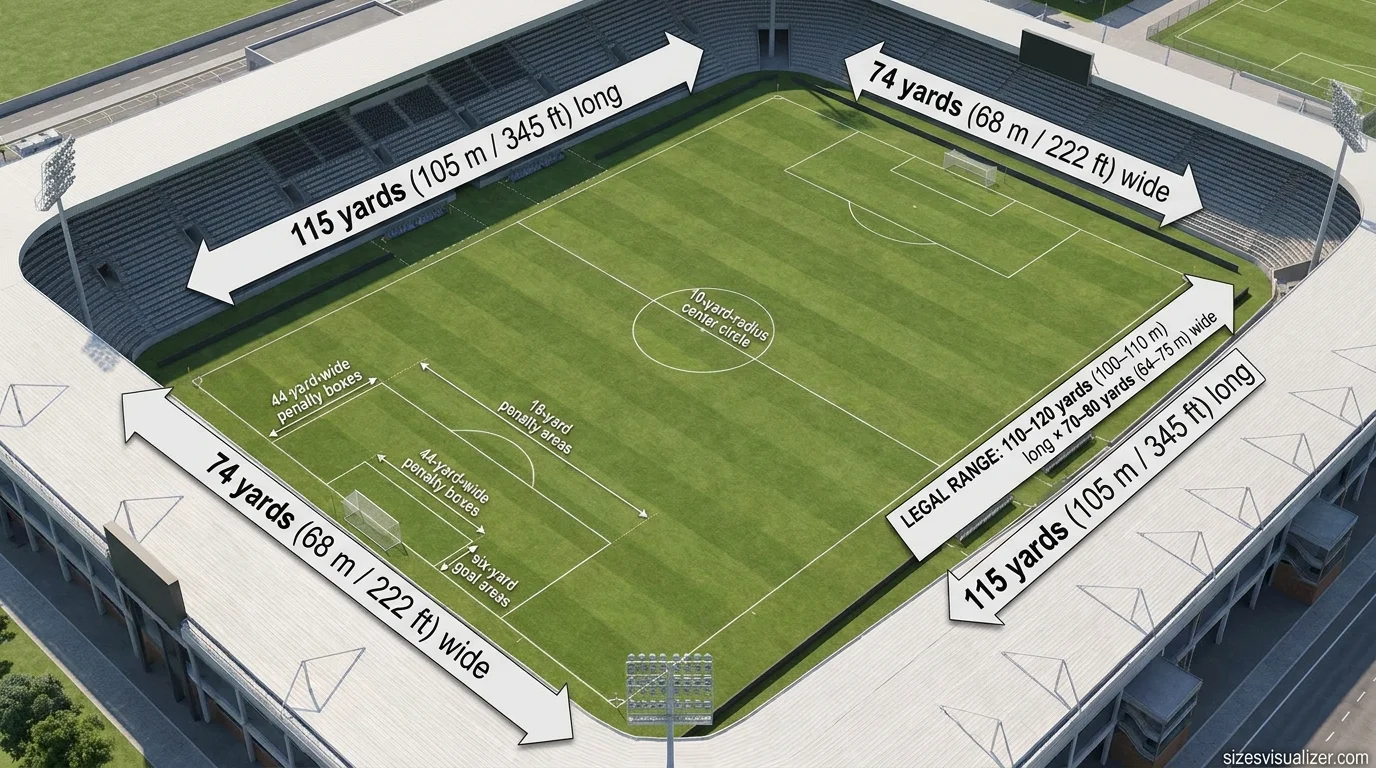
A full-size adult soccer field runs between 110 and 120 yards long, with a recommended length of 115 yards. Width falls between 70 and 80 yards, with 74 yards as the preferred standard.
These numbers come from the International Football Association Board (IFAB), the body that writes soccer’s official Laws of the Game, and FIFA, the sport’s global governing organization. Together they set the outer limits every regulation pitch must fall within.
In metric terms, that’s roughly 100 to 110 meters long and 64 to 75 meters wide. Unlike a basketball court or a tennis court, there’s no single fixed number — just a range. That’s a deliberate choice. It lets older stadiums, many built more than a century ago, keep their original footprint instead of being torn up to match a rigid template.
A regulation pitch also carries a set of required markings: the touchline (the sideline running the field’s length), the goal line, the halfway line, a center circle with a 10-yard radius, and two penalty boxes, each stretching 18 yards out from the goal line and 44 yards wide. The goal area, sometimes called the six-yard box, sits closer to the net and is used for goal kicks.
Total playing surface on a standard field works out to roughly 1.76 to 1.86 acres — nearly double the footprint of a football field once you strip away the end zones.
Make size measurements easier to understand by creating quick visual comparisons with our Size Visualizer & Comparison Tool.
Soccer Field Size by Age Group (Youth Soccer Dimensions)
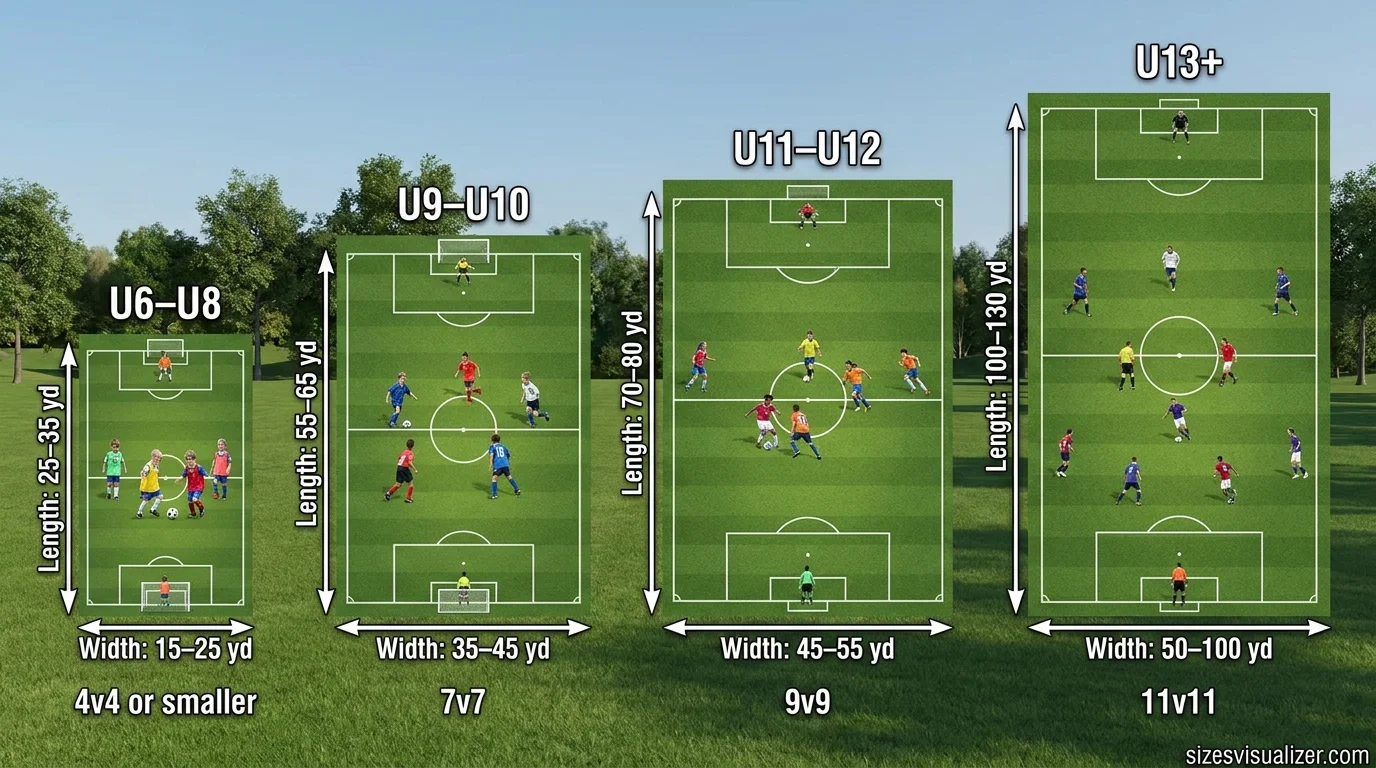
Field size doesn’t just shrink for kids — it scales step by step as players get older, gain endurance, and add teammates. This staged growth is intentional. A 7-year-old chasing a ball across a full 115-yard pitch would spend most of the game running, not playing.
The US Youth Soccer Association sets the benchmark most American leagues follow:
| Age group | Format | Length | Width |
|---|---|---|---|
| U6–U8 | 4v4 or smaller | 25–35 yds | 15–25 yds |
| U9–U10 | 7v7 | 55–65 yds | 35–45 yds |
| U11–U12 | 9v9 | 70–80 yds | 45–55 yds |
| U13 and up | 11v11 | 100–130 yds | 50–100 yds |
Small-sided games, like 4v4 and 7v7, aren’t just about field size — they’re built around child development. Fewer players per side means more touches on the ball for each kid, which speeds up skill-building far more than dropping an 8-year-old into a full 11v11 match ever would. By the time players reach U13, both the field size and the format jump straight to the adult standard, since that’s the age most youth bodies consider ready for the full 11-a-side game.
High School, College & Professional Soccer Field Sizes
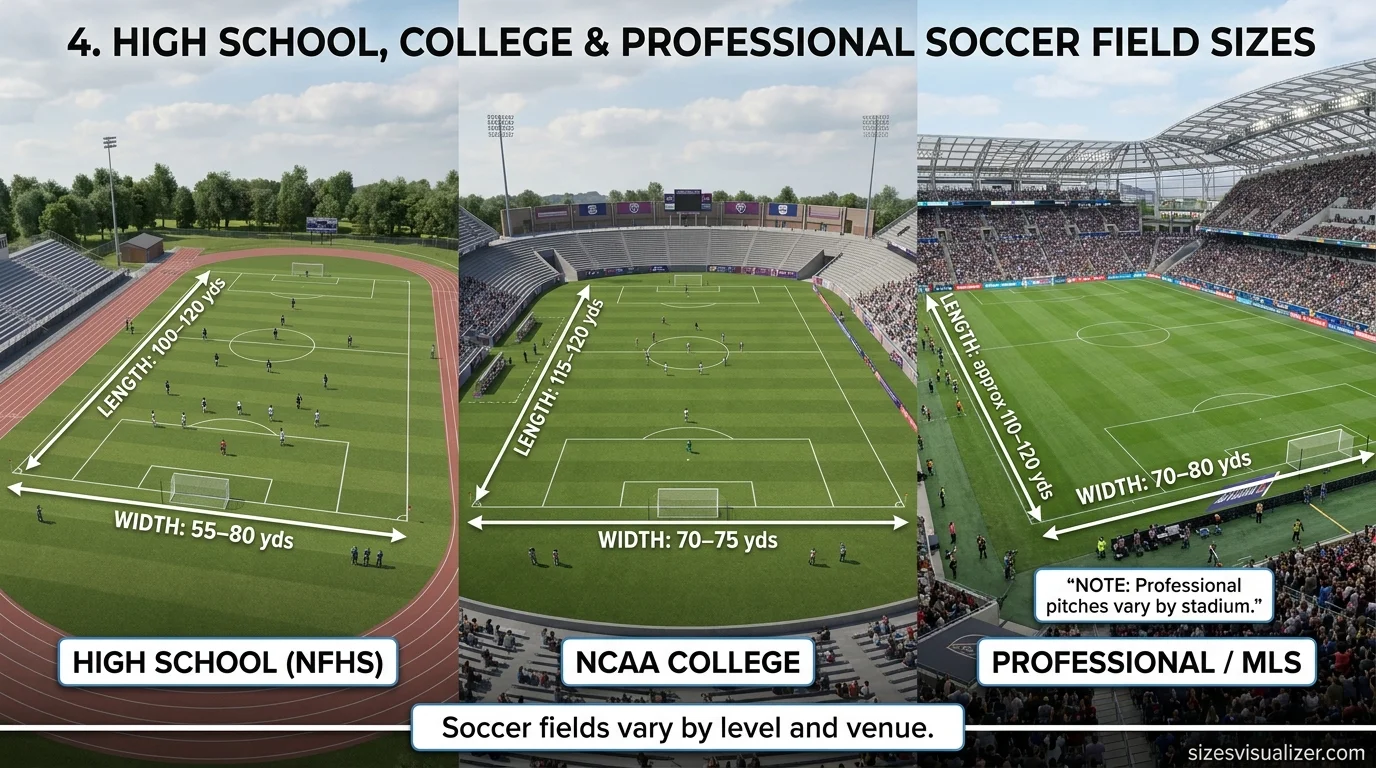
Most Premier League pitches measure between 112 and 115 yards long and 70 to 75 yards wide, though the league’s official guidance allows for a bit more range at either end.
High school soccer in the US follows rules set by the National Federation of State High School Associations (NFHS). Fields must be between 100 and 120 yards long and 55 to 80 yards wide — noticeably more flexible on width than the pro game.
College soccer answers to the NCAA, which requires a length of 115 to 120 yards and a width of 70 to 75 yards, closely mirroring professional standards. MLS fields fall in a similar band, with a minimum of 110 yards long and 70 yards wide.
Here’s what makes soccer different from American football: even top-tier stadiums don’t share identical dimensions. Anfield, Liverpool’s home ground, measures close to 110.5 yards by 74 yards. Old Trafford, home to Manchester United, runs slightly longer at roughly 114.8 by 74 yards. Every pitch stays inside IFAB’s legal window, but no two are forced to match exactly — a quirk that shapes how teams build tactics around their own home turf.
Must visit: How Wide Is a Sidewalk? Standard Width, Thickness, Slope & ADA Rules
Soccer Field Size Compared to Other Fields
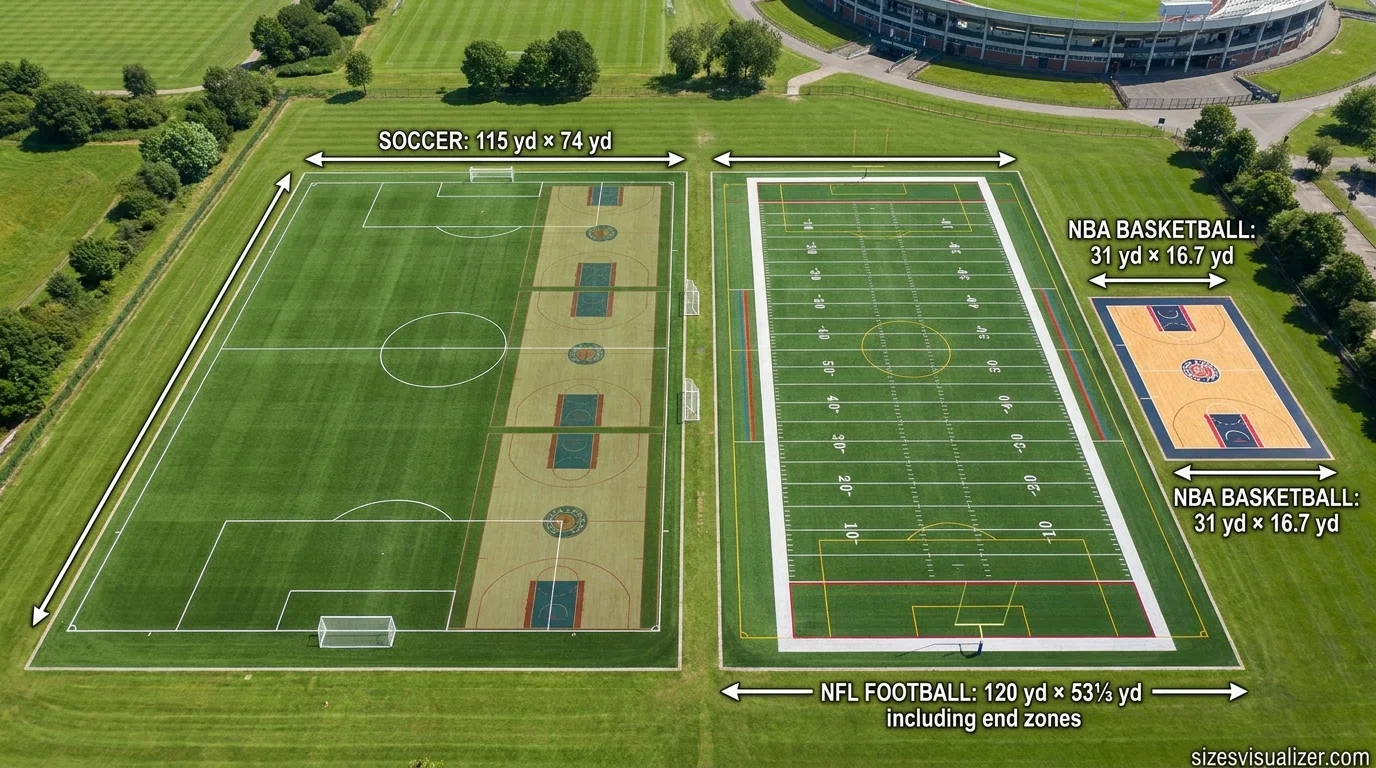
Is 100 yards a football field? Yes — an NFL field measures exactly 100 yards from goal line to goal line, stretching to 120 yards once you include both end zones. Width is fixed at 53⅓ yards, a number that never changes across high school, college, or the pros.
That fixed width is the biggest contrast with soccer. A soccer field, even at its narrowest legal width of 70 yards, is still noticeably wider than a football field. Length is roughly similar once end zones are counted, but soccer’s playing surface covers significantly more total ground — a big reason why soccer players log more distance per match than football players typically do.
Basketball offers another useful comparison. A regulation NBA court measures about 31 yards long and 16.7 yards wide. A standard soccer field could fit roughly three basketball courts across its length and four across its width.
Forty yards lands you a bit past the halfway line and close to the edge of the penalty box on a standard 115-yard pitch — roughly a third of the way down the field from one end. It’s also the rough benchmark scouts use when timing a player’s sprint speed, since a 40-yard dash covers close to the distance a winger might sprint on a fast break down the flank.
Soccer Field Dimensions in Yards, Feet & Meters
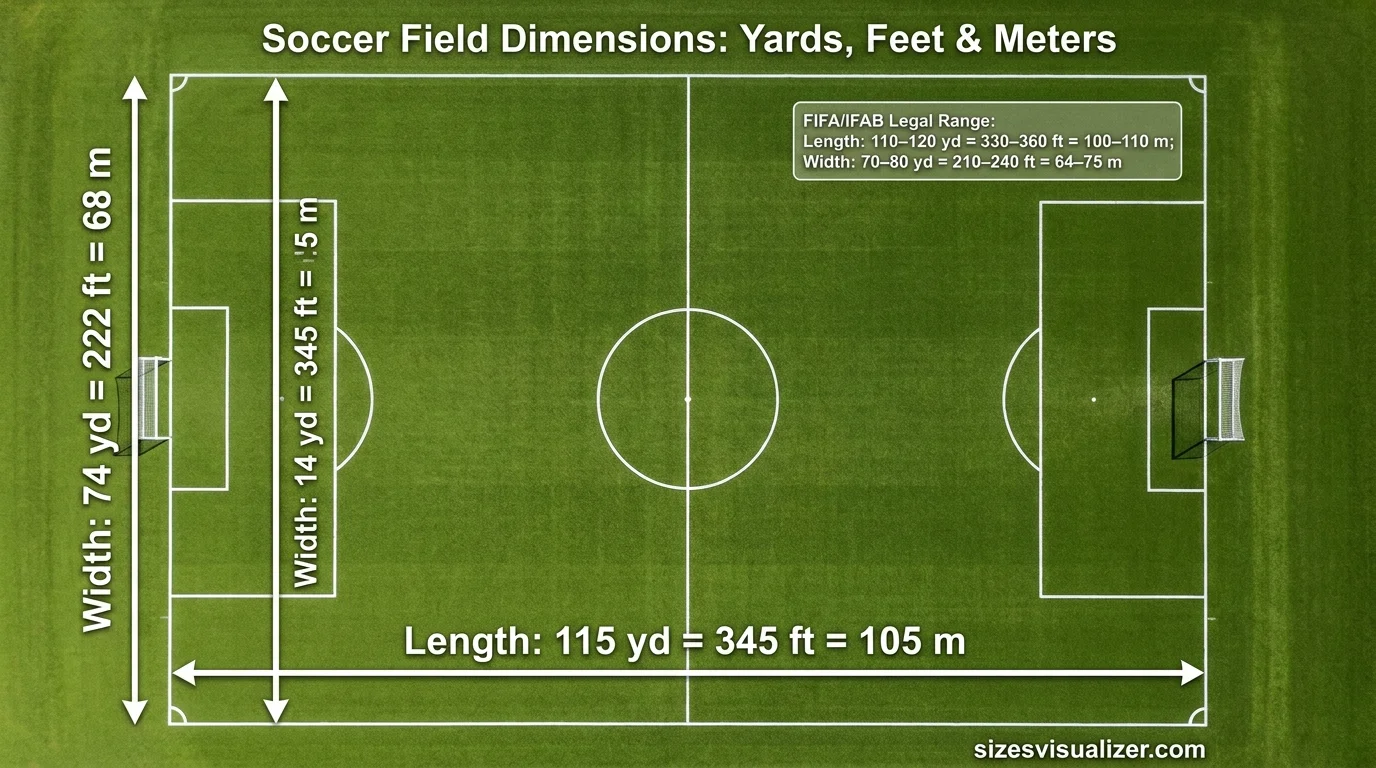
For quick reference, here’s every size tier converted across all three common units:
| Level | Length (yds) | Length (ft) | Length (m) | Width (yds) | Width (ft) | Width (m) |
|---|---|---|---|---|---|---|
| FIFA standard | 115 | 345 | 105 | 74 | 222 | 68 |
| FIFA range | 110–120 | 330–360 | 100–110 | 70–80 | 210–240 | 64–75 |
| NCAA college | 115–120 | 345–360 | 105–110 | 70–75 | 210–225 | 64–69 |
| High school (NFHS) | 100–120 | 300–360 | 91–110 | 55–80 | 165–240 | 50–73 |
| U13+ youth | 100–130 | 300–390 | 91–119 | 50–100 | 150–300 | 46–91 |
| U11–U12 | 70–80 | 210–240 | 64–73 | 45–55 | 135–165 | 41–50 |
| U9–U10 | 55–65 | 165–195 | 50–59 | 35–45 | 105–135 | 32–41 |
| U6–U8 | 25–35 | 75–105 | 23–32 | 15–25 | 45–75 | 14–23 |
FAQs
How many yards is a full-size soccer field?
A full-size soccer field is typically 115 yards long, with a legal range of 110 to 120 yards depending on the venue.
How large is a FIFA soccer field?
FIFA’s recommended field size is 115 yards long by 74 yards wide, though the accepted legal range runs from 110–120 yards long and 70–80 yards wide.
Is 100 meters a soccer field?
Not quite. A regulation soccer field’s minimum length is closer to 100 meters (about 109 yards), but the standard recommended length is longer, at 105 meters (115 yards). So 100 meters falls just short of a typical full-size field.
How big is a Premier League soccer field?
Premier League pitches generally measure between 112 and 115 yards long and 70 to 75 yards wide, though exact dimensions vary slightly by stadium.
Is 100 yards a football field?
Yes. An American football field is exactly 100 yards long between goal lines, extending to 120 yards when both end zones are included.
What is 40 yards on a soccer field?
Forty yards marks a point just past the halfway line on a standard 115-yard field, roughly one-third of the way down the pitch — and it’s also the standard distance used to time a player’s sprint speed.
Conclusion
Soccer field size isn’t one number — it’s a range shaped by age, level, and even the stadium itself. Once you know the standard dimensions, the youth breakdown, and how soccer stacks up against fields like football and basketball, the whole picture makes a lot more sense. Whether you’re marking out a field, coaching a youth team, or just settling a bar bet, you now have the real numbers to back it up.

Measurement Researcher, Size Comparison Writer & Content Specialist
Timmy Ahad is a dedicated content writer and research specialist at SizesVisualizer.com, where he focuses on creating accurate, easy-to-understand content about measurements, dimensions, size comparisons, and real-world object visualization.