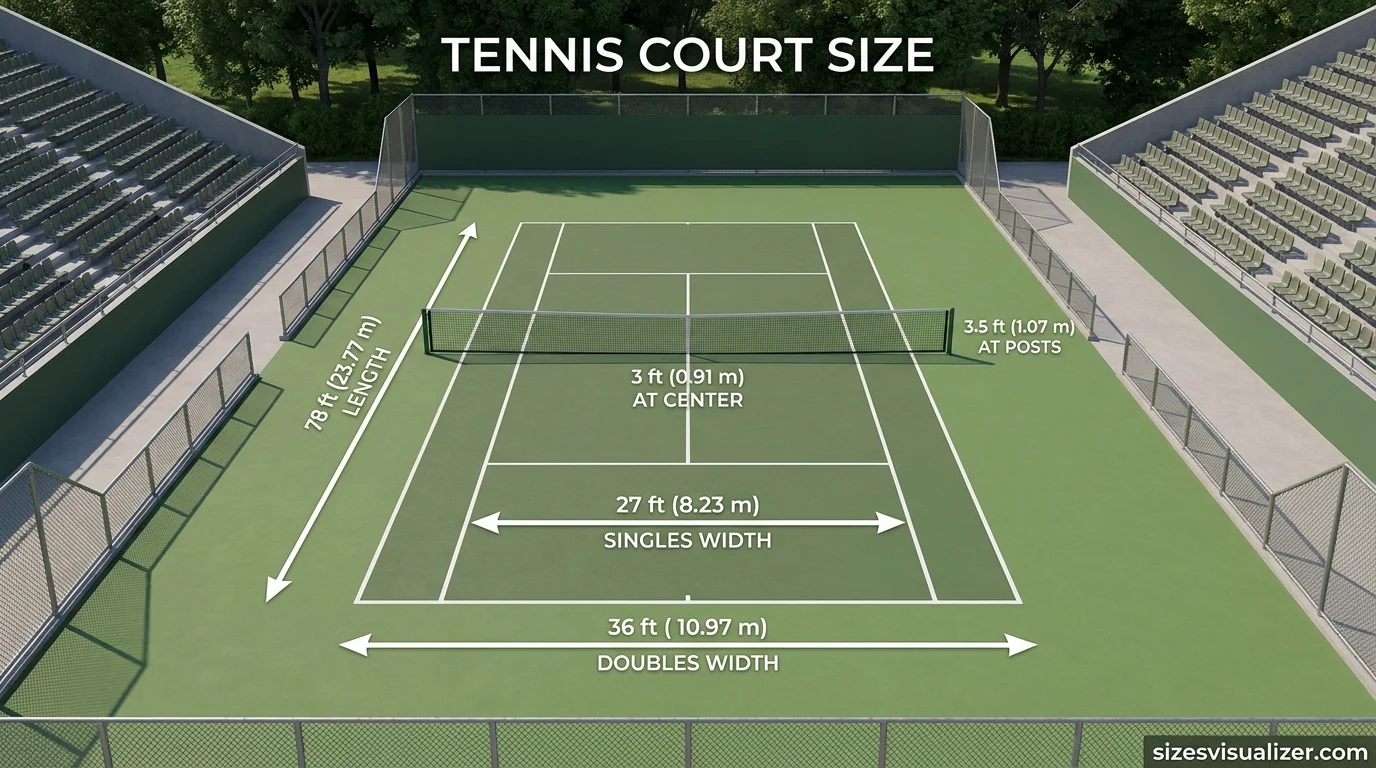
A tennis court looks simple from the stands. Two rectangles, a net, a few painted lines. But every measurement on that court is locked in by rule, down to the inch.
If you’re building a court, coaching a kid, or just curious after watching a match, this guide breaks down the real tennis court dimensions — in feet and meters — plus the layout, space needs, and a few surprising facts most guides skip.
Table of Contents
Standard Tennis Court Dimensions and Size
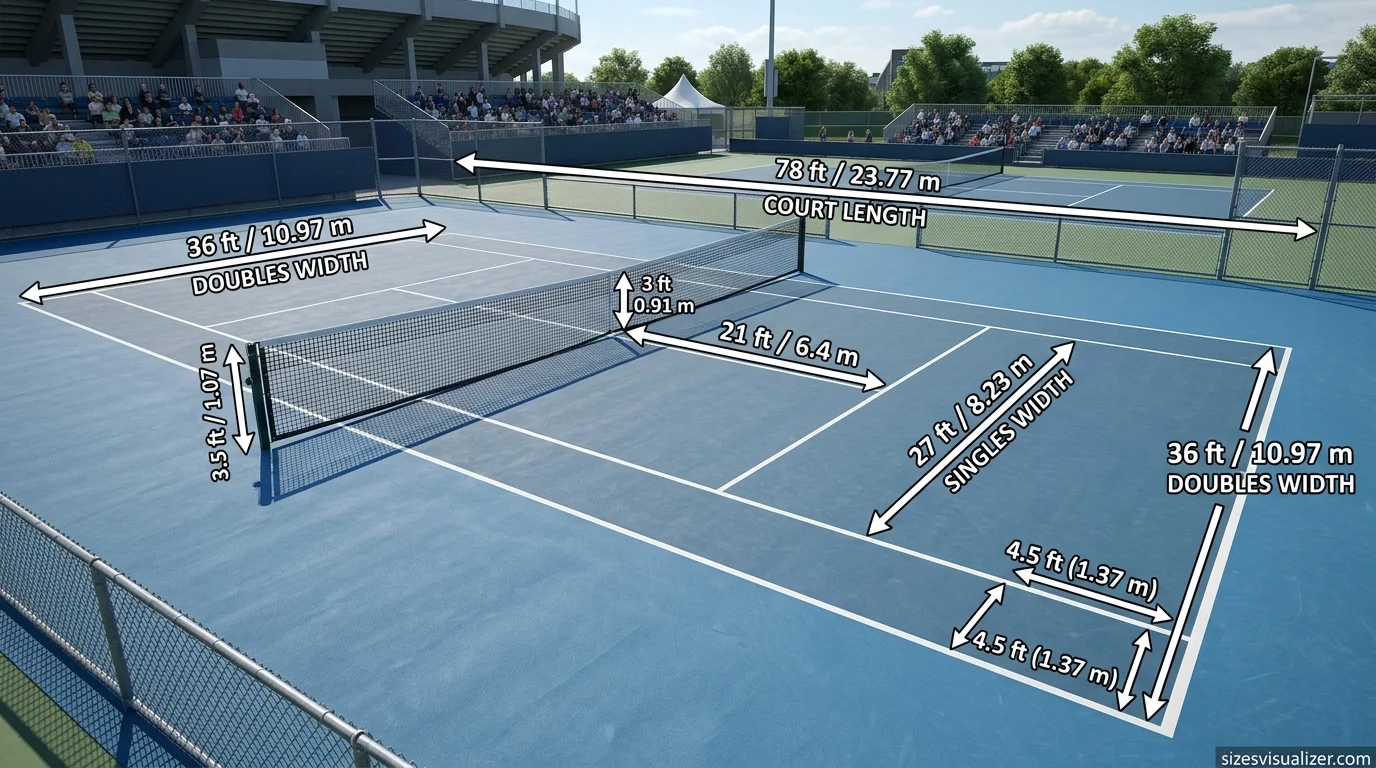
What is the size of a tennis court? A full-size tennis court measures 78 feet (23.77 m) long. That length never changes, whether you’re playing singles or doubles.
Width is where singles and doubles split:
- Singles width: 27 feet (8.23 m)
- Doubles width: 36 feet (10.97 m)
The extra width on a doubles court comes from the doubles alley — a 4.5-foot (1.37 m) strip running down each side, used only during doubles play.
In total playing area, a doubles court covers 260.87 m² (2,808 ft²). A singles court is smaller, at roughly 195.65 m² (2,106 ft²). These figures come from the International Tennis Federation rulebook, which every sanctioned court in the world — from your local park to Arthur Ashe Stadium — must follow.
The net has its own spec, and it’s not flat. It stands 3.5 feet (42 inches / 1.07 m) high at the posts, but dips to 3 feet (36 inches / 0.91 m) at the center. That sag isn’t a manufacturing flaw — it’s intentional, giving players a slightly easier target down the middle and rewarding accurate cross-court shots.
One more number worth knowing: the service line sits 21 feet (6.4 m) from the net on both sides, marking where serves must land to count.
| Measurement | Feet | Meters |
|---|---|---|
| Court length | 78 ft | 23.77 m |
| Singles width | 27 ft | 8.23 m |
| Doubles width | 36 ft | 10.97 m |
| Net height (posts) | 3.5 ft | 1.07 m |
| Net height (center) | 3 ft | 0.91 m |
| Service line from net | 21 ft | 6.4 m |
Compare the dimensions of rooms, objects, spaces, and everyday items with our intuitive Size Visualizer & Comparison Tool.
Tennis Court Layout: Lines, Boxes, and Zones
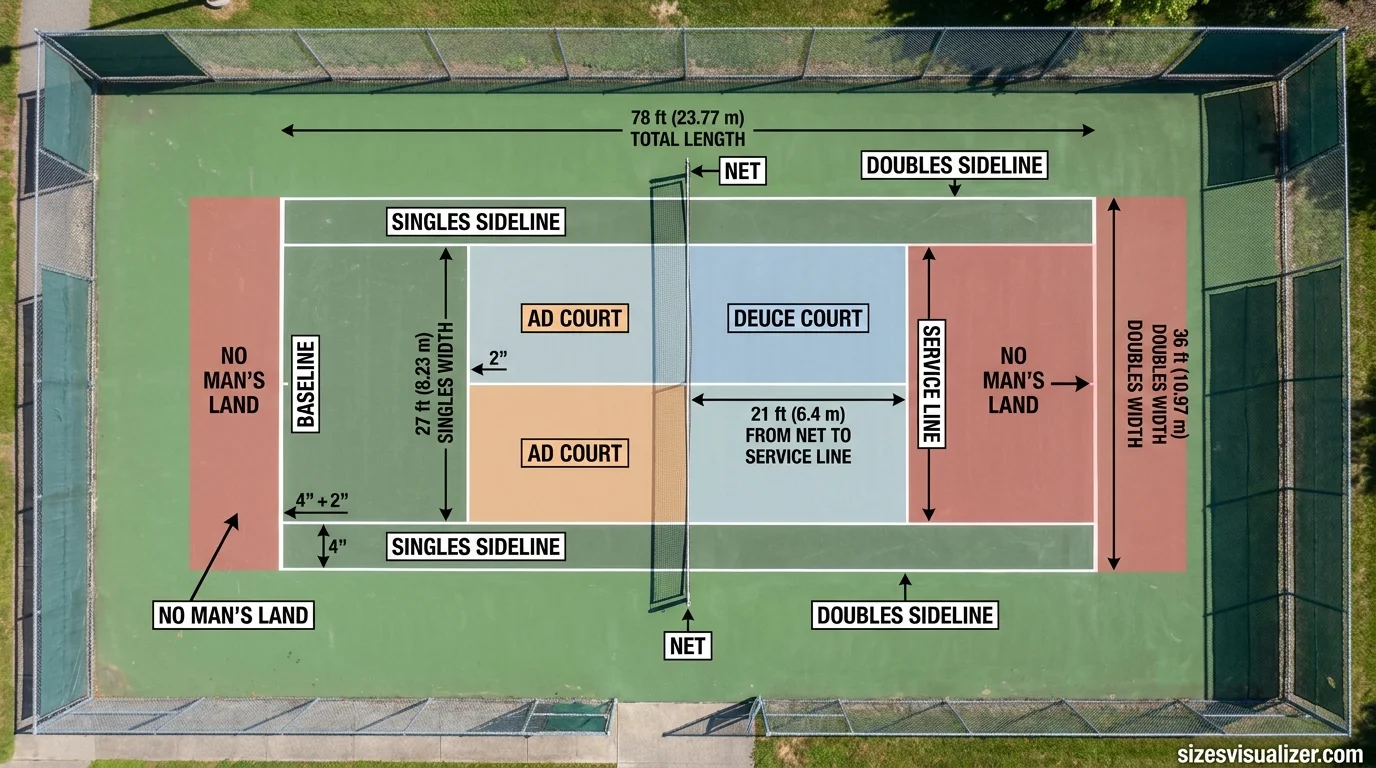
A tennis court isn’t just a rectangle — it’s divided into functional zones that decide where a ball must land to stay in play.
The baseline marks the back edge of the court, where players stand to serve and return. Down each side, the sidelines define the singles or doubles boundary, depending on which game is being played.
Closer to the net, you’ll find the service boxes — split into the deuce court and the ad court. These names trace back to old scoring terms: when the score is tied (deuce), players serve to the deuce court; when it’s advantage (ad), they serve to the ad court.
Between the service line and the baseline sits a stretch of court that coaches nicknamed “no man’s land.” It’s the toughest spot to stand during a rally — too far back to volley cleanly, too far forward to react to a passing shot.
Court markings matter too. Regulation lines must be at least 2 inches wide, while the baseline is a minimum of 4 inches wide — wide enough to be seen clearly by players and officials mid-rally.
Space Requirements: Indoor Courts, Clearance, and Surfaces
A regulation court needs far more room than its playing lines suggest. Players chase down wide shots and overhead lobs, so clearance space around the court isn’t optional — it’s part of the design.
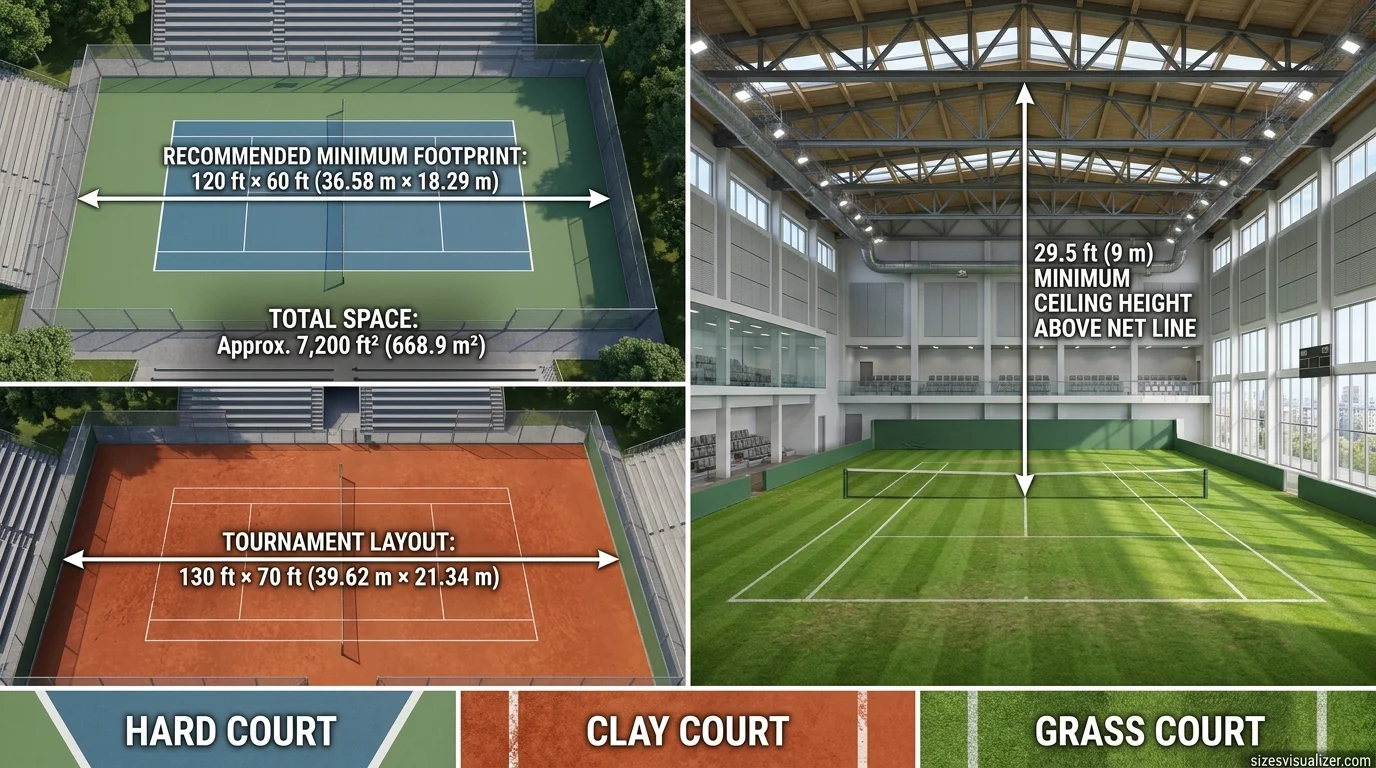
At minimum, a court needs about 120 feet by 60 feet (36.58 m x 18.29 m) of total space, covering roughly 7,200 ft² (668.9 m²). Tournament venues go bigger — closer to 130 feet by 70 feet (39.62 m x 21.34 m) — to leave room for umpires, ball crews, and player overrun during fast points.
Indoor tennis courts need extra vertical space too. Lobs and overhead smashes fly high, so most indoor facilities build ceilings to a minimum height of 29.5 feet (9 m) above the net line, giving shots plenty of room to clear without clipping the roof.
Surface choice changes how the game plays out, and each has its own personality:
- Hard courts — consistent bounce, low maintenance, common across most of the United States
- Clay courts — slower pace, higher bounce, popular in Europe and at the French Open
- Grass courts — fastest surface, low bounce, the signature surface of Wimbledon
None of these change the court’s dimensions. A hard court and a clay court follow the exact same size rules — only the surface material and how the ball reacts to it differ.
Must Visit: How Big Is a Soccer Field? Dimensions, Size & Field Measurements
Tennis Court Size vs. Wimbledon, Pickleball, and Padel
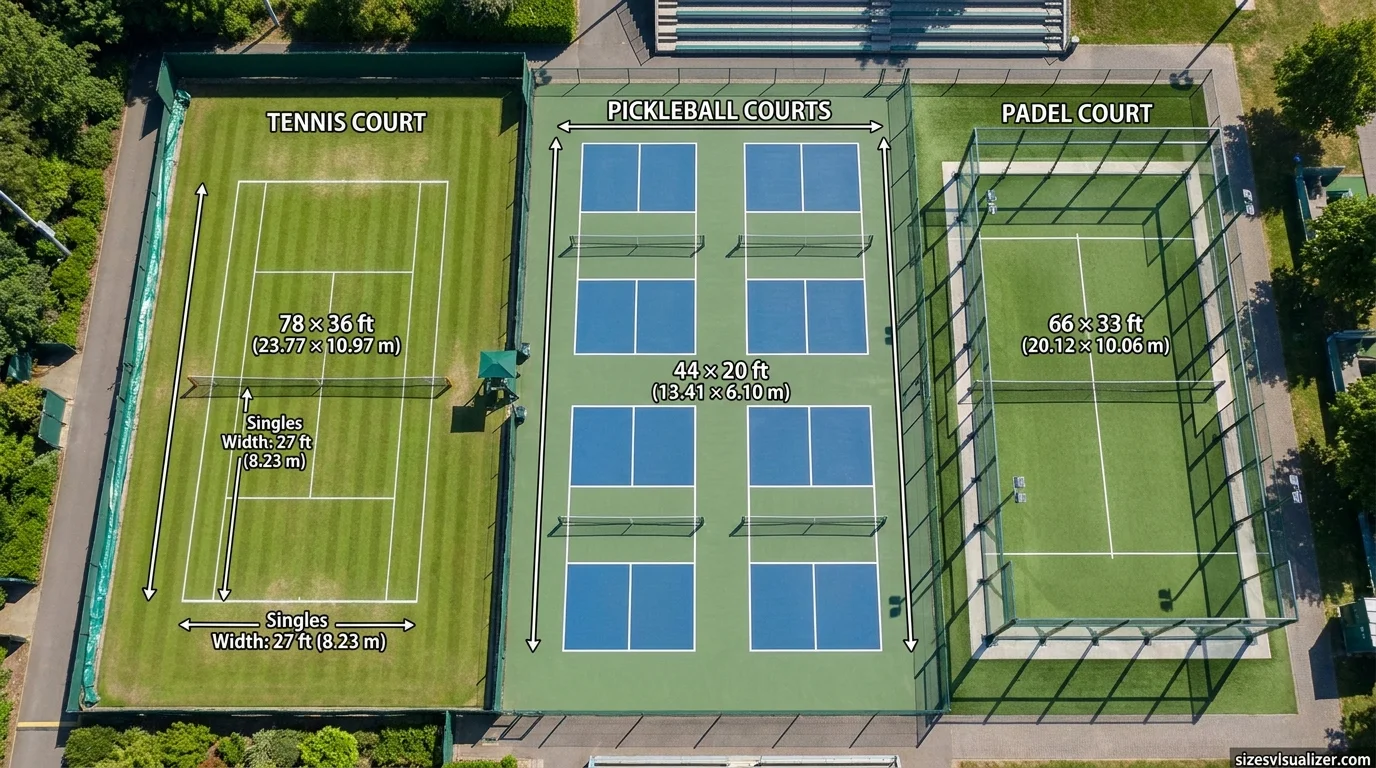
Compare that to two sports growing fast across American backyards and clubs:
Pickleball courts run much smaller — just 44 feet by 20 feet, small enough that four pickleball courts fit inside a single tennis court. That’s a major reason pickleball has exploded in popularity: existing tennis courts convert easily, without needing new land.
Padel courts sit in between — 66 feet by 33 feet, and fully enclosed by walls and glass. That enclosure changes strategy entirely, since the ball can rebound off the walls and stay in play, something a tennis court’s open boundaries never allow.
And speaking of history — what is the oldest racket sport? Most historians point to real tennis (also called “royal tennis”), which dates back to 12th-century France. It was played indoors, off walls, using a solid ball and wooden rackets — a distant ancestor of the modern lawn tennis game played today.
How to Build a Tennis Wall at Home
How to build a tennis wall? A practice tennis wall is the fastest way to train without needing a full court or a partner.
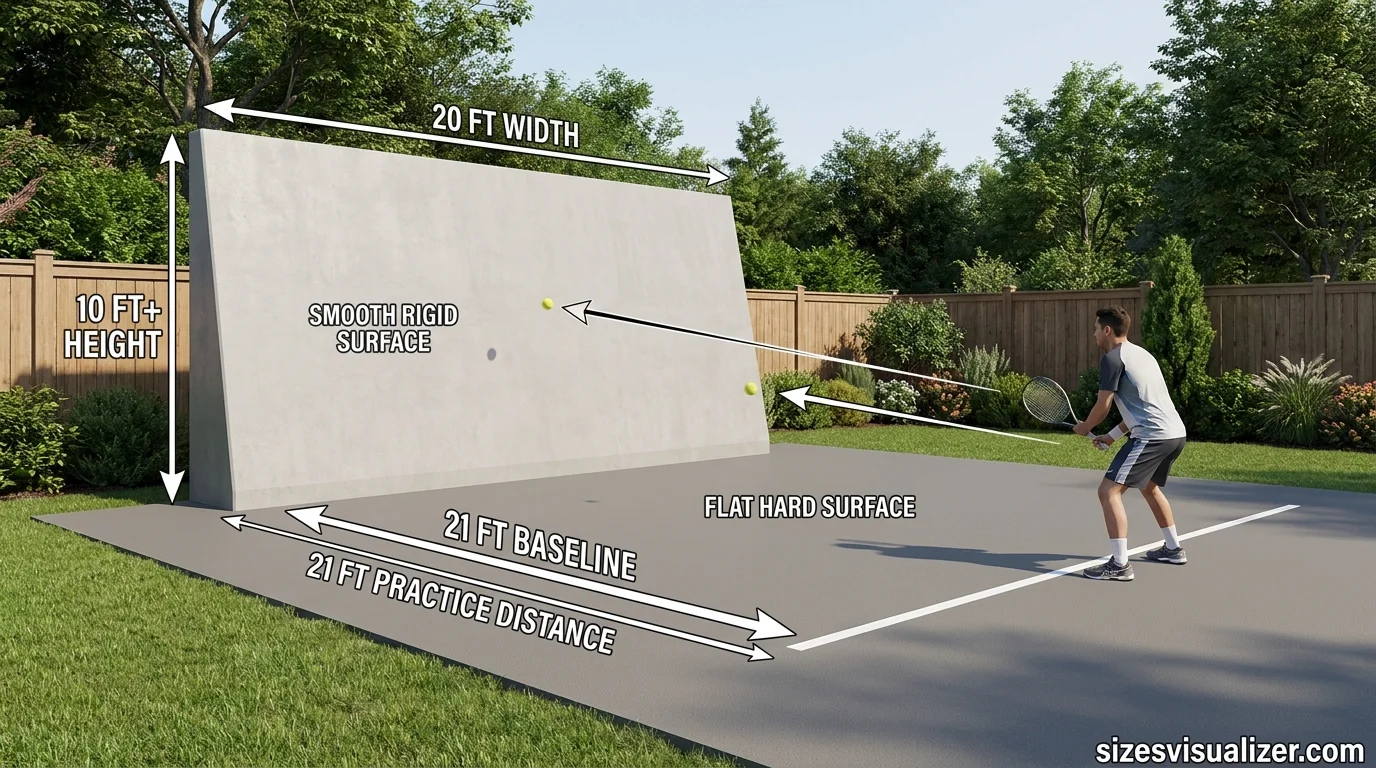
Here’s what matters most when building one:
- Height: at least 10 feet tall, so lobs and high shots stay in play
- Width: around 20 feet wide, wide enough to return angled shots
- Surface: smooth, rigid material — plywood, concrete, or a purpose-built rebound panel — angled slightly to control bounce
- Distance: set a baseline marker 21 feet from the wall to simulate real service-line depth
- Ground: a flat, hard surface underneath, matching the bounce of a real court
If you’re dreaming bigger — an actual backyard court — space is the real limiting factor. Building a regulation court, with proper clearance, typically requires at least 1.5 acres of land. Beyond that, check local zoning laws and HOA rules before pouring concrete, since many U.S. municipalities have specific setback and drainage requirements for outdoor sports surfaces.
FAQs
What is the size of a tennis court?
A standard tennis court is 78 feet (23.77 m) long. Width depends on the format: 27 feet (8.23 m) for singles, 36 feet (10.97 m) for doubles.
How many m² is a tennis court?
A doubles court covers 260.87 m² (2,808 ft²). A singles court covers about 195.65 m² (2,106 ft²).
Is the Wimbledon court smaller?
No. Wimbledon’s Centre Court uses the same regulation 78 x 36-foot dimensions as any other tennis court. It only appears smaller on camera.
What is the oldest racket sport?
Real tennis, dating back to 12th-century France, is widely considered the oldest racket sport and the direct ancestor of modern tennis.
How to build a tennis wall?
Build a smooth, rigid wall at least 10 feet high and 20 feet wide, set on a flat hard surface, with a baseline marked 21 feet away to mimic real court depth.
Conclusion
Every line on a tennis court exists for a reason — fairness, safety, and consistency across every level of play. Whether you’re sizing up a backyard project or just settling a debate about Wimbledon, these numbers stay the same everywhere the game is played.

Measurement Researcher, Size Comparison Writer & Content Specialist
Timmy Ahad is a dedicated content writer and research specialist at SizesVisualizer.com, where he focuses on creating accurate, easy-to-understand content about measurements, dimensions, size comparisons, and real-world object visualization.