You’re staring at a menu, trying to decide between sizes, and the question hits you: how big is a 16-inch pizza, really? Is it enough for two people, or too much? Will it feed the whole table?
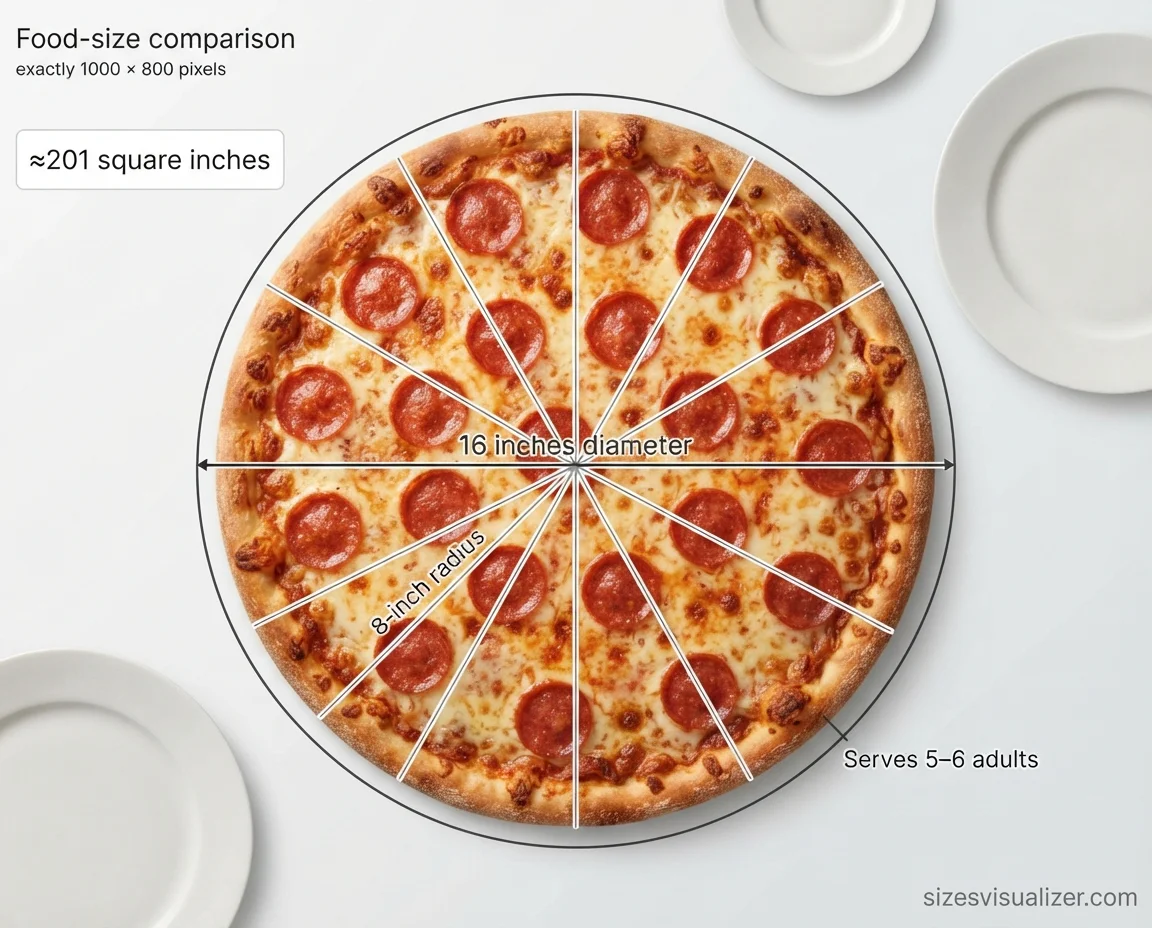
Here’s the short answer. A 16-inch pizza measures about 201 square inches, cuts into 10 to 12 slices, and comfortably feeds 5 to 6 adults. Below, we break down the size, the slice math, and how it stacks up against other pizza sizes — so your next order is exactly right.
Table of Contents
How Big Is a 16-Inch Pizza? Size, Diameter & Square Inches Explained
A 16-inch pizza is measured across its diameter — the straight line from one edge to the other, through the center. That gives it an 8-inch radius.
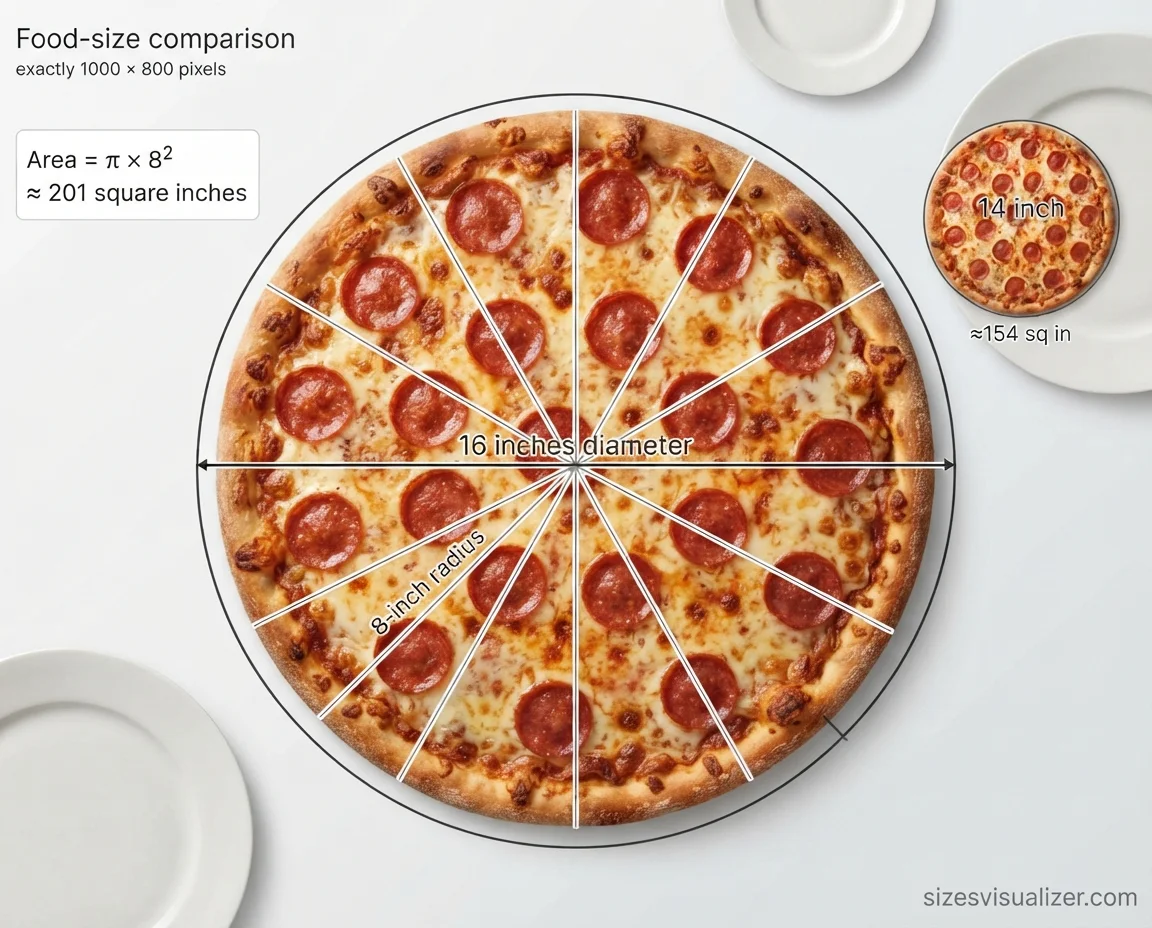
To find the actual eating surface, pizzerias (and mathematicians) use the circle area formula: π × radius². For a 16-inch pie, that works out to roughly 201 square inches of pizza.
Why does this matter? Because pizza size doesn’t grow in a straight line — it grows by area. A small jump in diameter creates a much bigger jump in food. Going from a 14-inch to a 16-inch pizza doesn’t just add “a little more.” It adds close to 31% more pizza, since you’re comparing circles, not squares.
Here’s how the 16-inch pizza size compares to its neighbors:
| Diameter | Radius | Area (sq inches) | Compared to 14″ |
|---|---|---|---|
| 10 inches | 5″ | ~79 sq in | 49% less |
| 12 inches | 6″ | ~113 sq in | 27% less |
| 14 inches | 7″ | ~154 sq in | baseline |
| 16 inches | 8″ | ~201 sq in | +31% more |
| 18 inches | 9″ | ~254 sq in | +65% more |
Picture it this way: 201 square inches is roughly the surface of a large stovetop burner, or a medium skateboard deck laid flat. It’s a genuinely large pie — big enough that most chains classify it as extra-large, not just “large.”
Want to see how big or small something really is? Use our Size Visualizer & Comparison Tool to compare measurements with familiar real-world objects.
How Many Slices Are in a 16-Inch Pizza?
Here’s a question almost everyone asks before ordering: how many slices are in a 16-inch pizza?
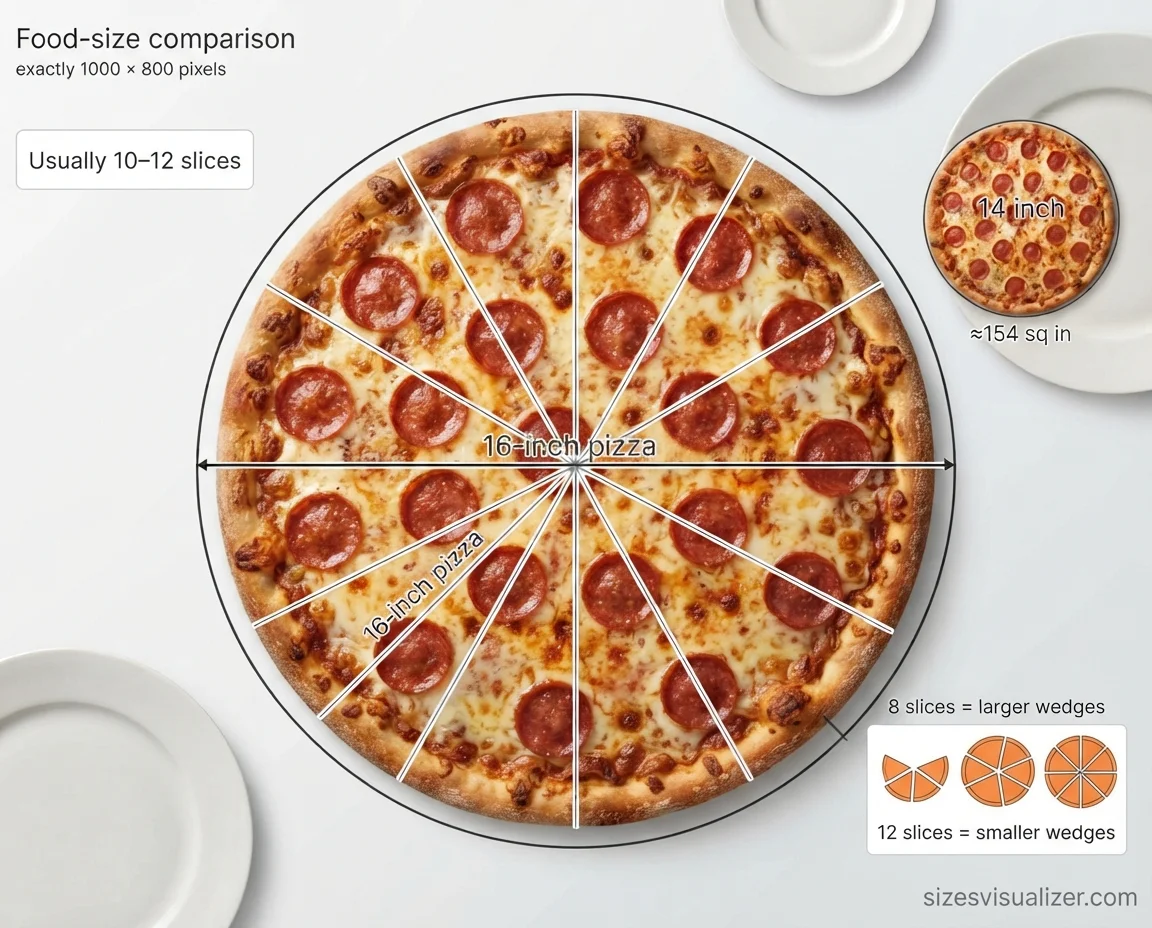
Most pizzerias cut a 16-inch pizza into 8, 10, or 12 slices. There’s no single industry standard — the number depends on the cutting style and the shop’s own habits.
- Triangle cut (classic wedge): The most common style. Usually yields 8 to 10 slices, radiating from the center like spokes on a wheel.
- Party cut (square or tavern-style): Cut in a grid pattern instead of wedges. This style often produces 12 or more smaller pieces, popular for game nights and office lunches because it’s easier to grab-and-go.
- NY-style cut: Wider, floppier triangle slices, usually landing around 8 slices for a pie this size.
The cutting style isn’t just cosmetic — it changes how the pizza feels to eat. Twelve smaller slices spread further in a group setting, while 8 large wedges suit fewer people with bigger appetites. If you’re ordering for a party, it’s worth asking for a party cut specifically, since not every shop defaults to it.
How Many People Does a 16-Inch Pizza Feed?
This is the real question behind most pizza orders: how many people does a 16-inch pizza serve?
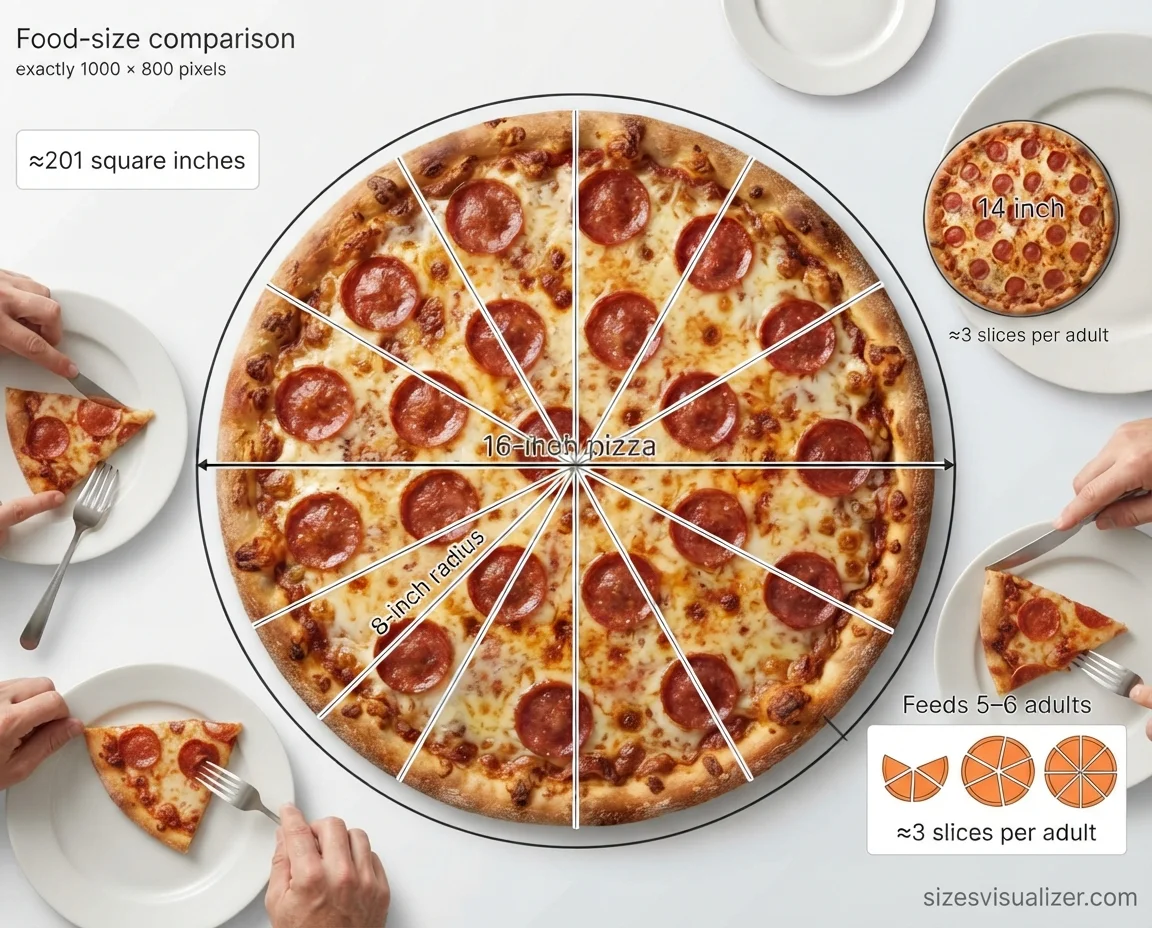
A widely used rule among pizzerias is 3 slices per adult and 2 slices per child. Using that math, a 16-inch pizza with 10–12 slices comfortably serves 5 to 6 adults.
Two adults eating 3 to 4 slices each use up 6 to 8 of the pizza’s 10 to 12 slices, leaving a couple of pieces for leftovers or a late-night snack. For two people with lighter appetites, it’s often more pizza than needed.
If you don’t want leftovers, a 12-inch to 14-inch pizza is usually the sweet spot for two average eaters. A 16-inch pie works too, especially if you want extra slices for later or you’re adding heavy toppings like meat and extra cheese, which make people feel full faster.
A few things shift these numbers:
- Crust thickness — thin crust feels lighter, so people tend to eat more slices. Thick or stuffed crust fills you up faster with fewer pieces.
- Toppings — a meat-heavy or supreme pizza goes further per slice than a plain cheese pizza, since protein and fat add satiety.
- Side dishes — wings, salad, or garlic bread on the table means fewer slices needed per person.
- Who’s eating — teenagers and hungry adults often eat 3 to 4 slices; younger kids usually stop at 1 to 2.
Must Visit: How Big Is a Pizza? Pizza Sizes, Dimensions, Square Inches & Price Guide
16-Inch Pizza vs Other Sizes: Is It Large or Extra-Large?
Here’s the side-by-side:
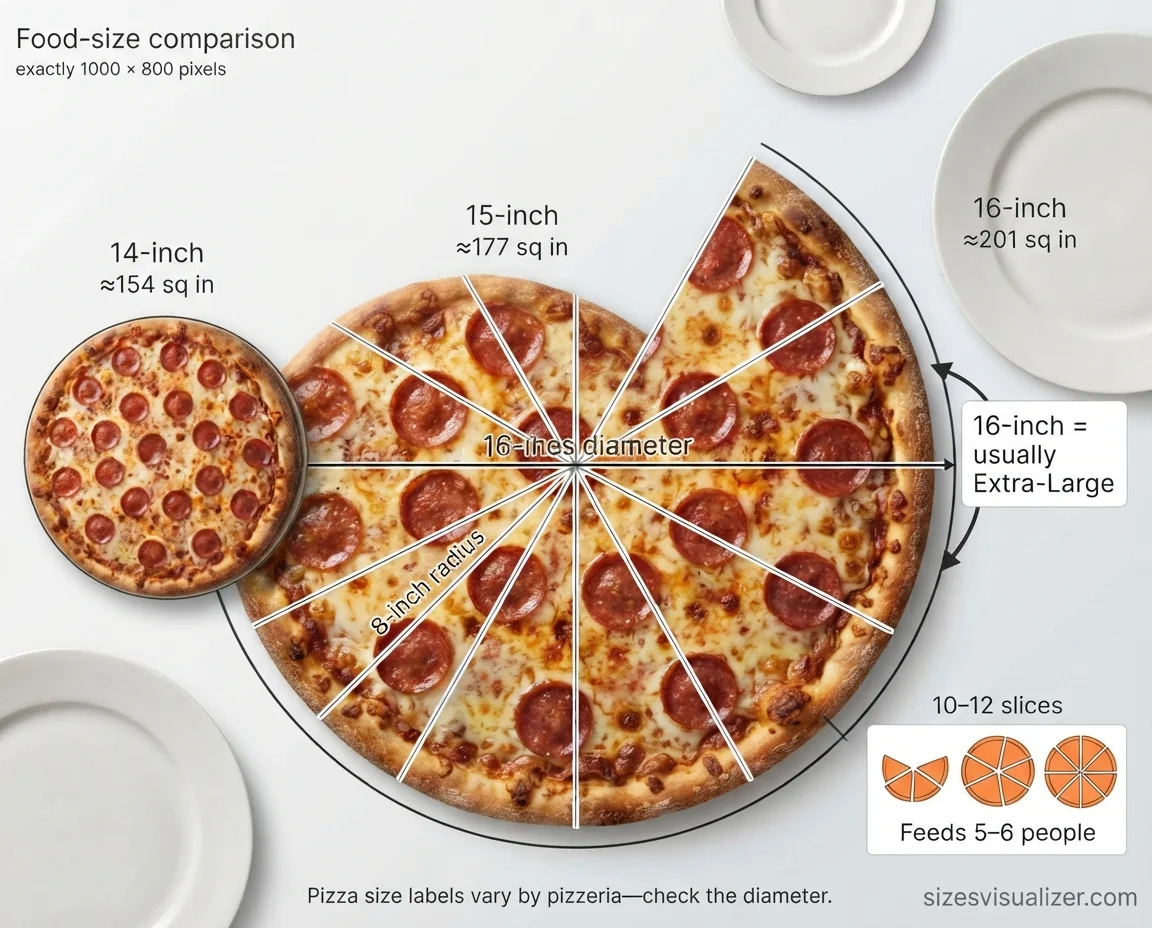
| Size | Area (sq in) | Typical Slices | Best For |
|---|---|---|---|
| 15 inches | ~177 sq in | 8–10 slices | 2–4 people |
| 16 inches | ~201 sq in | 10–12 slices | 5–6 people |
The takeaway: don’t rely on the words “Large” or “Extra-Large” alone. Two pizzas with the same label can differ by several inches depending on where you order.
FAQs
What size pizza for 2 adults?
A 12-inch to 14-inch pizza is usually enough for 2 adults without heavy leftovers. A 16-inch pizza also works well if you want extra slices to save for later, especially with lighter toppings.
Is a 16 pizza enough for 2 people?
Yes. With 10 to 12 slices on a 16-inch pizza, two people eating 3 to 4 slices each will be full, and there’s typically pizza left over.
Is a 15-inch pizza big enough for 2 people?
Yes. A 15-inch pizza offers about 177 square inches of pizza and 8 to 10 slices — plenty for two adults, with only a small size difference from a 16-inch pie.
Is a large pizza 12 or 16 inches?
Neither, typically. Most chains define “Large” as 14 inches. A 16-inch pizza is usually labeled “Extra-Large,” though sizing names vary by pizzeria, so it’s best to check the exact diameter before ordering.
Conclusion
A 16-inch pizza delivers about 201 square inches of food, splits into 10 to 12 slices, and feeds 5 to 6 people comfortably — or 2 people generously, with leftovers to spare. Slice count, crust style, and toppings all shape how far it stretches. When menus use fuzzy labels like “Large” or “Extra-Large,” the diameter in inches is the number that actually tells you what you’re getting.

Measurement Researcher, Size Comparison Writer & Content Specialist
Timmy Ahad is a dedicated content writer and research specialist at SizesVisualizer.com, where he focuses on creating accurate, easy-to-understand content about measurements, dimensions, size comparisons, and real-world object visualization.