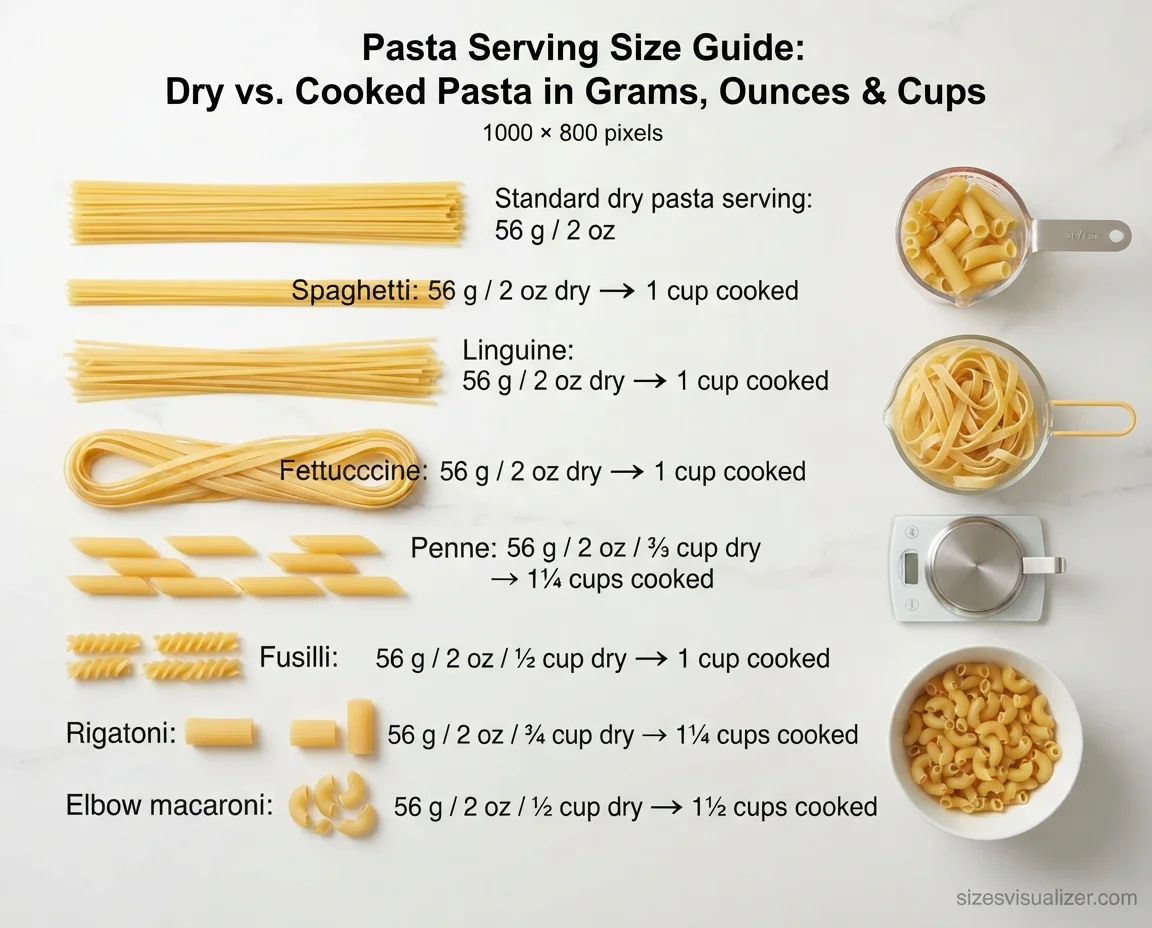
Ever cook pasta “by eye” and end up with way too much — or not enough? You’re not alone. Getting your pasta serving size right just takes the correct numbers, in the units you actually use.
This guide breaks down the exact pasta portion size in grams, ounces, and cups, for every shape, every diet, and every group size.
Table of Contents
What Is a Standard Pasta Serving Size?
A standard pasta serving size is 2 ounces (about 56 grams) of dry pasta per person. This is the number printed on most nutrition labels in the United States, and it’s the figure the USDA uses as its baseline grain serving once adjusted for pasta’s density.
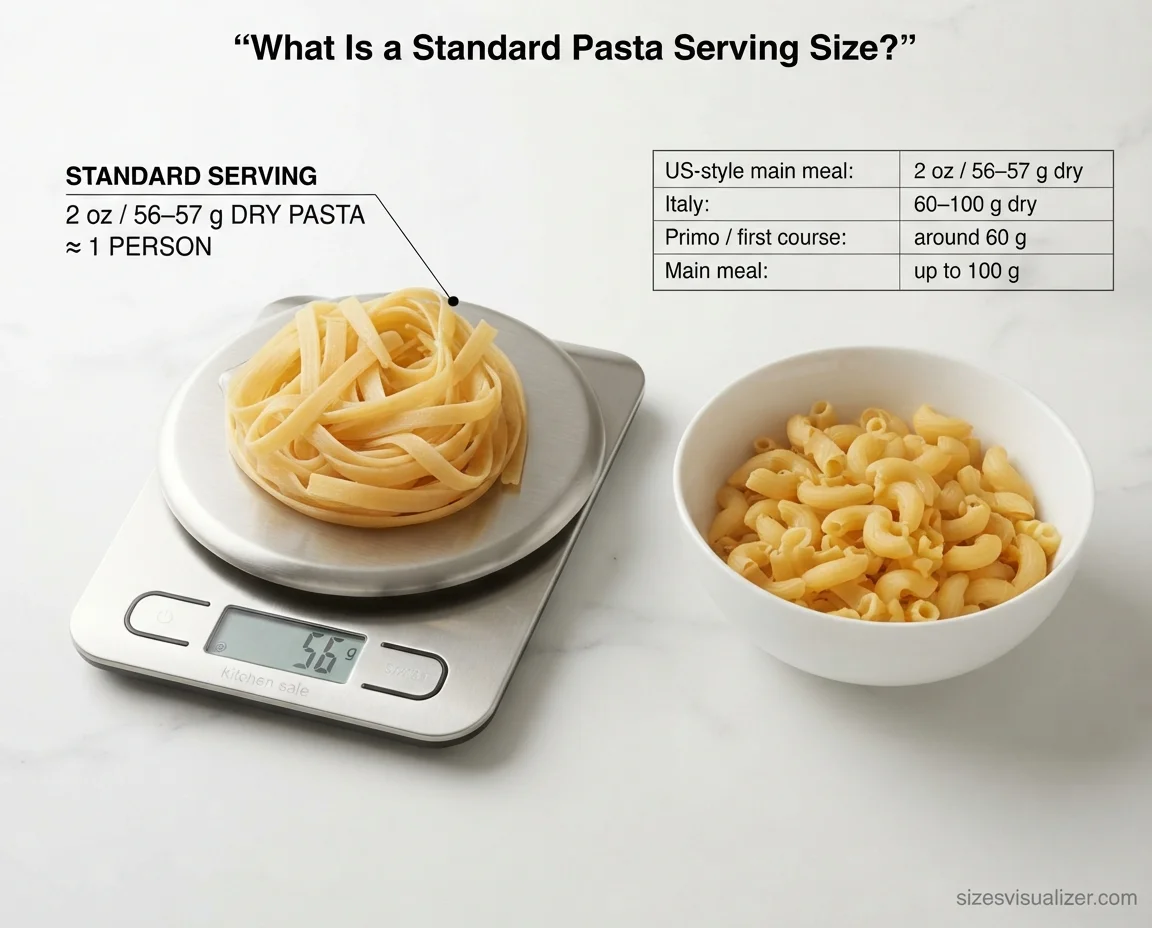
Here’s the catch: the USDA’s official “1 ounce” grain serving is technically too small to be practical. One ounce of dry pasta cooks down to just half a cup — not much of a meal. That’s why 2 ounces dry has become the real-world standard nutritionists and pasta brands actually recommend.
Italy uses a slightly wider range: 60 to 100 grams of dry pasta per person. The lower end applies when pasta is served as a primo, or first course, ahead of a meat or vegetable secondo. The higher end — closer to the US standard — applies when pasta is the entire meal, which is how most Americans eat it.
So which number should you use? If pasta is your main dish, 2 ounces (56–57g) per person is your safest, most accurate baseline. If you’re serving a smaller, appetizer-style portion, drop down toward 60 grams.
Our advanced Size Visualizer & Comparison Tool helps you explore accurate size relationships, compare objects side by side, and make measurements easy to understand.
Dry Pasta to Cooked Pasta Conversion Chart (Grams, Ounces & Cups)
Not all pasta shapes cook up the same. A 2-ounce dry pasta serving might fill a full measuring cup for one shape and barely half a cup for another. Density, shape, and how much water each noodle absorbs all change the math.
Below is a complete conversion chart covering grams, ounces, and cups together — something most pasta guides skip, since they usually give you only one unit at a time.
Long Pasta Serving Size (Spaghetti, Linguine, Fettuccine)
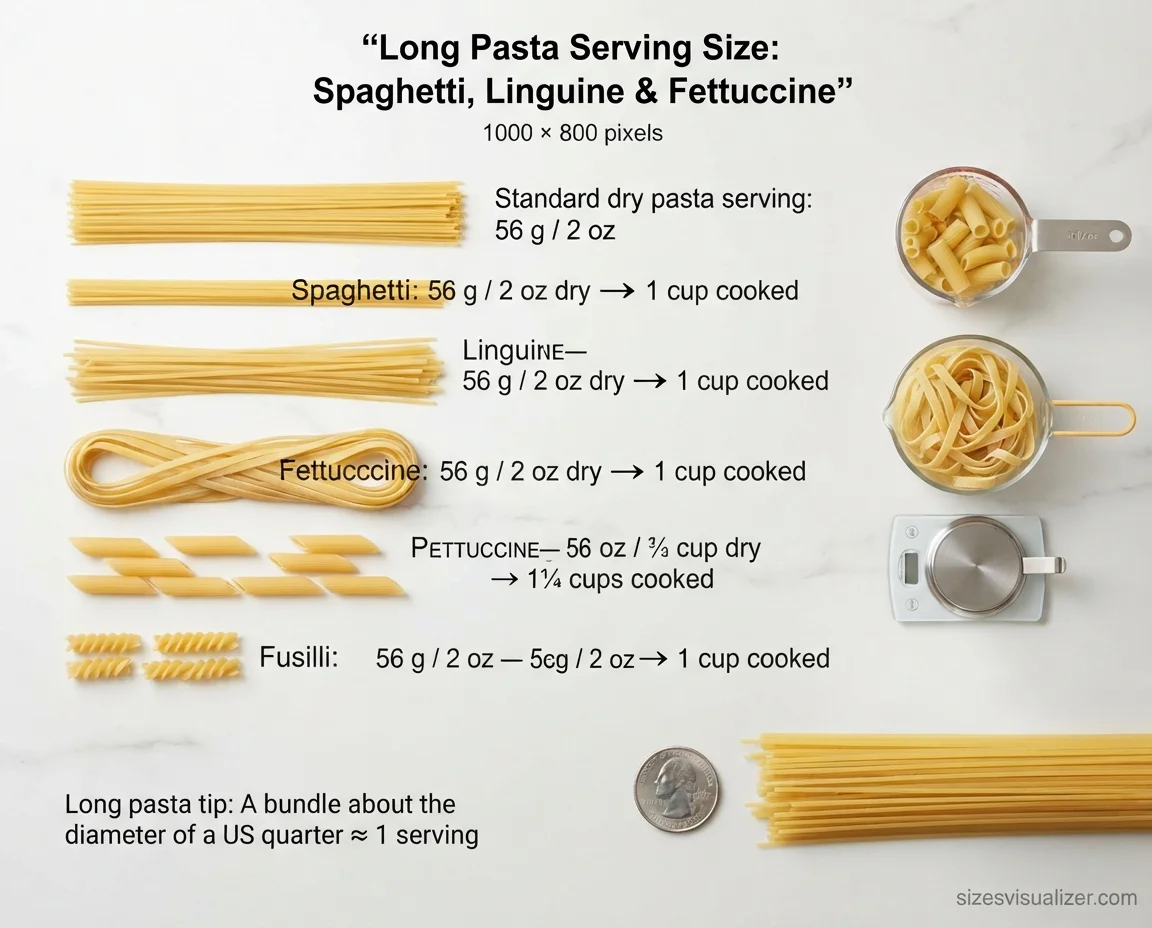
| Pasta Shape | Dry Serving | Cooked Yield |
|---|---|---|
| Spaghetti | 56g / 2 oz | 1 cup cooked |
| Linguine | 56g / 2 oz | 1 cup cooked |
| Fettuccine | 56g / 2 oz | 1 cup cooked |
| Angel Hair / Capellini | 56g / 2 oz | 1 cup cooked |
| Bucatini | 56g / 2 oz | 1 cup cooked |
Handy tip: since long noodles are awkward to measure by cup, gather the dry strands in your fist. A bundle roughly the width of a US quarter equals one serving.
Short Pasta Serving Size (Penne, Fusilli, Rigatoni, Rotini)
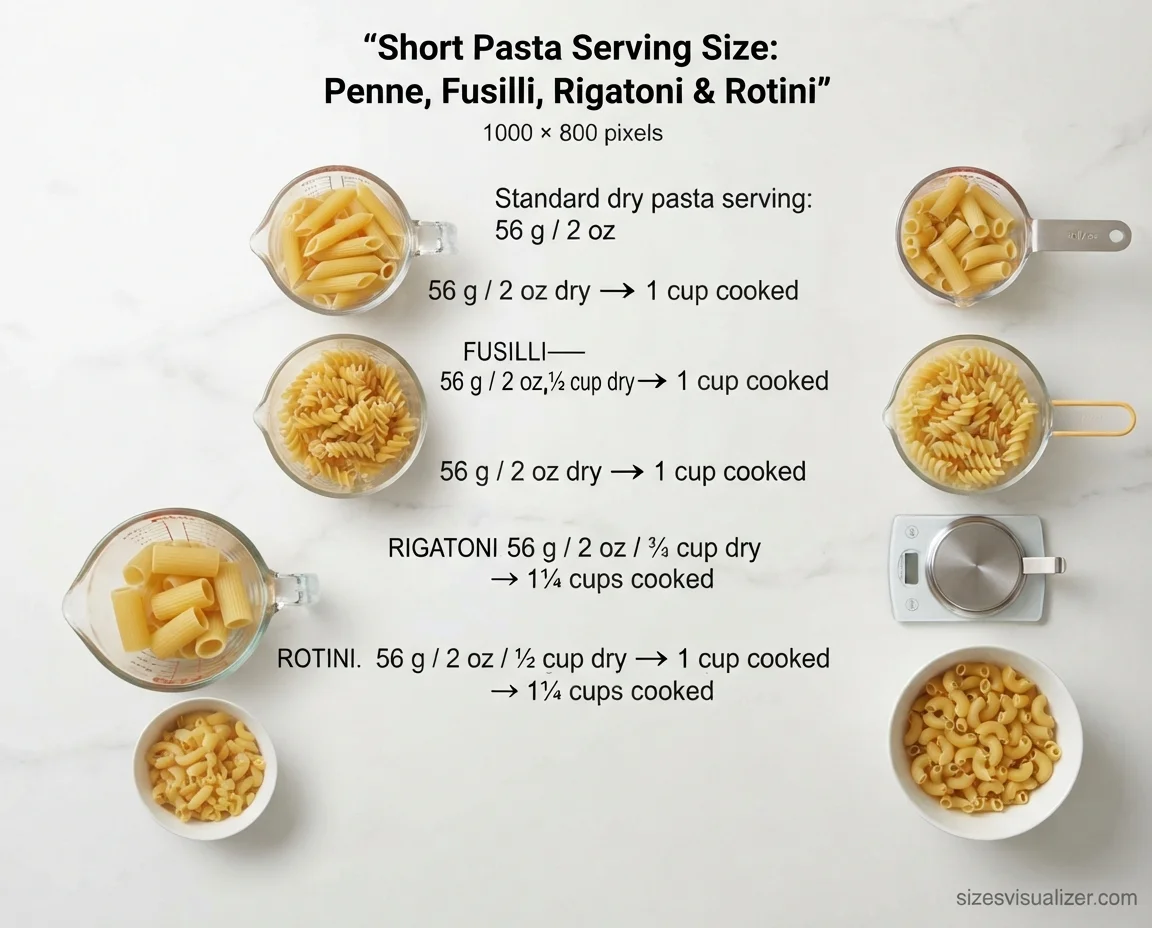
| Pasta Shape | Dry Serving | Cooked Yield |
|---|---|---|
| Penne | 56g / 2 oz (2/3 cup dry) | 1¼ cups cooked |
| Fusilli | 56g / 2 oz (½ cup dry) | 1 cup cooked |
| Rigatoni | 56g / 2 oz (¾ cup dry) | 1¼ cups cooked |
| Rotini | 56g / 2 oz (½ cup dry) | 1 cup cooked |
| Elbow Macaroni | 56g / 2 oz (½ cup dry) | 1½ cups cooked |
| Farfalle (Bowtie) | 56g / 2 oz (¾ cup dry) | 1¼ cups cooked |
| Medium Shells | 56g / 2 oz (¾ cup dry) | 1⅛ cups cooked |
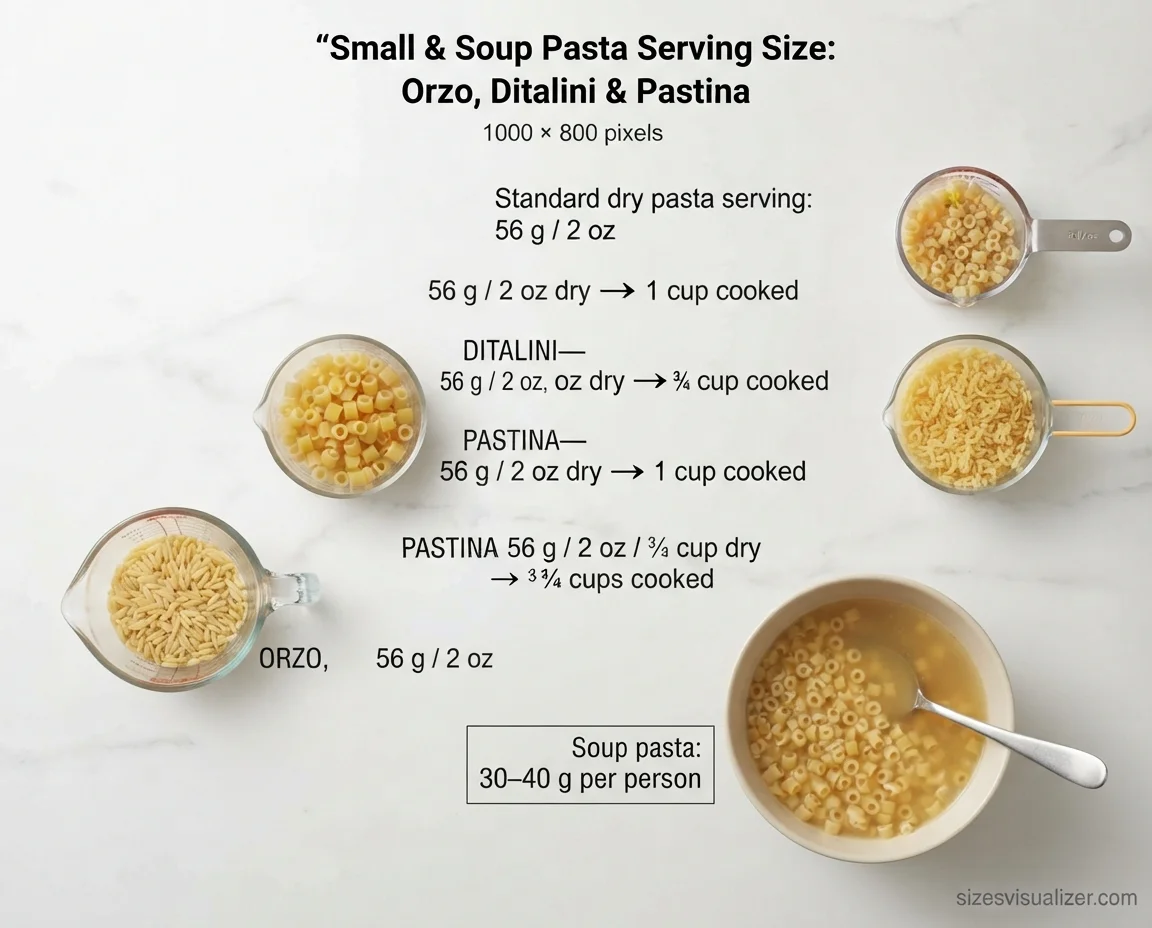
Small & Soup Pasta Serving Size (Orzo, Ditalini, Pastina)
| Pasta Shape | Dry Serving | Cooked Yield |
|---|---|---|
| Orzo | 56g / 2 oz (⅓ cup dry) | ⅘ cup cooked |
| Ditalini | 56g / 2 oz (⅓ cup dry) | ¾ cup cooked |
| Pastina | 56g / 2 oz (⅓ cup dry) | ¾ cup cooked |
For soup pasta specifically, 30 to 40 grams per person is usually enough, since it’s a supporting ingredient rather than the main event.
Filled & Fresh Pasta Serving Size (Ravioli, Tortellini, Gnocchi)
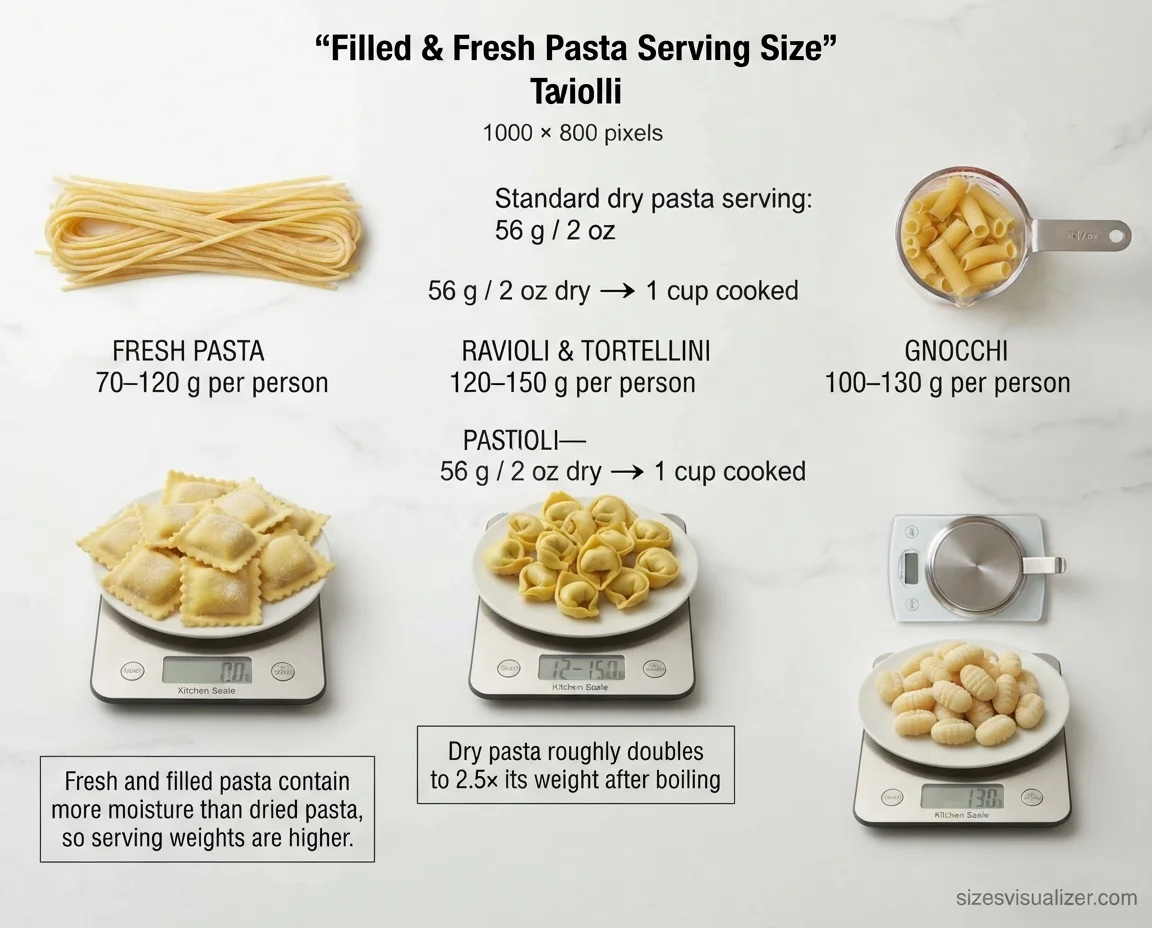
Fresh and filled pasta hold more water in the dough itself, so their serving sizes run higher than dry pasta:
- Fresh pasta: 70–120 grams per person
- Filled pasta (ravioli, tortellini): 120–150 grams per person
- Gnocchi: 100–130 grams per person
Why the bump? Fresh pasta is denser and hasn’t lost moisture through drying, so gram-for-gram, it delivers less bulk than dry pasta once cooked. You need more raw weight to end up with the same-size bowl.
As a rule of thumb, dry pasta roughly doubles to 2.5 times its weight once boiled, thanks to water absorption. That single fact explains almost every number in this chart.
How to Measure a Pasta Serving Without a Kitchen Scale
Not everyone owns a food scale, and that’s fine. Here are three reliable, tool-light methods.
The quarter-size handful method
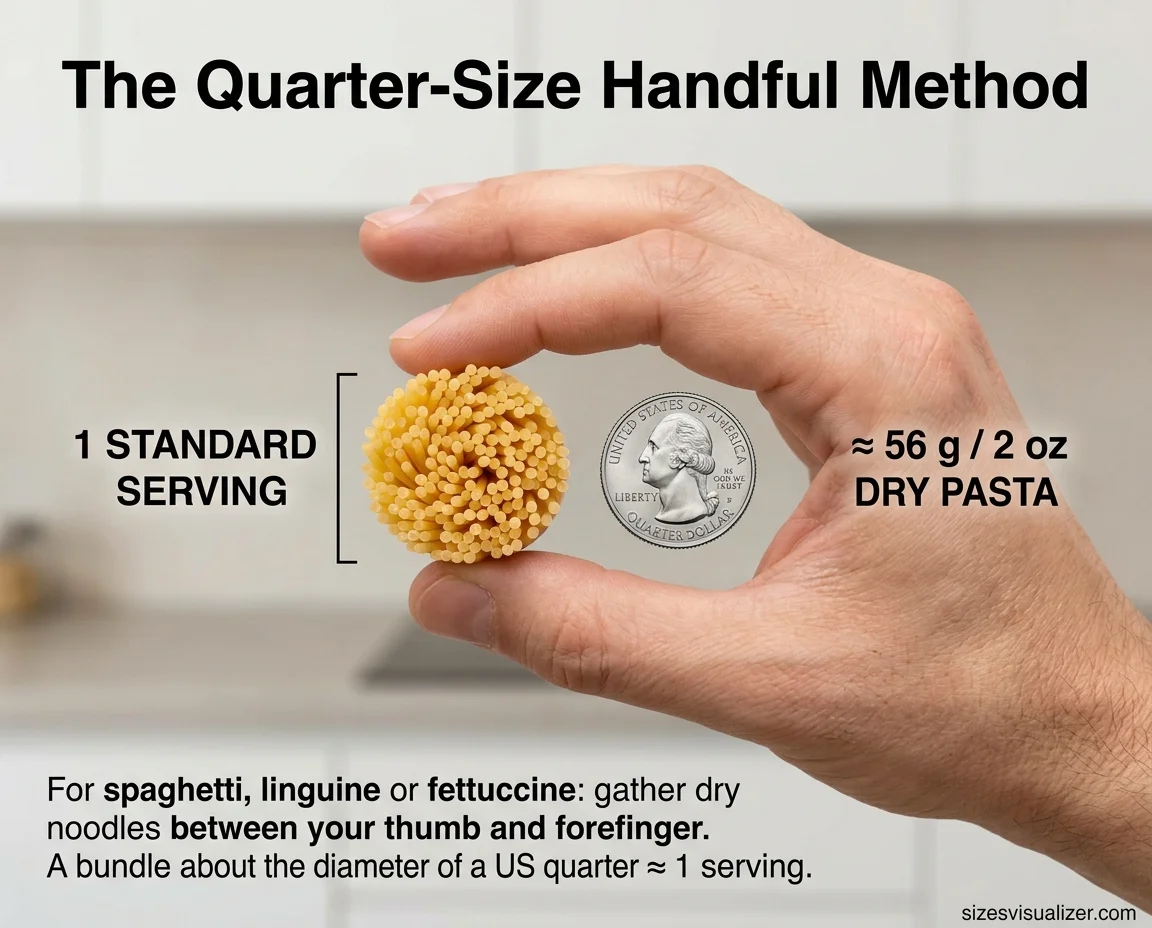
Grab a bunch of long pasta — spaghetti, linguine, fettuccine — between your thumb and forefinger. If the bundle is about the diameter of a US quarter, you’ve got roughly one 2-ounce serving.
The measuring cup method
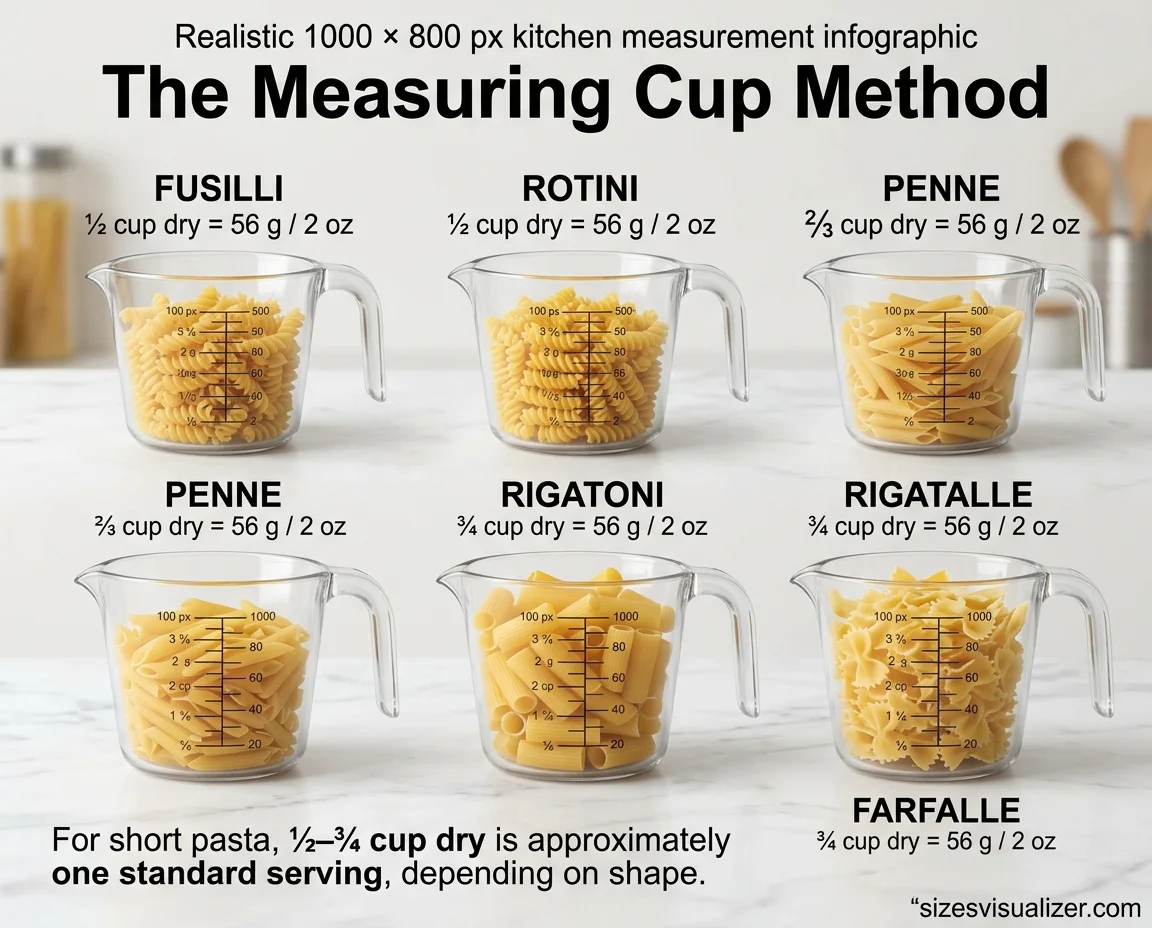
For short pasta shapes, a standard ½-cup to ¾-cup of dry pasta lines up closely with a single serving, depending on the shape (see the chart above for exact figures).
The plate and palm method
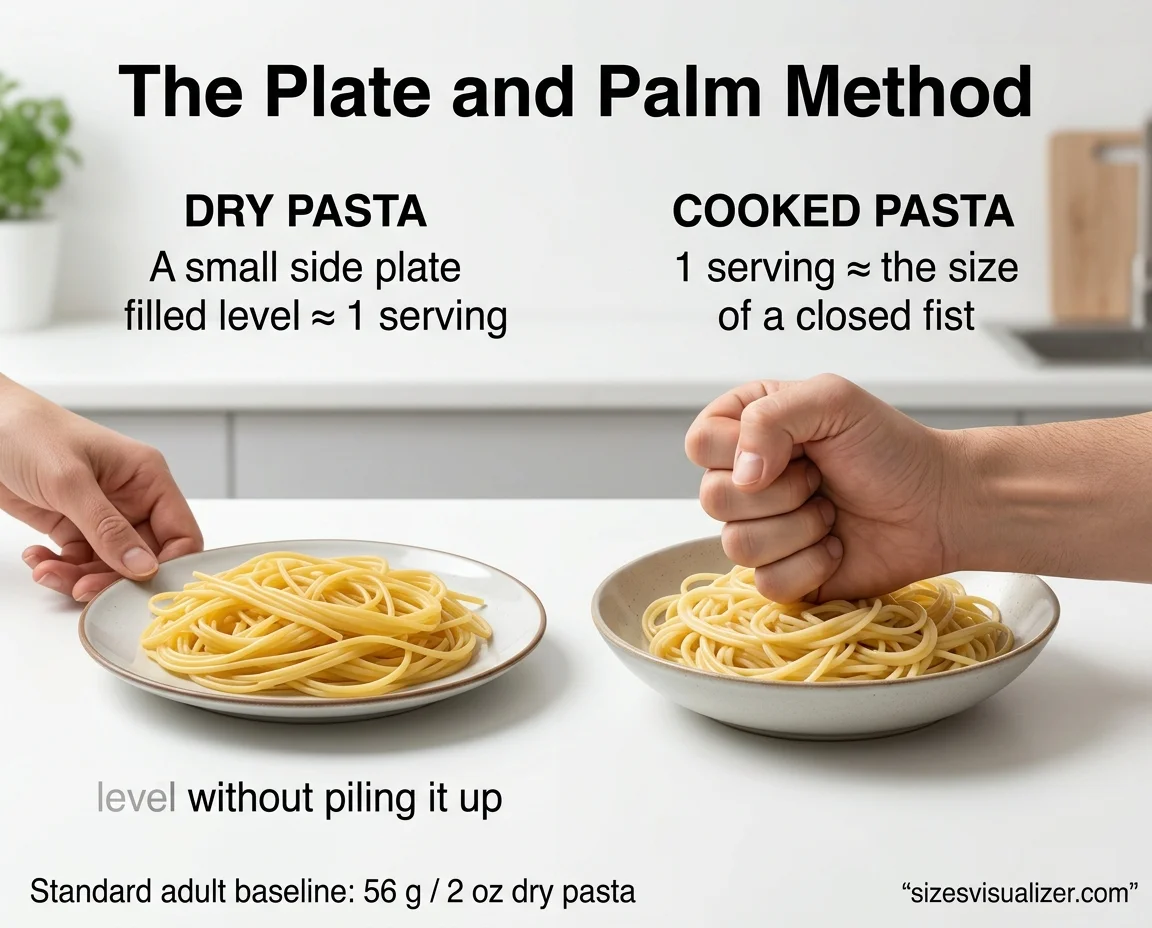
Fill a small side plate — not a large dinner plate — level with dry pasta, without piling it up. That roughly matches one serving. As a visual cue, a serving of cooked pasta is about the size of a closed fist.
Scaling for groups is simple math. Multiply the per-person amount by your headcount:
- 2 people: 112g / 4 oz
- 4 people: 224g / 8 oz
- 5 people: 280g / 10 oz
- 6 people: 336g / 12 oz
A standard 1-pound (16 oz) box of pasta serves about 8 people at the 2-ounce standard, or 5 to 6 people at a more generous 80–100g serving.
Must visit: How Many Grams in 1 Cup of Cooked Rice? Exact Weight, Calories & Easy Conversions
Pasta Portion Sizes by Diet, Age & Goal
The “right” serving size isn’t fixed. It shifts depending on who’s eating and why.
Pasta serving size for kids vs. adults

Children generally need 50 to 70 grams (about 1.5–2.5 oz) of dry pasta, roughly two-thirds of the adult amount. Portion size should scale with age and appetite, not follow a rigid rule.
Pasta portions for weight loss or low-carb diets

A 2-ounce (56g) dry serving of most pasta contains around 200 calories and roughly 42 grams of carbohydrate, according to USDA FoodData Central. If you’re watching carb intake, sticking to the standard serving — rather than a “restaurant-size” bowl, which can run 4 ounces or more — makes a measurable difference. Pairing pasta with protein and vegetables also helps balance the meal without needing to shrink the noodles further.
Pasta servings for athletes and high-protein diets
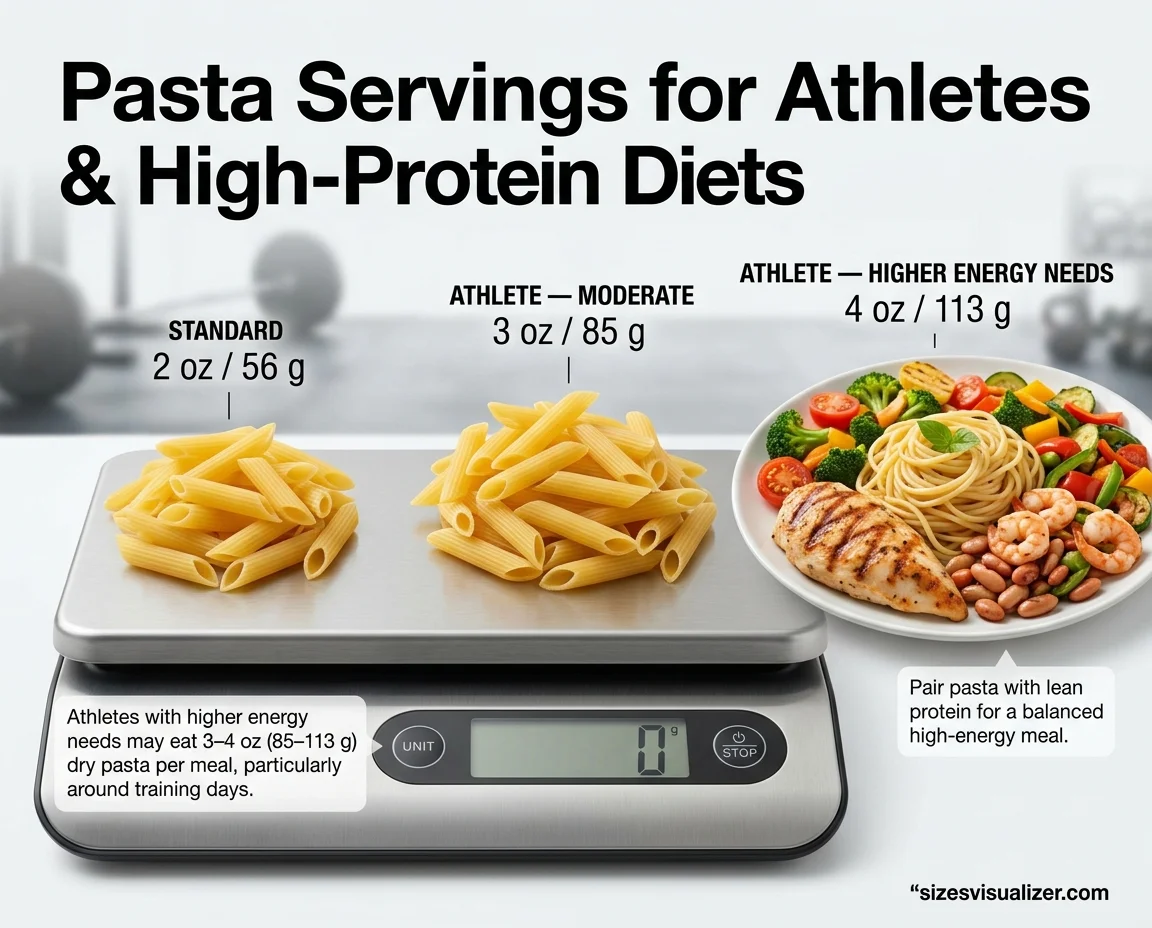
Athletes with higher energy needs sometimes eat 3 to 4 ounces (85–113g) dry pasta per meal to support glycogen stores, particularly around training days. Pairing that larger portion with a lean protein source like chicken, shrimp, or beans keeps the meal balanced rather than carb-heavy alone.
Whatever your goal, the same 2-ounce dry pasta baseline is your starting point — you’re just scaling it up or down from there.
FAQs
Is 200g pasta too much for one person?
Yes, for most adults. 200g of dry pasta is roughly 3.5 standard servings — enough for two to three people at the typical 2-ounce (56g) benchmark, not one.
Is 100g of pasta too much?
Not really. 100g sits close to the Italian main-meal guideline (80–100g) and is a generous single serving, especially if pasta is your entire meal rather than a side dish.
Is 400g pasta enough for 5 people?
It’s on the lighter side. 400g works out to 80g per person, which fits the Italian guideline but falls a bit under the fuller 2-ounce (56–57g x 5 = 280–285g minimum, or up to 500g at 100g each) US-style serving. For a filling, main-dish portion, 500g for 5 people is safer.
Is 50g of pasta a lot?
No. 50g of dry pasta is a modest, appetizer-size portion, close to a small child’s serving and below the standard 56–100g adult range.
How much pasta is too much in a day?
There’s no single fixed limit, but eating well beyond 2 to 4 ounces of pasta in one sitting, especially repeatedly across a day, adds up in refined carbohydrates. Balance matters more than a strict cutoff — pairing pasta with vegetables, protein, and fiber keeps a meal in check even at generous portions.
What does 75g of cooked pasta weigh?
75g of cooked pasta is a smaller side-dish amount, roughly equivalent to about 30 grams of dry pasta, since pasta gains weight as it absorbs water during boiling.
Conclusion
The numbers don’t lie: 2 ounces (56 grams) of dry pasta per person is the most reliable baseline for a US-style main meal, with 60–100 grams covering the wider range used internationally.
Keep the conversion chart above handy, and you’ll never have to guess your pasta portions again.

Measurement Researcher, Size Comparison Writer & Content Specialist
Timmy Ahad is a dedicated content writer and research specialist at SizesVisualizer.com, where he focuses on creating accurate, easy-to-understand content about measurements, dimensions, size comparisons, and real-world object visualization.