Yellowstone National Park covers 2.2 million acres, making it one of the largest protected wild spaces in the United States. That’s 3,472 square miles of geysers, canyons, forests, and free-roaming wildlife — an area so big it spills across three states.
If you’re planning a trip, that size matters. It affects how long you’ll need, which entrance you should use, and how much ground you can realistically cover. Below, we break down exactly how big Yellowstone National Park is, what fits inside it, and how it stacks up against places you already know.
Table of Contents
How Big Is Yellowstone National Park? (Acres, Square Miles & Km²)
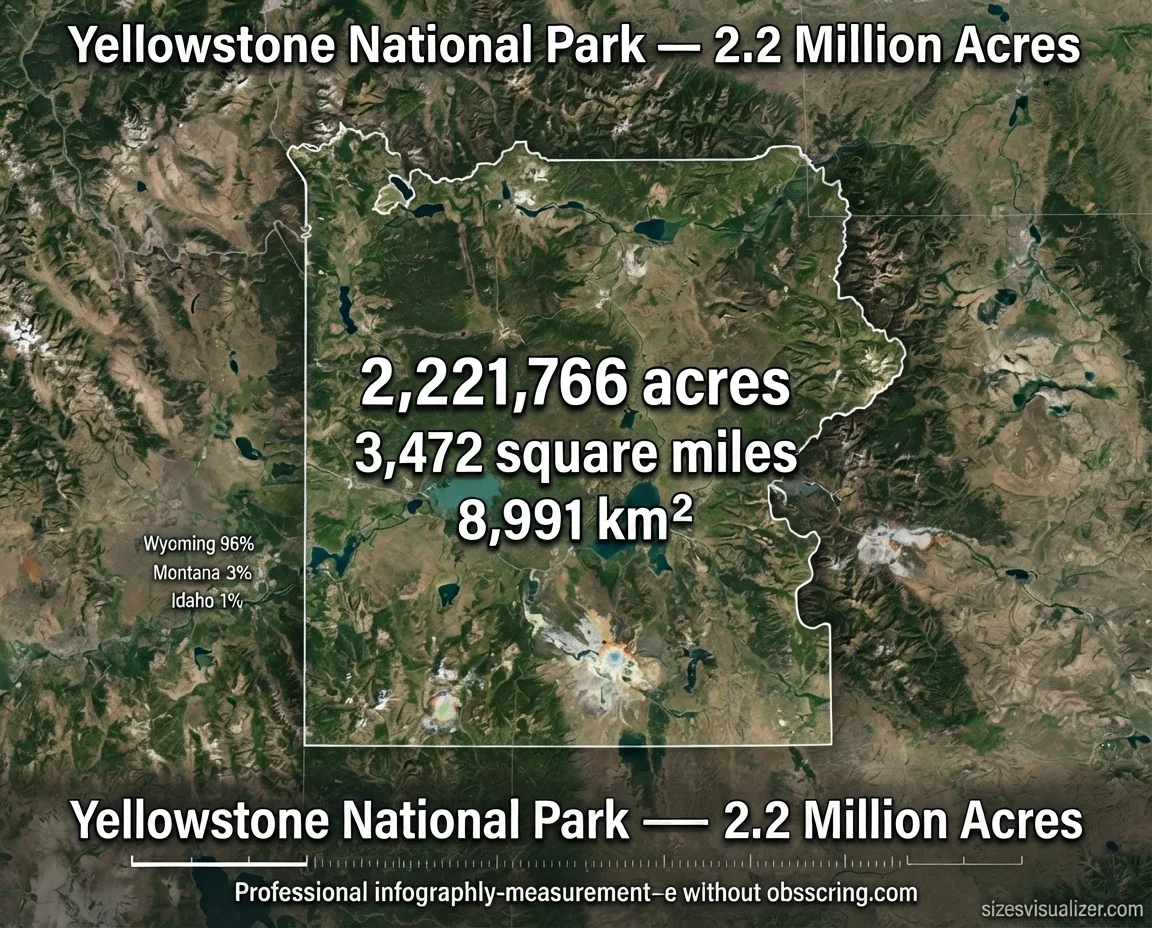
How big is Yellowstone National Park in hard numbers? Here’s the breakdown:
- 2,221,766 acres
- 3,472 square miles
- 8,991 square kilometers
That makes Yellowstone roughly the same size as the state of Rhode Island, but with volcanic activity underneath it instead of city blocks on top.
Which states is Yellowstone National Park in? The park sits mostly in Wyoming, which holds 96% of the land. Montana covers about 3%, and Idaho takes up the remaining 1% (National Park Service). Most visitors enter through Wyoming, but the park’s boundaries genuinely stretch across all three states.
Measure objects with confidence using our Length Measurement Tool, designed for fast, convenient, and easy-to-understand length calculations.
Yellowstone Size Compared: Real-World Comparisons
Numbers like “3,472 square miles” are hard to picture. So let’s put Yellowstone’s size next to things you already understand.
Yellowstone vs. U.S. states
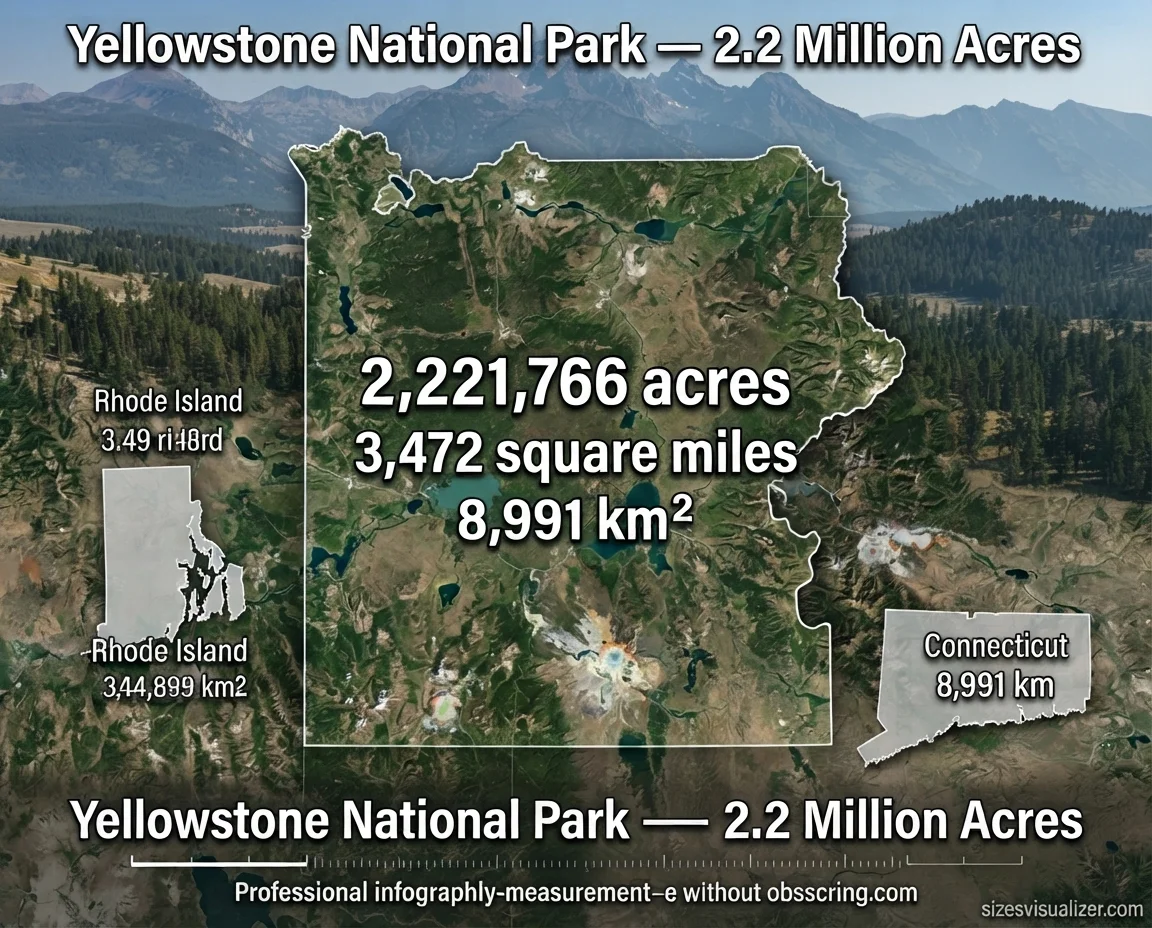
Yellowstone is bigger than Rhode Island and Delaware combined. It’s also larger than the entire state of Connecticut land area on its own.
Yellowstone vs. major cities
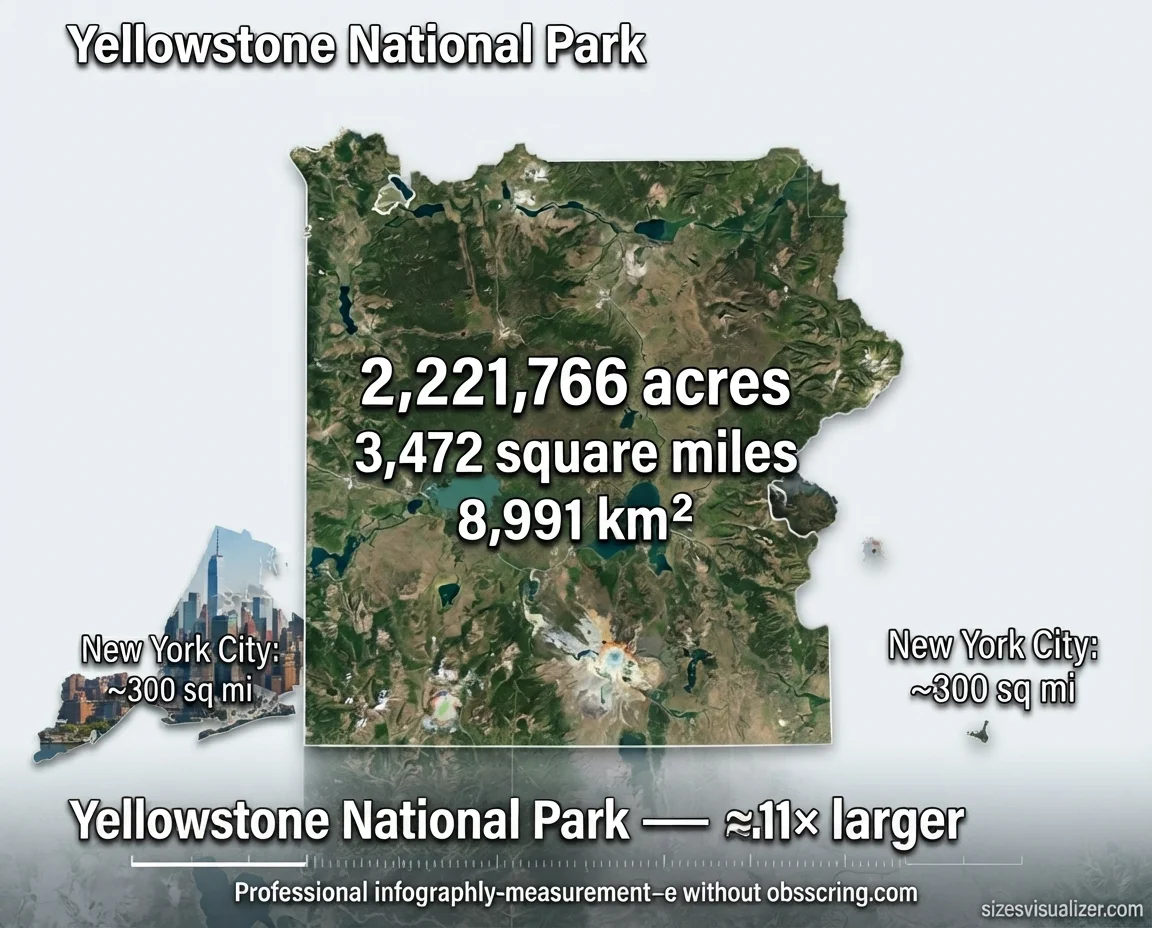
New York City’s five boroughs total about 300 square miles. Yellowstone is roughly 11 times bigger than all of NYC. Even the sprawling Los Angeles metro area doesn’t come close to matching Yellowstone’s footprint.
Yellowstone vs. countries
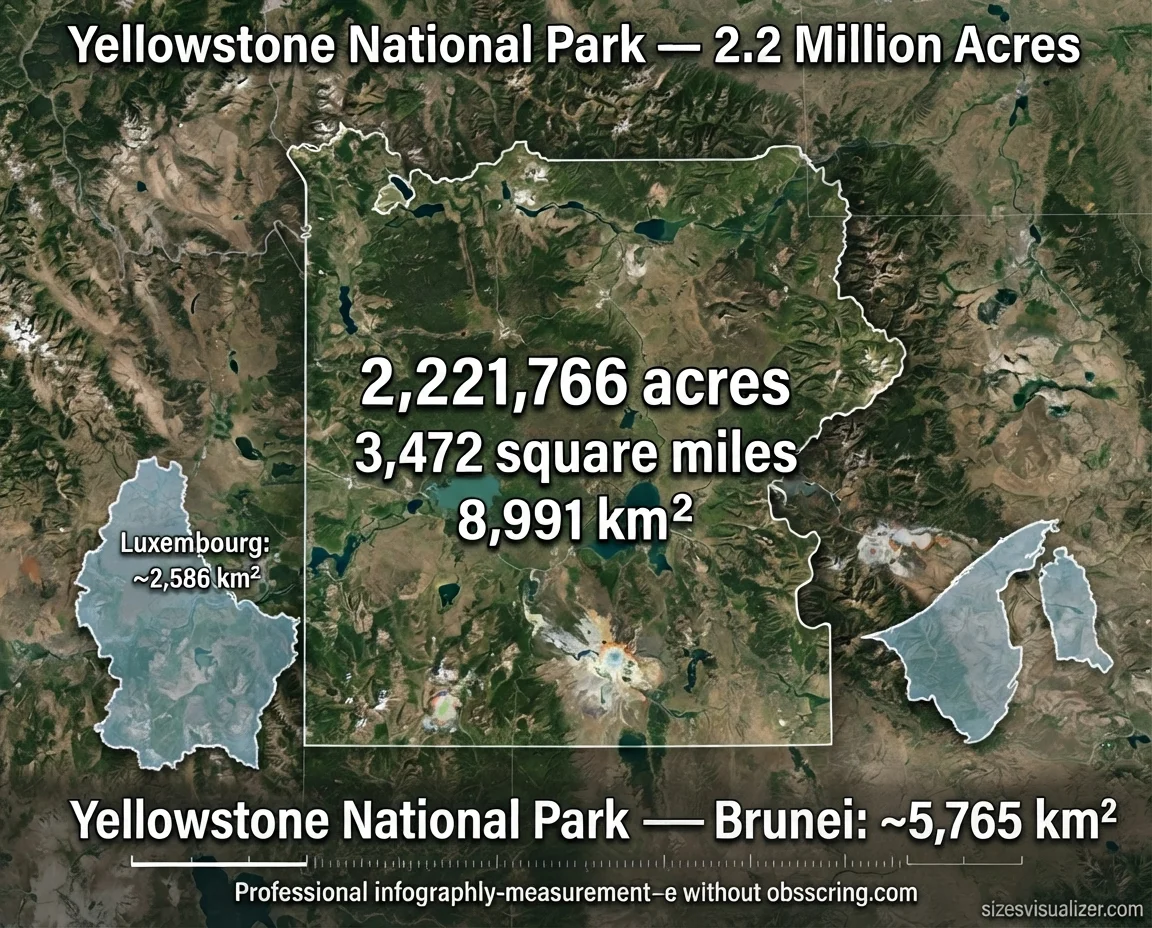
The park is larger than some entire nations, including Luxembourg, and comes close to the total land area of a country like Brunei.
Yellowstone in football fields
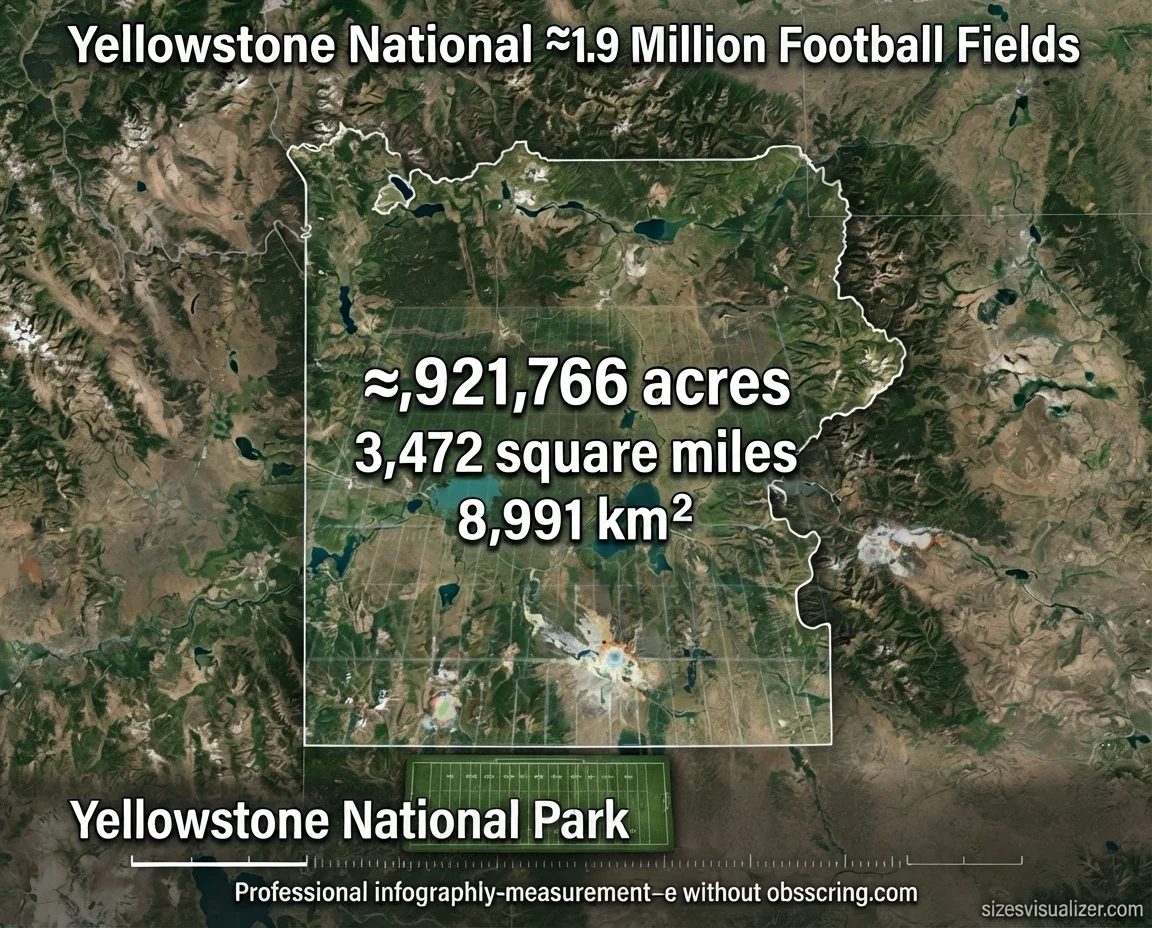
If you like a more visual measure, Yellowstone could hold roughly 1.9 million football fields. Or picture this: you could fit Central Park inside Yellowstone more than 2,600 times.
These comparisons matter for one practical reason — they explain why you can’t “just drive through” Yellowstone in an afternoon. The park’s massive footprint is exactly why planning ahead pays off.
Is Yellowstone the Largest National Park? (How It Ranks)
Yellowstone is huge, but it isn’t the biggest national park in the country. Wrangell-St. Elias National Park in Alaska dwarfs it, covering over 13 million acres — roughly six times larger than Yellowstone. Death Valley National Park and Glacier Bay also outrank Yellowstone in raw acreage.
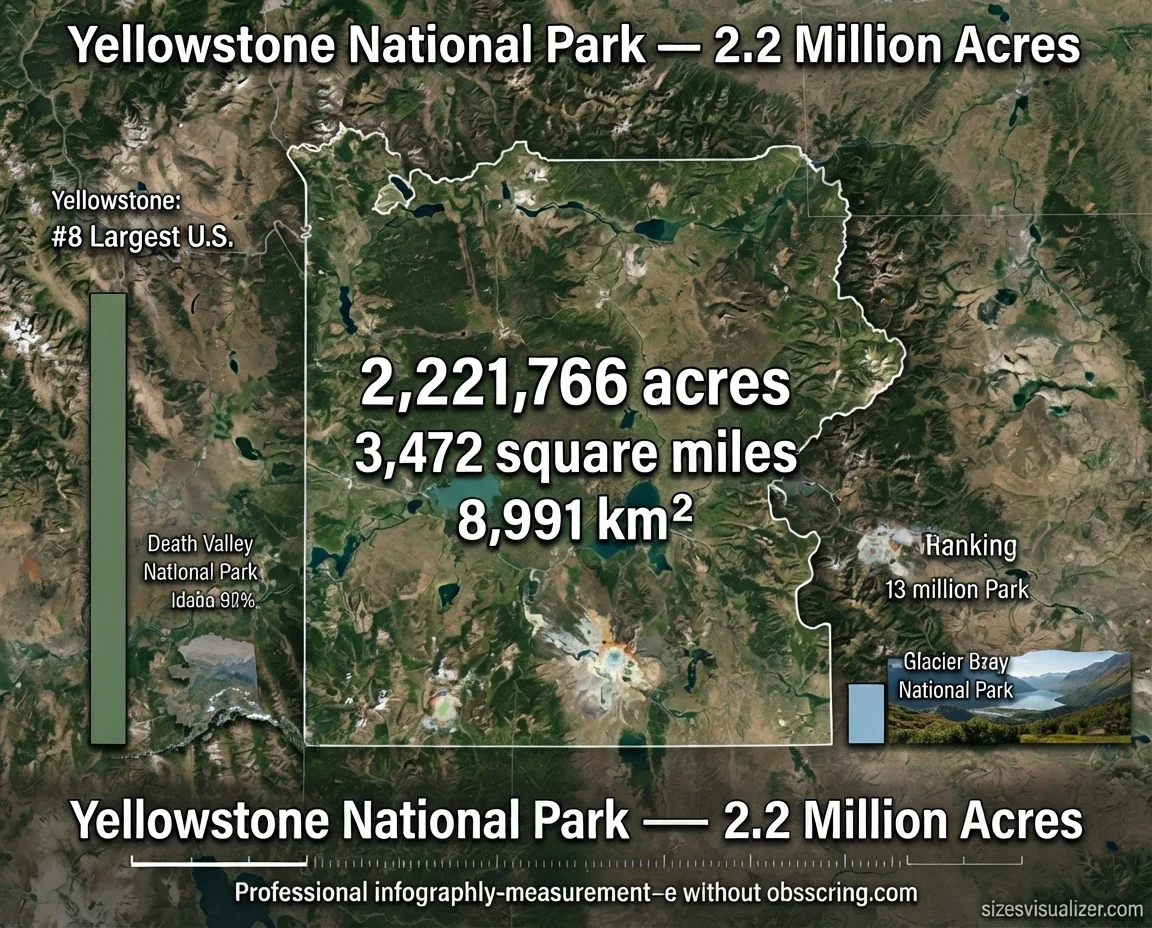
So where does that leave Yellowstone? It’s typically ranked as the eighth-largest national park in the U.S., and by far the largest and most visited park in the contiguous 48 states outside Alaska.
Is Yellowstone the largest park in the world? No. Several international parks and conservation areas, like Northeast Greenland National Park, are far larger. What makes Yellowstone stand out isn’t sheer size — it’s what’s packed inside that size.
Yellowstone earned UNESCO World Heritage status in 1978, recognized for its geothermal features, wildlife, and geology (UNESCO World Heritage Centre). The park’s protected core spans about 898,349 hectares, and it sits at the heart of the Greater Yellowstone Ecosystem — a connected wild region covering more than 7 million hectares when you include surrounding national forests and wilderness areas. It’s also a designated Biosphere Reserve, a status it’s held since 1976.
Must visit: How Tall Is Mount Everest? The True Height, Location & Fascinating Facts
What’s Inside Yellowstone’s 2.2 Million Acres? (Landscapes, Entrances & Wildlife)
A park this large needs multiple ways in. Yellowstone has five entrances:
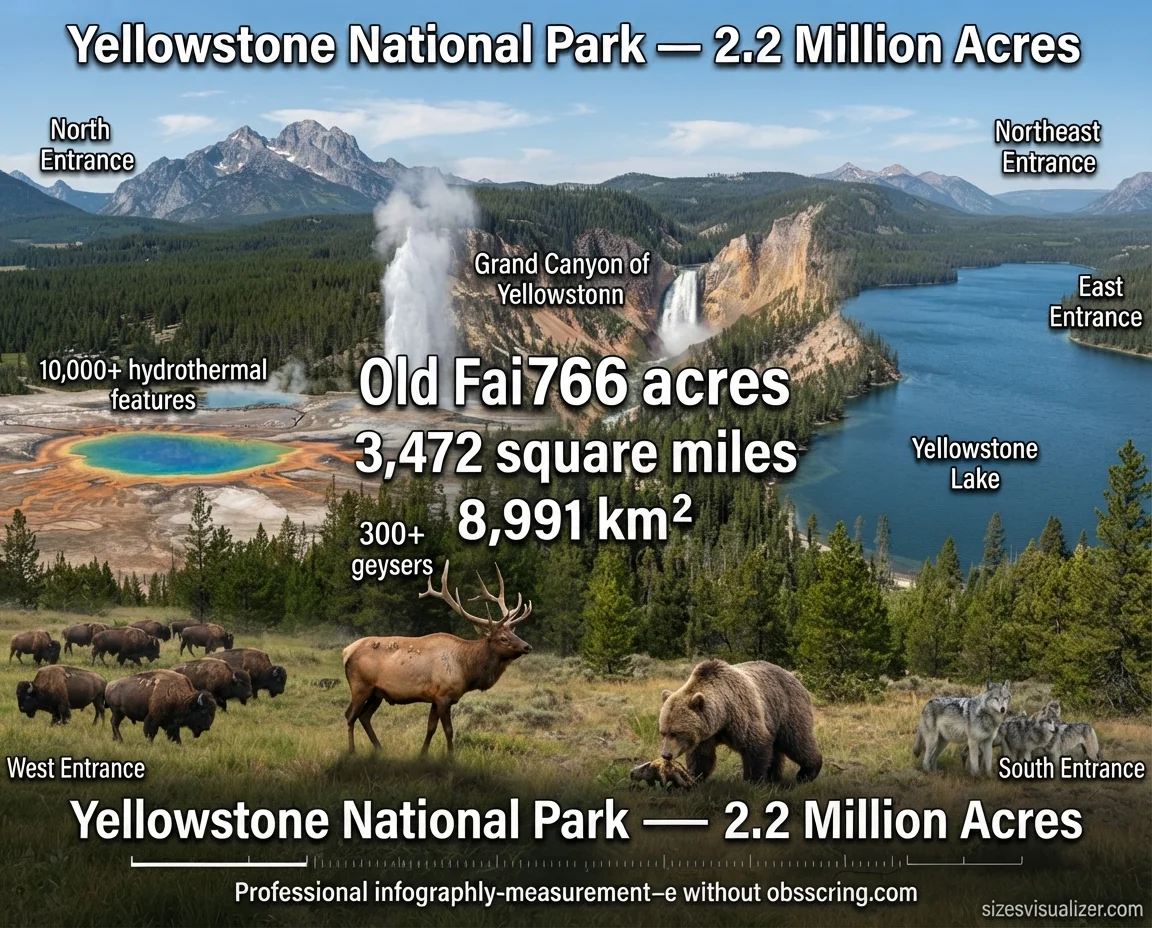
- North Entrance (Gardiner, MT) — the only one open year-round
- Northeast Entrance (near Cooke City, MT) — gateway to wildlife-rich Lamar Valley
- East Entrance (near Cody, WY) — leads toward Yellowstone Lake
- West Entrance (West Yellowstone, MT) — the busiest in summer
- South Entrance (near Jackson Hole, WY) — connects to Grand Teton National Park
Inside those boundaries, the terrain shifts dramatically. You’ll find geothermal basins holding over 10,000 hydrothermal features — more than half of everything like it on Earth (UNESCO). Old Faithful is the most famous geyser, but Yellowstone holds over 300 geysers total, roughly two-thirds of every geyser on the planet.
Other standout landmarks include the Grand Prismatic Spring, known for its rainbow-colored waters, the Grand Canyon of the Yellowstone with its dramatic waterfalls, and Yellowstone Lake, the largest high-elevation lake in North America.
Wildlife thrives across this landscape. Grizzly bears, gray wolves, elk, and bison all roam freely here. Yellowstone’s bison herd is notable for being the only place in the U.S. with continuously wild, free-ranging bison that trace back to the original herds of the Great Plains.
Not every corner gets visited. Remote zones like the Thorofare Region and Teton Wilderness sit dozens of miles from any road, reachable only on foot or horseback — a reminder of just how vast and untamed most of this park stays.
How Long Does It Take to See All of Yellowstone?
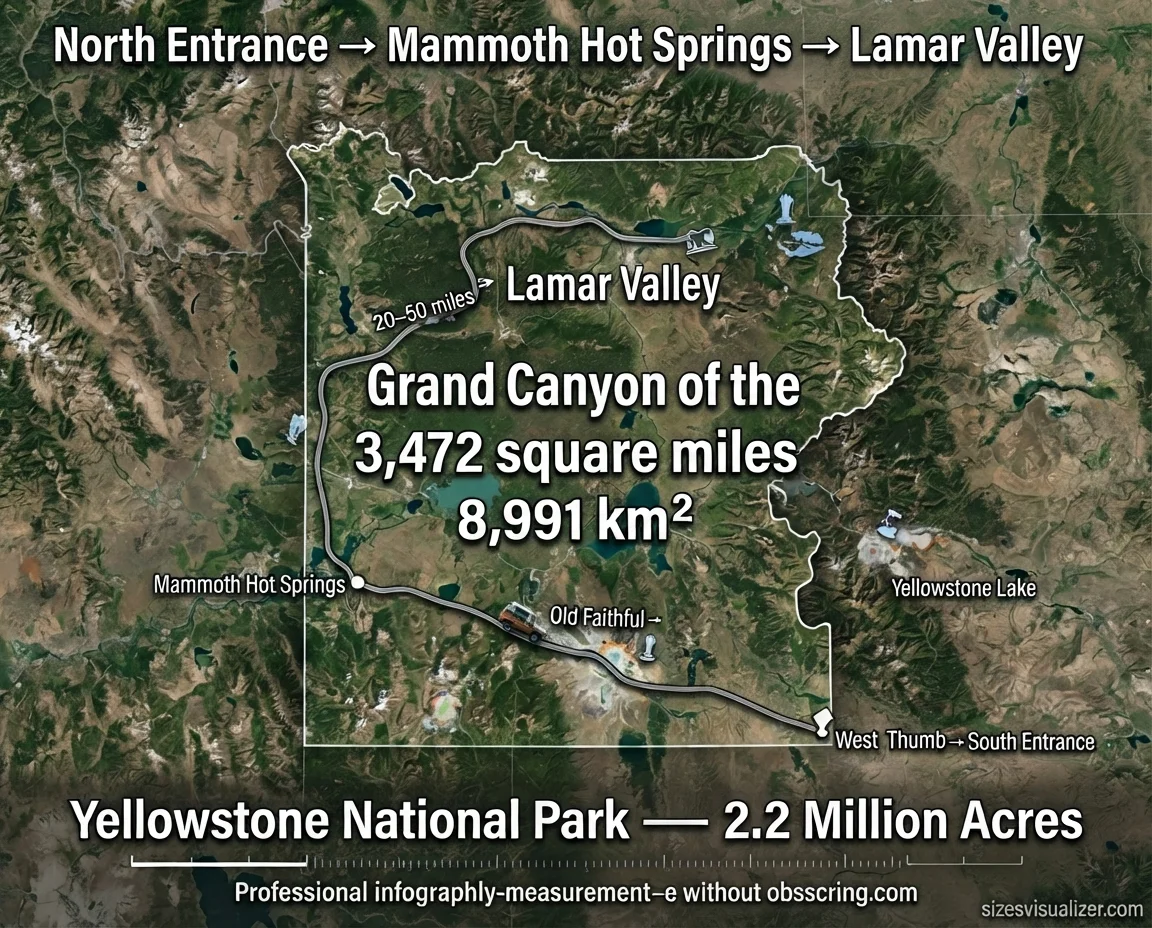
Given Yellowstone’s size, most visitors can’t “do it all” in one trip — and honestly, that’s fine.
For a solid first look, plan on three to four days. That’s enough time to see the major geothermal areas, drive through Lamar Valley for wildlife, and take in the Grand Canyon of the Yellowstone without feeling rushed.
A simple four-day route looks like this:
- Day 1: Enter through the North Entrance, explore Mammoth Hot Springs
- Day 2: Drive Lamar Valley, visit the Grand Canyon of the Yellowstone
- Day 3: See Old Faithful and the geyser basins near West Thumb
- Day 4: Head south toward Grand Teton National Park
Because distances between sights can stretch 20 to 50 miles, and speed limits inside the park stay low for wildlife safety, driving times add up fast. This is exactly why the park’s scale should shape your itinerary from day one, not something you figure out once you arrive.
FAQs About Yellowstone National Park’s Size
Is Yellowstone the largest park in the world?
No. Yellowstone is large, but parks like Northeast Greenland National Park are far bigger. Within the U.S., Alaska’s Wrangell-St. Elias holds the title of largest national park.
Why is Yellowstone so famous?
Yellowstone is famous for being the world’s first national park, established in 1872, and for holding the largest concentration of geysers and hydrothermal features on Earth, alongside free-roaming grizzly bears, wolves, and bison.
How long does it take to go through all of Yellowstone?
Most visitors need three to four days to see the main highlights. Seeing every corner, including remote backcountry areas, could take weeks, since much of the park has no roads at all.
Who is the top predator in Yellowstone?
The grizzly bear and the gray wolf sit at the top of Yellowstone’s food chain. Wolves were reintroduced to the park in 1994-95 after being absent for decades, and their return reshaped the entire ecosystem.
Is it safe to swim in Yellowstone Lake?
Swimming isn’t recommended. Yellowstone Lake stays extremely cold year-round, even in summer, and sudden temperature drops can cause hypothermia quickly. Most visitors stick to boating or shoreline viewing instead.
Which president protected Yellowstone?
President Ulysses S. Grant signed the act that created Yellowstone National Park on March 1, 1872, making it the first protected national park anywhere in the world.
Conclusion
Yellowstone’s 2.2 million acres hold more geothermal activity, wildlife, and untouched wilderness than almost anywhere else on the planet. Understanding its true scale — bigger than Rhode Island, packed with 300+ geysers, and stretched across three states — helps you plan a trip that actually matches what the park has to offer. Whatever time you have, Yellowstone rewards those who respect just how big it really is.

Measurement Researcher, Size Comparison Writer & Content Specialist
Timmy Ahad is a dedicated content writer and research specialist at SizesVisualizer.com, where he focuses on creating accurate, easy-to-understand content about measurements, dimensions, size comparisons, and real-world object visualization.