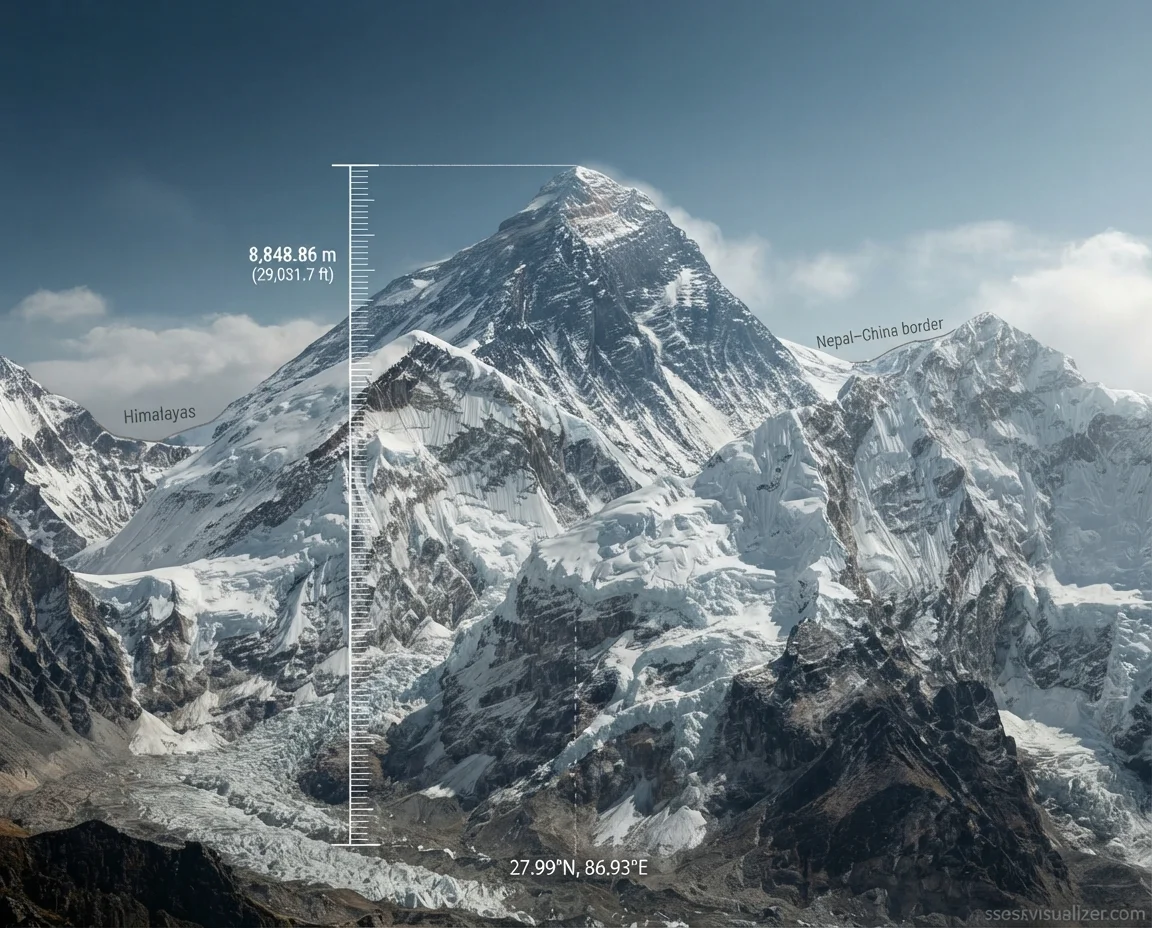
Mount Everest stands 8,848.86 meters (29,031.7 feet) tall — the highest point on Earth. But that number has changed more than once, and there’s a lot more to Everest’s size than a single figure on a map.
In this guide, you’ll learn exactly how tall Mount Everest is, where it sits on the globe, why scientists keep remeasuring it, and how it stacks up against man-made giants like the Burj Khalifa.
Table of Contents
How Tall Is Mount Everest? (Official Height in Feet and Meters)

The official height of Mount Everest is 8,848.86 meters, or 29,031.7 feet, above sea level. This figure comes from a joint 2020 survey by Nepal and China, using GPS and satellite data.
You’ll still see older numbers floating around, like 8,848 meters (29,029 feet). That’s the height British surveyors settled on decades ago, before modern satellite tools existed. The 2020 measurement is the one geographers and mountaineering bodies now treat as accurate.
To put that height in perspective: Everest is tall enough to swallow more than 20 Empire State Buildings stacked on top of each other. It’s also the reason climbers need supplemental oxygen near the top — there’s simply not enough air up there to breathe normally.
Our Size Visualizer Tool makes size comparisons simple by providing an interactive way to see how different objects and measurements relate to one another.
Where Is Mount Everest Located?
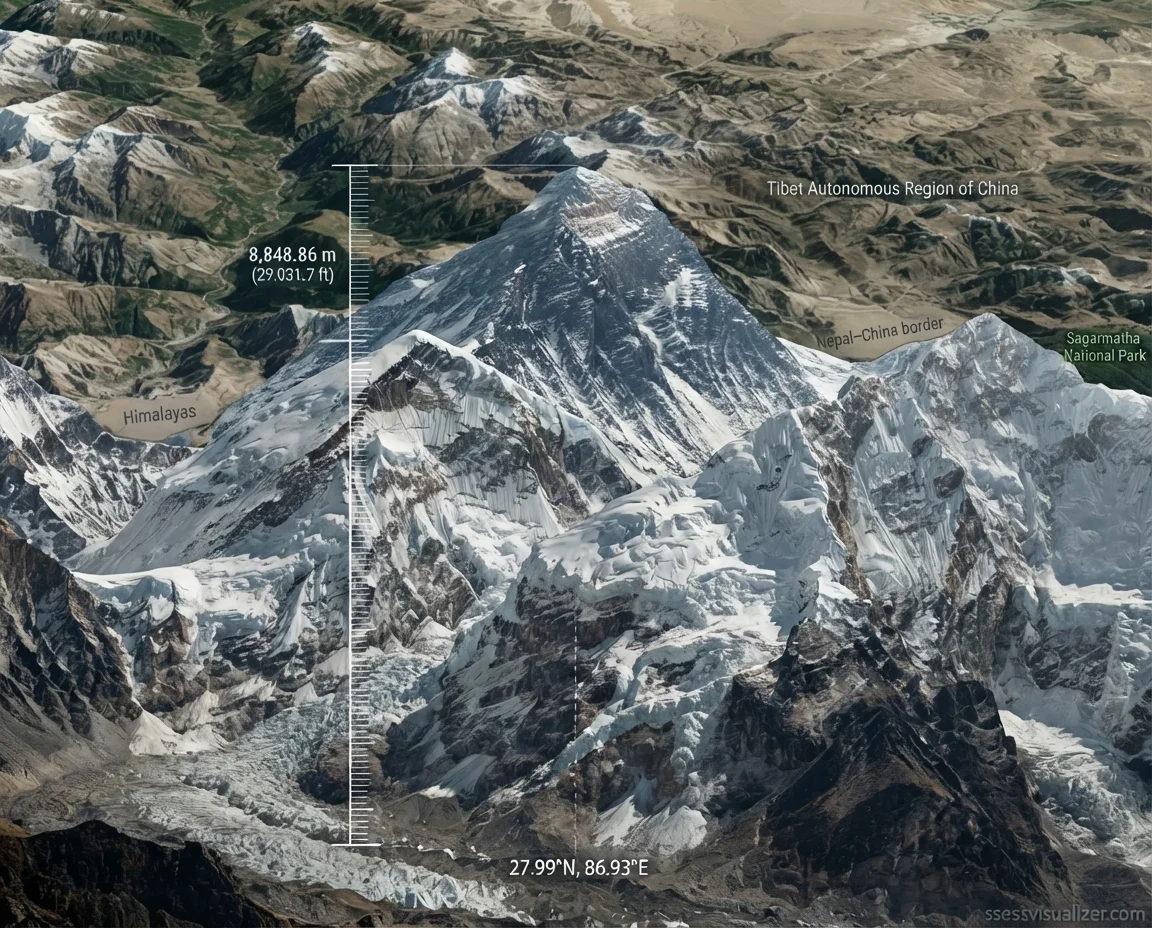
Everest sits on the border between Nepal and the Tibet Autonomous Region of China, deep in the Himalayas. Its exact coordinates are roughly 27.99°N, 86.93°E.
The Nepal side falls inside Sagarmatha National Park, a UNESCO World Heritage Site in the Solukhumbu district. The Tibetan side is reached through Lhasa.
Locals don’t just call it “Everest.” In Nepali, it’s Sagarmatha, meaning “Peak of Heaven.” In Tibetan, it’s Chomolungma, or “Goddess Mother of the World.” The English name honors George Everest, a former Surveyor General of India, even though he reportedly never saw the mountain himself.
Why Mount Everest’s Height Keeps Changing
Here’s something most people don’t realize: Everest is still growing. The mountain gains roughly 4 millimeters in height every year.
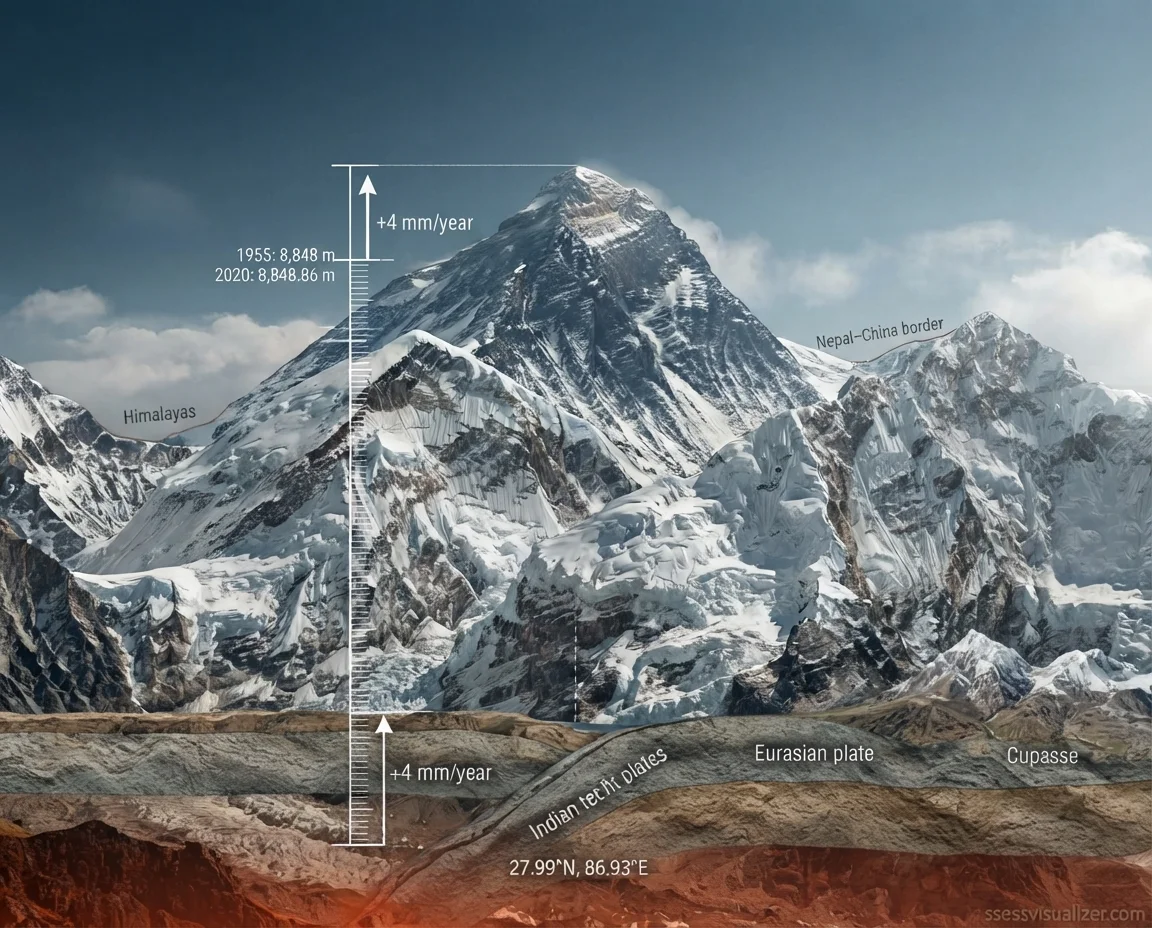
The reason comes down to plate tectonics. The Indian tectonic plate is slowly crashing into the Eurasian plate, pushing the entire Himalayan range upward. This same collision, happening over more than 50 million years, is what created Everest in the first place.
The height hasn’t always crept up smoothly, though. After a major earthquake struck Nepal in 2015, scientists worried the mountain might have shrunk. The 2020 Nepal-China survey settled the debate — Everest hadn’t shrunk at all. It was actually slightly taller than the older 1955 measurement of 8,848 meters.
The very first height estimate came in 1856, when British surveyors calculated Everest at 8,840 meters using basic trigonometry from a distance — no satellites, no GPS, just careful math and telescopes.
How Tall Is Mount Everest Compared to Other Famous Landmarks?
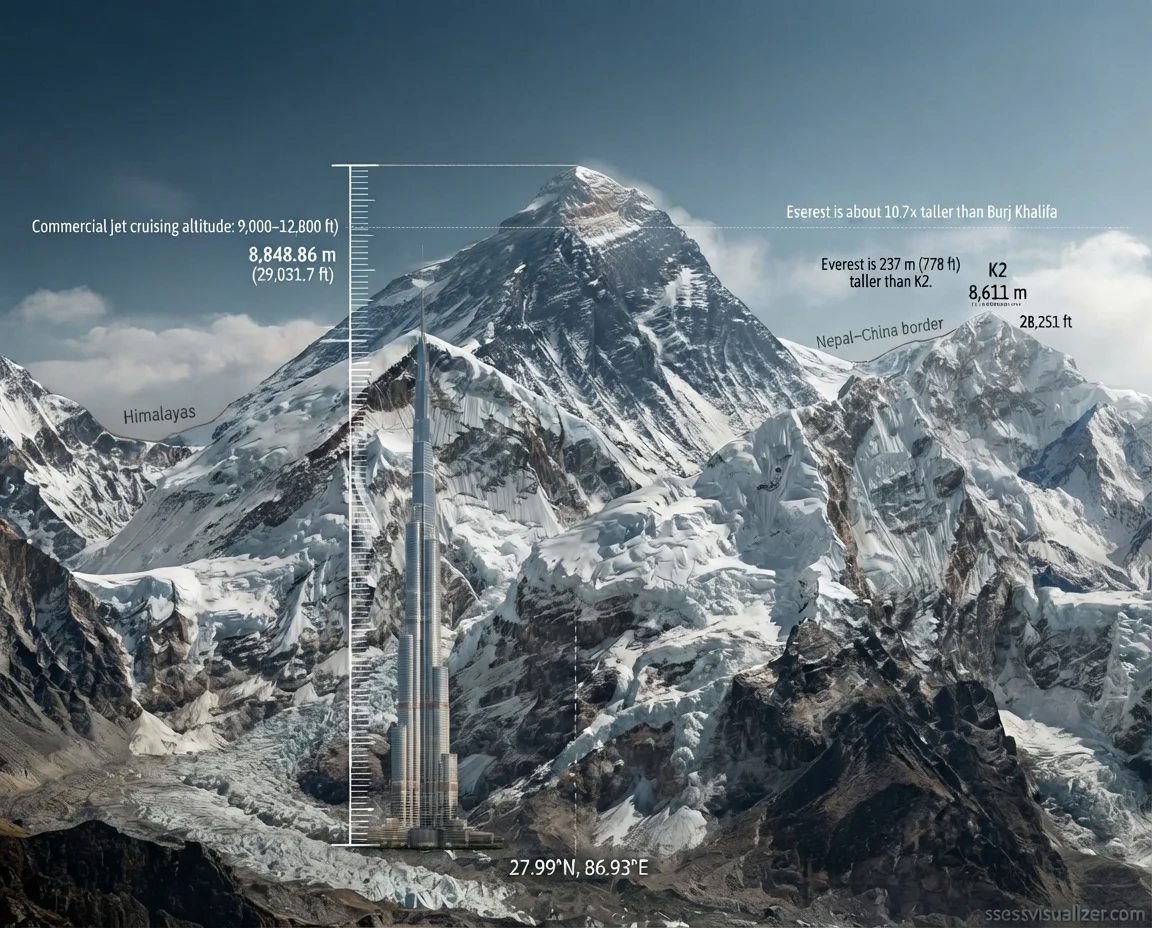
Numbers like “29,031 feet” are hard to picture. Comparing Everest to things you already know makes the scale click.
| Landmark | Height | Everest Comparison |
|---|---|---|
| Burj Khalifa (Dubai) | 828 m (2,717 ft) | Everest is about 10.7 times taller |
| K2 (Pakistan/China) | 8,611 m (28,251 ft) | Everest is 237 m (778 ft) taller |
| Mauna Kea (Hawaii, base to peak) | ~10,210 m from ocean floor | Taller base-to-summit, but Everest wins for elevation above sea level |
| Commercial jet cruising altitude | 9,000–12,800 m (30,000–42,000 ft) | Everest’s summit sits within that same altitude band |
That last row explains a common question people search for. Can a plane fly over Mount Everest? Technically, yes — most commercial jets cruise well above the summit. But many airlines deliberately avoid flying directly over the peak. If a plane loses cabin pressure over ordinary terrain, it can quickly descend to a safe altitude. Over Everest, the ground is too high for that emergency descent to work, so carriers reroute around the region as a safety precaution.
Must visit: How Wide Is the Grand Canyon? Width, Depth, Length & Fascinating Facts
Climbing Mount Everest: Cost, Conditions & the Death Zone
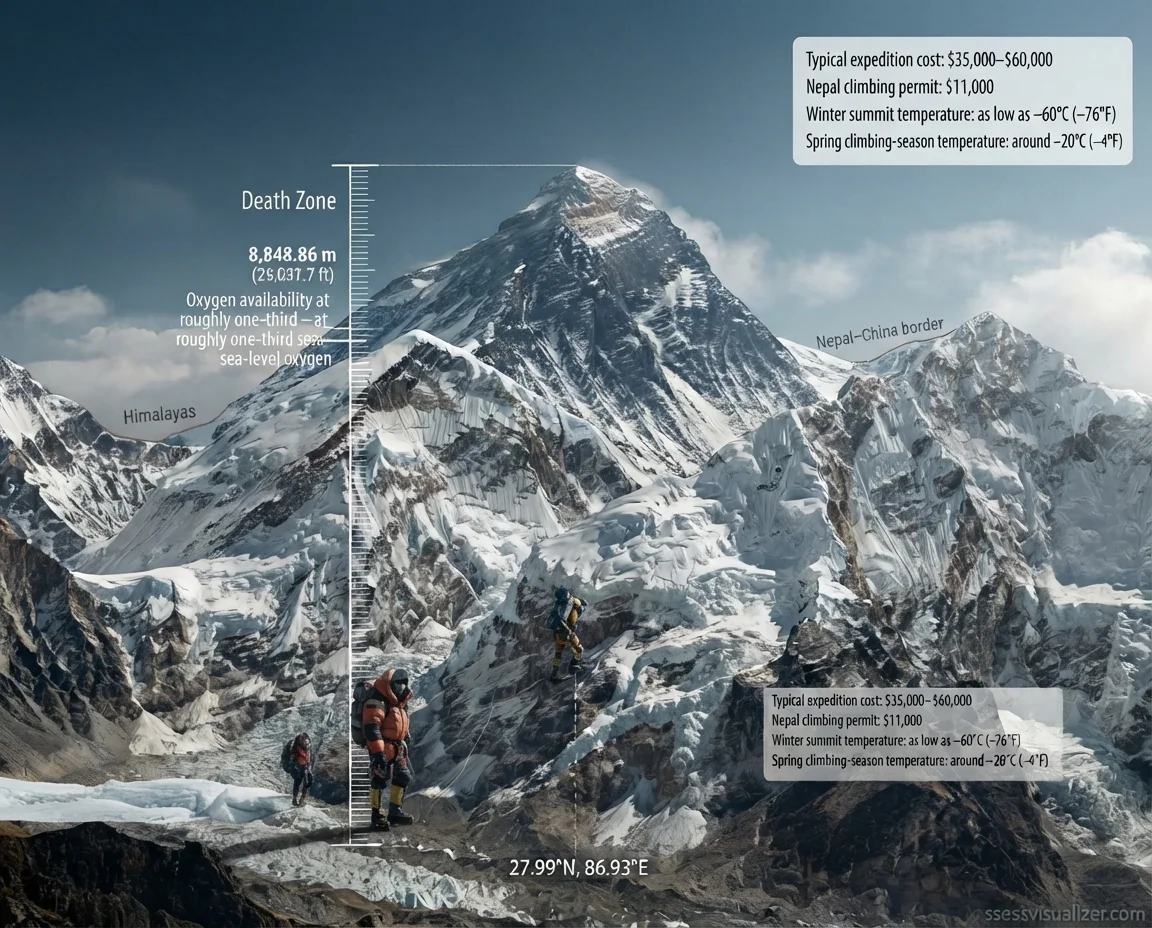
Reaching the summit isn’t just physically brutal. It’s expensive. A full Everest expedition typically costs between $35,000 and $60,000, and luxury guided trips can run past $100,000.
Where does that money go? Nepal’s government charges a climbing permit fee of $11,000 per foreign climber. On top of that, climbers pay for Sherpa guides, bottled oxygen, base camp logistics, gear, insurance, and weeks of food and lodging at high altitude. Add it up, and $40,000 becomes an easy number to hit.
The danger isn’t just cost — it’s the environment. Above 8,000 meters, climbers enter what’s known as the death zone. Oxygen levels there are roughly one-third of what they are at sea level, which is why most climbers carry supplemental oxygen. Winter temperatures at the summit can plunge to -60°C (-76°F). Even in the more popular April-to-May climbing season, temperatures still hover around -20°C (-4°F).
Because conditions are so extreme, recovering bodies from high on the mountain is often too dangerous to attempt. Some climbers who died decades ago remain there today. One of the most well-known cases is George Mallory, a British climber who disappeared on Everest in 1924. His body wasn’t found until 1999 — 75 years later — and it was left on the mountain out of respect and because retrieval was too risky.
Fascinating Facts About Mount Everest
A few more details rarely make it into the standard “how tall” articles.
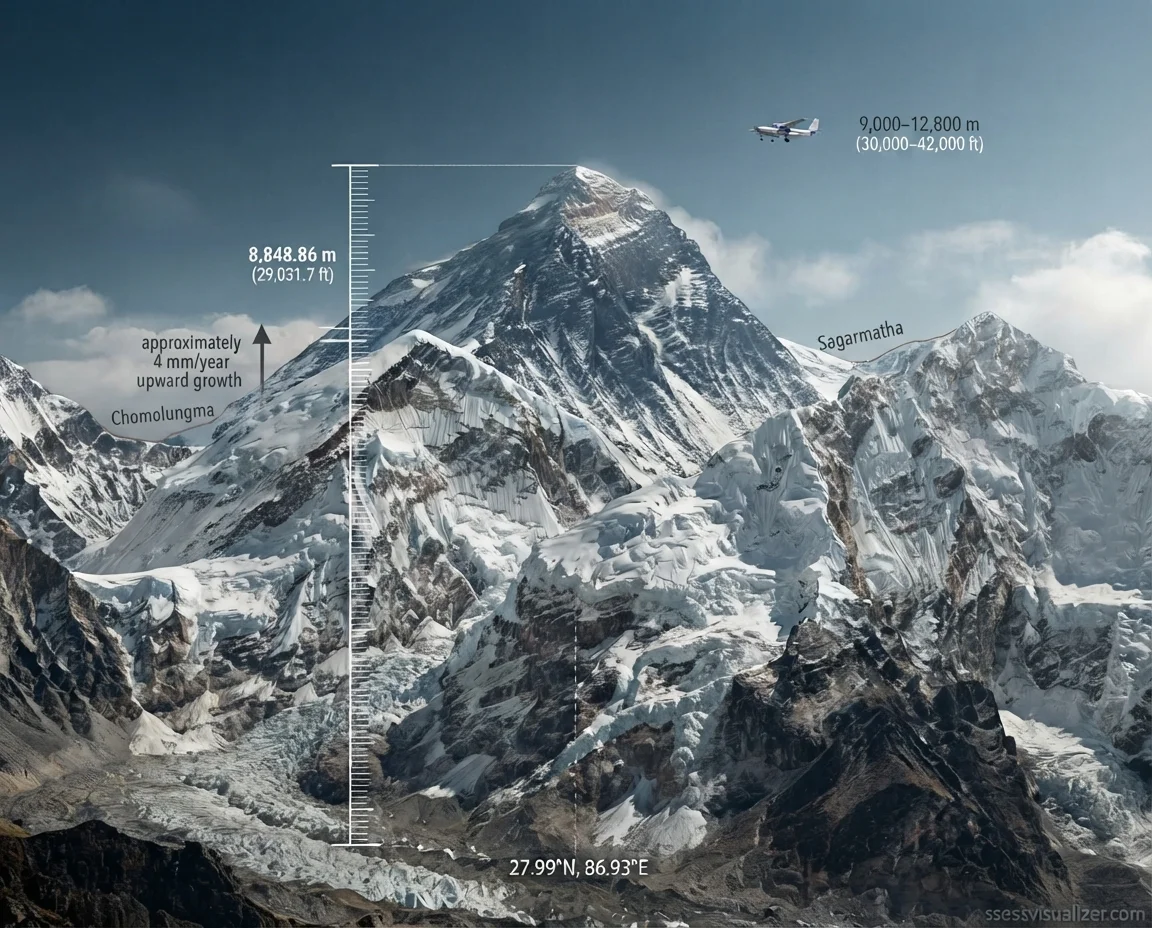
Can you see Mount Everest from Kathmandu? Not directly. Kathmandu sits too low, and closer mountains block the view. On a clear day, though, nearby viewpoints like Nagarkot or the Chandragiri hills offer a genuine glimpse of the peak.
Everest also plays a bigger ecological role than most people know. Snow and glacial melt from the mountain feed major rivers, including the Ganges, Brahmaputra, and Indus. Millions of people across South Asia rely on that water.
And the mountain’s cultural weight goes beyond climbing records. For the Sherpa people, who live in the shadow of Everest, the mountain is sacred ground, not just a bucket-list summit.
FAQs
Can a plane fly over Mount Everest?
Yes, most jets cruise higher than Everest’s summit. However, many airlines avoid the direct flight path because an emergency descent to safe breathing altitude isn’t possible over such high terrain.
Why does it cost $40,000 to climb Mount Everest?
The Nepal government charges an $11,000 climbing permit per person. The rest covers Sherpa guides, bottled oxygen, gear, insurance, and weeks of logistics at high altitude — expenses that add up fast on a mountain this remote.
Is Mount Everest bigger than Burj Khalifa?
Yes, by a wide margin. Everest is roughly 10.7 times taller than the Burj Khalifa, the world’s tallest building.
How cold is it at the top of Everest?
Winter temperatures can drop to -60°C (-76°F). Even during the main climbing season in spring, it can still be around -20°C (-4°F).
What is the oldest body still on Everest?
George Mallory’s body, discovered in 1999 after he disappeared in 1924, is one of the oldest known remains still on the mountain.
Can I see Mount Everest from Kathmandu?
Not from the city itself — closer mountains block the direct view. Nearby viewpoints like Nagarkot allow a clear sighting on good-weather days.
Conclusion
Mount Everest’s height isn’t a fixed number frozen in a textbook. It’s 8,848.86 meters (29,031.7 feet) today, still rising a few millimeters each year as tectonic plates push the Himalayas skyward. Whether you’re comparing it to a skyscraper or planning a trek to see it up close, Everest remains the one mountain every measurement in the world gets measured against.

Measurement Researcher, Size Comparison Writer & Content Specialist
Timmy Ahad is a dedicated content writer and research specialist at SizesVisualizer.com, where he focuses on creating accurate, easy-to-understand content about measurements, dimensions, size comparisons, and real-world object visualization.