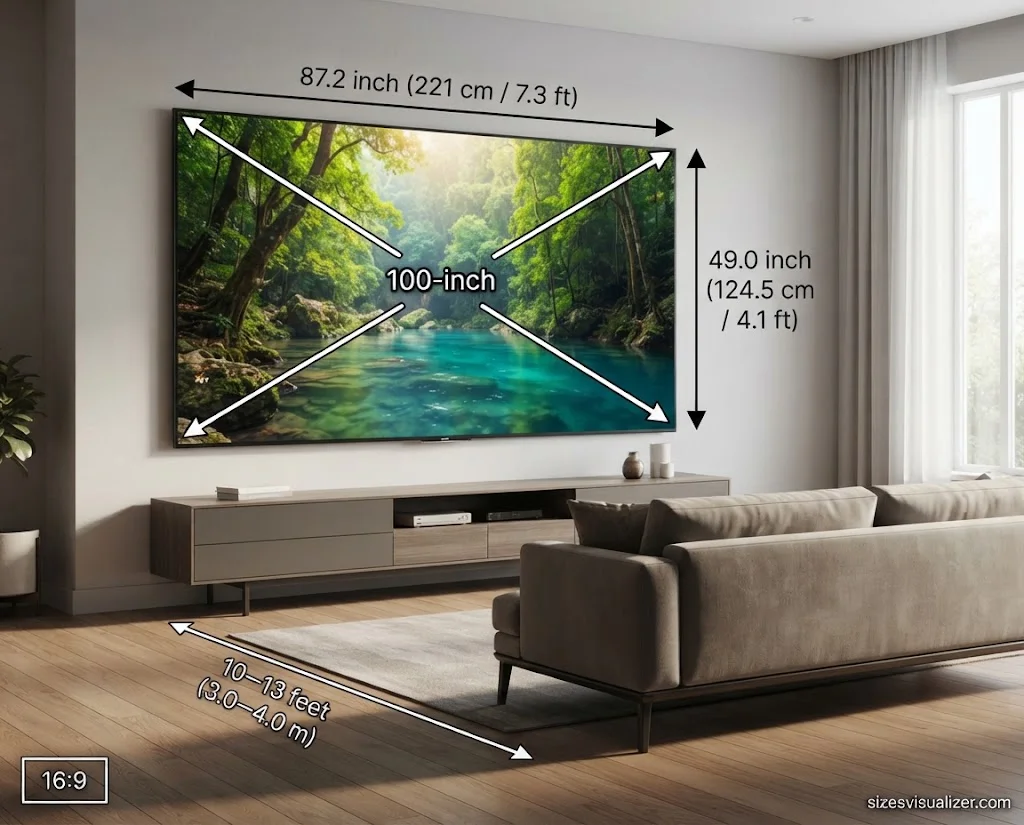
A 100-inch TV is about 87.2 inches wide and 49 inches tall. That is roughly 7.3 feet by 4.1 feet. The “100” is the diagonal, not the width.
So how big is a 100-inchs TV in a real room? Below you will find exact 100-inchs TV dimensions, the best viewing distance, weight, and mounting needs for US homes.
Table of Contents
100-Inch TV Dimensions: Exact Width, Height & Depth
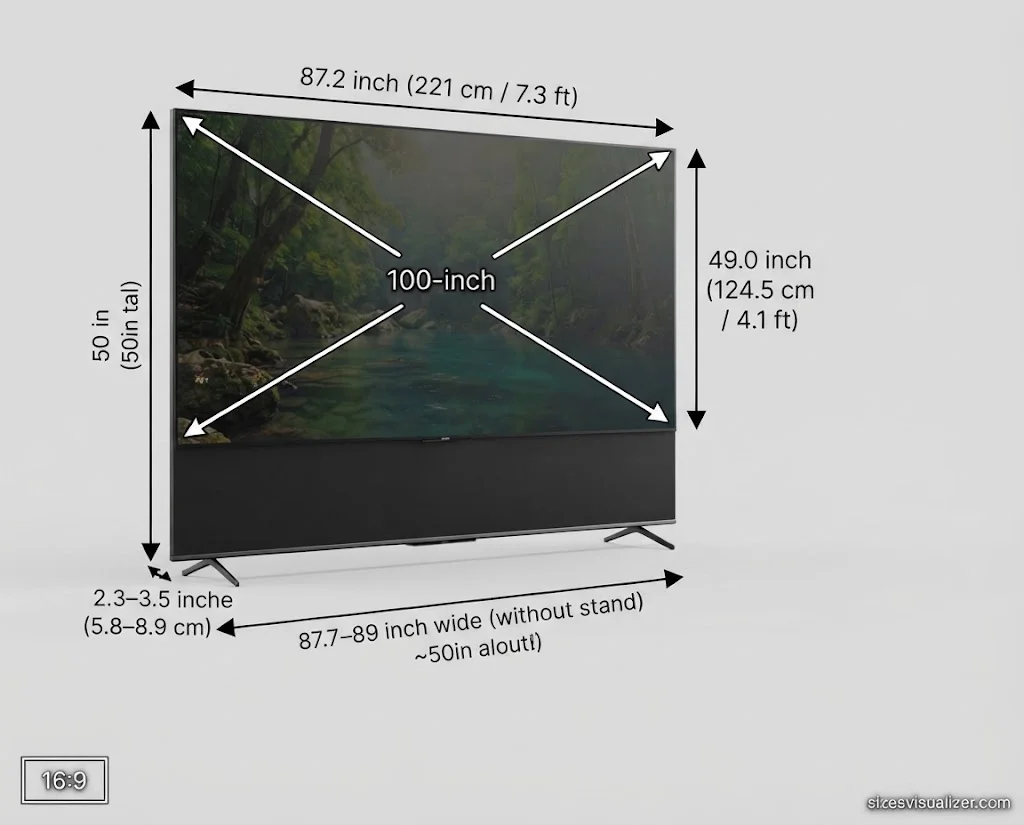
A 100-inchs TV screen measures 87.2 inches wide by 49.0 inches tall. That equals 221 by 124.5 cm, or 7.3 by 4.1 feet. It uses the 16:9 aspect ratio. Real sets run a little bigger because of the frame, called the bezel.
The math is easy. The Pythagorean theorem turns a diagonal into width and height. For a quick shortcut, multiply the diagonal by 0.872 for width and 0.49 for height.
| Measurement | Inches | Centimeters | Feet |
|---|---|---|---|
| Diagonal | 100″ | 254 cm | 8.3 ft |
| Screen width (exact 16:9) | 87.2″ | 221 cm | 7.3 ft |
| Screen height (exact 16:9) | 49.0″ | 124.5 cm | 4.1 ft |
| Real TV width, with frame | 87.7″-89″ | 223-226 cm | 7.3-7.4 ft |
| Real TV height, no stand | about 50″ | 127 cm | 4.2 ft |
| Height with stand | up to about 52.8″ | 134 cm | 4.4 ft |
| Depth, panel only | 2.3″-3.5″ | 5.8-8.9 cm | 0.2-0.3 ft |
Spec sheets back this up. Vizio lists its 100-inch Quantum Pro at about 87.7 by 50 inches, and LG’s 100-inch QNED lands in the same range. Samsung’s 100-inch Neo QLED and the Hisense U8 also follow this pattern.
The screen holds about 4,273 square inches of viewing area. That is roughly 2.4 times the area of a 65-inch TV.
Watch the stand. It adds height and pushes the depth to 16 inches or more. A stand-mounted 100-inchs TV will overhang a standard 72-inch media console.
Best Viewing Distance for a 100-Inch TV
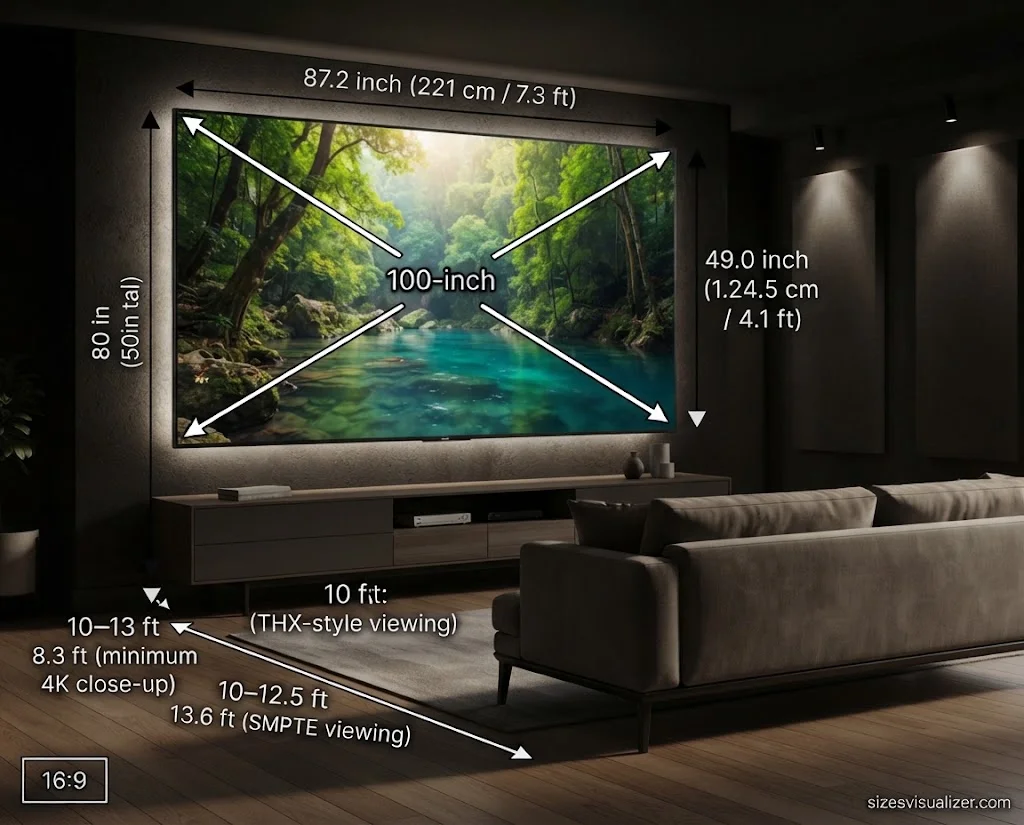
The best viewing distance for a 100-inchs TV is about 10 to 13 feet. You can sit as close as 8.3 feet with a 4K picture. Past roughly 16 feet, the screen starts to feel small.
| Method | Distance for a 100″ TV |
|---|---|
| 4K close-up limit (1x the diagonal) | about 8.3 ft |
| THX-style 40° view | about 10 ft |
| Comfort range (1.2-1.5x the diagonal) | 10-12.5 ft |
| SMPTE 30° minimum view | about 13.6 ft |
| Screen feels small | beyond about 16 ft |
SMPTE (the Society of Motion Picture and Television Engineers) asks for a view angle of at least 30 degrees. That works out to about 13.6 feet here. THX favors a wider, cinema-style view near 40 degrees, or about 10 feet.
Use this simple guide:
- Movies: sit 10 to 13 feet away for a true home theater feel.
- Sports: 10 to 12 feet keeps the whole field in view without head turns.
- Gaming: many players sit 8 to 10 feet away, but HUD text at the edges can be hard to see.
For 1080p content, add a few feet. Upscaled HD looks soft on a screen this large. For more on sizing, read RTINGS on TV size and distance or Consumer Reports’ TV size guide.
Must visit: Pallet Sizes & Dimensions: Standard Shipping Sizes, Types & Chart
100-Inchs TV Room Size, Weight & Mounting Needs
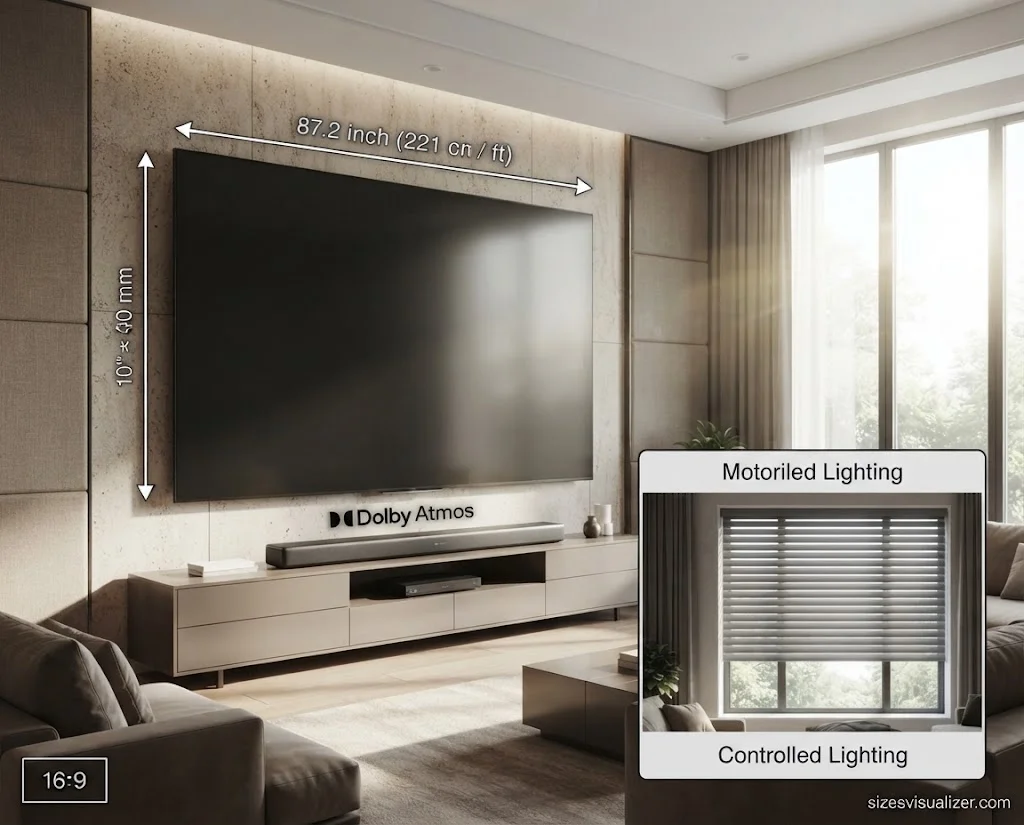
A 100-inchs TV fits best where you can sit 10 to 13 feet away and have a wall at least 9 feet wide. That gives room for the 7.4-foot frame, airflow, and a soundbar.
Wall and seat
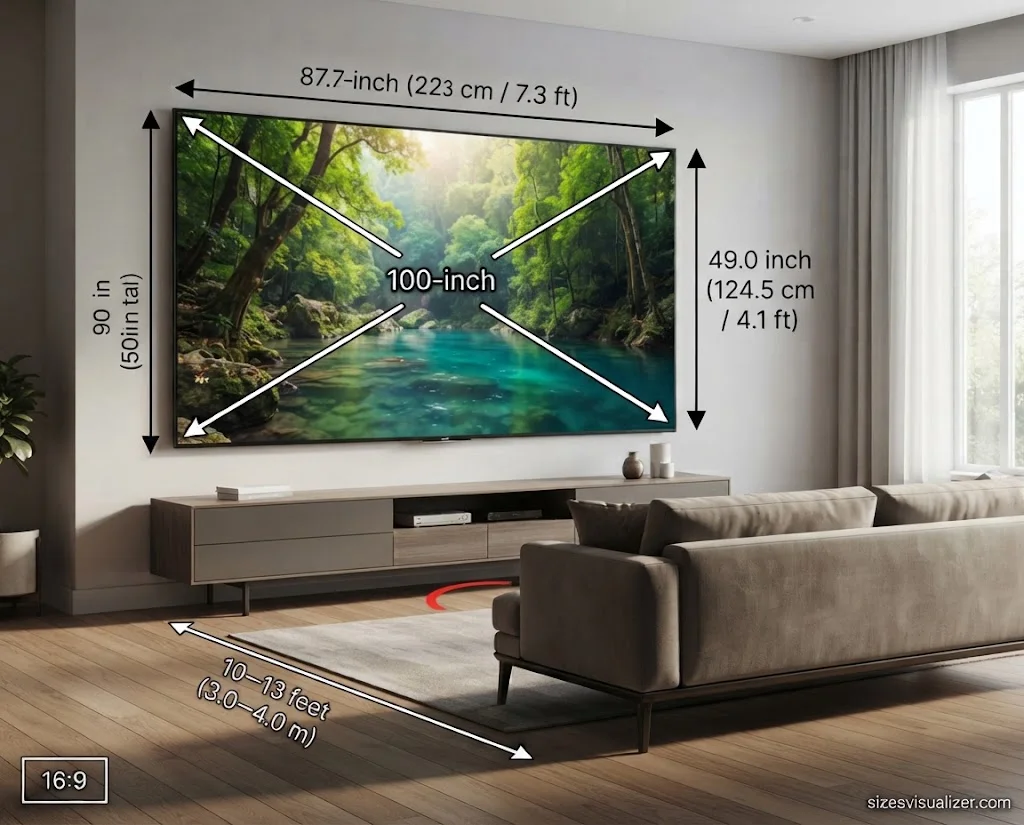
Leave a few inches on each side for ventilation. Seating under 8 feet away feels cramped and tires the eyes.
Weight
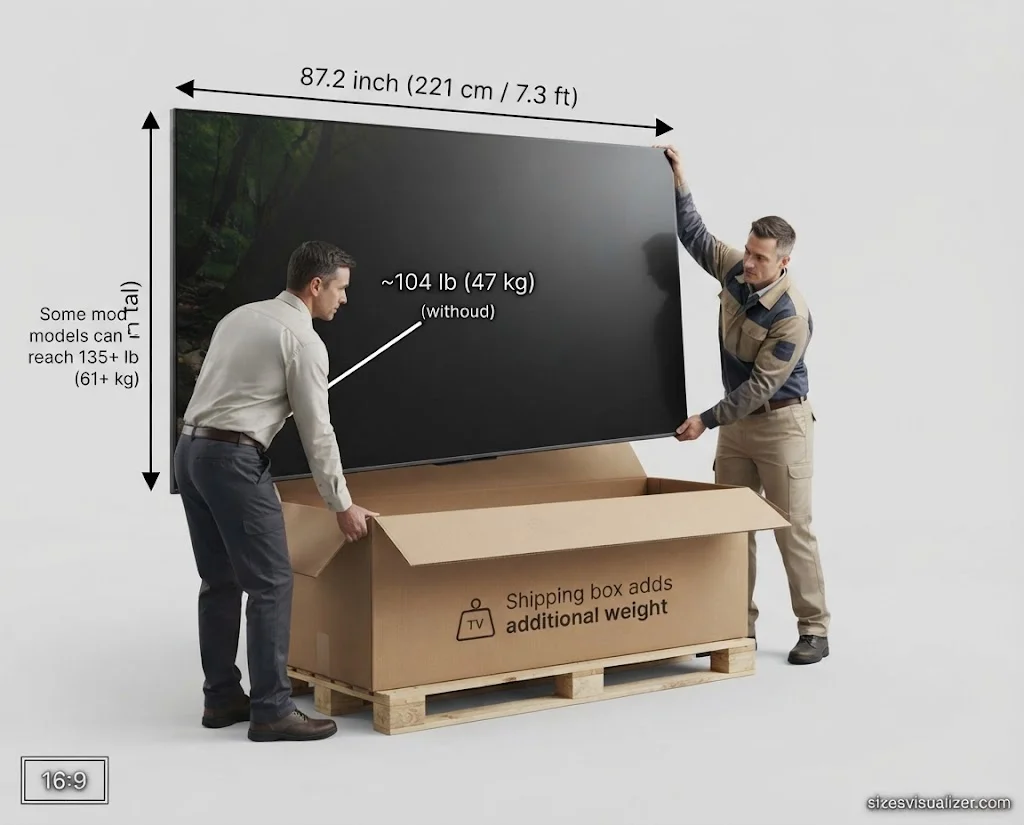
Popular models weigh about 104 pounds without the stand (Vizio lists 104.06 lbs). Some reach 135 lbs or more, as on Hisense’s 100-inch line. The box adds more.
Mounting
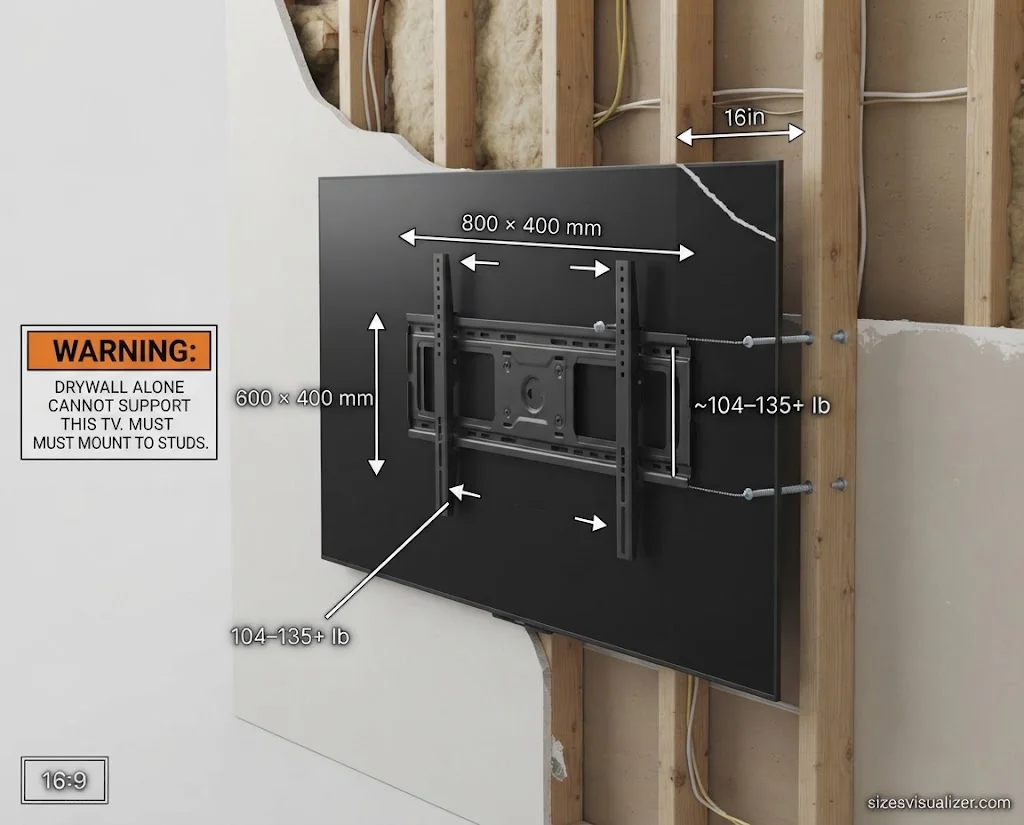
Many models use a VESA pattern of 600×400 or 800×400 mm. Pick a mount rated well above the TV’s weight, and anchor it into wall studs. US studs sit 16 or 24 inches apart, so plan the position first. Drywall anchors alone will fail.
Eye level
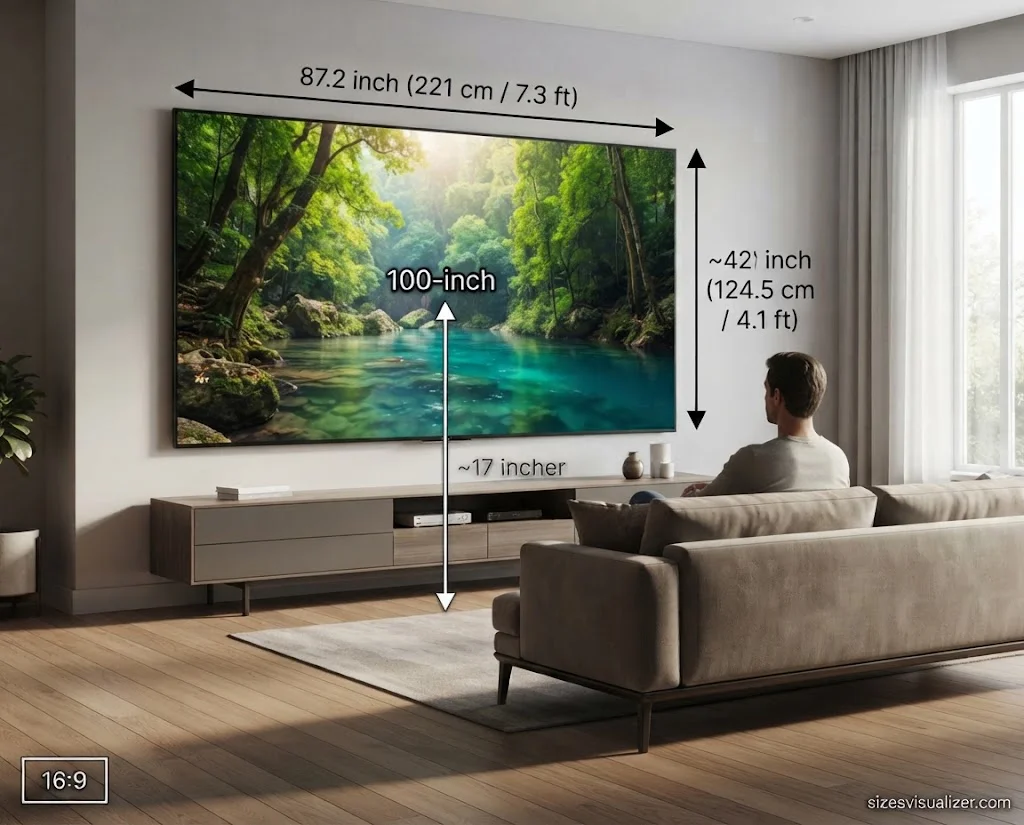
Set the screen’s center near seated eye height, about 42 inches. The bottom edge then sits about 17 inches off the floor.
Delivery
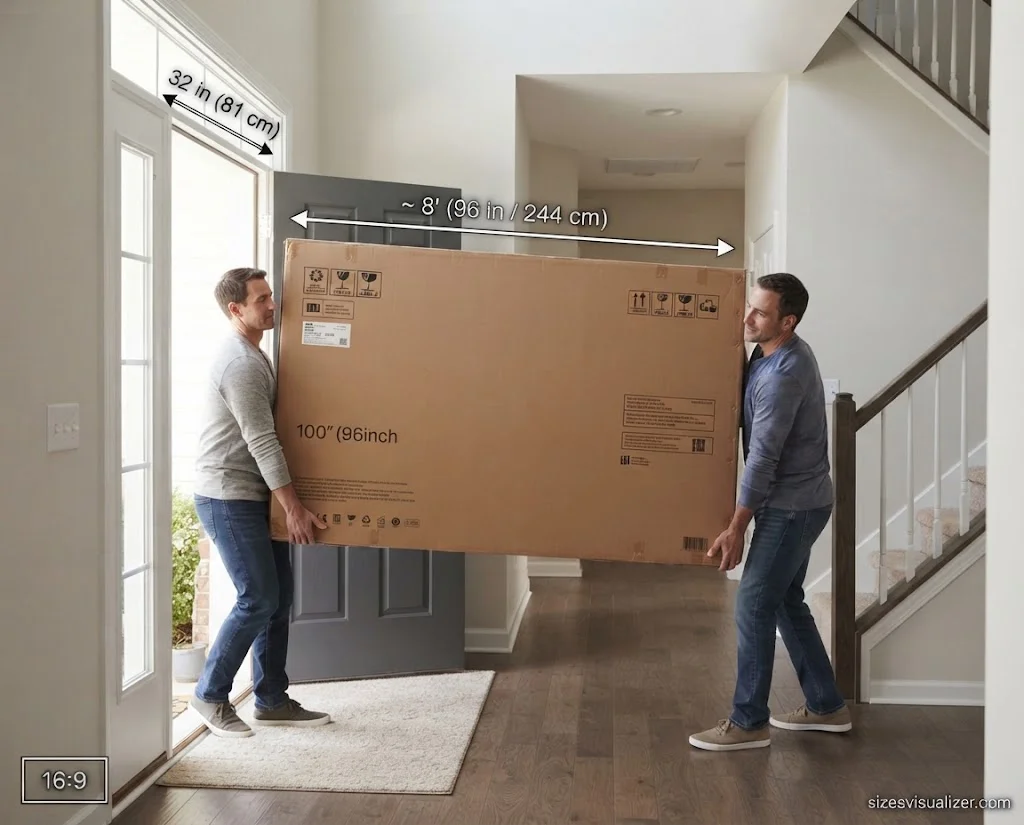
The box often runs close to 8 feet long, so it travels on its side. Measure doors (US interior doors are about 30 to 36 inches wide), halls, stairs and elevators. Two adults are a must.
Light and sound
A bright window causes glare on any big screen. Mini-LED and QLED panels handle bright rooms better than most projectors. Add a Dolby Atmos soundbar sized for an 87-inch screen.
100-Inch TV vs 85, 98 & 120-Inch: Size Compared
A 100-inchs TV has about 38% more screen area than an 85-inch, and only about 4% more than a 98-inch. Screen area grows with the square of the diagonal, so small jumps in inches add up.
| Size | Width x Height | Screen area vs 100″ | Best for |
|---|---|---|---|
| 85″ | 74.1″ x 41.7″ | 28% smaller | Large living rooms |
| 90″ | 78.4″ x 44.1″ | 19% smaller | Big rooms, tighter walls |
| 98″ | 85.4″ x 48.0″ | 4% smaller | Home theaters |
| 100″ | 87.2″ x 49.0″ | Baseline | Dedicated theater rooms |
| 120″ | 104.6″ x 58.8″ | 44% larger | Very large rooms, projectors |
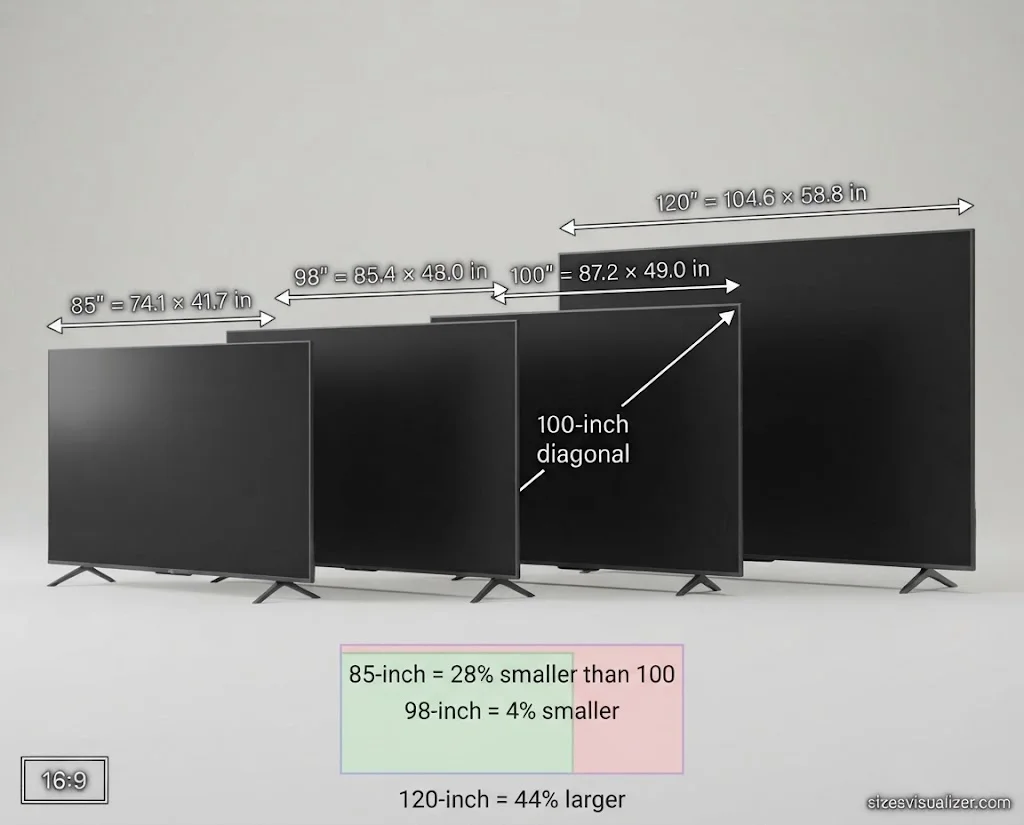
The 98-inch versus 100-inch choice comes down to price and picture quality. The 1.8-inch width gap is hard to notice. The real jump is from 85 to 98 or 100 inches, which adds about 11 to 13 inches of width.
Above 110 inches, a short-throw laser projector with an ALR screen often costs less per inch. Below that, a Mini-LED TV usually wins on brightness, color, and easy setup.
Skip a 100-inchs TV if your seat sits under 8 feet away, your walls can’t take the weight, or you plan to move soon.
FAQs
How wide is a 100-inch screen?
A 100-inch screen is about 87.2 inches wide, which is 221 cm or 7.3 feet. That figure is for a 16:9 screen. Real TVs measure 87.7 to 89 inches with the frame. Plan for about 7.4 feet of wall space, plus a little room on each side.
Is a 100 inchs TV overkill?
No, not if you sit 10 to 13 feet away in a mid-size or large room. It feels like overkill when your seat is under 8 feet from the screen, or when a bright room washes out the picture. In tight rooms, an 85-inch or 98-inch TV gives a similar wow factor with less hassle.
What size TV is 100 cm wide?
A 16:9 TV that is 100 cm (39.4 inches) wide has a diagonal of about 45 inches. The closest sizes on sale are 43 and 50 inches. If you mean 100 cm on the diagonal, that is about a 40-inch TV. Check the spec sheet, since frames vary.
How tall is a 100-inchs TV?
A 100-inchs TV is about 49 inches tall, which is 124.5 cm or 4.1 feet. Real models measure around 50 inches without the stand. With the stand, some reach about 52.8 inches. Check that number against your cabinet, mantel, or console before you buy.
Is a 100-inchs TV heavy?
Yes. Most 100-inch TVs weigh about 104 to 135 pounds without the stand, and some go higher. The box adds more weight. You need two adults to lift it, and a mount rated well above the TV’s weight. Anchor that mount to wall studs, not just drywall.
Is there a 200 inch TV?
Not as a normal single-panel TV. A 200-inch screen would measure about 174 by 98 inches, or 14.5 by 8.2 feet. You can reach that size with modular MicroLED walls or a projector and screen. Store-shelf TVs stop well below it, so most homes pick a 100 to 120-inch TV or a projector.
Conclusion
How big is a 100-inchs TV? About 87 inches wide, 49 inches tall, and 104 pounds or more. It works best with seating 10 to 13 feet away and a wall built to hold it. Measure your wall, doorway, and seat first, then shop with the exact 100-inchs TV dimensions in hand.

Measurement Researcher, Size Comparison Writer & Content Specialist
Timmy Ahad is a dedicated content writer and research specialist at SizesVisualizer.com, where he focuses on creating accurate, easy-to-understand content about measurements, dimensions, size comparisons, and real-world object visualization.