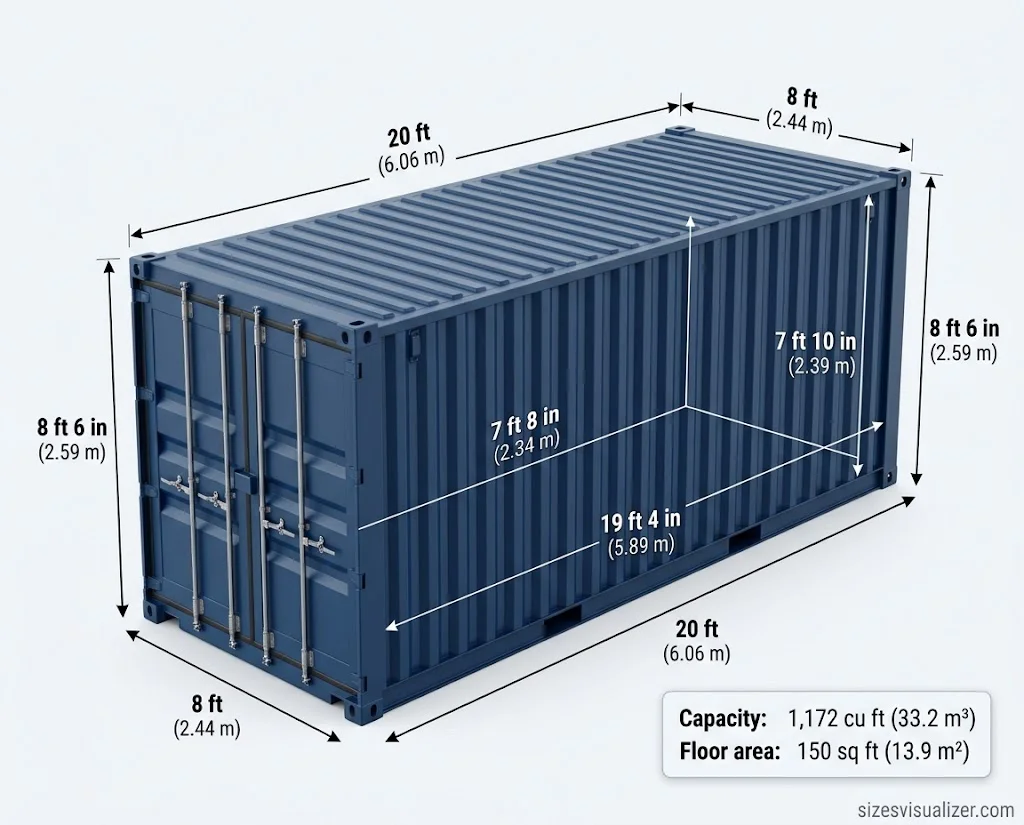
Most shipping container dimensions follow one rule. Containers are 8 ft wide and 8’6″ tall, or 9’6″ for a high cube. They come in 10, 20 and 40 ft lengths.
This guide covers the exact container sizes, container capacity and container weight numbers. It also adds U.S. road limits and 2026 prices that many guides skip.
Table of Contents
Shipping Container Dimensions Chart (20ft, 40ft & High Cube)
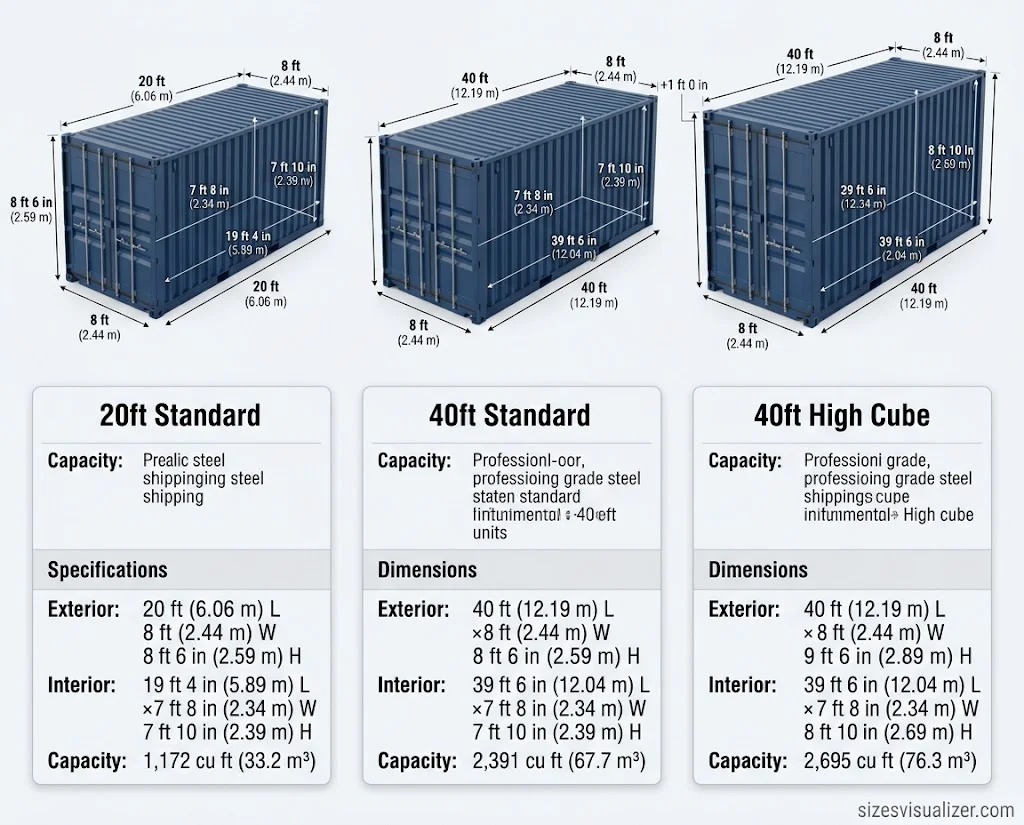
The ISO 668 standard fixes the outside size of every container. That is why one box fits any ship, rail car or truck chassis. Inside sizes vary a little by maker and build year.
| Container | Exterior (L × W × H) | Interior (L × W × H) | Door opening (W × H) | Capacity | Floor area |
|---|---|---|---|---|---|
| 10ft | 9’9¾” × 8′ × 8’6″ | 9’3″ × 7’8″ × 7’10” | 7’8″ × 7’5″ | ~555 cu ft (15.7 m³) | 75 sq ft |
| 20ft | 20′ × 8′ × 8’6″ | 19’4″ × 7’8″ × 7’10” | 7’8″ × 7’5″ | 1,172 cu ft (33.2 m³) | 150 sq ft |
| 20ft HC | 20′ × 8′ × 9’6″ | 19’4″ × 7’8″ × 8’10” | 7’8″ × 8’5″ | ~1,300 cu ft (~37 m³) | 150 sq ft |
| 40ft | 40′ × 8′ × 8’6″ | 39’6″ × 7’8″ × 7’10” | 7’8″ × 7’5″ | 2,391 cu ft (67.7 m³) | 300 sq ft |
| 40ft HC | 40′ × 8′ × 9’6″ | 39’6″ × 7’8″ × 8’10” | 7’8″ × 8’5″ | 2,695 cu ft (76.3 m³) | 300 sq ft |
| 45ft HC | 45′ × 8′ × 9’6″ | 44’6″ × 7’8″ × 8’10” | 7’8″ × 8’5″ | 3,037 cu ft (86.0 m³) | 337 sq ft |
Figures are approximate. Carriers such as Hapag-Lloyd publish exact specs by unit.
20ft container dimensions: The box is 20 ft long outside and about 19’4″ long inside. It holds roughly 1,172 cubic feet. The 20ft is the base of the TEU (twenty-foot equivalent unit), the global measure of cargo capacity.
40ft container dimensions: The box is 40 ft long outside and about 39’6″ long inside. It holds about 2,391 cubic feet, a bit more than twice the 20ft.
High cube container dimensions: A high cube (HC) adds one foot of height. A 40ft HC gains about 9 m³ of space over a standard 40ft. Carriers such as OOCL list the full specs.
Watch the door. The door opening is shorter than the inside height. Cargo that clears the ceiling can still jam at the door.
Plan for lost space. Flooring, insulation and wall panels cut the usable size. On a conversion, a 9’6″ HC can lose 4 to 6 inches of ceiling height.
Quick conversions: 1 ft = 0.3048 m. 1 m³ = 35.31 cu ft.
Container Weight & Capacity: Tare, Payload and Maximum Load
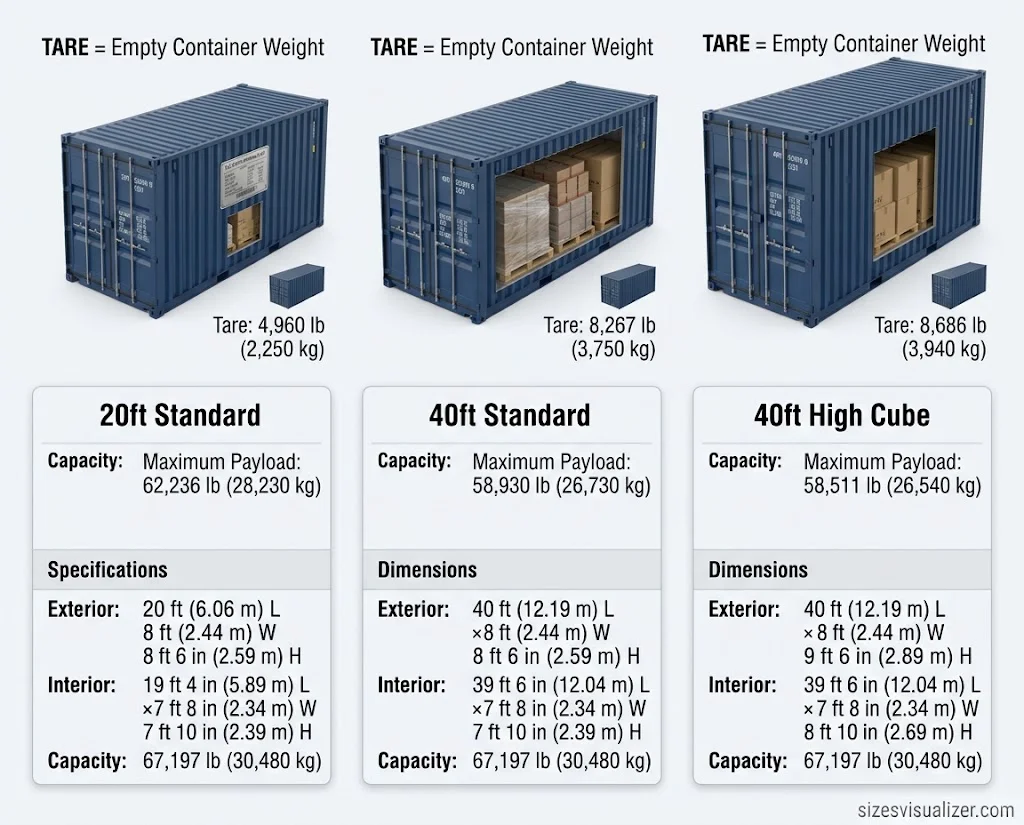
Three weight terms matter. Tare is the empty box. Payload is the cargo plus packing. Gross weight is both together.
| Container | Tare (empty) | Max gross weight | Max payload |
|---|---|---|---|
| 20ft | 4,960 lb (2,250 kg) | 67,197 lb (30,480 kg) | 62,236 lb (28,230 kg) |
| 40ft | 8,267 lb (3,750 kg) | 67,197 lb (30,480 kg) | 58,930 lb (26,730 kg) |
| 40ft HC | 8,686 lb (3,940 kg) | 67,197 lb (30,480 kg) | 58,511 lb (26,540 kg) |
A 20ft carries about 62,000 lb. A 40ft carries about 58,900 lb. A 40ft cannot hold twice the weight of a 20ft because its own steel is heavier.
Check the CSC plate. The CSC safety-approval plate on the door lists the rated limits for that exact box. Treat it as the final word.
Know the road limit. The rated payload is not always what you can legally haul. Federal law caps trucks on the Interstate at 80,000 lb gross, with 20,000 lb per single axle and 34,000 lb per tandem axle. The tractor, chassis, container and cargo all count toward that total. State rules can be tighter, and the FHWA explains the federal baseline.
Why a 20ft often “weighs out.” Dense cargo such as tile, stone or machinery hits the weight limit before the box fills up.
A quick example: Load 40,000 lb of cargo into a 20ft. Add the 4,960 lb tare, and the gross weight is 44,960 lb. That is under the 67,197 lb rating, but the truck must still pass the road limit.
About 1,172 cu ft. That is roughly 10 standard 48×40 in. pallets in one layer, depending on the layout. For a home move, it holds the contents of about four to six rooms.
A container’s dimensions are only one example of how precise standardized measurements can be. If you’re comparing other engineered systems where exact sizing and specifications matter, our guide to Picatinny rail dimensions and measurements] explains the standardized profiles and tolerances in detail.
20ft vs 40ft Container: Size, Capacity and Cost Compared

What is the difference between a 20ft and 40ft container? Length. Width and standard height stay the same. The 40ft has about twice the space but a slightly lower payload.
| Feature | 20ft | 40ft |
|---|---|---|
| Interior length | 19’4″ | 39’6″ |
| Capacity | 1,172 cu ft | 2,391 cu ft |
| Floor area | 150 sq ft | 300 sq ft |
| Max payload | ~62,200 lb | ~58,900 lb |
| Best for | Heavy cargo, tight sites, small offices | Bulk goods, container homes, large moves |
When to pick a 20ft: Choose it for dense loads, narrow driveways and storage. It is easier to deliver and place.
When to pick a 40ft: Choose it for light, bulky cargo and for homes or offices. Go for the 40ft high cube if you need headroom after insulation.
How much does a 40ft container cost? In 2026, U.S. listings show used 40ft units from about $1,750 to $4,500, and new one-trip units from about $3,700 to $7,500. A high cube usually adds about $200 to $500 over a standard 40ft.
Price per space: A 40ft gives about double the floor area of a 20ft for only 30 to 60 percent more in base price. Delivery is usually extra, so ask for an all-in quote.
Before delivery, check three things:
- Most delivery trucks need about 10 to 12 ft of width and 14 ft of overhead clearance.
- The ground must be level, or the doors can bind and water can pool.
- Local zoning and permit rules vary, so confirm them before you order.
Other Container Sizes and Types: 10ft, 45ft, 53ft, Reefer, Open Top & Flat Rack
10ft container
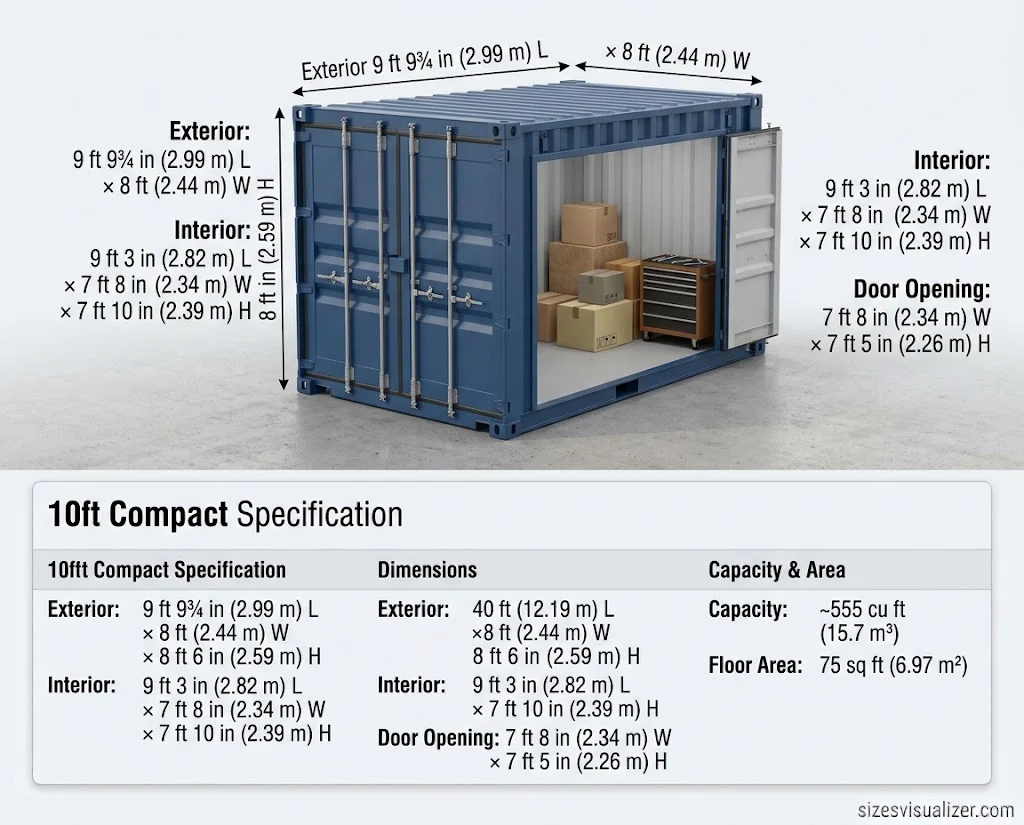
It is about 9’9¾” long outside and has 75 sq ft of floor. It suits small storage, tool sheds and guard shacks.
45ft high cube
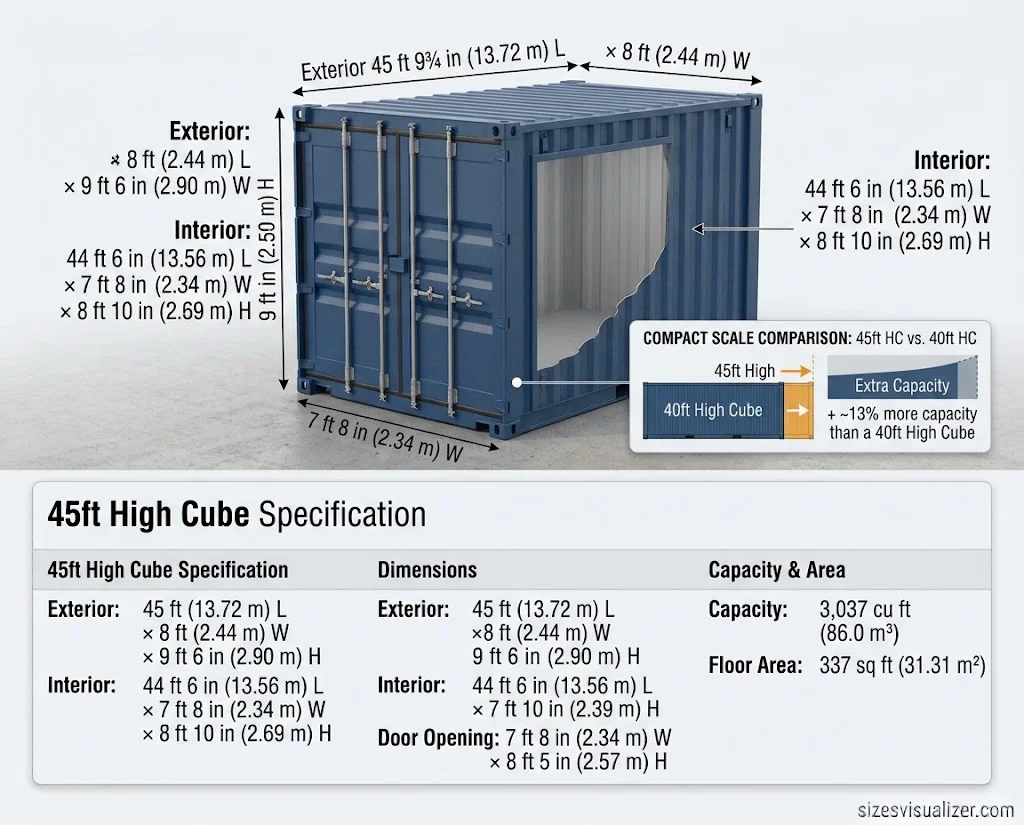
It holds about 3,037 cu ft, around 13% more than a 40ft HC. It is not available everywhere, and some inland routes restrict it.
53ft container
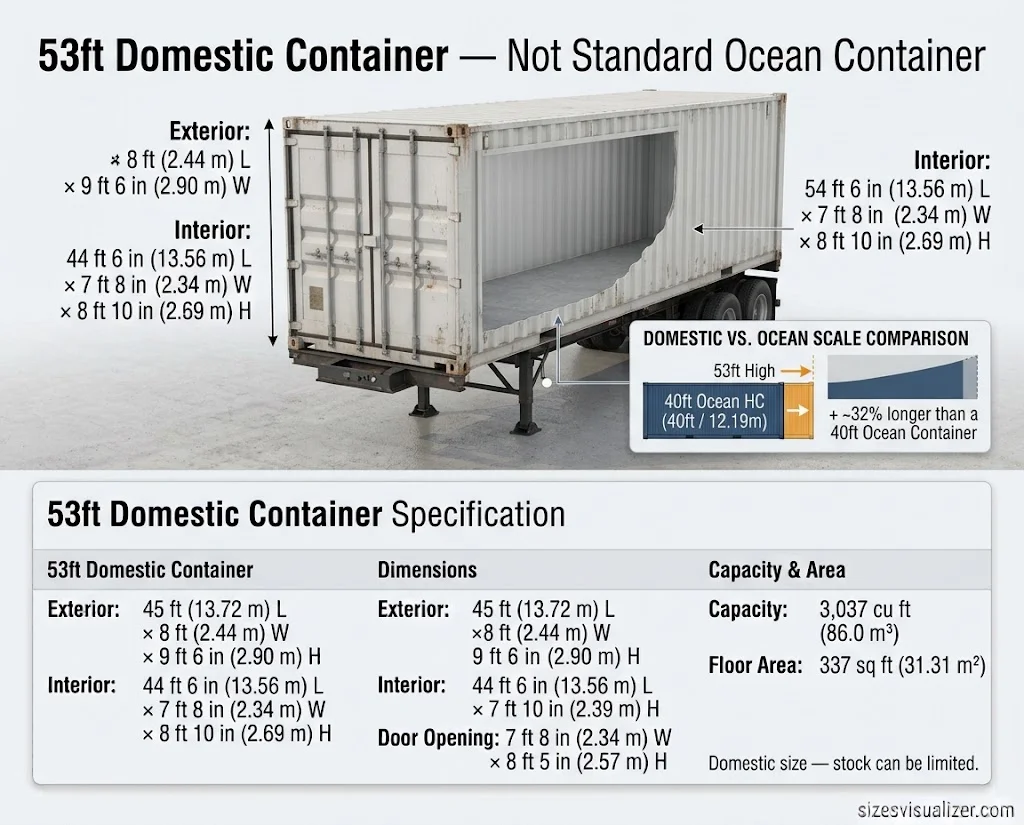
This is a domestic size. It is not a standard ocean size, and its interior runs about 52’6″ long. Stock is rare.
Custom sizes
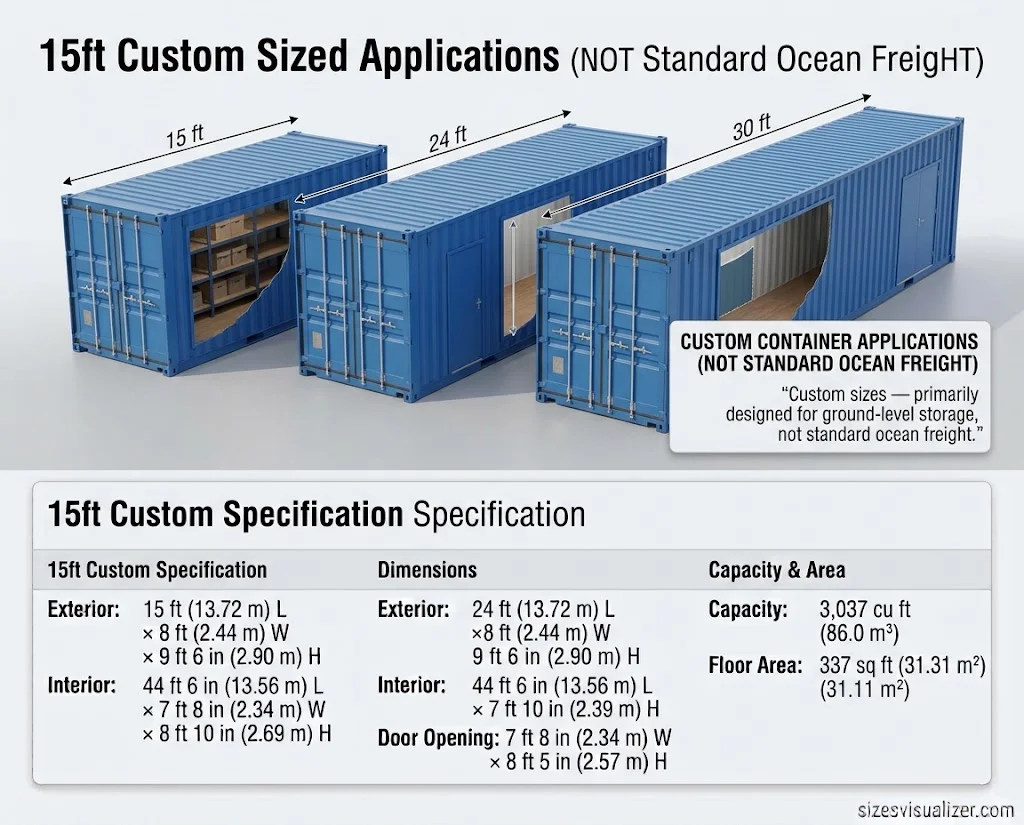
Some suppliers build 15ft, 24ft and 30ft units for storage. These are made for ground-level use, not ocean freight.
Reefer (refrigerated)
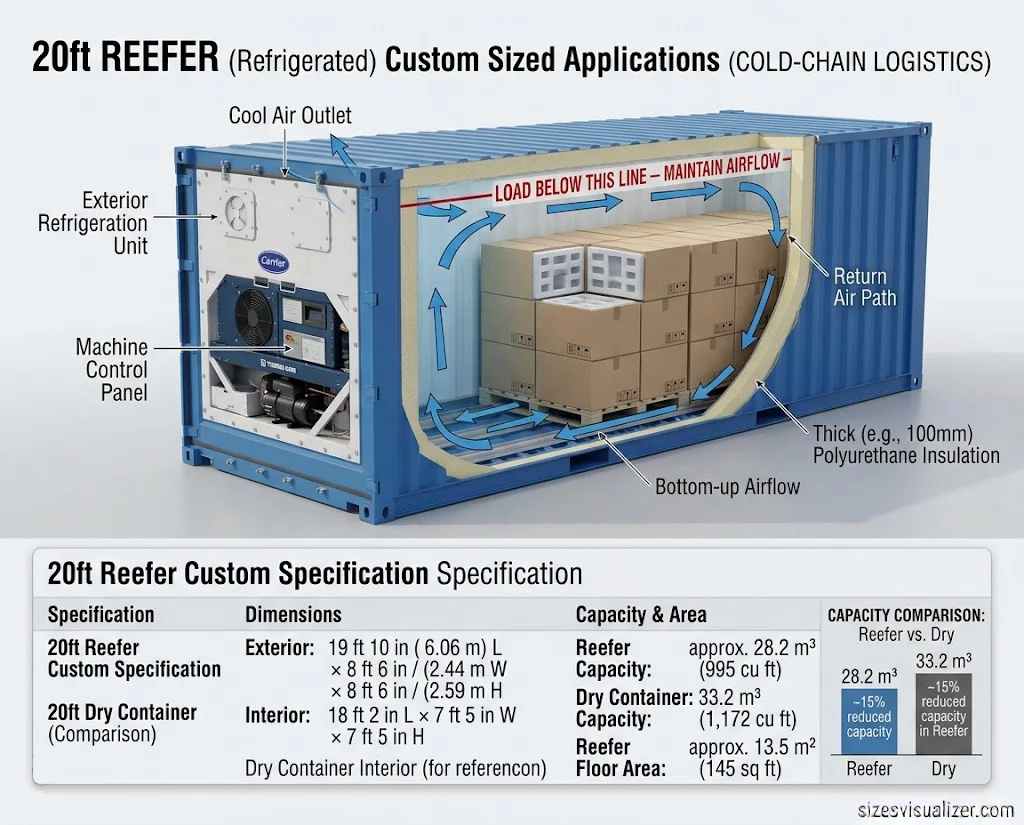
Insulated walls and a cooling unit shrink the inside. A 20ft reefer holds about 28.2 m³, versus 33.2 m³ for a dry box. Cargo must stay below the load line so air can flow.
Open top
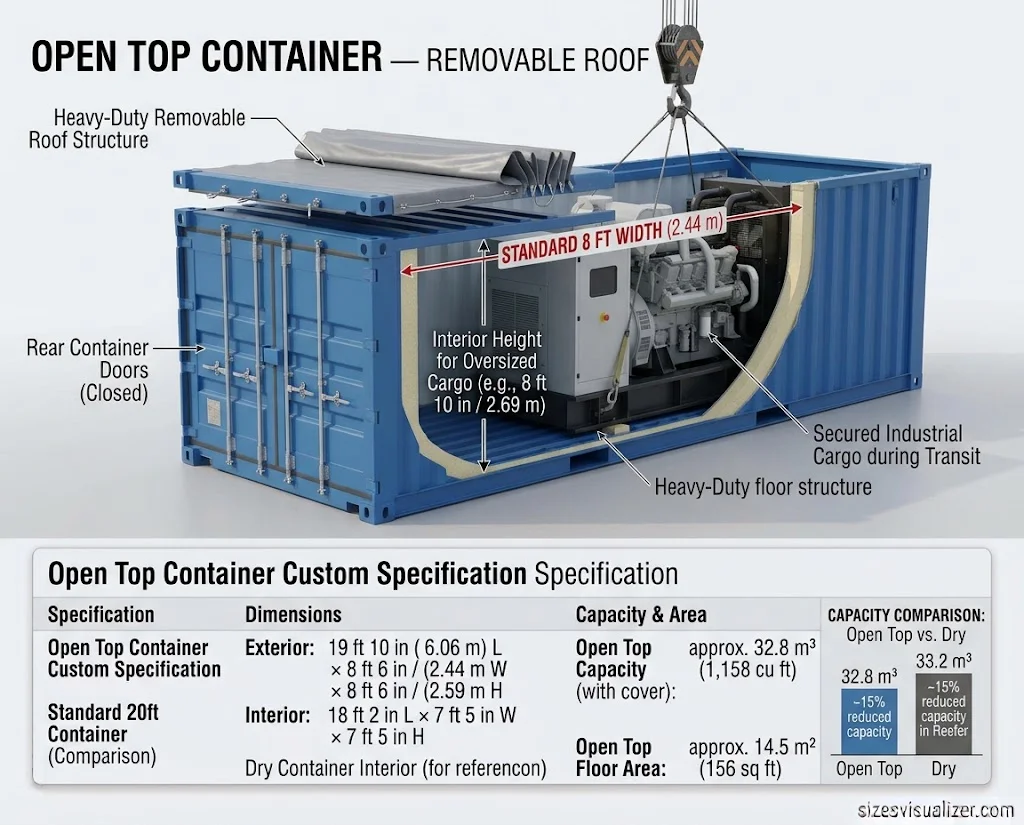
It has a removable roof and loads by crane. It suits tall cargo that will not fit a standard door.
Flat rack
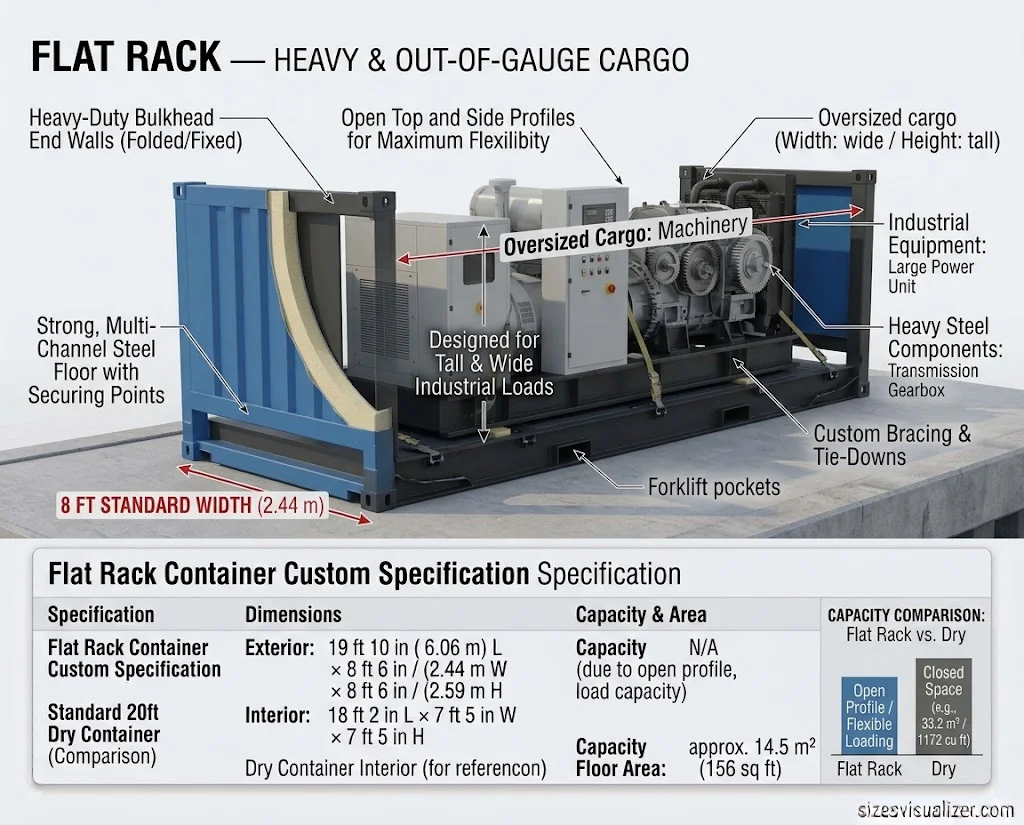
It has a floor and end walls, but no sides, roof or doors. It carries heavy or out-of-gauge cargo such as machinery, steel and vehicles.
One-trip vs used
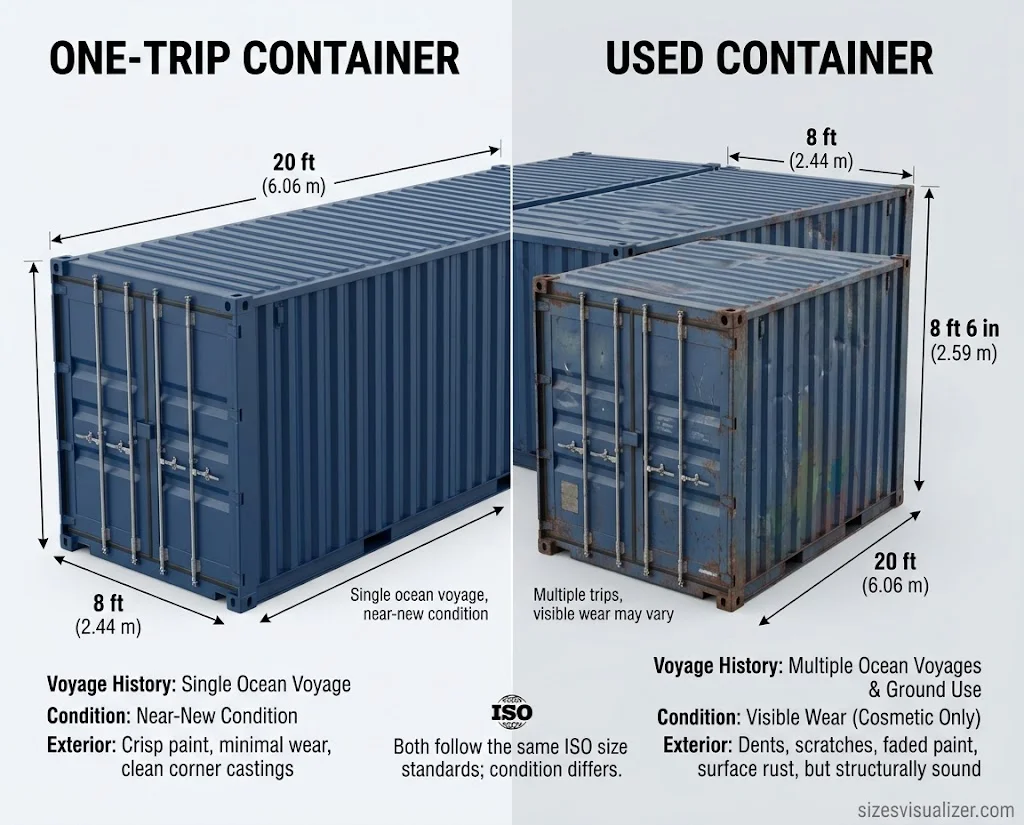
A one-trip container has made a single ocean voyage and is near new. Used units have made several trips. Both follow the same ISO sizes, but wear and dents differ.
FAQs
What is the dimension of a 40ft container?
Outside, it measures 40′ × 8′ × 8’6″. Inside, it is about 39’6″ × 7’8″ × 7’10”, with 2,391 cu ft of space. The door opening is about 7’8″ wide and 7’5″ tall. A 40ft high cube is 9’6″ tall outside.
What is the dimension of a 20ft container?
Outside, it measures 20′ × 8′ × 8’6″. Inside, it is about 19’4″ × 7’8″ × 7’10”, with 1,172 cu ft (33.2 m³) of space. The door opening is about 7’8″ × 7’5″.
What is the difference between a 20ft and 40ft container?
Length and capacity. A 40ft has about double the floor area and cubic space. Width and height match. The 40ft carries slightly less payload because the box itself weighs more.
How much can a 20ft container hold?
It holds up to 1,172 cu ft and about 62,000 lb. In practice, that means roughly 10 standard pallets per layer, or four to six rooms of household goods. Dense cargo hits the weight limit first.
What is the maximum load for a 20ft and 40ft container?
A 20ft carries about 62,236 lb of payload. A 40ft carries about 58,930 lb. Road limits, such as 80,000 lb gross on the Interstate, often cut the usable load. Always check the CSC plate.
How much does a 40ft container cost?
In 2026, used 40ft units run about $1,750 to $4,500. New one-trip units run about $3,700 to $7,500. Condition, location and delivery change the final price.
Conclusion:
Before you ship, buy or convert a box, confirm the exact container measurements on the unit’s CSC plate. The key numbers are about 1,172 cu ft for a 20ft, about 2,391 cu ft for a 40ft, and one extra foot of height for a high cube. For a firm price, request a quote from a container specialist.

Measurement Researcher, Size Comparison Writer & Content Specialist
Timmy Ahad is a dedicated content writer and research specialist at SizesVisualizer.com, where he focuses on creating accurate, easy-to-understand content about measurements, dimensions, size comparisons, and real-world object visualization.