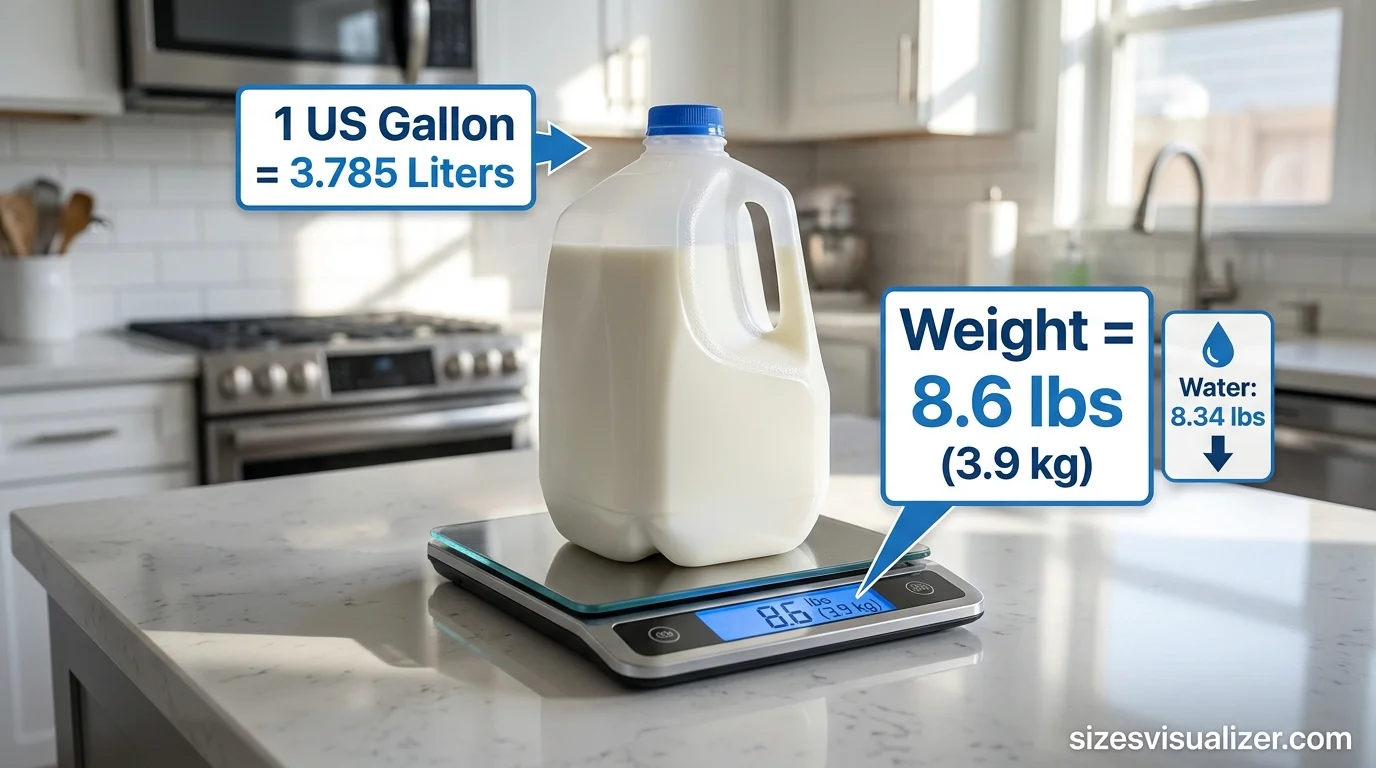
A gallon of milk weighs 8.6 pounds, or about 3.9 kilograms. That is heavier than a gallon of water, which weighs only 8.34 pounds. The extra weight comes from fat, protein, and milk sugar dissolved inside it.
This number changes slightly depending on the type of milk and where you buy it. Whole milk, 2% milk, skim milk, and imperial gallons sold in the UK or Canada all carry a different number on the scale. Here is the full breakdown, in pounds, kilograms, and liters.
Table of Contents
How Much Does a Gallon of Milk Weigh in Pounds, KG & Liters?
One gallon of milk weighs 8.6 lbs (3.901 kg). In liters, that same gallon holds 3.785 liters of milk, and each liter weighs roughly 2.27 pounds (1.03 kg).
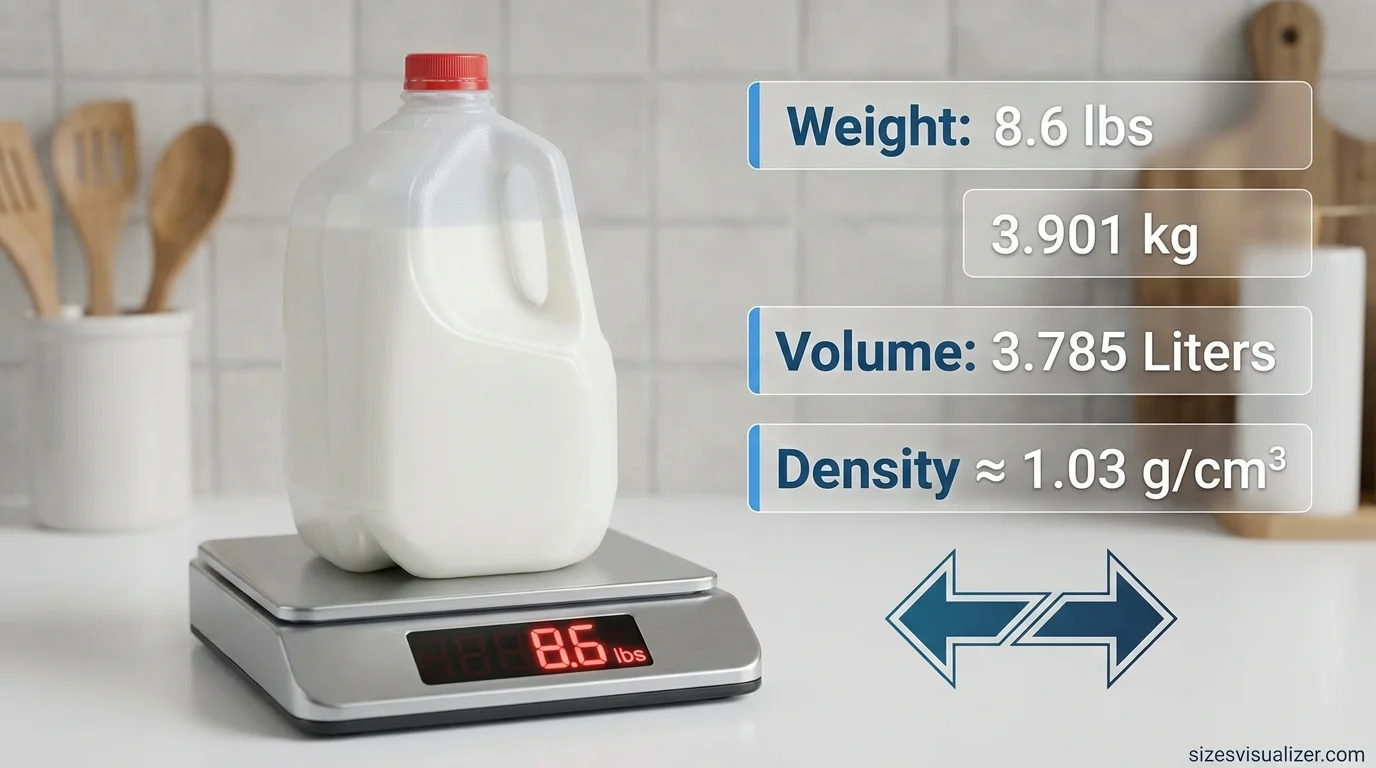
Weight is not a fixed number for any liquid. It comes from volume multiplied by density. Milk is denser than water because it carries dissolved solids like fat, protein, and lactose. That is why the gallon weight lands above water’s 8.34 pounds instead of matching it exactly.
See how this measurement compares in real life with our Size Visualizer & Comparison Tool, designed for quick and accurate visual comparisons.
Milk Weight Chart: Cup, Pint, Quart, Half Gallon & Gallon
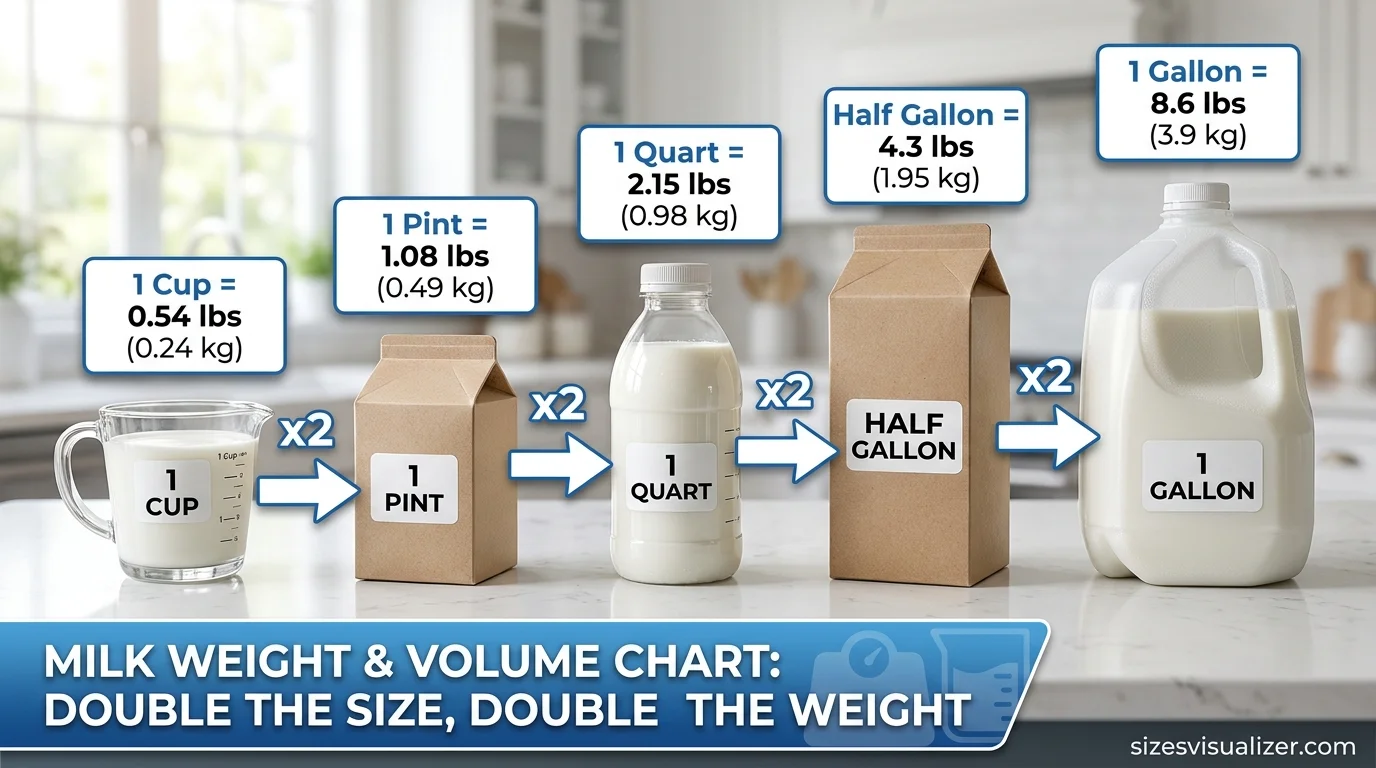
Here is how milk weight breaks down across common kitchen and shipping measurements, in both US and metric units.
| Volume | Weight (lbs) | Weight (kg) |
|---|---|---|
| 1 cup | 0.54 lbs | 0.24 kg |
| 1 pint | 1.08 lbs | 0.49 kg |
| 1 quart | 2.15 lbs | 0.98 kg |
| Half gallon | 4.3 lbs | 1.95 kg |
| 1 gallon | 8.6 lbs | 3.9 kg |
| 1 liter | 2.27 lbs | 1.03 kg |
Notice the pattern: every measurement scales evenly. Double the volume, double the weight. A half gallon of milk weighs 4.3 pounds, exactly half of a full gallon, because density stays constant no matter how much milk you pour.
Why Does Milk Weigh More Than Water?
Milk weighs more than water because of what is dissolved inside it, not because of any single ingredient acting alone. Milk’s density sits between 1.02 and 1.034 grams per cubic centimeter, while pure water sits at exactly 1.0 g/cm³.
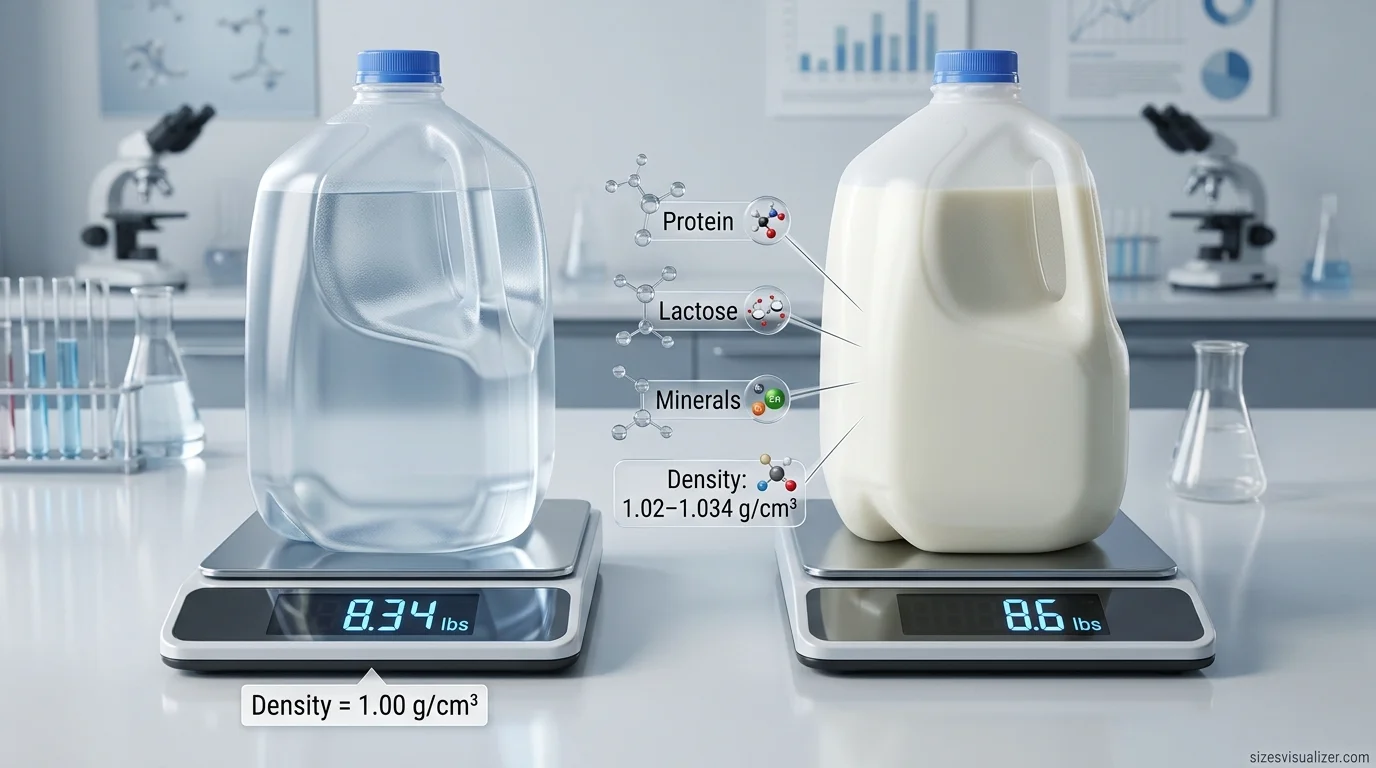
Milk is roughly 87% water. The remaining 13% is a mix of milkfat, protein, lactose, and minerals like calcium and phosphorus. Protein and lactose are both denser than water, and they pull the overall density upward. Fat, on the other hand, is actually less dense than water, not more. So the common idea that “fat makes milk heavier” gets the science backward. It is the non-fat solids, mainly protein and milk sugar, doing the heavy lifting.
Here is the formula used to calculate it, step by step:
Weight (grams) = Volume (cm³) × Density (g/cm³)
One US gallon equals 3,785.41 cubic centimeters. Multiply that by an average milk density of 1.03 g/cm³, and you get 3,898.97 grams. Divide by 453.59 grams per pound, and the result lands at 8.6 pounds per gallon, matching real-world measurements almost exactly.
Must Visit: How Big Is 3 Inches? 20 Everyday Things That Are About 3 Inches Long
Does Milk Fat Content Change the Weight? Whole, 2%, and Skim Compared
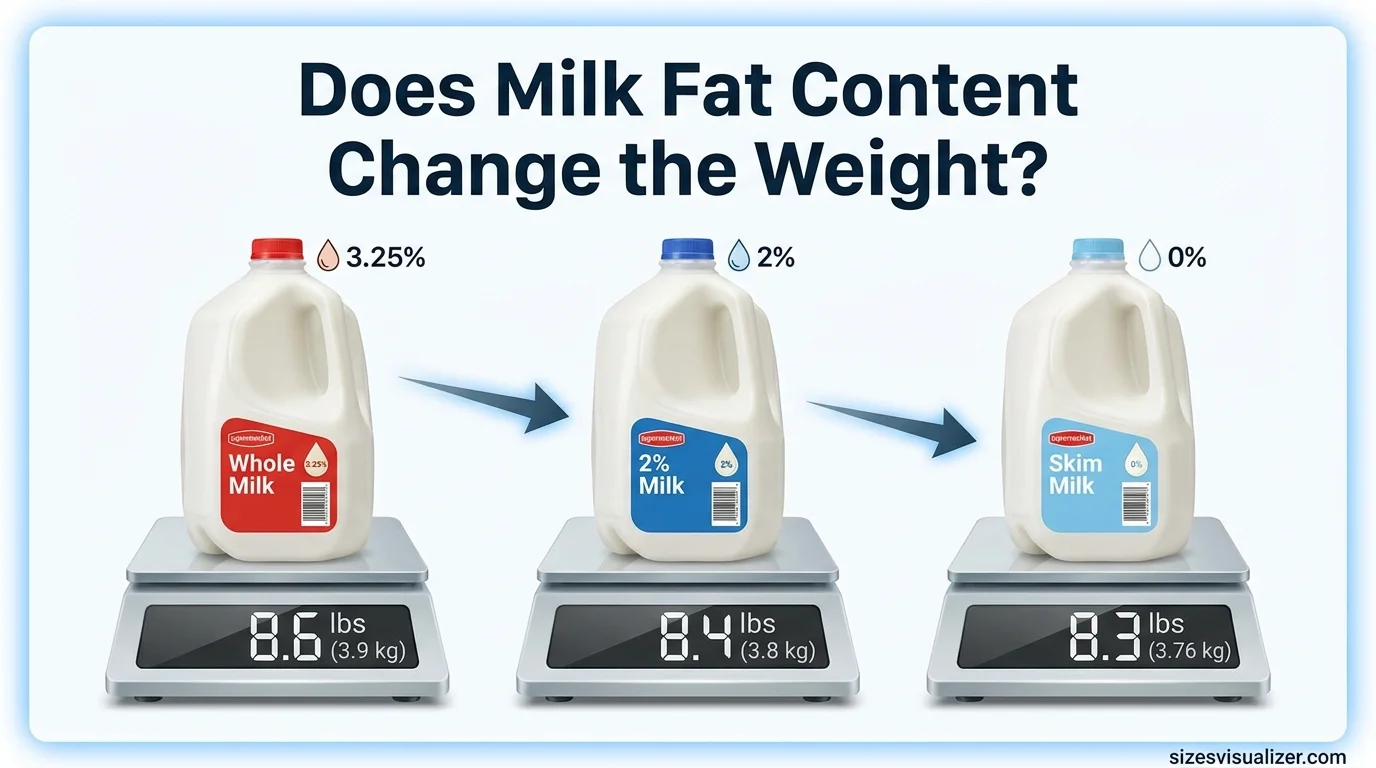
Yes, but only slightly. Removing fat from milk lowers its density a small amount, since fat molecules are lighter than the water and protein around them.
| Milk Type | Weight per Gallon (lbs) | Weight per Gallon (kg) |
|---|---|---|
| Whole milk | 8.6 lbs | 3.9 kg |
| 2% milk | 8.4 lbs | 3.8 kg |
| Skim milk | 8.3 lbs | 3.76 kg |
The gap between whole milk and skim milk is small, usually under half a pound per gallon. That is because fat only makes up a few percent of milk’s total volume to begin with. A gallon of 2% milk weighs close to 8.4 pounds, sitting right between whole and skim on the density scale.
US Gallon vs UK/Imperial Gallon: Why Milk Weight Varies by Country
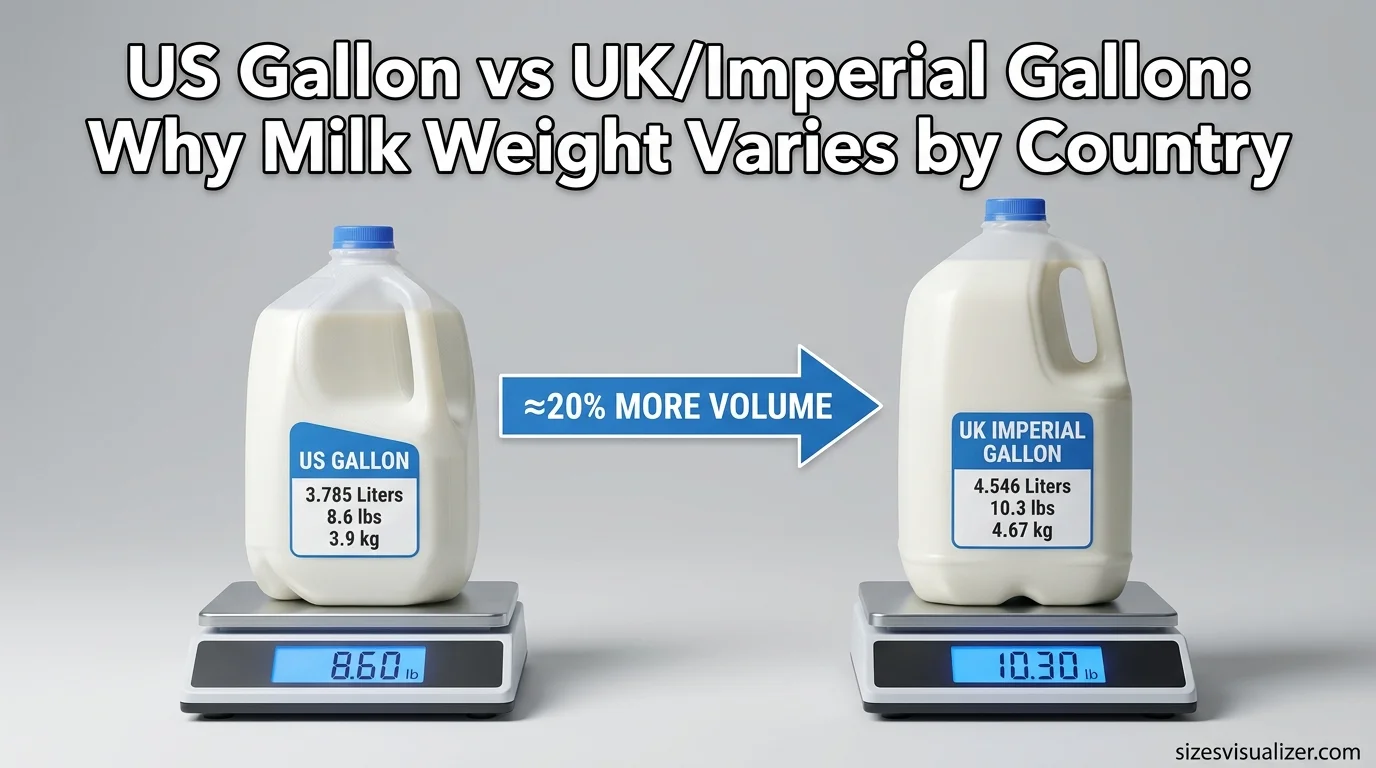
A US gallon and a UK gallon are not the same size, and that changes the weight of milk sold in each country. The US gallon holds 3.785 liters, while the UK imperial gallon holds 4.546 liters, about 20% more volume.
That difference carries straight through to weight. A gallon of milk in the United States weighs 8.6 pounds. In the UK or Canada, where the imperial gallon is standard, a gallon of milk weighs closer to 10.3 pounds, simply because it holds more liquid, not because the milk itself is denser.
If you are comparing a recipe, shipping label, or nutrition source from outside the US, check which gallon it is using before trusting the number.
FAQs
How heavy is 1 gallon of milk in pounds?
One gallon of milk weighs 8.6 pounds. This applies to whole milk in a standard US gallon container.
Is a gallon of milk 10 lb?
No, a US gallon of milk weighs 8.6 pounds, not 10. A gallon of milk only reaches around 10.3 pounds when measured using the larger UK imperial gallon.
Which is heavier, a gallon of milk or water?
Milk is heavier. A gallon of milk weighs 8.6 pounds, while a gallon of water weighs 8.34 pounds, a difference caused by milk’s dissolved protein and lactose.
How heavy is a gallon of 2% milk?
A gallon of 2% milk weighs about 8.4 pounds. It sits between whole milk (8.6 lbs) and skim milk (8.3 lbs) because of its lower fat content.
How much heavier is milk than water?
Milk is about 0.25 to 0.3 pounds heavier per gallon than water, roughly a 3% difference. This comes from milk’s density of 1.02 to 1.034 g/cm³ versus water’s 1.0 g/cm³.
Does 1 gallon equal 1 lb?
No. A gallon measures volume, and a pound measures weight. The two only relate to each other once you know the density of the liquid inside the gallon.
Conclusion
A gallon of milk weighs 8.6 pounds, or 3.9 kilograms, a little heavier than water because of the protein, lactose, and minerals dissolved inside it. The exact number shifts slightly by fat content and shifts more by country, since the US and UK use different sized gallons. Use the chart above any time you need an exact figure for cooking, shipping, or packing.

Measurement Researcher, Size Comparison Writer & Content Specialist
Timmy Ahad is a dedicated content writer and research specialist at SizesVisualizer.com, where he focuses on creating accurate, easy-to-understand content about measurements, dimensions, size comparisons, and real-world object visualization.