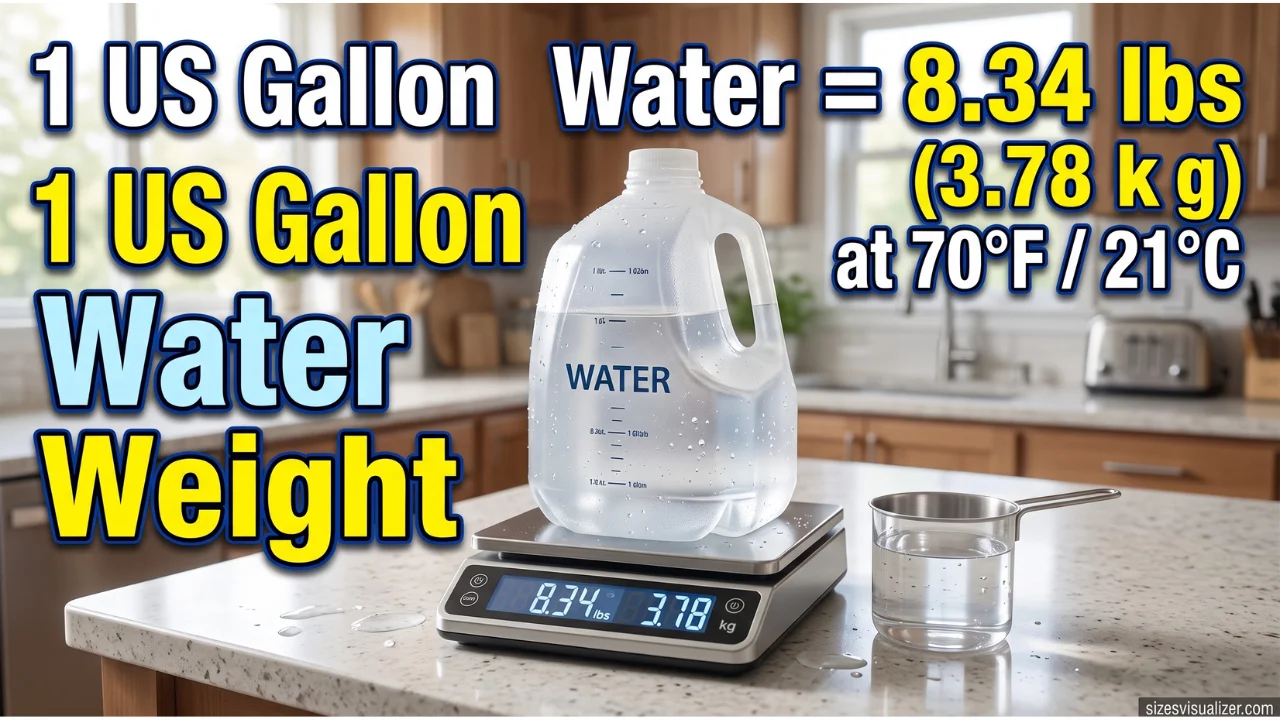
Most people guess somewhere around 8 pounds. They’re close — but not exactly right.
A US gallon of water weighs 8.34 pounds (3.78 kg) at room temperature (70°F / 21°C). But that number shifts depending on temperature, water type, and even where you are on Earth.
This guide breaks it all down — with facts, real numbers, and practical examples that actually matter in daily life.
What Does a Gallon of Water Actually Weigh? (US vs Imperial)
Before jumping to the weight, you need to know which gallon you’re measuring. This matters more than most people realize.
There are two types of gallons in common use today:
- US liquid gallon = 128 fluid ounces = 3.785 liters
- Imperial (UK) gallon = 160 fluid ounces = 4.546 liters
They are not the same. Using the wrong one can throw off your calculations by nearly 20%.
How Much Does a US Gallon of Water Weigh in Pounds?
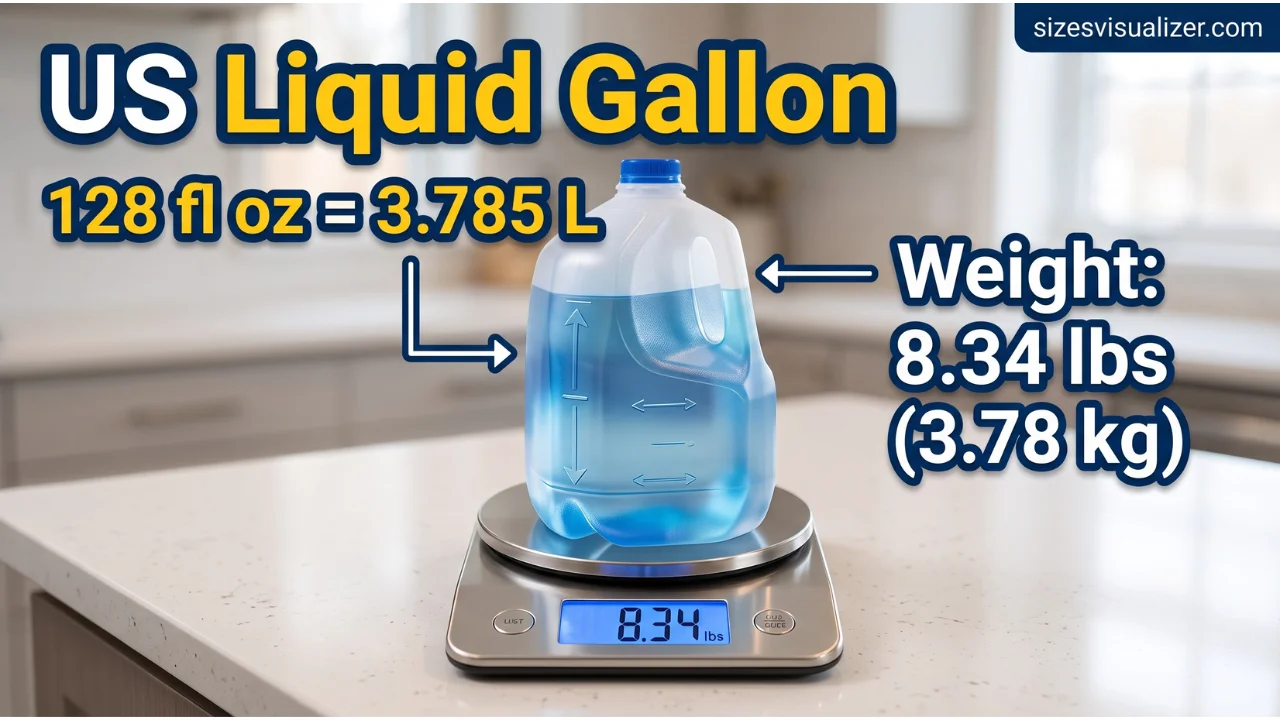
At room temperature (70°F / 21°C), one US gallon of fresh water weighs 8.33 to 8.34 pounds.
At its maximum density point — 39.2°F (4°C) — that same gallon weighs 8.345 pounds. This is the heaviest water gets.
At boiling point (212°F / 100°C), water expands and weighs only about 7.92 pounds per gallon.
The formula is simple:
Weight = Volume × Density
Since water density changes with temperature, the weight changes too.
How Much Does an Imperial Gallon of Water Weigh?
One Imperial gallon of water weighs approximately 10.02 pounds (4.54 kg).
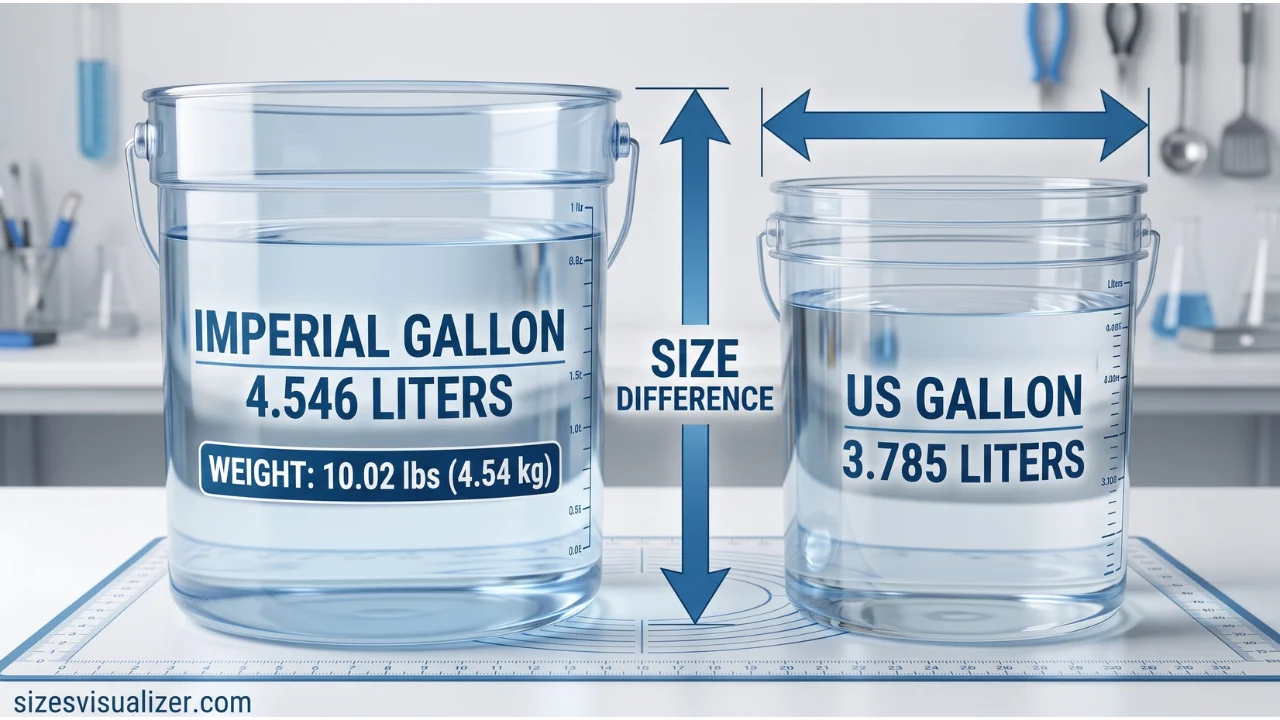
That’s nearly 1.7 pounds heavier than a US gallon — because the Imperial gallon holds more volume (4.546 liters vs 3.785 liters).
Always check your source. A recipe or product guide written in the UK uses Imperial gallons. If you apply US gallon math to it, your numbers will be wrong.
| Gallon Type | Volume | Weight (lbs) | Weight (kg) |
|---|---|---|---|
| US Liquid Gallon | 3.785 L | 8.34 lbs | 3.78 kg |
| Imperial (UK) Gallon | 4.546 L | 10.02 lbs | 4.54 kg |
How Heavy Is a Gallon of Water in kg?
- 1 US gallon of water = 3.78 kg
- 1 Imperial gallon of water = 4.54 kg
The metric system makes this easy. One liter of water weighs almost exactly 1 kilogram at standard conditions. So 3.785 liters (1 US gallon) ≈ 3.785 kg.
Must Visit: Standard Door Sizes Explained: A Complete Guide to Residential Door Dimensions
What Factors Affect the Weight of a Gallon of Water?
Water weight is not a fixed number. It varies based on three key factors: temperature, altitude/pressure, and dissolved content (like salt).
How Does Temperature Change the Weight of Water?
This is the biggest factor — and it surprises most people.
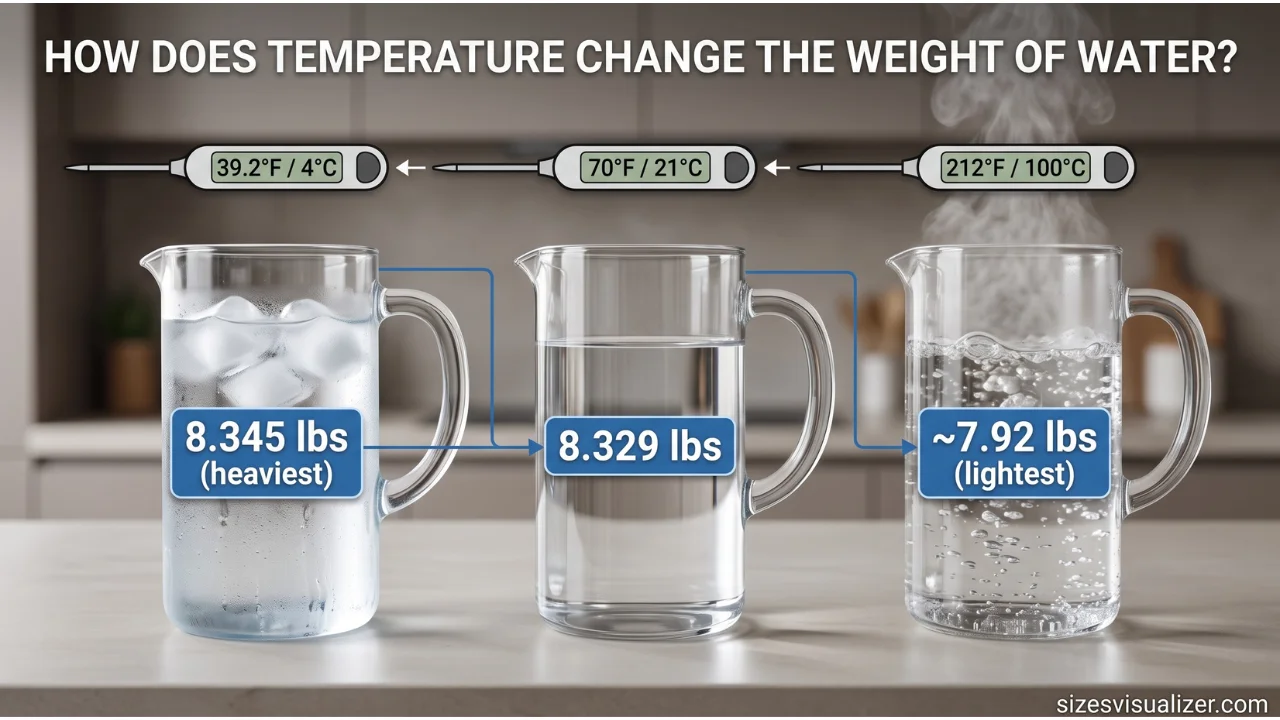
Water reaches peak density at 39.2°F (4°C). At this point, water molecules are packed together most efficiently. This is when water is heaviest.
As temperature rises, molecules gain energy and spread apart. This lowers water density — and therefore lowers the weight per gallon.
As temperature drops below 39.2°F toward freezing (32°F / 0°C), water starts forming a crystalline ice structure. This actually expands the volume, making it slightly lighter per gallon too.
Here’s how water density changes across temperatures:
| Temperature | Density (g/ml) | Weight per US Gallon |
|---|---|---|
| 39.2°F / 4°C (peak density) | 1.00000 | 8.345 lbs (heaviest) |
| 62°F / 16.7°C | 0.99907 | 8.338 lbs |
| 70°F / 21°C (room temp) | 0.99802 | 8.329 lbs |
| 100°F / 37.8°C | 0.99318 | 8.285 lbs |
| 212°F / 100°C (boiling) | 0.95865 | ~7.92 lbs (lightest) |
Key takeaway: The difference between cold and boiling water is about 0.4 pounds per gallon. Small for one gallon — significant for 100 gallons.
Does Altitude and Atmospheric Pressure Affect Water Weight?
Yes — but only slightly.
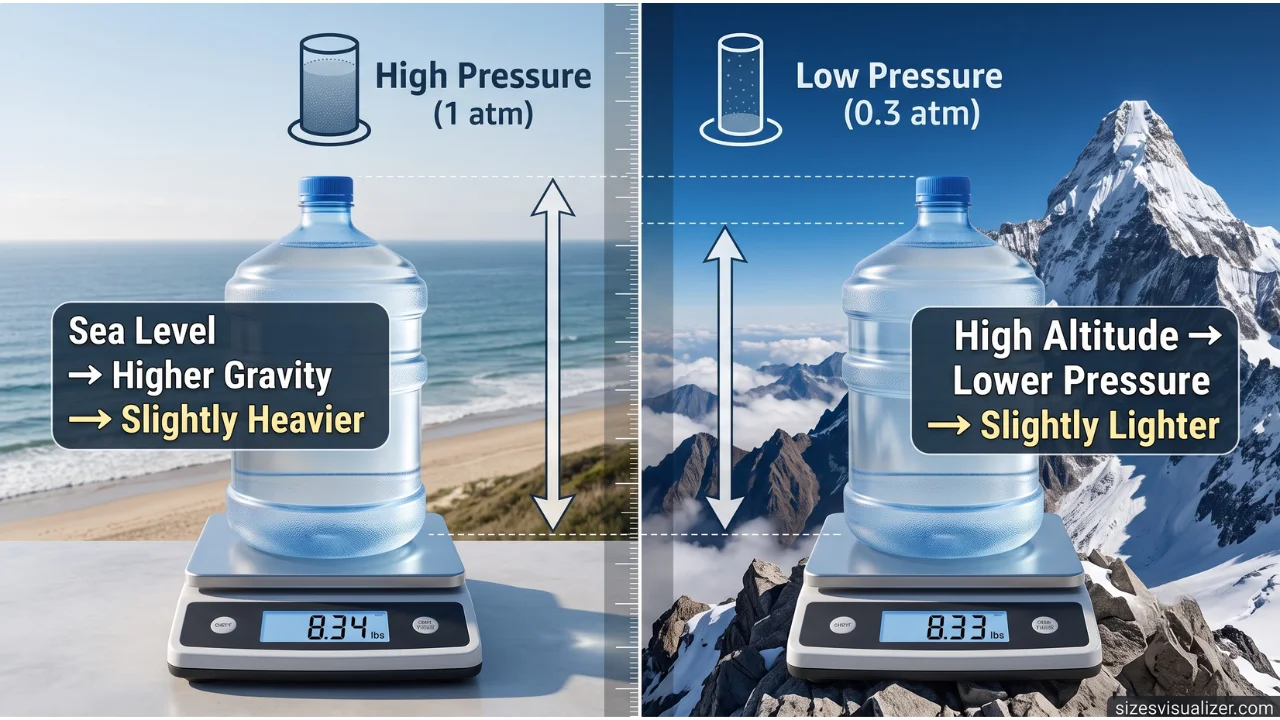
Gravity is what gives water its weight. At sea level, Earth’s gravitational pull is strongest. At higher altitudes, that pull weakens slightly. So a gallon of water measured at the top of a mountain technically weighs a fraction less than at sea level.
Atmospheric pressure follows the same pattern. Higher elevation = lower pressure = marginally lower weight.
For everyday use — cooking, camping, RV travel — this difference is negligible. But in precision scientific measurements or engineering applications, these factors must be accounted for.
A gallon of water on Jupiter would weigh close to 20 pounds — because Jupiter’s gravity is roughly 2.4x stronger than Earth’s.
Does Salt Change How Much a Gallon of Water Weighs?
Absolutely — and this one matters more than most people expect.
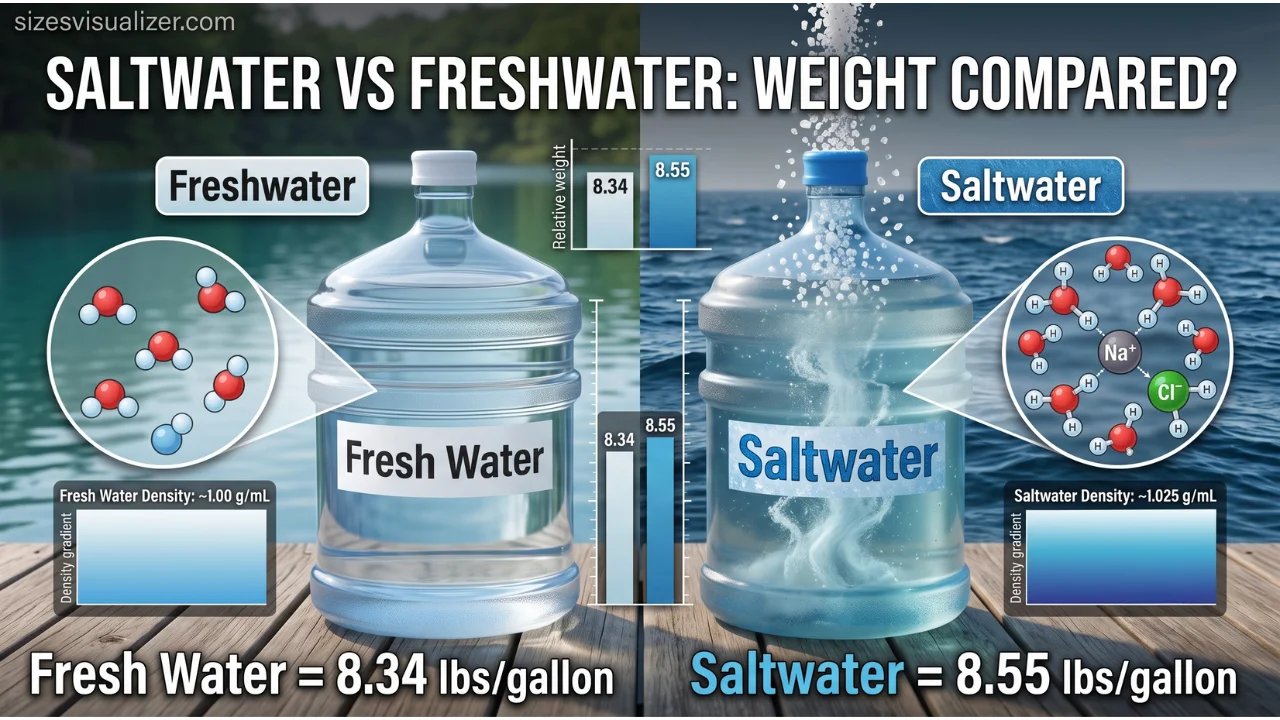
Saltwater is denser than fresh water. Dissolved salt minerals add mass without significantly increasing volume. This raises the density of seawater to approximately 1.025 g/ml.
As a result:
- Fresh water: ~8.34 lbs per gallon
- Saltwater (ocean salinity): ~8.55 lbs per gallon
That’s a difference of 0.21 pounds per gallon. For a 50-gallon saltwater aquarium, that’s an extra 10+ pounds you need to account for when building a stand or calculating structural load.
Reef tank owners, boat operators, and marine researchers all need to use saltwater weight — not freshwater weight — in their calculations.
Use our Size Visualizer Tool to instantly compare and visualize real-world dimensions of any object, space, or measurement before making accurate decisions.
How Much Do Multiple Gallons of Water Weigh?
Understanding one gallon is useful. But most real-world situations involve much larger volumes.
How Much Do 2, 5, 10, 50 and 100 Gallons of Water Weigh?
- How heavy is a 2-gallon of water? → 16.68 lbs (7.56 kg)
- How much do 5 gallons of water weigh? → 41.7 lbs (18.9 kg) — that’s the standard office water jug weight
- 10 gallons of water → 83.4 lbs (37.8 kg) — exceeds safe solo lifting limits for most adults
- 50 gallons of water → 417 lbs (189 kg) — common water heater tank load
- 100 gallons of water → 834 lbs (378 kg) — close to the weight of a compact car engine
Backpacking note: Just 2 gallons of emergency water adds over 16 lbs to your pack. In survival terms, that’s significant.
Water Weight by Gallon — Full Reference Table (lbs & kg)
| Gallons | Weight (lbs) | Weight (kg) |
|---|---|---|
| 1 | 8.34 | 3.78 |
| 2 | 16.68 | 7.56 |
| 3 | 25.02 | 11.34 |
| 4 | 33.36 | 15.12 |
| 5 | 41.70 | 18.90 |
| 10 | 83.40 | 37.80 |
| 15 | 125.10 | 56.70 |
| 20 | 166.80 | 75.60 |
| 30 | 250.20 | 113.40 |
| 40 | 333.60 | 151.20 |
| 50 | 417.00 | 189.00 |
| 75 | 625.50 | 283.50 |
| 100 | 834.00 | 378.00 |
Based on US gallons at room temperature (70°F / 21°C). Fresh water density: 0.998 g/ml.
Why Does Water Weight Matter in Real Life?
This is where most guides fall short. Knowing 8.34 lbs is trivia. Knowing why it matters is practical intelligence.
Water Weight for Aquariums, Fish Tanks & Home Use
A 10-gallon fish tank doesn’t just weigh 83 lbs. Add the glass, gravel (substrate), filter, lid, and decorations — and you’re easily looking at 100–120 lbs on your furniture.
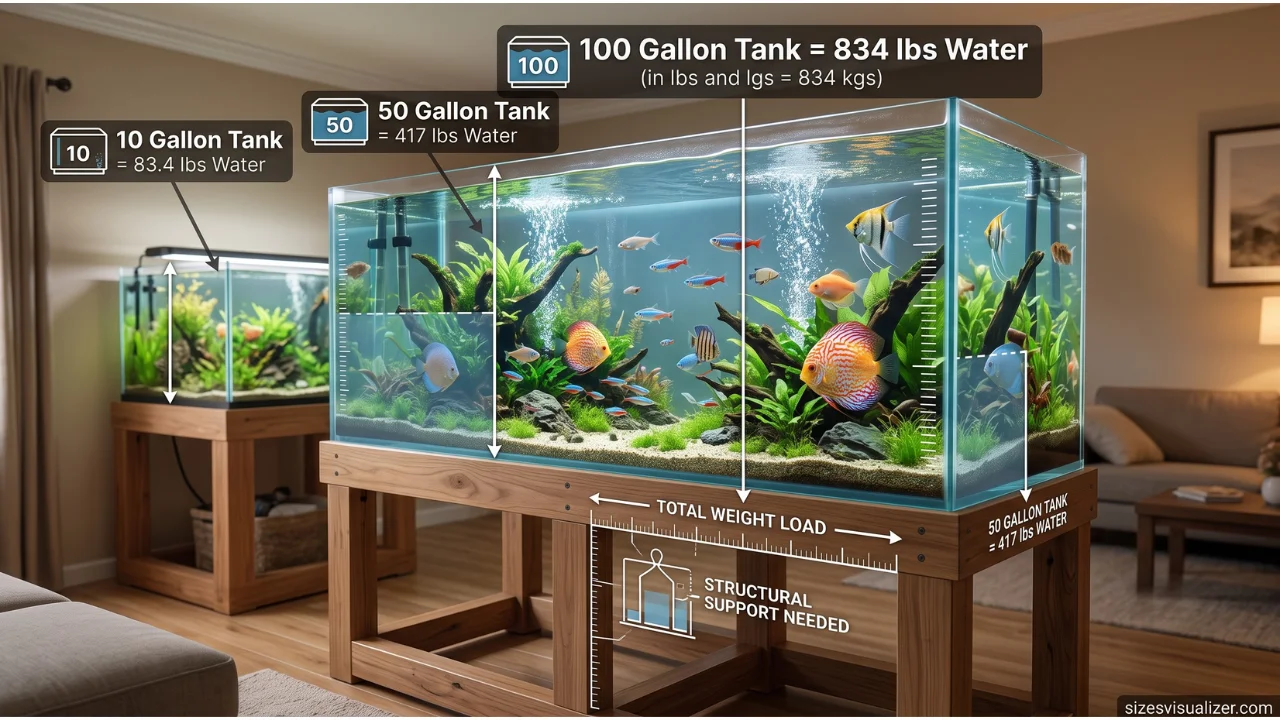
A 100-gallon aquarium holds over 834 lbs of fresh water alone. With the tank, stand, and equipment, total load can exceed 1,000 lbs. That requires reinforced flooring.
Always check your furniture’s static load rating before filling any tank.
For saltwater aquariums, use 8.55 lbs/gallon — not 8.34. A 50-gallon reef tank holds approximately 427.5 lbs of saltwater, which is over 10 lbs more than fresh water at the same volume.
RV, Camping & Emergency Water Storage Weight
For RV travelers, water weight directly affects your vehicle’s Gross Vehicle Weight Rating (GVWR).
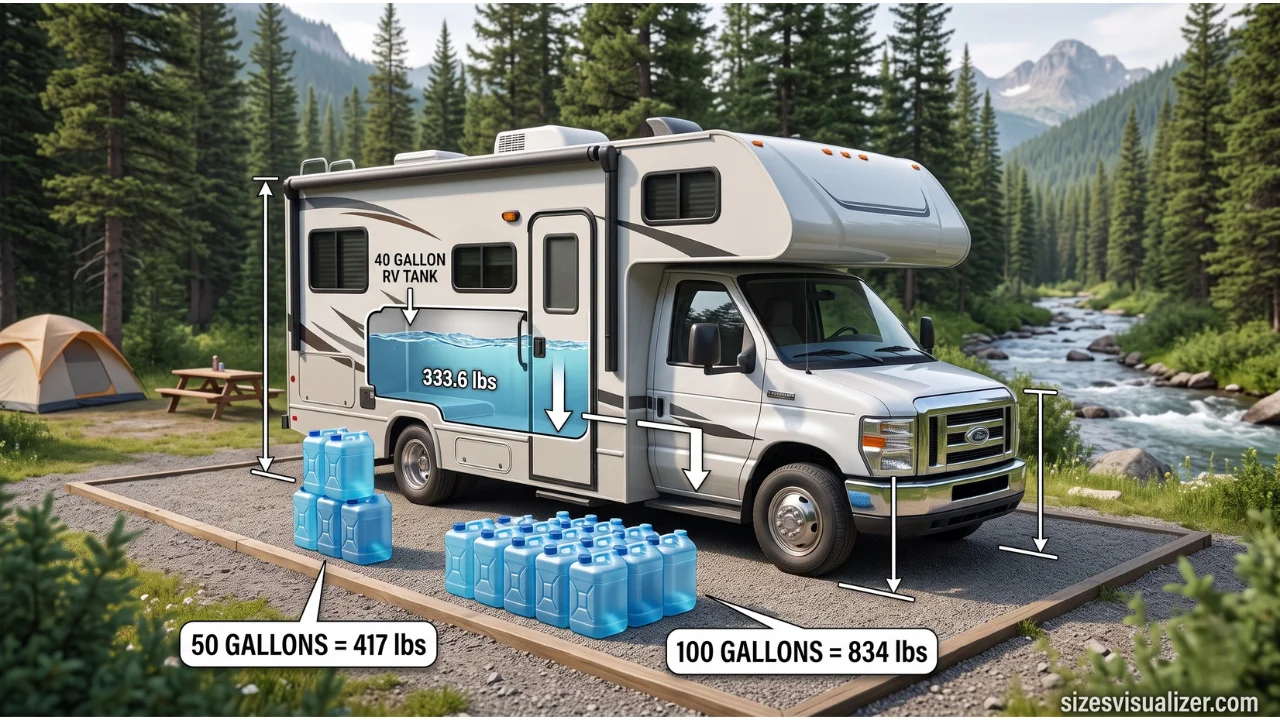
A standard 40-gallon freshwater tank, when full, adds 333.6 lbs to your RV. This impacts fuel efficiency, braking distance, and axle stress.
A 500-gallon water storage tank — common for off-grid homes and farms — holds approximately 4,170 lbs of water. That’s over two metric tons. The ground or platform beneath it must be rated for that load.
For emergency water storage, FEMA recommends at least 1 gallon per person per day. A 2-week supply for a family of 4 = 56 gallons = roughly 467 lbs. Plan your storage structure accordingly.
Backpacking & Survival — How Heavy Is the Water You Carry?
In the survival and backpacking community, there’s a well-known saying: “ounces equal pounds, and pounds equal pain.”
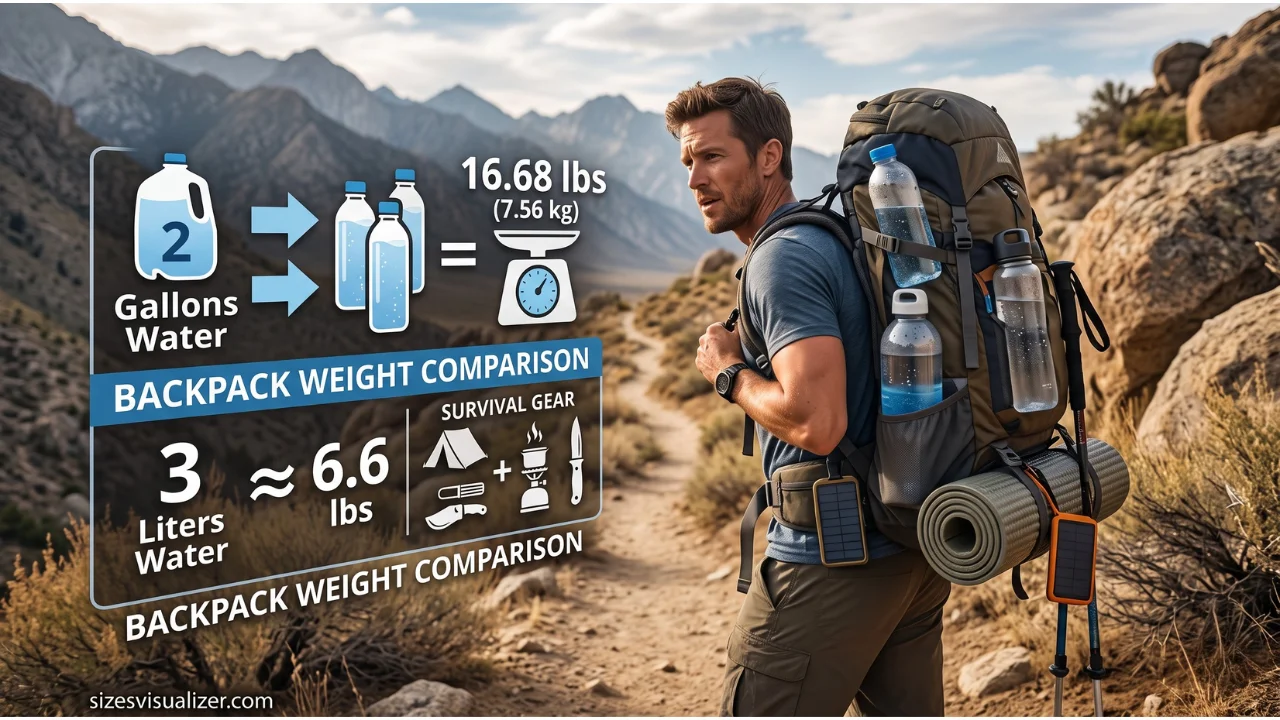
Carrying 2 gallons of water adds 16.68 lbs to your pack. For a hiker whose base pack weight is 20–25 lbs, that’s nearly 50% more weight.
Most experienced hikers carry no more than 2–3 liters at a time (roughly 4.4–6.6 lbs) and refill at water sources along the route.
Water filtration systems like pump filters, UV pens, or gravity filters allow hikers to carry less and drink safely from natural sources.
How Does Water Weight Compare to Other Common Liquids?
Not all liquids weigh the same per gallon. Water is the standard reference point — but here’s how it actually stacks up.
Water vs Gasoline, Honey & Saltwater
| Liquid | Weight per US Gallon | Denser Than Water? |
|---|---|---|
| Saltwater | ~8.55 lbs | ✅ Yes |
| Whole Milk | ~8.60 lbs | ✅ Yes |
| Fresh Water | 8.34 lbs | — (baseline) |
| Vegetable Oil | ~7.5–7.7 lbs | ❌ No |
| Gasoline | ~6.1 lbs | ❌ No |
| Propane (liquid) | ~4.24 lbs | ❌ No |
| Honey | ~12.0 lbs | ✅ Yes |
Honey is the densest common kitchen liquid — nearly 44% heavier than water per gallon. This is due to its high sugar concentration and very low water content.
Gasoline floats on water for the same reason oil does — lower molecular density. This is a critical fact in fire safety and environmental spill response.
FAQ”s
Is a gallon of milk heavier than water?
Yes. A gallon of whole milk weighs about 8.6 lbs, while a gallon of water weighs 8.34 lbs. The extra weight comes from the fats, proteins, and sugars dissolved in milk, which increase its overall density slightly above pure water.
How much do 5 gallons of water weigh?
Five US gallons of water weigh approximately 41.7 pounds (18.9 kg) at room temperature. This is why standard 5-gallon water jugs — like those used in offices and gyms — require a proper grip and lifting technique. Never hoist one with a straight back.
How heavy is a gallon of water in kg?
One US gallon of water weighs 3.78 kg at room temperature (70°F / 21°C). At peak density (39.2°F / 4°C), it weighs very close to 3.785 kg, since one US gallon equals 3.785 liters and water density peaks at almost exactly 1 kg per liter at that temperature.
How heavy is a 2-gallon of water?
Two US gallons of water weigh 16.68 pounds (7.56 kg) at room temperature. To put that in perspective, it’s roughly the weight of a newborn baby — something surprisingly heavy to carry for extended periods.
Is water heavier than oil?
Yes. Water is denser than most oils, which is why oil floats on water. A gallon of cooking oil weighs approximately 7.5–7.7 lbs — noticeably lighter than water’s 8.34 lbs per gallon. This density difference is also the science behind why oil-water mixtures always separate.
Conclusion
One US gallon of water weighs 8.34 pounds (3.78 kg) at room temperature. That number shifts with temperature, altitude, and what’s dissolved in the water — but for most everyday purposes, 8.34 lbs is your reliable baseline.
Understanding water weight isn’t just a science trivia answer. It affects how you set up an aquarium, load an RV, plan emergency storage, or carry water on a trail.
The formula is always the same: Weight = Volume × Density.
Know your gallon type (US vs Imperial), know your conditions, and your calculations will always be accurate.

Measurement Researcher, Size Comparison Writer & Content Specialist
Timmy Ahad is a dedicated content writer and research specialist at SizesVisualizer.com, where he focuses on creating accurate, easy-to-understand content about measurements, dimensions, size comparisons, and real-world object visualization.