
Garage door dimensions seem simple until the new door won’t fit. Most single garage doors are 8 or 9 feet wide and 7 feet tall. Most double garage doors are 16 feet wide and 7 feet tall.
RV and oversized doors follow different rules. This guide gives you the full garage door size chart, easy measuring steps, and fit tips for trucks and RVs.
Table of Contents
Standard Garage Door Dimensions and Size Chart

What are standard garage door sizes? Single doors run 8–10 ft wide and 7–8 ft tall. Double doors run 14–18 ft wide and 7–8 ft tall. Makers build around a small set of standard garage door sizes, so panels, tracks and openers are easy to find. Amarr’s sizing guide confirms that residential sizes are fairly consistent.
| Door type | Width × height | In inches | Best for |
|---|---|---|---|
| Single | 8 × 7 ft | 96″ × 84″ | Older homes, compact cars |
| Single | 9 × 7 ft | 108″ × 84″ | Most modern homes |
| Single | 10 × 7 ft | 120″ × 84″ | SUVs and pickups |
| Single (tall) | 9 × 8 ft | 108″ × 96″ | Roof racks, lifted trucks |
| Double | 14 × 7 ft | 168″ × 84″ | Small two-car garages |
| Double | 16 × 7 ft | 192″ × 84″ | The common two-car size |
| Double (tall) | 16 × 8 ft | 192″ × 96″ | Two-car, extra height |
| Double (wide) | 18 × 7 ft | 216″ × 84″ | Wide bays, large trucks |
| Golf cart | 5–6 × 7 ft | 60–72″ × 84″ | Carts, small sheds |
| RV | 10–14 × 12–14 ft | 120–168″ × 144–168″ | Motorhomes, trailers |
Here is how to read the chart:
- Door size equals opening size. A 16×7 door fits a 16×7 opening.
- Seven feet is the standard height. Eight feet is the upgrade for taller vehicles.
- Sectional doors are built from horizontal panels. These panels are often 18, 21 or 24 inches tall.
- Triple garages have no single standard door. Most use three single doors, or one single plus one double.
Single, Double and RV Garage Door Sizes by Vehicle
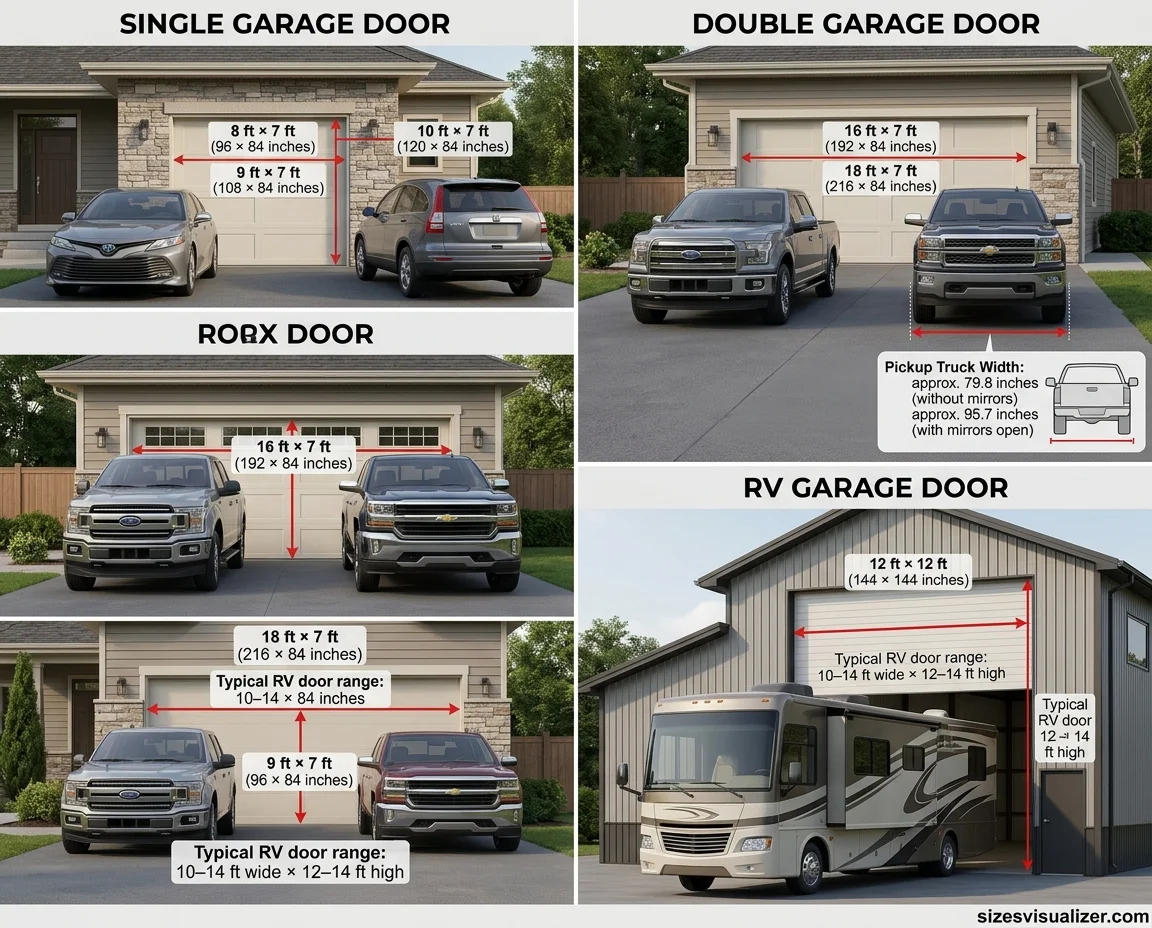
What size garage door fits a pickup truck or SUV? A 9×7 door can work. A 10×7 or a 9×8 gives you more room. Mirrors are the real problem. A 2021 F-150 Regular Cab measures about 79.8 inches wide without mirrors and 95.7 inches with mirrors open.
Here’s the math. A 9-ft door is 108 inches wide. With mirrors open, that leaves about 6 inches per side. A 10-ft door leaves about 12 inches per side.
What size is a two-car garage door? The usual double garage doors dimensions are 16×7 ft. Use 18 ft if you park two full-size trucks. You can also install two single doors with a center pier. That setup costs more, but one bay still works if the other door breaks.
Which garage door size is best for a sedan? An 8×7 is enough. A 9×7 is easier to park in and is the more common choice today.
RV and Oversized Garage Door Dimensions

What size garage door do you need for an RV? Start with the height of your RV. Here are typical heights, per Extra Space Storage:
- Class A: 12–13 ft
- Class B: 9–10 ft
- Class C: 10–12 ft
Travel trailers run about 10–12 ft, and fifth wheels run 11–13 ft. Some guides say a 12×12 door fits most Class C motorhomes and many travel trailers. Measure your RV at its tallest point. That is often the roof air conditioner. A common rule is to add at least one foot of clearance.
The building matters as much as the door. A tall door needs a strong header, extra headroom, and a deep bay. Heavy RV doors also need heavy-duty springs and tracks. Most RV doors are custom-sized, so expect a longer lead time.
Choosing the right garage door size is essential for vehicle clearance, storage space, and overall garage functionality. Similarly, selecting the right bed dimensions can make a significant difference in bedroom comfort and layout, so understanding the various Casper mattress sizes and measurements can help you create a more practical and comfortable living space.
How to Measure Garage Door Dimensions (and Avoid Costly Mistakes)

How do you measure a garage door opening? Take five measurements:
- Width: inside edge to inside edge of the finished opening.
- Height: floor to the underside of the header.
- Headroom: the gap from the top of the opening to the ceiling or lowest obstacle.
- Side room: the wall space on each side of the opening.
- Backroom: the depth from the opening to the back wall.
How much headroom, side room and backroom do you need? Clopay lists these figures for standard residential doors:
- Torsion springs need 12 inches of headroom.
- Side room is 3¾ inches per side.
- Backroom is door height plus 18 inches.
An opener needs extra space, so check its manual. Low-headroom tracks can cut the headroom need to about 4.5 inches. They need more backroom, about door height plus 23 to 30 inches.
What if your opening isn’t standard? Order a custom garage door built to your measurements. This is common in older homes and additions. Reframing the opening is costly, so ordering custom is usually the easier fix.
What are the most common sizing mistakes?
- Measuring the old door instead of the opening.
- Skipping headroom and side room.
- Measuring once, on an uneven floor.
- Sizing only for today’s vehicle.
- Forgetting HOA or local code rules.
When replacing a door, measure the opening. The old door may have been shimmed or forced to fit.
FAQs
What is the most common garage door size?
For a single door, it’s 9×7 ft. For a double door, it’s 16×7 ft.
How wide is a 10-foot garage door?
It’s 120 inches wide. It is a good fit for full-size pickups and large SUVs.
Is a 12-foot-wide garage door standard?
No. It’s a specialty size for workshops, boats and oversized single bays. You can order one, but it is not a common residential size.
Can I put a taller door in my existing opening?
Not without reframing. A taller door means raising the header, which is structural work. You also need enough headroom above it.
Does a bigger garage door cost more?
Yes. Material, insulation, windows and springs also raise the price. Ask for a written quote after a measurement visit.
Conclusion
Garage doors dimensions come down to a few numbers. Most homes use 9×7 or 16×7 doors, while RV bays need a custom height. Measure the opening, check your clearances, and plan for the vehicles you may own later.

Measurement Researcher, Size Comparison Writer & Content Specialist
Timmy Ahad is a dedicated content writer and research specialist at SizesVisualizer.com, where he focuses on creating accurate, easy-to-understand content about measurements, dimensions, size comparisons, and real-world object visualization.


