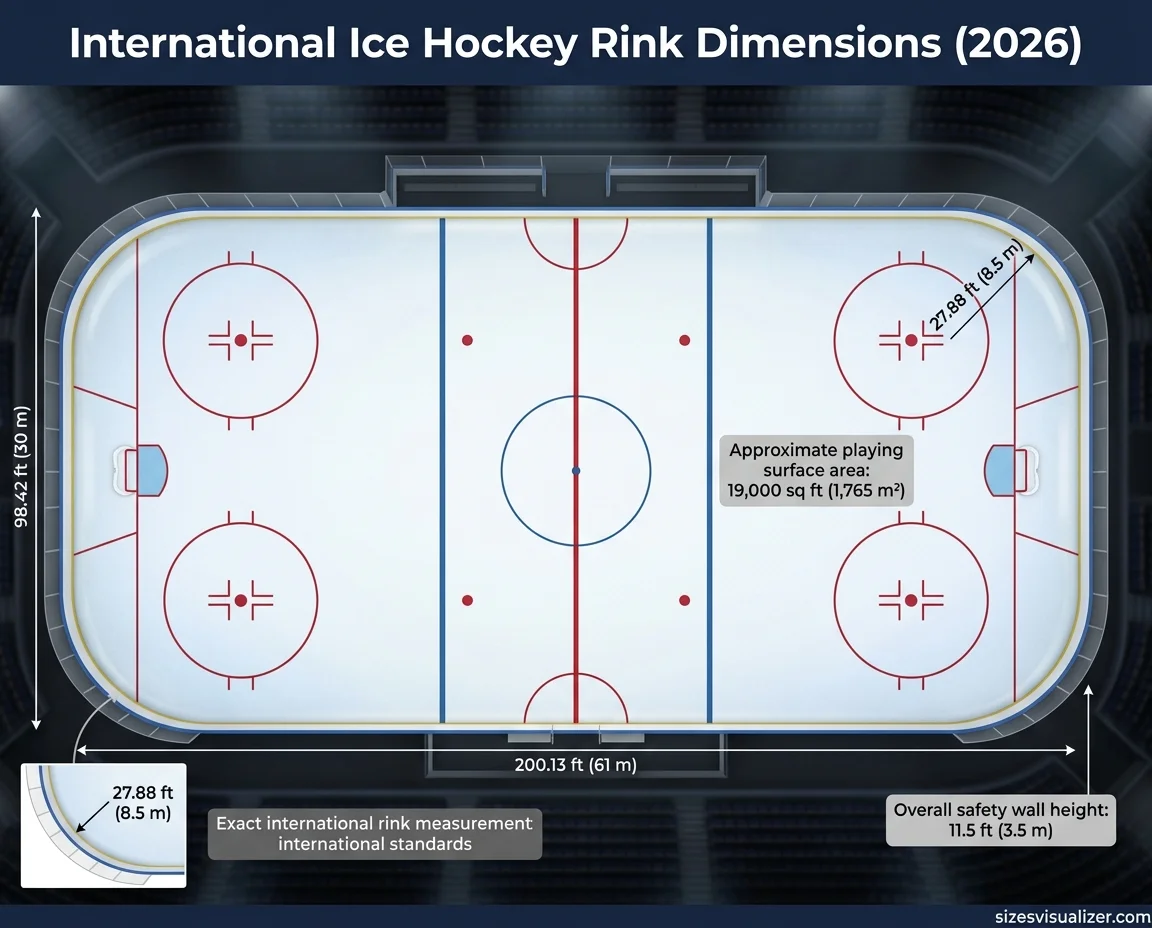
An international ice hockey rink measures 200.13 feet long and 98.42 feet wide (61 m × 30 m). Olympic games and top European leagues use this size.
This guide covers the standard rink size, the layout and markings, and how it compares with the NHL rink. You’ll also learn how to use these numbers for your own rink.
Table of Contents
International Ice Hockey Rink Size and Standard Measurements
How big is an international ice hockey rink? It is 200.13 ft × 98.42 ft (61 m × 30 m). That is about 19,000 square feet (1,765 m²) of playing surface.
| Measurement | Feet | Meters |
|---|---|---|
| Length | 200.13 ft | 61 m |
| Width | 98.42 ft | 30 m |
| Total area | ~19,000 sq ft | ~1,765 m² |
| Corner radius | 27.88 ft | 8.5 m |
| Safety wall height (overall) | 11.5 ft | 3.5 m |
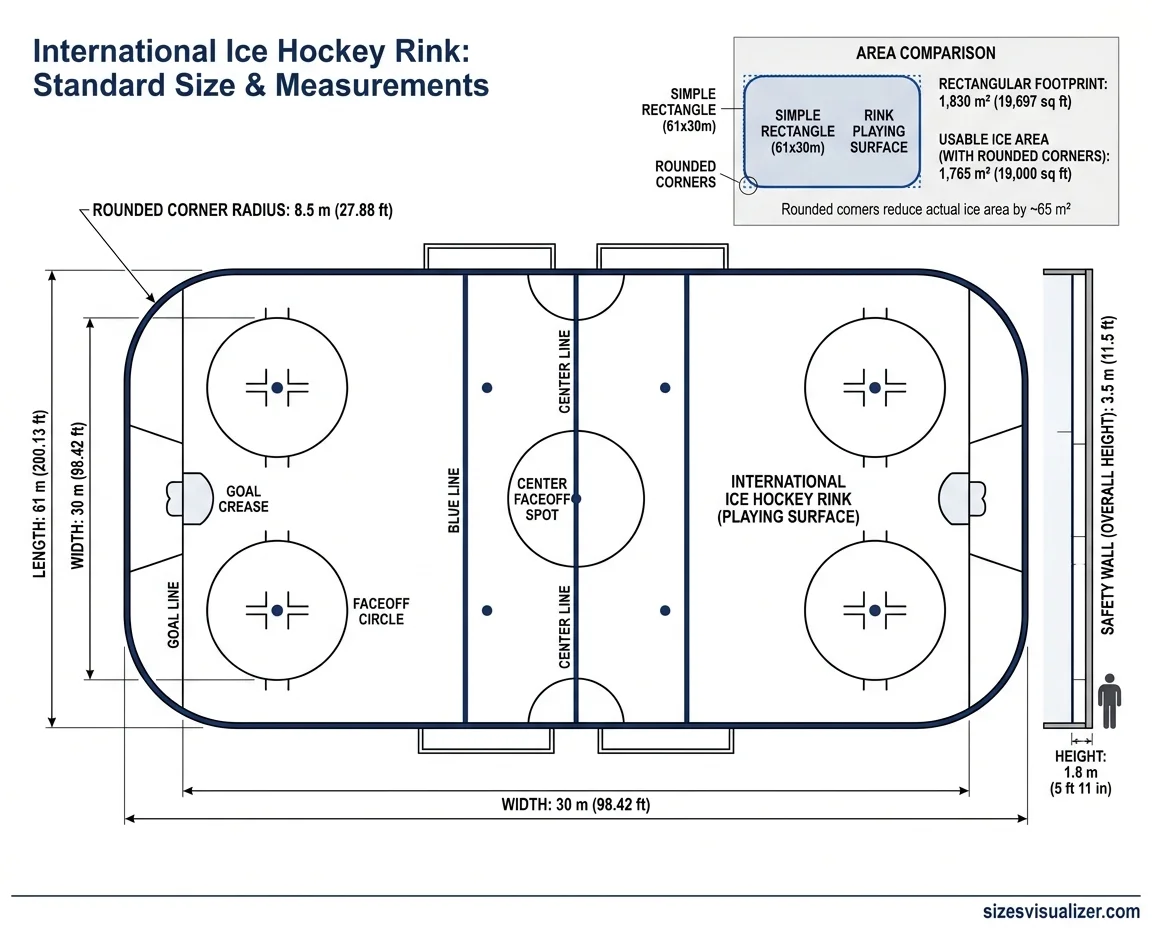
Why do some sources list a different area? You may see 19,697 sq ft (1,830 m²) online. That number multiplies 61 m by 30 m. It treats the rink as a perfect rectangle.
Real rinks have rounded corners, which remove about 62 m² of ice. That is how you get the 1,765 m² figure. Both numbers are correct. They just count different things.
The surface itself is simple. A thin layer of ice sits on top of level, painted concrete. You can see the measured drawings here.
International Ice Hockey Rink Layout and Markings
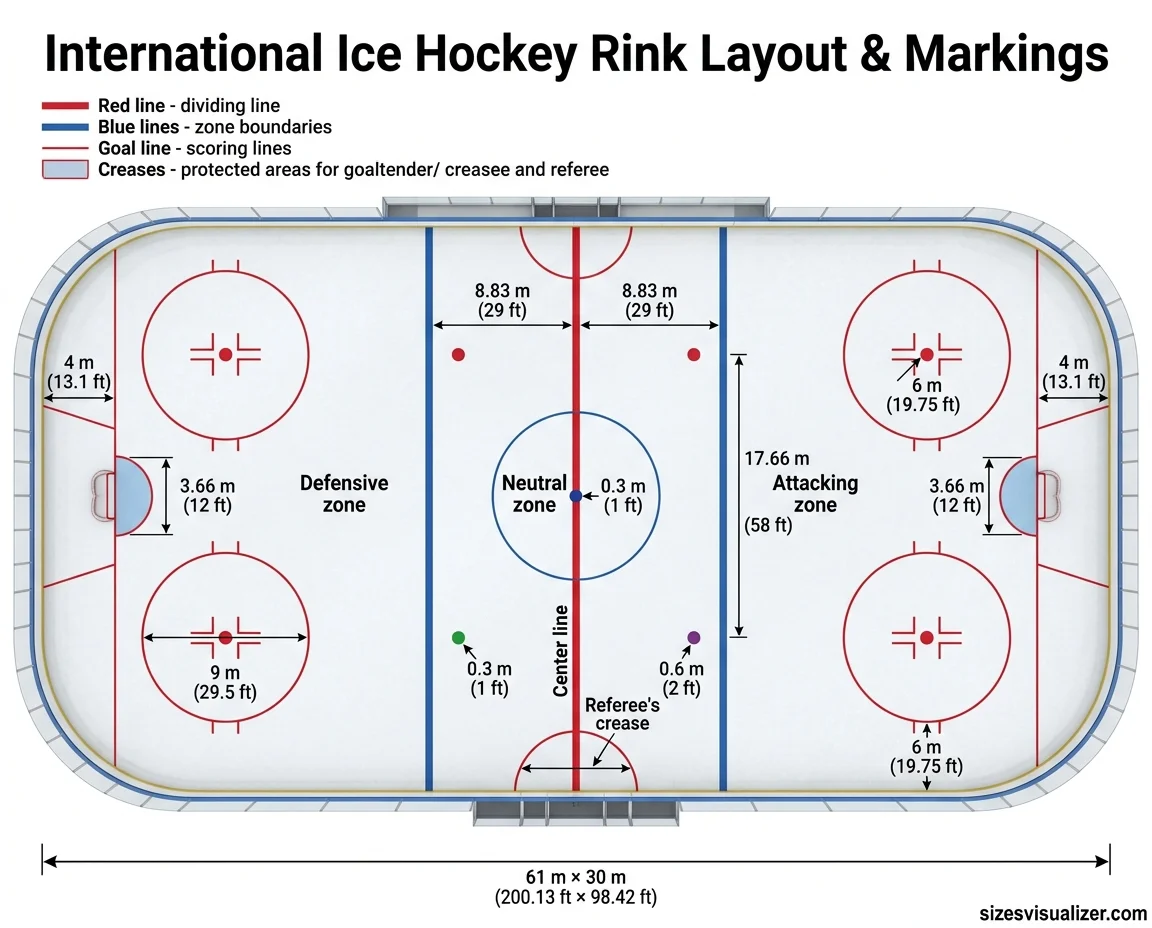
What are the lines on a hockey rink? The rink has one center line, two blue lines, and two goal lines. These lines split the ice into three zones: defensive, neutral, and attacking.
- Blue lines: 29 ft (8.83 m) from the center.
- Goal lines: 13.1 ft (4 m) from the end boards.
- Goal crease: 12 ft (3.66 m) in diameter.
- Referee’s crease: 19.75 ft (6 m) in diameter.
How many faceoff spots are on a hockey rink? There are nine. One sits at center ice. Four sit in the neutral zone. Four sit in the end zones.
Faceoff circles are 29.5 ft (9 m) wide. The center spot is 1 ft (0.3 m) across. The other spots are 2 ft (0.6 m) across.
End zone faceoff spots are 22 ft (6.7 m) from the goal line. Neutral zone spots are 5 ft (1.5 m) from the blue line.
Each line has a job. Blue lines control offside. The goal line decides whether the puck counts as a goal. The creases protect the goalie.
When presenting international ice hockey rink dimensions, a clear visual layout can make measurements, markings, and size comparisons much easier to understand. Explore this PowerPoint slide size guide to choose the right slide proportions and create professional presentations featuring rink diagrams, measurement charts, and layout illustrations.
International vs NHL Rink Size: Key Differences

What is the difference between an NHL rink and an international rink? Width is the big one. The NHL rink is 200 ft × 85 ft (61 m × 26 m). The international rink is about 13 ft (4 m) wider.
| Feature | NHL Rink | International Rink |
|---|---|---|
| Length | 200 ft (61 m) | 200.13 ft (61 m) |
| Width | 85 ft (25.91 m) | 98.42 ft (30 m) |
| Approx. area | 17,000 sq ft | 19,000 sq ft |
| Goal line to end boards | 11 ft | 13.1 ft |
The extra width gives players more room to skate, pass, and set up plays. That is why international hockey is often described as more open and skill-based. NHL ice is tighter. It favors speed, hits, and quick turns near the boards.
Some leagues use a middle size. Research on rink variability notes that some Swedish Hockey League (SHL) arenas use hybrid rinks that are 28–29 m wide.
Why Hockey Rink Dimensions Matter for Real-World Planning
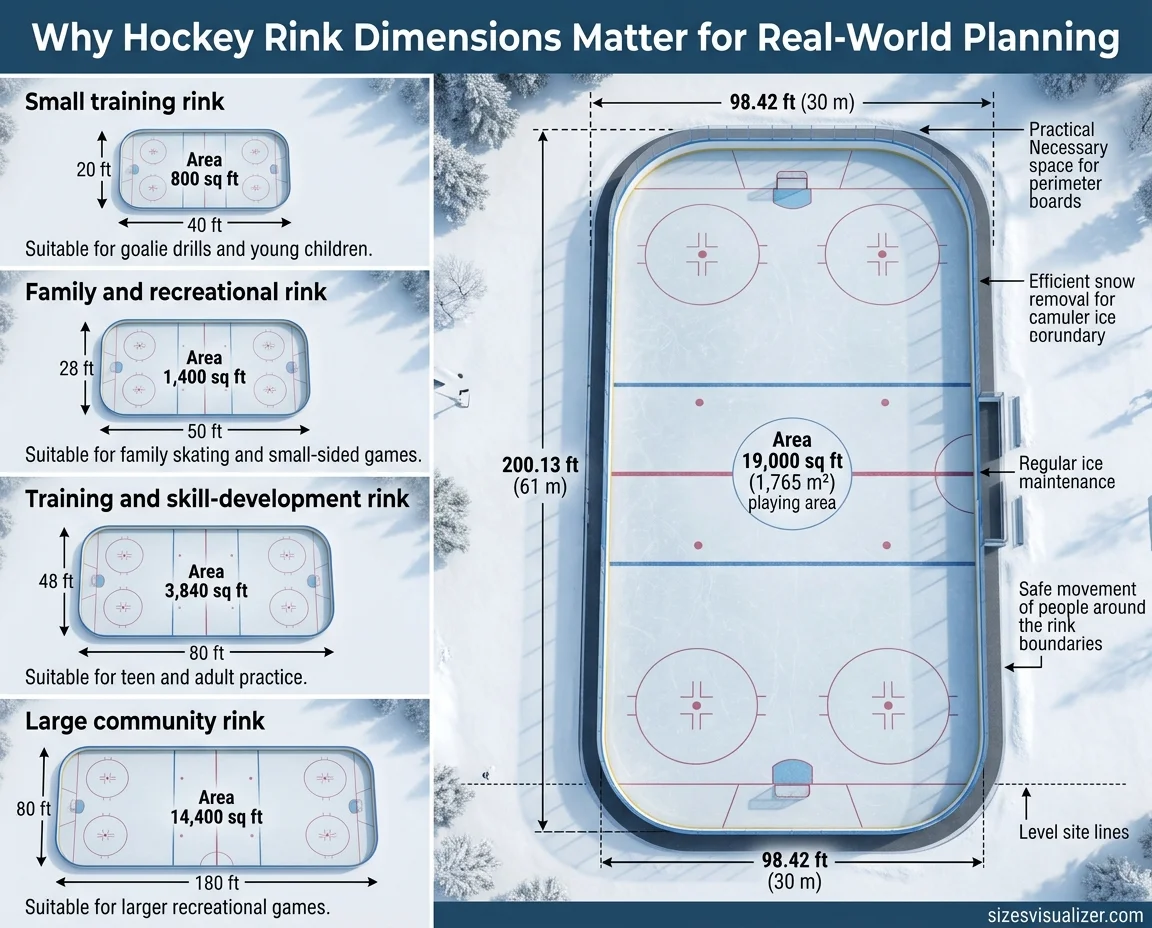
Do you need a full-size rink? Most people don’t. Official dimensions matter for arenas, tournaments, and league play. Backyard, training, and community rinks can be smaller.
Here is a simple guide to common ice rink sizes and uses:
| Size | Best for |
|---|---|
| Under 800 sq ft (20 ft × 40 ft or smaller) | Goalie training and young kids |
| 1,400–3,200 sq ft (28 × 50 ft to 40 × 80 ft) | Family skating and 3-on-3 |
| 3,840–7,200 sq ft (48 × 80 ft to 60 × 120 ft) | Teens, adults, and training |
| Over 7,200 sq ft (80 × 180 ft to 85 × 200 ft) | Community and full games |
Plan ahead before you build. Portable rinks can be enlarged later, but permanent rinks cannot. Kids grow fast, so pick a size they won’t outgrow.
Leave extra room on every side. You need space for boards, snow removal, and ice maintenance. A level site also cuts excavation work and cost.
FAQs
What are the dimensions of an international ice hockey rink?
It measures 200.13 ft long by 98.42 ft wide (61 m × 30 m). The corners are rounded with a radius of 27.88 ft (8.5 m). The ice covers about 19,000 square feet (1,765 m²).
Are Olympic hockey rinks the same as international rinks?
Yes. Olympic hockey follows the International Ice Hockey Federation (IIHF) standard of 61 m × 30 m. Most European leagues use the same size.
Is an NHL rink bigger than an international rink?
No. The NHL rink is smaller. It is 200 ft × 85 ft, while the international rink is 200.13 ft × 98.42 ft. The difference is about 13 ft in width.
How many square feet is an international hockey rink?
About 19,000 square feet after accounting for rounded corners. A simple 61 m × 30 m rectangle gives about 19,697 square feet.
How far apart are the blue lines on a hockey rink?
Each blue line sits 29 ft (8.83 m) from center ice, so the neutral zone between them is about 58 ft (17.66 m) wide.
Conclusion
The international ice hockey rink size is 200.13 ft × 98.42 ft (61 m × 30 m). It is about 13 feet wider than an NHL rink, and that width shapes how the game is played. Use these rink measurements as your guide, then scale to your space and your players.

Measurement Researcher, Size Comparison Writer & Content Specialist
Timmy Ahad is a dedicated content writer and research specialist at SizesVisualizer.com, where he focuses on creating accurate, easy-to-understand content about measurements, dimensions, size comparisons, and real-world object visualization.