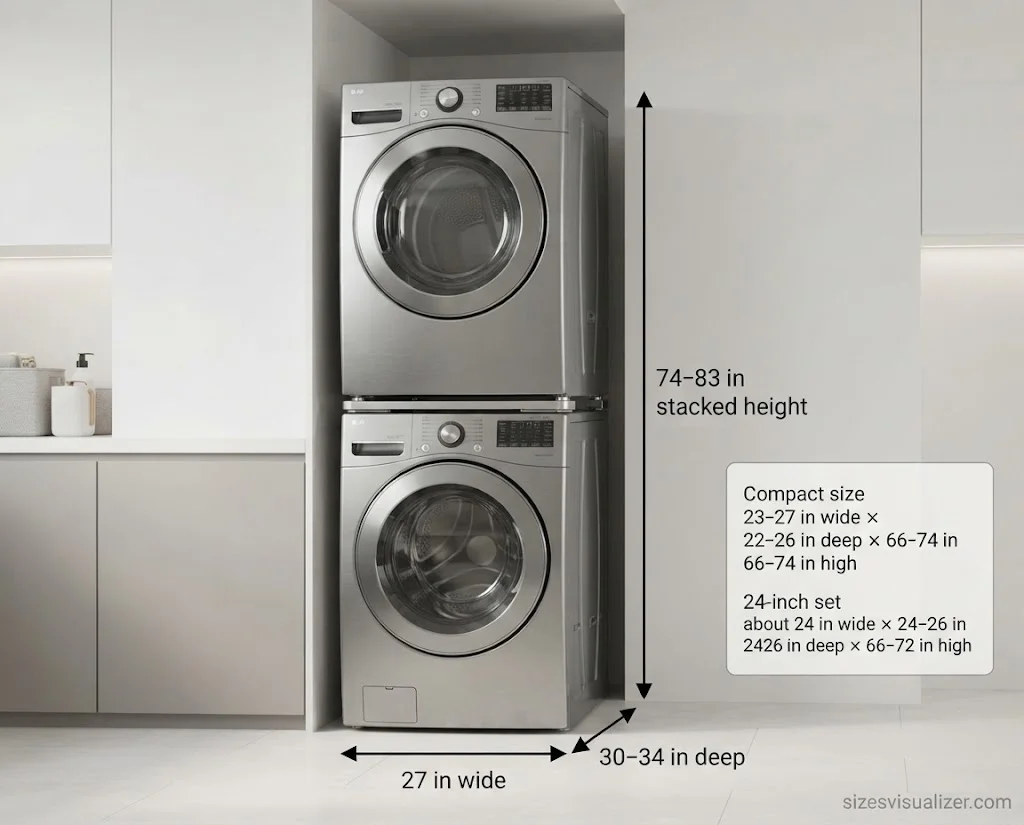
Short on floor space? A stacked laundry set can free up almost half of it. But you must know the right size before you buy.
Most full size stackable washer and dryer dimensions are about 27 inches wide, 30 to 34 inches deep, and 74 to 83 inches tall. Below, you’ll find sizes by type, measuring steps, clearance rules, and answers to common questions.
Table of Contents
Stackable Washer and Dryer Dimensions by Type
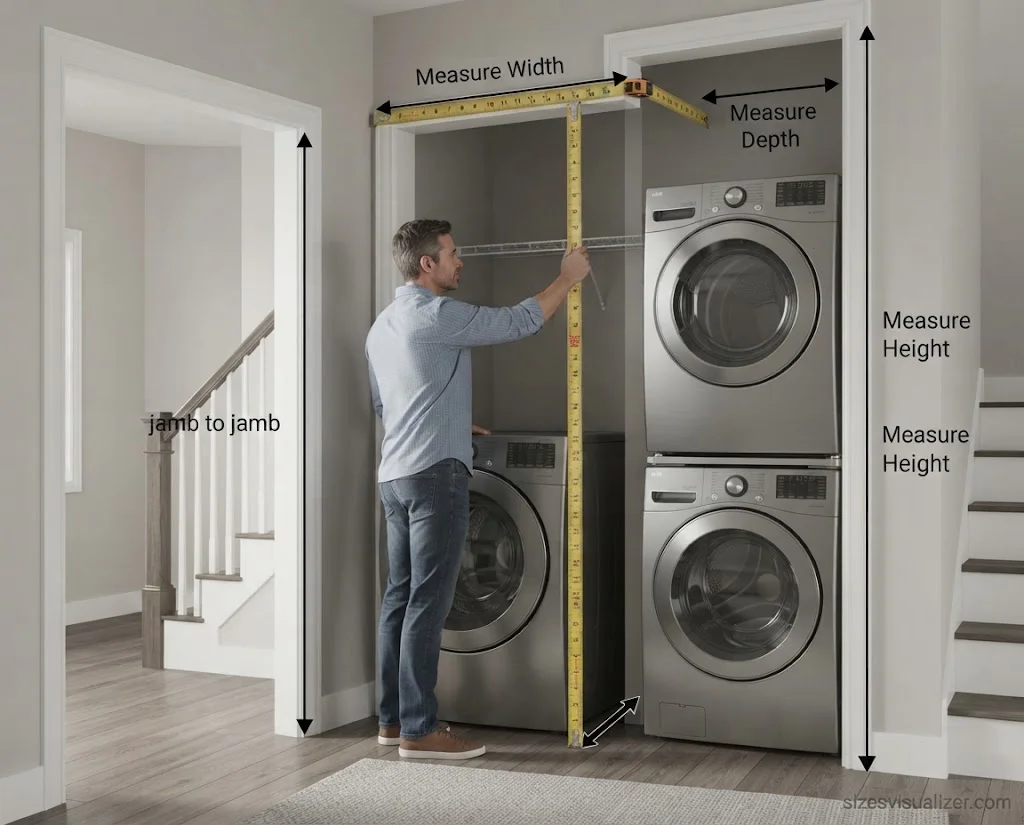
Stacked washer and dryer size changes with the model. Here is a quick chart:
| Type | Width | Depth | Stacked Height |
|---|---|---|---|
| Full size stackable set | 27 in | 30–34 in | 74–83 in |
| Large capacity stackable set | 24–29 in | up to 33 in | 74–83 in |
| Compact or apartment size | 23–27 in | 22–26 in | 66–74 in |
| 24 inch stackable set | about 24 in | 24–26 in | 66–72 in |
| Laundry center (all-in-one tower) | 23–27 in | 27–29 in | about 74 in |
Maytag lists its full size stacked pairs at 77 to 80 inches tall. That is a good real-world example. Always check the spec sheet for your exact model.
There are two main styles. A stackable front load set is two separate machines joined with a stacking kit. A laundry center is one all-in-one tower, so it has one plug instead of two.
Large capacity sets hold more. A standard washer takes about 16 pounds of laundry, and a large one can take about 25 pounds.
Do not add a pedestal to a stacked set. It adds height, and the control panel becomes hard to reach. Also, a washer dryer combo is one machine that washes and dries in the same drum. It is not a stacked set.
How to Measure Space for a Stackable Washer and Dryer
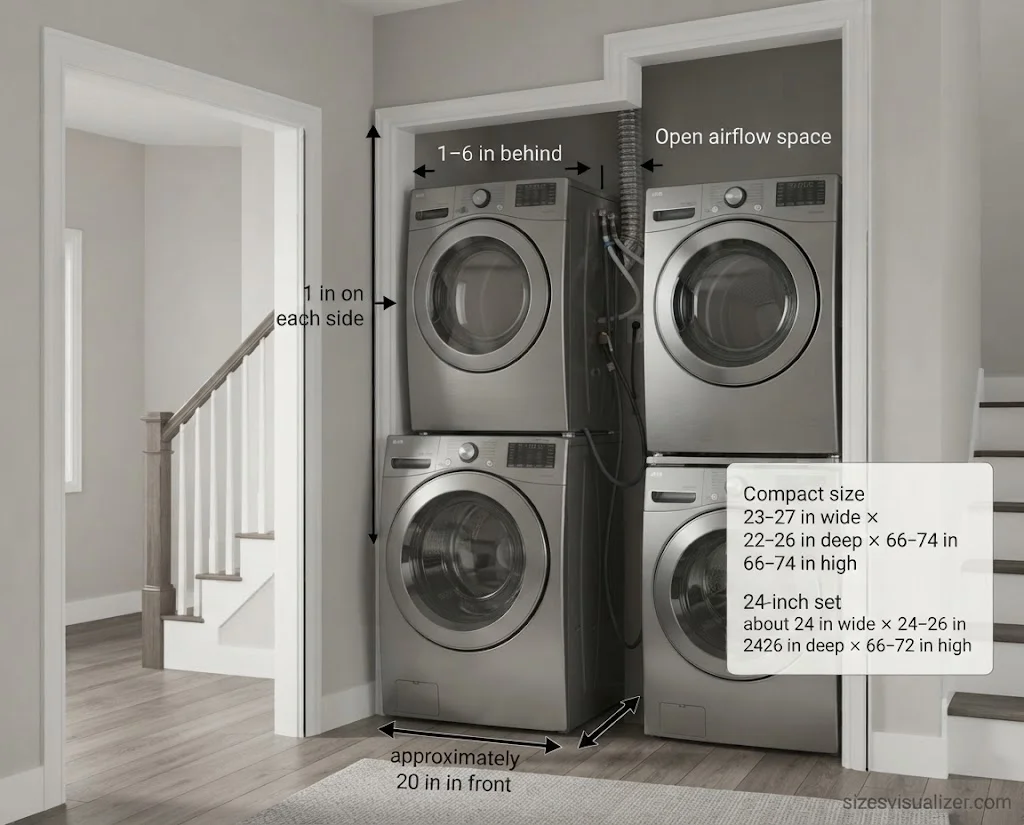
Measuring takes five minutes. Use a tape measure and follow these steps.
- Measure the width of the spot, wall to wall.
- Measure the depth, from the back wall outward.
- Measure the height, floor to ceiling. Look for low soffits, pipes, or shelves.
- Check that you can reach the top controls without a stool.
- Measure the delivery path, including doorways, hallways, and stairs.
What is the delivery path? It is the route the machines take from the truck to your laundry spot. Measure each doorway from jamb to jamb. A set that fits the closet but not the front door is a costly mistake.
Here is a quick “will it fit?” check. Your space should be a bit bigger than the machine in every direction. If it is exact, it is too tight.
Clearance, Closet, and Cabinet Size for a Stackable Washer and Dryer
Clearance keeps the machines cool, quiet, and safe. Plan for these gaps:
- Behind: about 1 to 6 inches for hoses, cords, and the dryer vent.
- Sides: about 1 inch on each side to cut noise and vibration.
- Front: about 20 inches so the door swing clears the wall.
- Top: leave air space above the dryer.
Closet fit
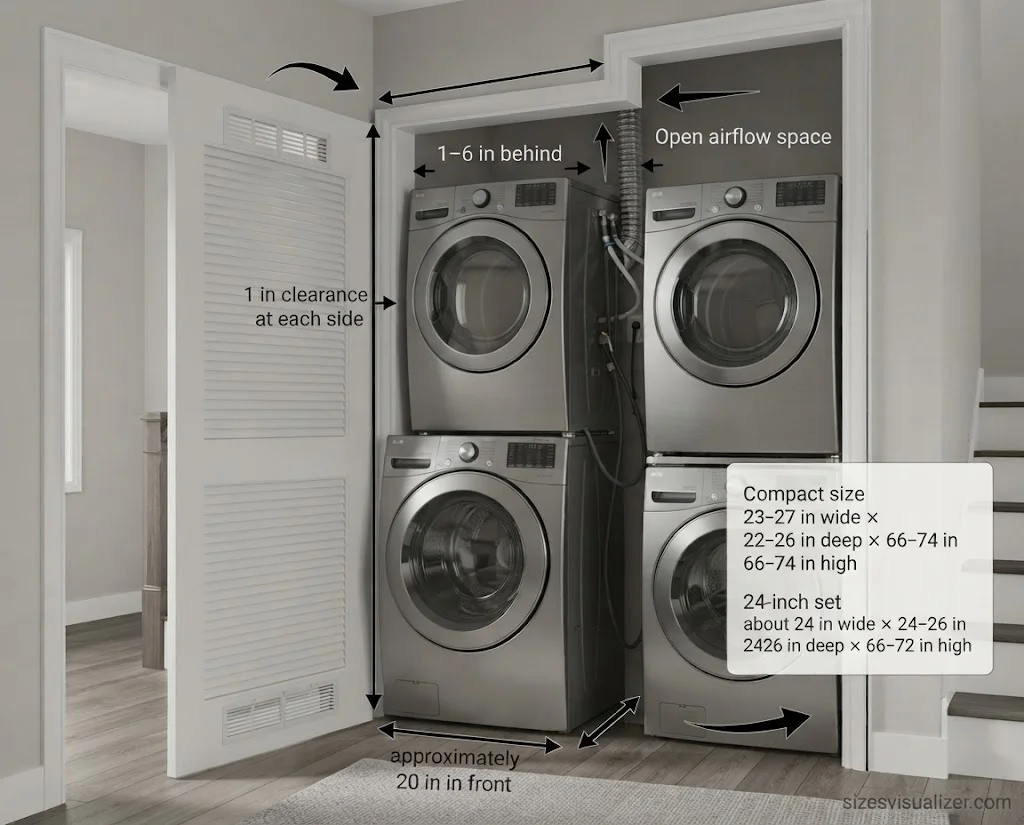
A closet needs airflow. Use a louvered door, or add vents at the top and bottom. Leave about 1 inch between the closet door and the floor.
Cabinet fit
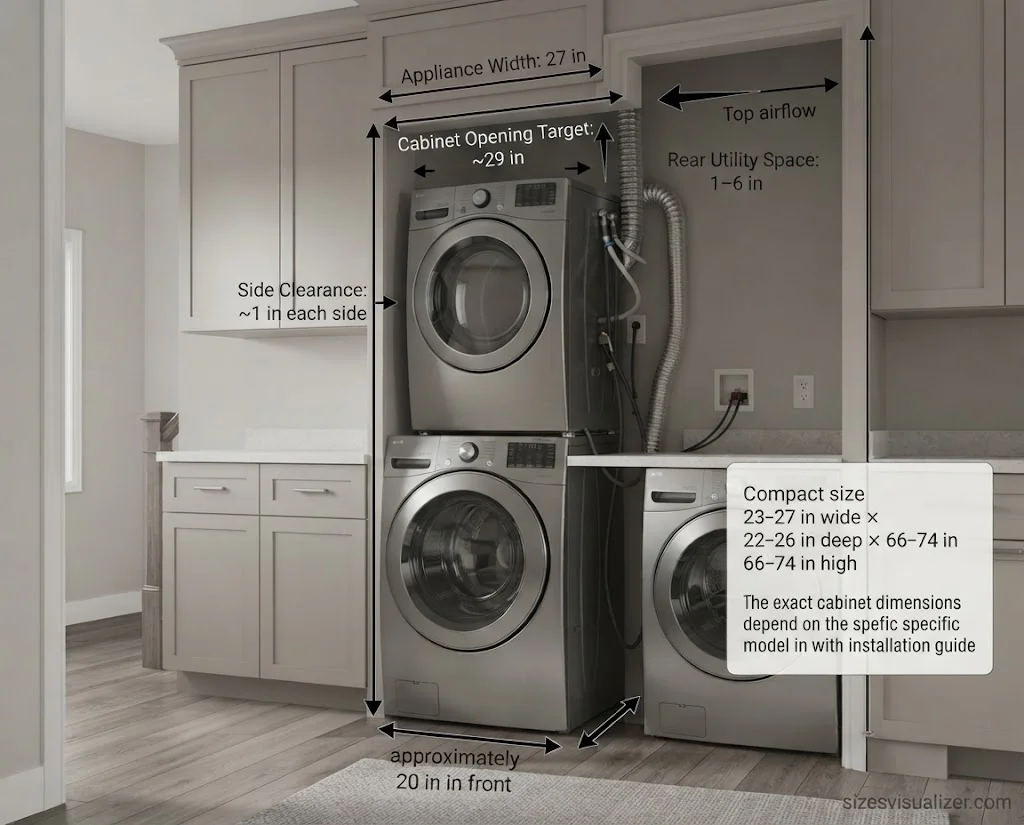
No one size fits all. As a planning target, add about 1 inch per side to the width and a few inches to the depth and height. For a full size set, that means an opening near 29 inches wide. Confirm this in the install guide.
Check the utilities too:
- A 240V outlet for an electric dryer, and a 120V outlet for the washer
- Hot and cold water lines and a drain
- An exterior vent, unless you buy a ventless dryer
- A gas line if you choose a gas dryer
Make sure the floor is level and sturdy. A spinning washer on top of a dryer needs a firm base.
Must Visit: A4 Size in Pixels: 2480 × 3508 px at 300 DPI + Complete Pixel Guide
Stackable Washer and Dryer Pros, Cons, and Top Brands
Pros: A stacked set saves floor space and uses vertical space. It suits closets, condos, and apartments. Many sets can also be used unstacked later.
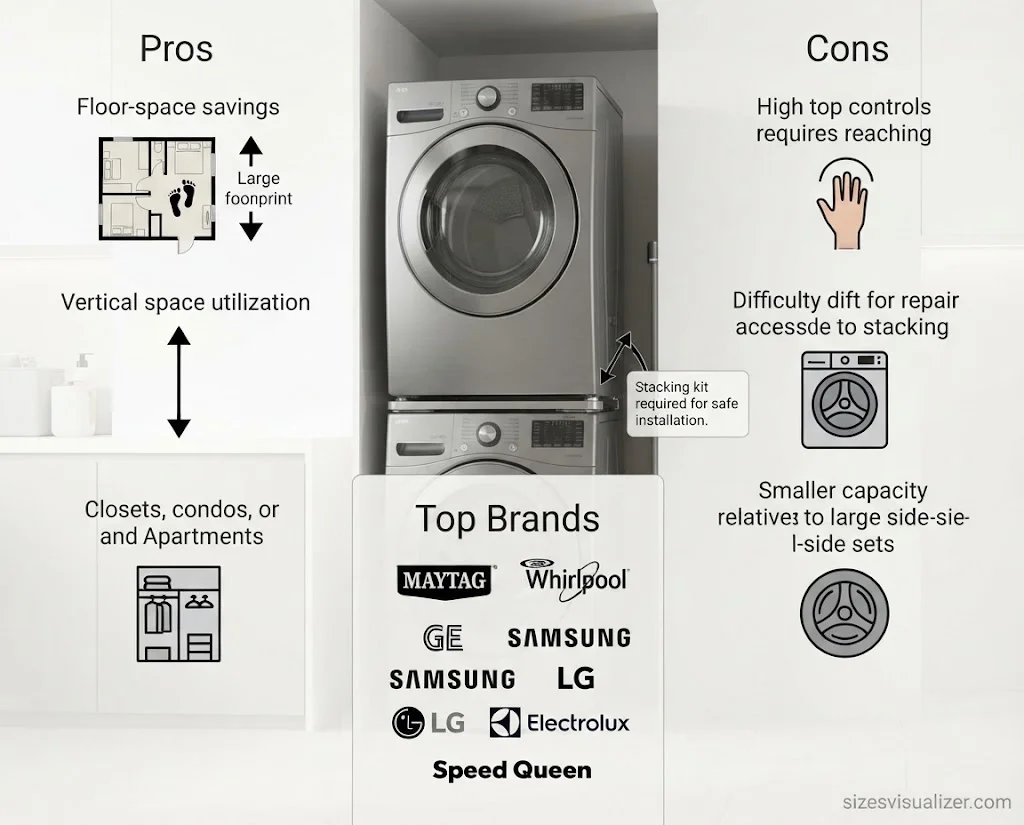
Cons: The top machine sits high, and the controls can be hard to reach. Repairs can be slower, since the stack may need to come apart. Compact sets also hold smaller loads.
Top brands include Maytag, Whirlpool, GE, Samsung, LG, Electrolux, and Speed Queen. Here are a few facts to help you compare:
- Maytag offers a factory-certified stacking kit and a Pet Pro washer option.
- Some LG and Electrolux models come in ventless styles, which help in homes with no outside vent.
- Stacking kits are required by most makers for safety.
Look at ENERGY STAR ratings for clothes washers and clothes dryers to compare running costs.
FAQs
How much space is needed behind a stackable washer and dryer?
Plan for about 1 to 6 inches behind the set. This room fits the water hoses, power cords, and dryer vent. Check your model’s manual for the exact number.
What is the downside to a stackable washer and dryer?
The main downside is reach, since the top controls sit high. Repairs can also take longer, and compact sets hold smaller loads. You must use a stacking kit for safety.
How small can you get a stackable washer and dryer?
A compact stackable set is about 24 inches wide and 22 to 26 inches deep. Stacked, it stands about 66 to 72 inches tall. These fit small closets and apartments.
What are the dimensions of a 24 inch stackable washer and dryer?
A 24 inch stackable washer and dryer is about 24 inches wide and 24 to 26 inches deep. Its stacked height runs about 66 to 72 inches. Leave 1 to 5 inches behind for hoses and venting.
What are the cabinet dimensions needed for a stackable washer and dryer?
There is no set standard. Use your model’s width, depth, and height, then add about 1 inch per side and room for the vent and top airflow. A full size set needs an opening near 29 inches wide.
Which brand makes the best stackable washer and dryer sets?
It depends on your space, budget, and needs. Maytag, Whirlpool, GE, Samsung, LG, Electrolux, and Speed Queen all make stackable sets. Compare size, capacity, venting type, and energy rating before you choose.
Conclusion
The right stackable washer and dryer dimensions save you time and stress. Measure the space, the delivery path, and the clearances. Then match the numbers to the spec sheet before you buy.

Measurement Researcher, Size Comparison Writer & Content Specialist
Timmy Ahad is a dedicated content writer and research specialist at SizesVisualizer.com, where he focuses on creating accurate, easy-to-understand content about measurements, dimensions, size comparisons, and real-world object visualization.