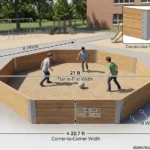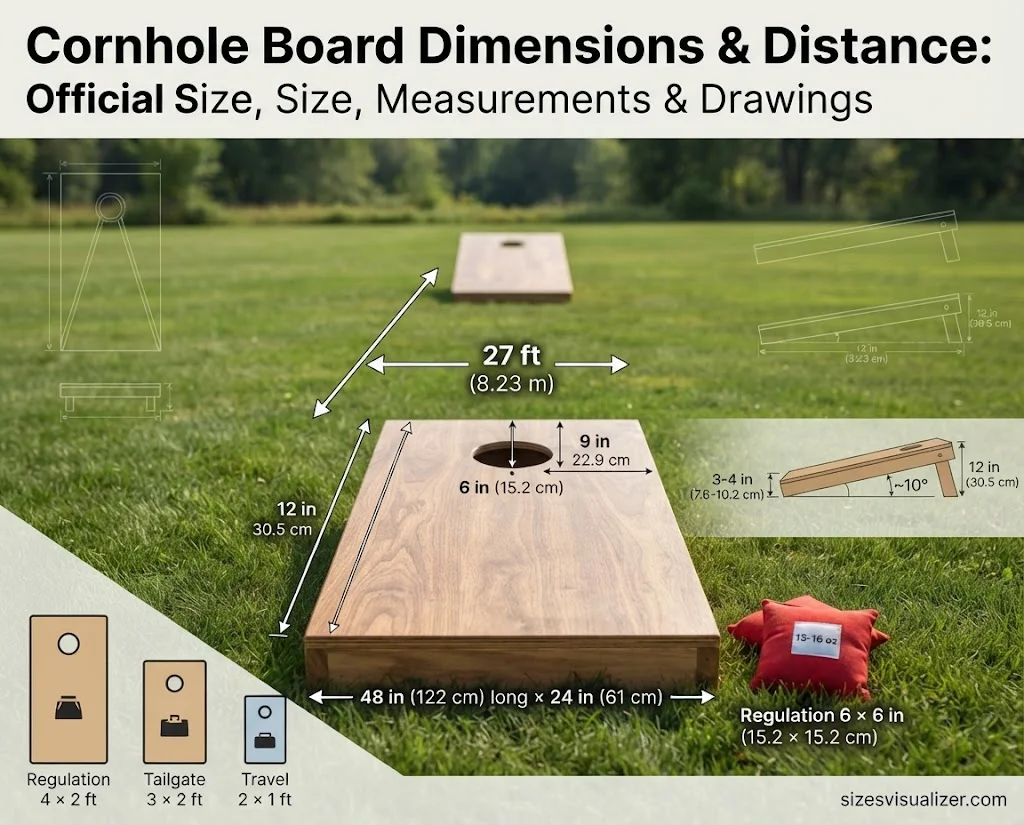
A regulation cornhole board is 48 inches long and 24 inches wide. The two boards sit 27 feet apart, measured front edge to front edge.
This guide gives you every official cornhole board dimension, the regulation distance, bag specs and a simple drawing you can copy. The numbers follow the American Cornhole Association (ACA) standards used in the USA.
Table of Contents
Official Cornhole Board Dimensions (Size & Measurements)
What size is a regulation cornhole board? It measures 48 in x 24 in (122 cm x 61 cm). ACA rules allow a small range: 47½–48 in long and 23½–24 in wide.
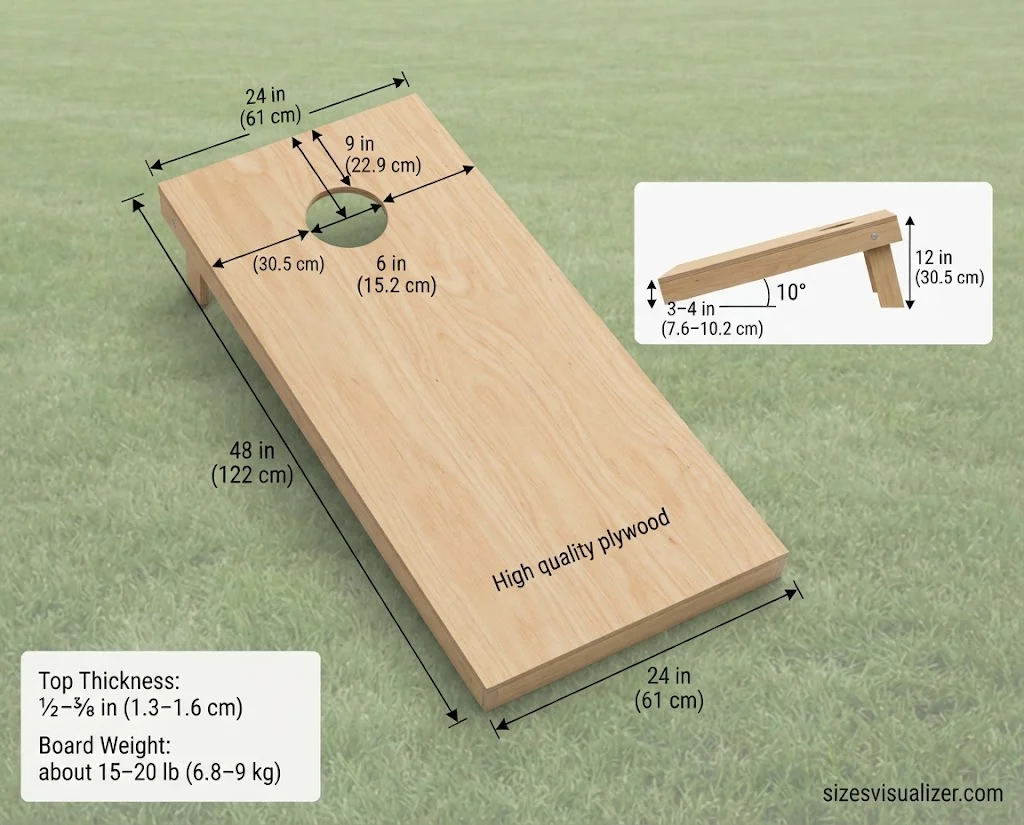
The hole matters most. It has a 6 in diameter. Its center sits 9 in from the top edge and 12 in from each side. That puts the hole in the middle of the board’s width. The allowed error is only ¼ in.
The board also slopes. The front stands 3–4 in off the ground. The rear stands 12 in high. That rise gives an angle of about 10°. It lets bags slide toward the hole.
| Spec | Imperial | Metric |
|---|---|---|
| Board top | 48 x 24 in | 122 x 61 cm |
| Top thickness | ½–⅝ in | 1.3–1.6 cm |
| Hole diameter | 6 in | 15.2 cm |
| Top edge to hole center | 9 in | 22.9 cm |
| Side edge to hole center | 12 in | 30.5 cm |
| Front height | 3–4 in | 7.6–10.2 cm |
| Rear height | 12 in | 30.5 cm |
| Board weight | about 15–20 lbs | about 6.8–9 kg |
A good board has a smooth playing surface, a strong center frame support and no wobble. Most boards use plywood on a wood frame. Weight helps too. A board in the 15–20 lb range stays put when a bag lands hard.
Common mistakes are easy to spot:
- A hole set too close to the top edge.
- A rear height that is too tall or too short.
- A warped or bumpy top.
- A rough hole edge that snags bags.
Cornhole Distance: How Far Apart Should Boards Be?
How far apart should cornhole boards be? The official cornhole distance is 27 feet (8.23 m). Measure from the front edge of one board to the front edge of the other.
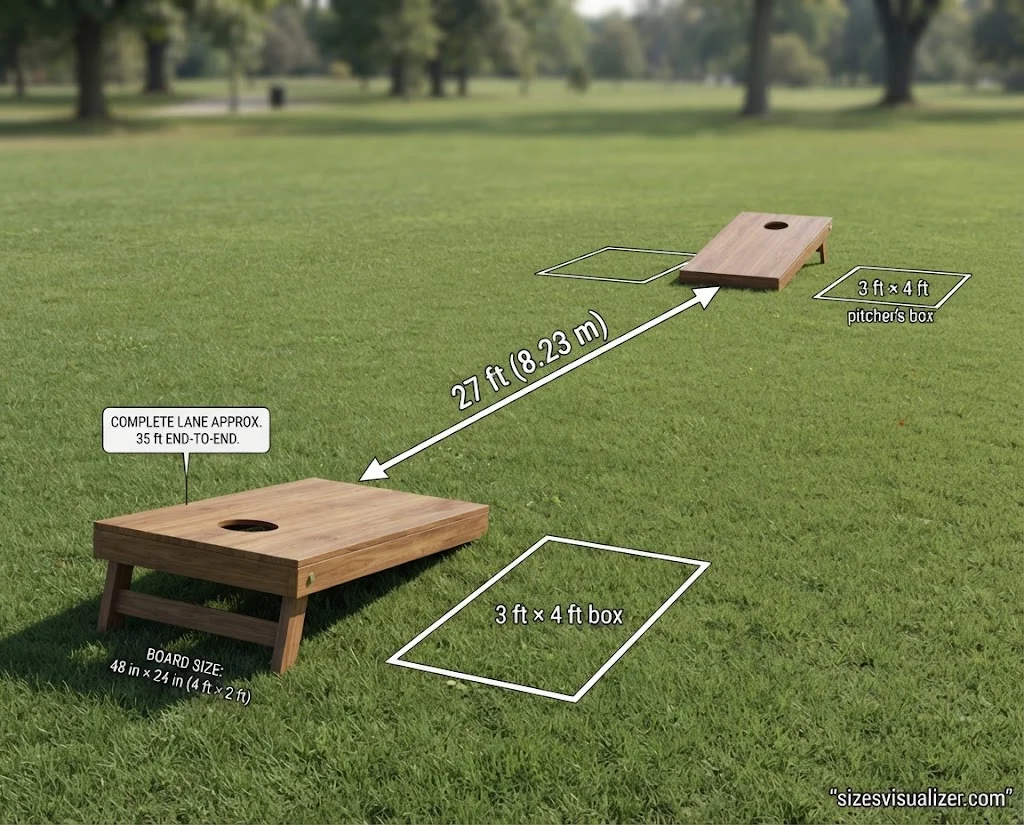
Each board is 4 ft long. So a full lane runs about 35 feet end to end. Plan for that before you set up in a backyard.
Players stand in the pitcher’s box. This is a 3 ft x 4 ft space on each side of the board. Stay inside it while you throw.
Here is a quick setup routine:
- Lay a tape measure along the grass.
- Mark 27 ft between the two front edges.
- Point the boards straight at each other.
- Check that the ground is flat.
Can you shorten the distance? Yes, for casual play. Many families cut the gap to about 20 feet for kids and new players. That is a fun-game rule, not an official one. Use the full 27 ft for tournament play and competitive matches.
Is your setup regulation-ready?
- Boards are about 48 x 24 in.
- The hole is 6 in wide and sits 9 in from the top.
- The boards are 27 ft apart.
- Bags are 6 x 6 in.
Cornhole Bag Size & Board Options
How big is a cornhole bag? A regulation bag is 6 in x 6 in. It weighs 15–16 oz. Most are filled with resin or plastic pellets. Older sets used dried corn, which is where the game got its name.
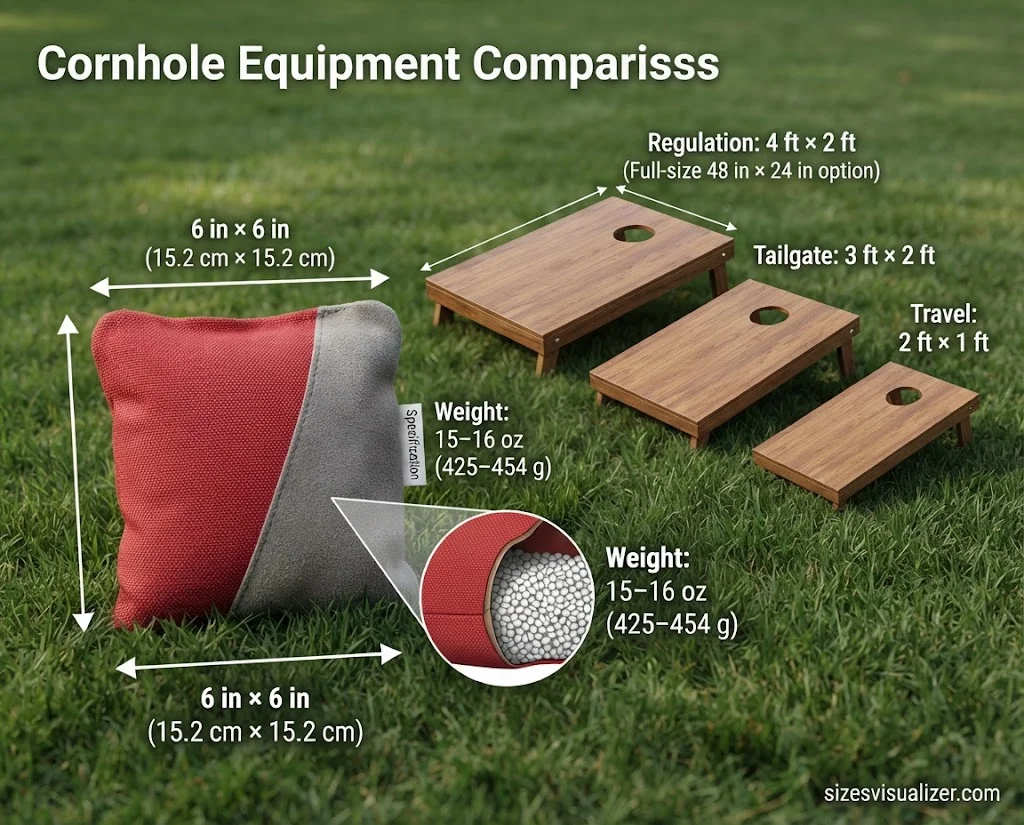
Bags come in duck cloth and other tough fabrics. Many are double-sided. One side is fast and slides. The other is slow and grips. Pick the side that fits your throw.
Board size varies by use:
| Board type | Size | Best for |
|---|---|---|
| Regulation | 4 ft x 2 ft | Backyard, league and tournament play |
| Tailgate | 3 ft x 2 ft | Parking lots and car trunks |
| Travel | 2 ft x 1 ft | Camping, indoor and kids |
Only the 2×4 regulation board counts for official events. Smaller boards are fun, but the throw feels different. Practice on the full size if you plan to compete.
Dimensions also shape your score. A bag in the hole earns 3 points. A bag on the board earns 1 point. A bag that hits the ground scores nothing.
Must visit: Stackable Washer and Dryer Dimensions: Complete Size Guide for 2026
Cornhole Board Dimensions Drawing & PDF Diagram
A cornhole board dimensions drawing shows the board from three views. Each one answers a different question.
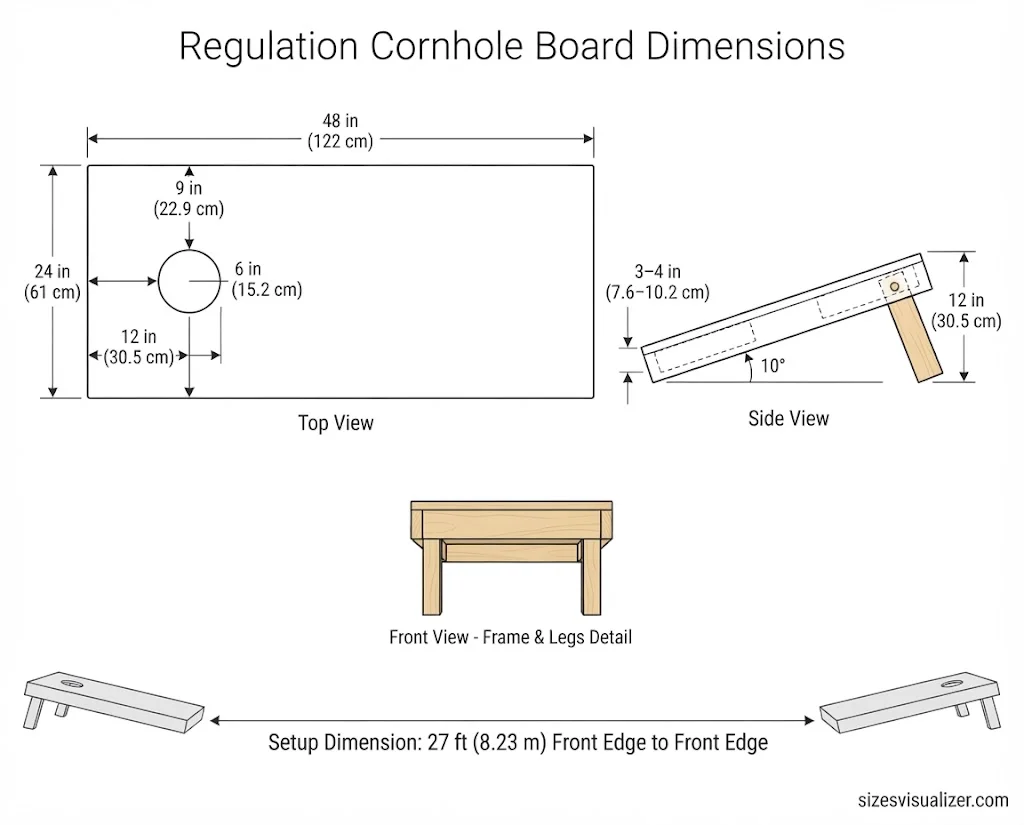
- Top view: shows the length, width and hole placement.
- Side view: shows the slope, plus front and rear height.
- Front view: shows the frame and leg layout.
Use this text version as your quick regulation cornhole board hole dimensions sheet. Print it or save it to your phone.
Board top: 48 in x 24 in Hole: 6 in wide, 9 in from top, 12 in from each side Front height: 3–4 in | Rear height: 12 in Distance: 27 ft, front edge to front edge
Building your own? Follow these steps:
- Cut the top to 48 x 24 in.
- Mark the hole center 9 in down and 12 in across.
- Trace a 6 in circle around that point.
- Cut with a jigsaw, then sand the edge smooth.
- Build a frame and set the legs so the rear stands 12 in tall.
- Finish with a smooth coat so bags glide evenly.
Always double-check each mark before you cut. A small slip can push the board out of the official size.
FAQs
What is a cornhole board?
A cornhole board is an angled wooden platform with a 6 in hole near the top. Players toss bags at it for points. A regulation board measures 48 x 24 in.
What are the rules of cornhole?
Two players or teams take turns throwing four bags each. A bag in the hole scores 3 points. A bag on the board scores 1 point. Points cancel between sides after each round. The first side to reach 21 wins. Full details are in the official ACA rules.
Why is it called cornhole?
The name comes from the two key parts: bags once filled with dried corn, and the hole in the board. The game’s exact origin is debated. Kentucky and Germany are both often named, as the cornhole history on Wikipedia explains. Today, most bags hold plastic pellets.
What is the regulation cornhole board hole dimensions PDF?
It is a printable diagram of the official hole specs. The hole is 6 in wide, 9 in from the top edge and 12 in from each side. Use the spec sheet above as your quick reference.
Conclusion
Remember three numbers: 48 x 24 in for the board, a 6 in hole, and 27 ft between boards. Match those, and your game plays like a real regulation setup. Measure once, cut carefully, and enjoy fair throws.

Measurement Researcher, Size Comparison Writer & Content Specialist
Timmy Ahad is a dedicated content writer and research specialist at SizesVisualizer.com, where he focuses on creating accurate, easy-to-understand content about measurements, dimensions, size comparisons, and real-world object visualization.