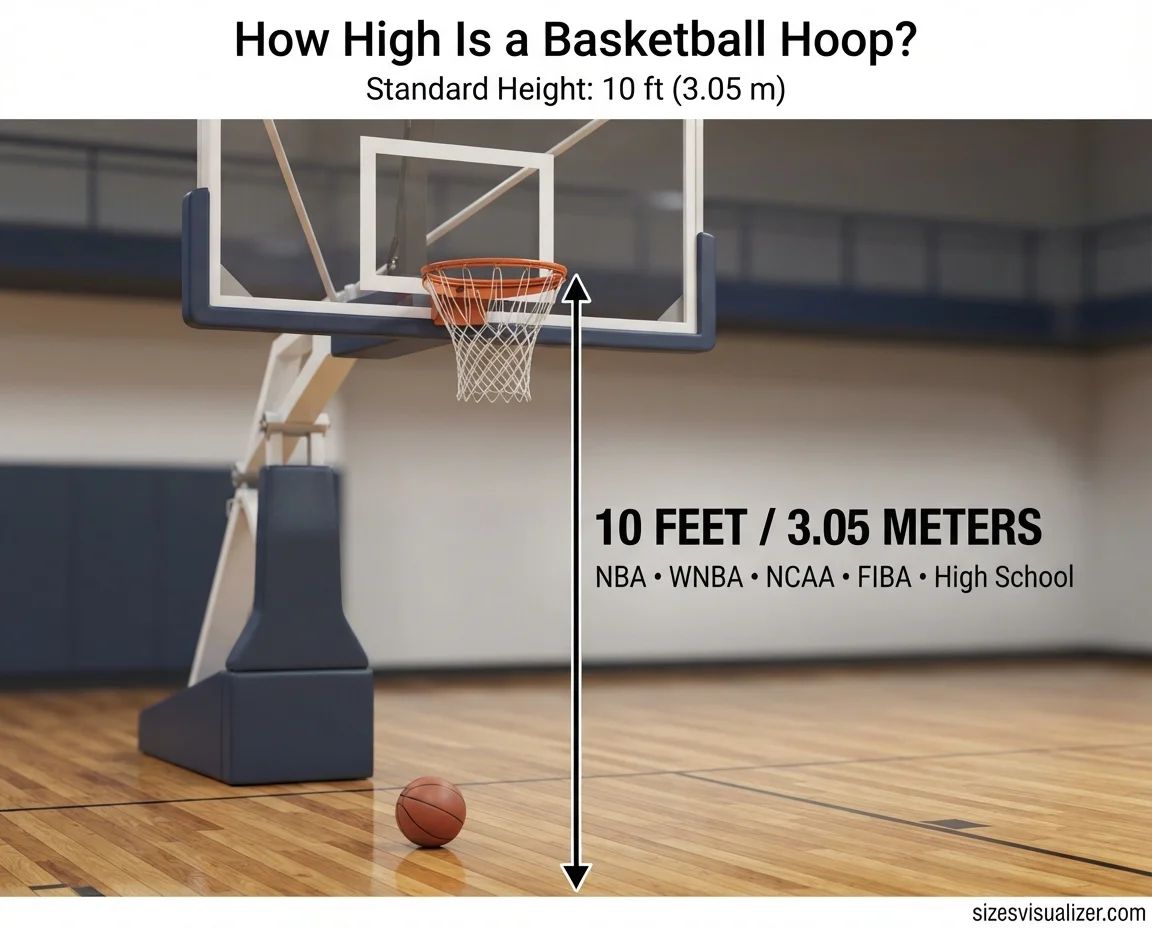
A basketball hoop is 10 feet high. That’s the number every player, coach, and parent needs to know. It’s the same basketball hoop height used in the NBA, WNBA, college ball, and most high school gyms across America.
But that single number doesn’t tell the whole story. Younger kids need a lower rim. Backboards come in different sizes. And plenty of basketball trivia — like whether the NBA rim is really 10 feet — gets asked in search bars every day. This guide covers it all, in plain, simple language.
Table of Contents
Standard Basketball Hoop Height (10 Feet, Every Level)
The standard basketball hoop height is 10 feet, or 3.05 meters, measured from the floor to the top of the rim. This isn’t a rough guideline. It’s a fixed rule.
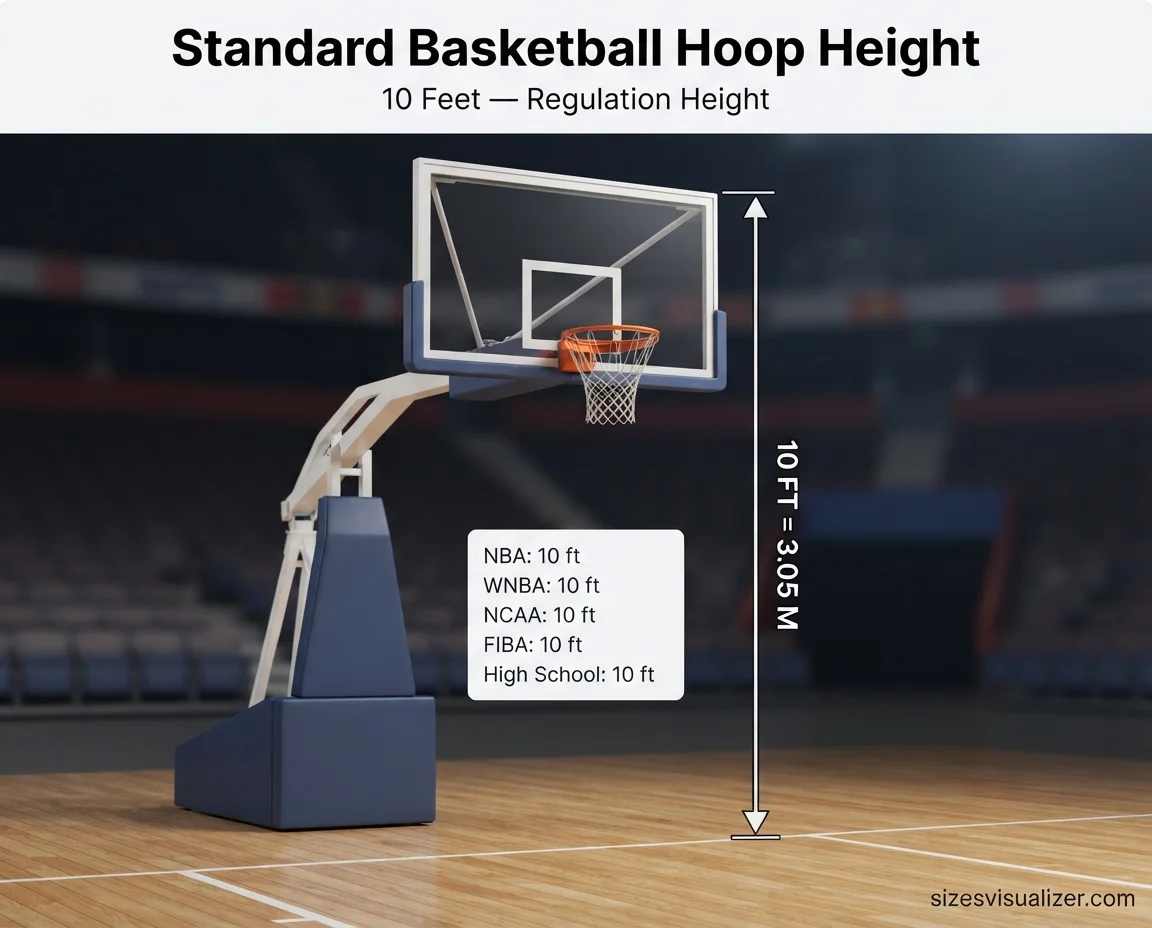
You’ll find this exact basketball rim height at every serious level of the game:
- NBA and WNBA
- NCAA college basketball
- FIBA international competition
- U.S. high school varsity basketball
No matter where the court sits — a packed NBA arena or a small-town high school gym — the rim sits at the same height. That consistency matters. It means a jump shot practiced in a driveway hoop set to regulation height will look and feel the same on a college court.
Quick conversion, since not everyone thinks in feet:
- 10 ft (regulation) = 3.05 m
- 9 ft = 2.74 m
- 8 ft = 2.44 m
- 6 ft = 1.83 m
One detail most guides skip: NCAA, FIBA, and NBA rules all use the same 10-foot rim height. The rules do differ elsewhere — FIBA courts are smaller, and the three-point line sits closer to the basket — but rim height has never been part of that difference. It’s the one constant across every rulebook.
Get a better understanding of length, width, height, and area by comparing different sizes with our Size Visualizer & Comparison Tool.
Why Is a Basketball Hoop 10 Feet High?
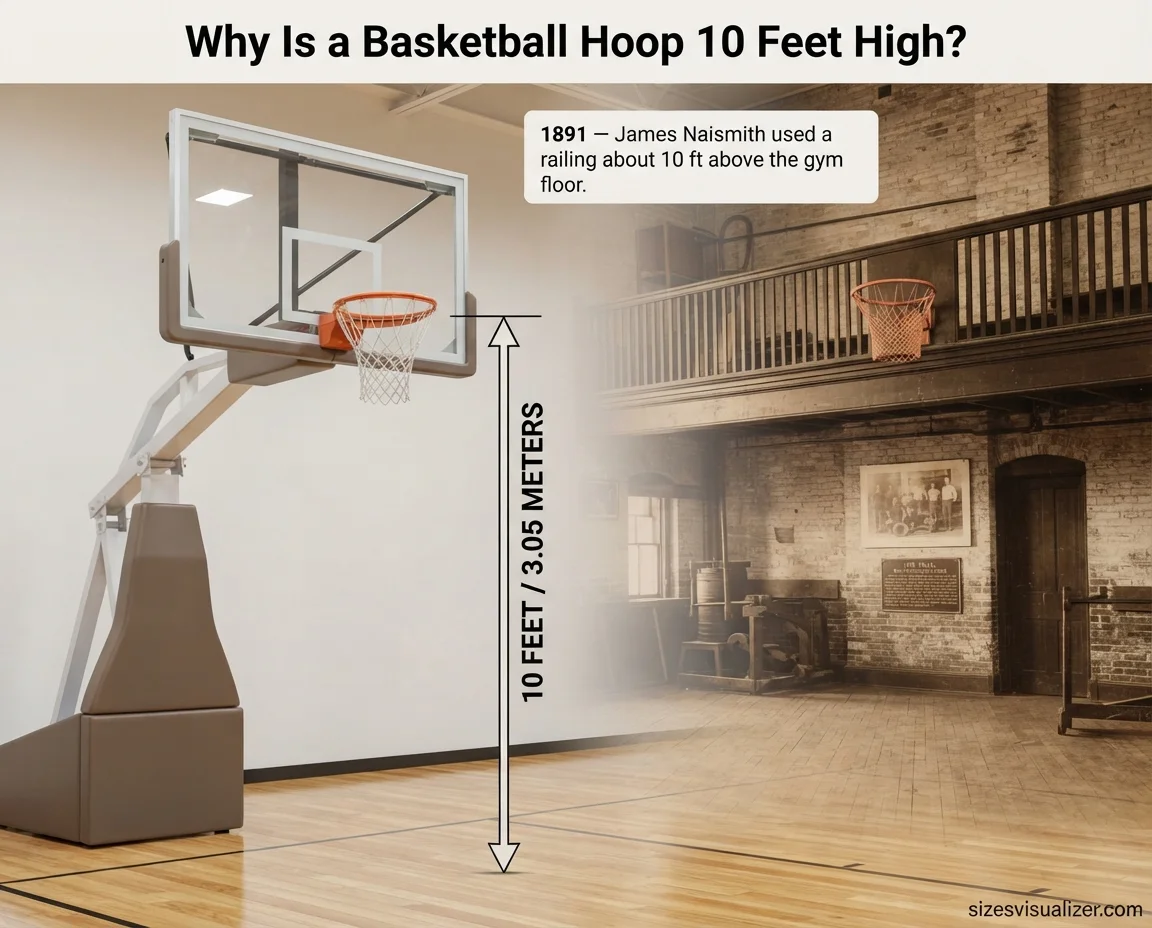
The 10-foot standard goes back to 1891, when Dr. James Naismith invented basketball at a YMCA gym in Springfield, Massachusetts. He needed something to nail a peach basket to. The running track above the gym floor had a railing, and that railing happened to sit 10 feet off the ground. So that’s where the basket went (Britannica).
That’s really the whole story. Naismith wasn’t chasing a perfect athletic challenge. He grabbed what was already there. Over a century later, the number has never changed, even as the peach basket became an iron rim and the game turned into a global sport.
What’s changed instead is the players. In 1947, the average NBA player stood about 6 feet 2 inches. By 2015, that average climbed to nearly 6 feet 7 inches (Britannica). Athletes got taller, faster, and more explosive — yet the rim stayed put at 10 feet. That’s part of why today’s game features so many highlight-reel dunks. The hoop didn’t get easier to reach. The players got closer to it naturally.
Basketball Hoop Height by Age
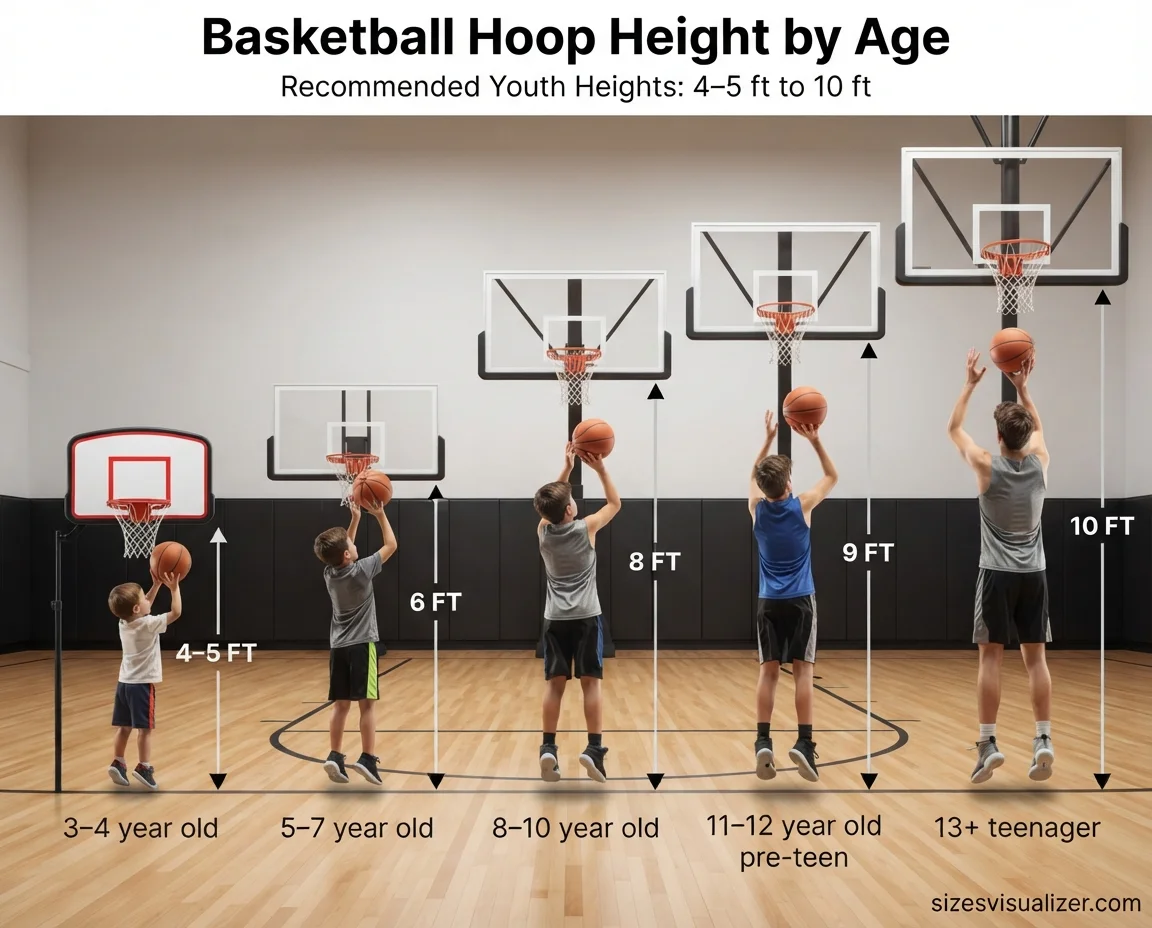
A regulation 10-foot rim is too tall for a young child learning the game. A basketball hoop height by age chart solves that problem, letting kids build proper shooting form instead of heaving the ball with their whole body just to reach the rim.
Here’s the general breakdown used by youth leagues and coaches nationwide:
- Ages 3–4 (preschool): 4–5 ft
- Ages 5–7: 6 ft
- Ages 8–10: 8 ft
- Ages 11–12: 9 ft
- Ages 13 and up: 10 ft
The preschool range rarely gets mentioned, but it matters. Toddler hoop sets sold for backyards and playrooms usually sit between 4 and 5 feet, low enough for a 3-year-old to actually score without help.
These numbers are a starting point, not a strict rule. A tall, confident 10-year-old might handle a 9-foot rim just fine. A smaller 12-year-old might still benefit from 8 feet. Shooting form matters more than sticking rigidly to an age bracket. If a kid starts pushing the ball from the chest instead of shooting overhead, the hoop is probably too high.
Must Visit: Stop Sign Dimensions: Standard Size, Height & How High to Mount a STOP Sign
Basketball Hoop and Backboard Dimensions
Height isn’t the only number that matters. A regulation hoop has a rim diameter of 18 inches (46 cm). That’s true at every senior level of play, from high school gyms to NBA arenas.
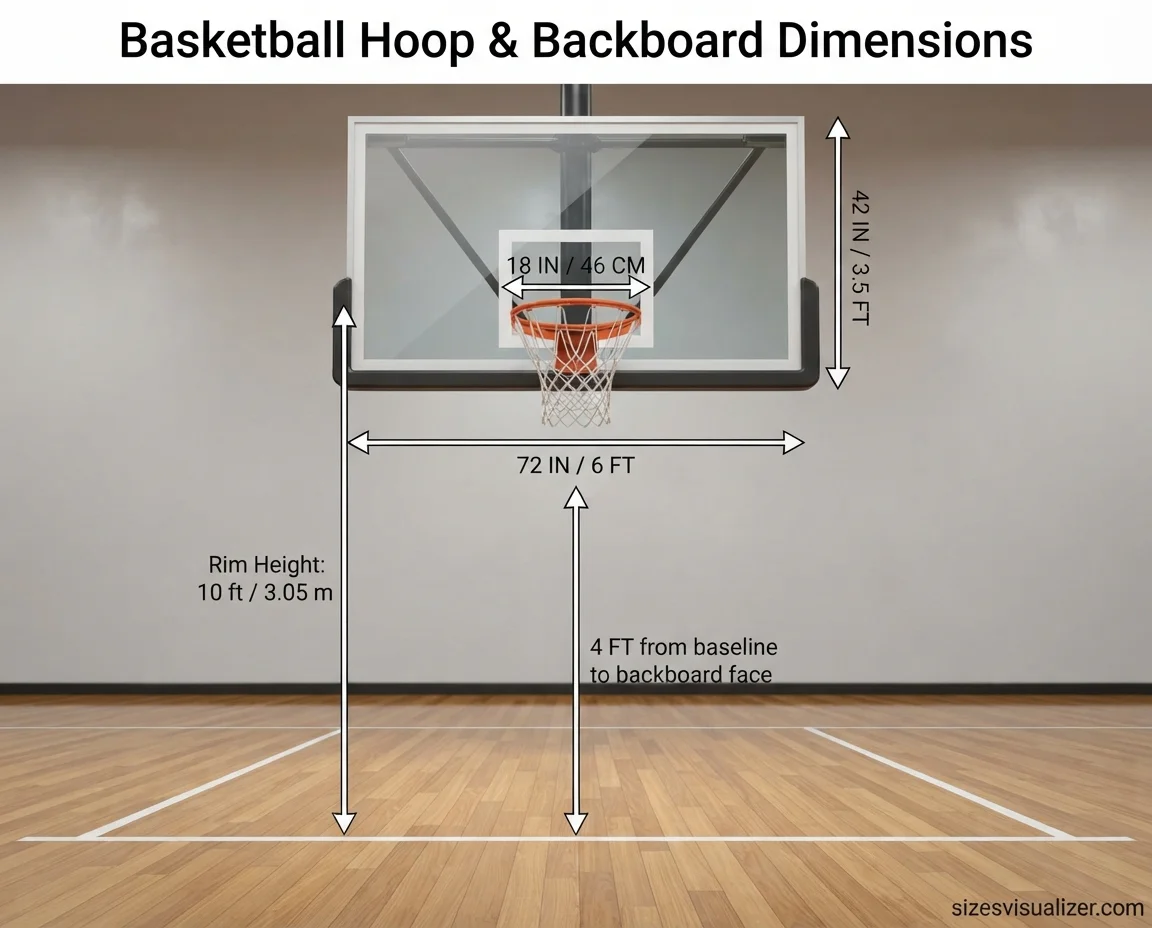
Backboards vary more. NBA rules call for a backboard measuring 42 inches tall by 72 inches wide (about 3.5 by 6 feet), made of tempered glass. Home and driveway systems are usually smaller, ranging from 48 to 72 inches wide, often built from acrylic or polycarbonate instead of glass.
One measurement almost never gets mentioned, even though it trips people up during installation: the rim doesn’t sit at the very edge of the court. On a regulation court, the basket is set 4 feet in from the baseline, with the backboard’s face positioned that same distance from the end line. If you’re mapping out a home court and wondering why your setup feels “off” compared to a real gym, this offset is usually the missing piece.
When checking your own hoop, always measure from the floor to the top of the rim — not the backboard, and not the net. A tape measure and a helper are enough to confirm you’re at the right height, whether that’s 10 feet or one of the youth heights above.
How to Choose and Set Up the Right Hoop Height
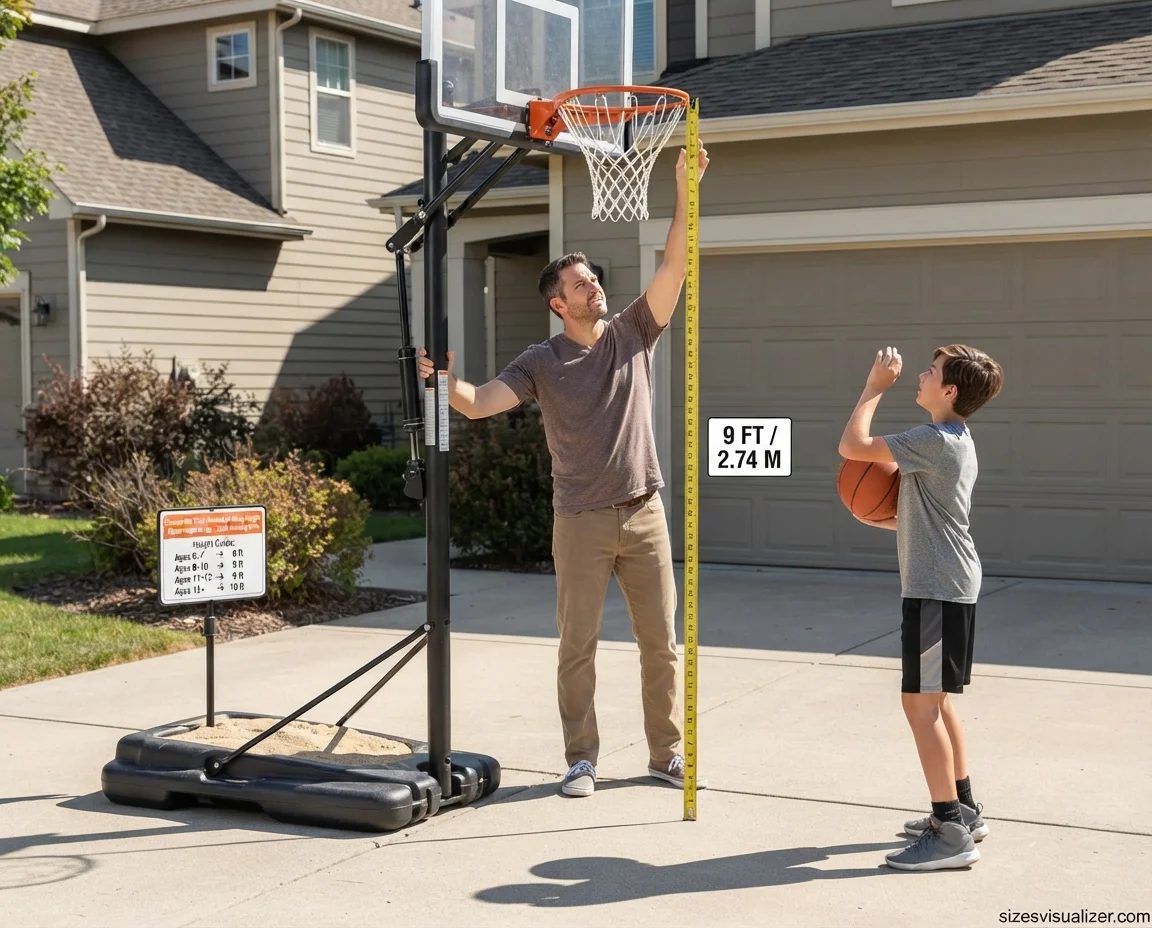
Picking the right basketball hoop height starts with honesty about the player’s age, size, and skill level — not just what looks impressive in the driveway.
Adjustable hoops are the practical choice for most families. A crank, lever, or pin system lets you raise the rim as a child grows, so one hoop can last from age 6 through the teenage years. Fixed-height hoops work fine for adults or dedicated youth teams that already know their target height.
A wobbly base undercuts all of this. Portable hoops rely on a weighted base — usually filled with water or sand — to stay steady during real play. A hoop that tips or shakes on contact isn’t just annoying. It’s a safety issue, especially with younger kids driving to the basket.
Here’s a useful reality check: even future pros didn’t start tall. Stephen Curry, now one of the most accurate shooters in NBA history, was famously undersized as a kid and didn’t hit his growth spurt until later in his teens — he was still shooting on lowered hoops and building his form well after most of his peers had moved to full height (Britannica). Height at 12 doesn’t decide anything. Good form built at the right hoop height does far more for long-term skill than rushing a kid onto a 10-foot rim too early.
FAQs
Is the NBA rim 12 feet?
No. This is a common myth, but the NBA rim sits at 10 feet, exactly like every other level of organized basketball. There’s no official rule anywhere that uses a 12-foot rim.
Are NBA rims really 10 ft?
Yes. Every NBA basket is set at 10 feet, measured from the court floor to the top of the rim. This has been true since the league’s founding and traces back to Naismith’s original 1891 setup.
How tall is a 12-year-old basketball hoop?
Most youth basketball guides recommend a 9-foot hoop for 11- to 12-year-olds. Some 12-year-olds who are taller or more advanced move up to the full 10-foot regulation height around this age, depending on strength and shooting form.
Is 6’4″ short for the NBA?
By everyday standards, no — 6’4″ is well above average height. But inside the NBA, where the league average sits closer to 6’6″, a player at 6’4″ is on the shorter end, especially for guard and wing positions where taller players are common. It’s not unusually short; several successful NBA players have stood well under 6’4″, including Hall of Famer Muggsy Bogues at 5’3″.
Is 6’4″ short for the NBA?
Historically, yes — players like Suleiman Ali Nashnush have been listed at close to 7’11” in older records, though modern measurement standards are stricter. The tallest verified professional player in recent years is Sun Mingming, measured by Guinness World Records at 7’9″ (Guinness World Records). No 7’11” player has ever appeared in an NBA game.
How tall was Steph Curry at 12?
There’s no officially documented height for Curry at exactly age 12. What is well documented is that he stayed small for his age well into high school — reportedly around 5’6″ and 125 pounds as a teenager — before a late growth spurt pushed him to his current 6’2″ (Britannica). His early years are a good reminder that height at 12 rarely predicts anything about a player’s future.
Conclusion
The basketball hoop height question has one firm answer: 10 feet, everywhere from the NBA to your local high school. For younger players, the right height depends on age and skill, not a fixed rule. Get the height right, measure it correctly, and the game gets more fun and a lot fairer for everyone shooting at the rim.

Measurement Researcher, Size Comparison Writer & Content Specialist
Timmy Ahad is a dedicated content writer and research specialist at SizesVisualizer.com, where he focuses on creating accurate, easy-to-understand content about measurements, dimensions, size comparisons, and real-world object visualization.