Pick up any can of beans or tomatoes, and you’ll see a number stamped somewhere on the label or lid. That number isn’t random. It ties back to a standard food can size system that the entire U.S. canning industry has used for over a century.
Knowing food can dimensions and sizes helps you shop smarter, scale recipes correctly, and plan pantry space without guessing. This guide breaks down the standard height, diameter, and weight of every common can, plus how to measure one yourself.
Table of Contents
Standard Food Can Sizes Chart — Diameter, Height & Weight
Here’s a quick-reference chart of standard can sizes used across U.S. grocery stores and foodservice kitchens. These figures line up with the Can Manufacturers Institute (CMI) and the USDA Food Buying Guide, which food service buyers use to identify cans by sight.

| Can Name | Diameter | Height | Net Weight / Volume | Common Uses |
|---|---|---|---|---|
| #10 | 6-3/16″ | 7″ | 6 lb – 7 lb 5 oz (~12–13 cups) | Restaurants, school cafeterias, bulk fruit and sauce |
| #3 Cylinder | 4-1/4″ | 7″ | 46–51 fl oz (~5¾ cups) | Vegetable juice, condensed soup |
| #2.5 | 4-1/16″ | 4-11/16″ | 26–30 oz (~3½ cups) | Pumpkin, tomatoes, peaches |
| #2 | 3-7/16″ | 4-9/16″ | 1 lb 4 oz / 20 fl oz (~2½ cups) | Fruit juice, ready-to-serve soup |
| #303 | 3-3/16″ | 4-3/8″ | 16–17 oz (~2 cups) | Green beans, corn, fruit |
| #300 | 3″ | 4-7/16″ | 14–16 oz (~1¾ cups) | Baked beans, cranberry sauce |
| #1 (Picnic) | 2-11/16″ | 4″ | 10½–12 oz (~1¼ cups) | Small vegetables, meats |
| 12 oz | 2-11/16″ | 4-13/16″ | 12 oz | Tuna, small soups |
| 8 oz | 2-11/16″ | 3″ | 8 oz | Tomato sauce, paste |
| 5 oz | 2-1/8″ | 2-1/4″ | 5 oz | Sardines, small tuna |
Quick answer: the most common standard can on U.S. shelves is the #303, holding about 16 ounces, followed closely by the #300 and #2 for soups and vegetables.
Common Food Can Sizes Explained
Numbers only tell half the story. Here’s what each size actually looks and feels like on a shelf.
The #10 can

The #10 can is the giant of the group. At 6-3/16 inches wide and 7 inches tall, it holds roughly 13 cups — enough for a big batch of chili at a church supper or a diner’s morning eggs. It’s built for volume, not for a single household meal.
The #2.5 can

The #2.5 can sits in the middle. You’ll spot it holding pumpkin around the holidays or peach halves in syrup. Its wider 4-1/16-inch diameter gives whole fruit slices room to sit flat.
The #303 can

The #303 can is the one most home cooks reach for daily. Green beans, sweet corn, diced tomatoes — nearly all of them ship in this 3-3/16-inch by 4-3/8-inch container.
The #300 can looks almost identical to the #303 but is slightly narrower. Baked beans and cranberry sauce commonly use this size.
Smaller cans
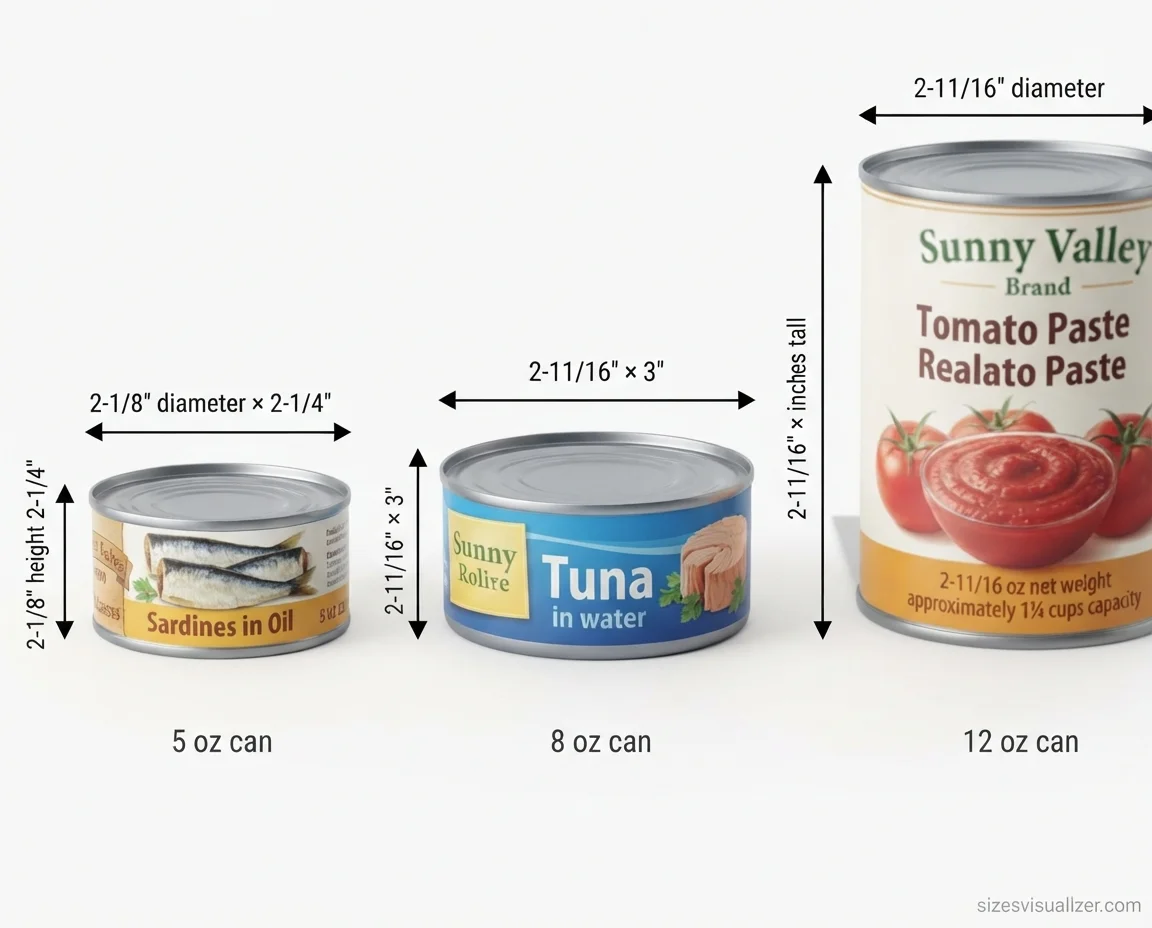
Smaller cans, like the 5 oz and 8 oz sizes, exist for portion control. Sardine tins, small tomato paste cans, and single-serve tuna all fall into this bracket, letting shoppers buy just what a recipe calls for without leftovers going to waste.
One detail trips people up constantly: the ounces printed on a can measure weight, not liquid volume, unless the label explicitly says “fl oz.” A can of diced tomatoes might read 14.5 oz by weight but contain slightly less liquid volume once you account for the solid pieces. The USDA’s canned fruit and vegetable size chart uses this same weight-based standard for grading produce sizes.
How to Read Can Size Codes
Ever seen a can stamped 307×409 instead of a name like “#2”? That’s the manufacturer’s raw dimension code, and once you know the pattern, it’s simple to decode.
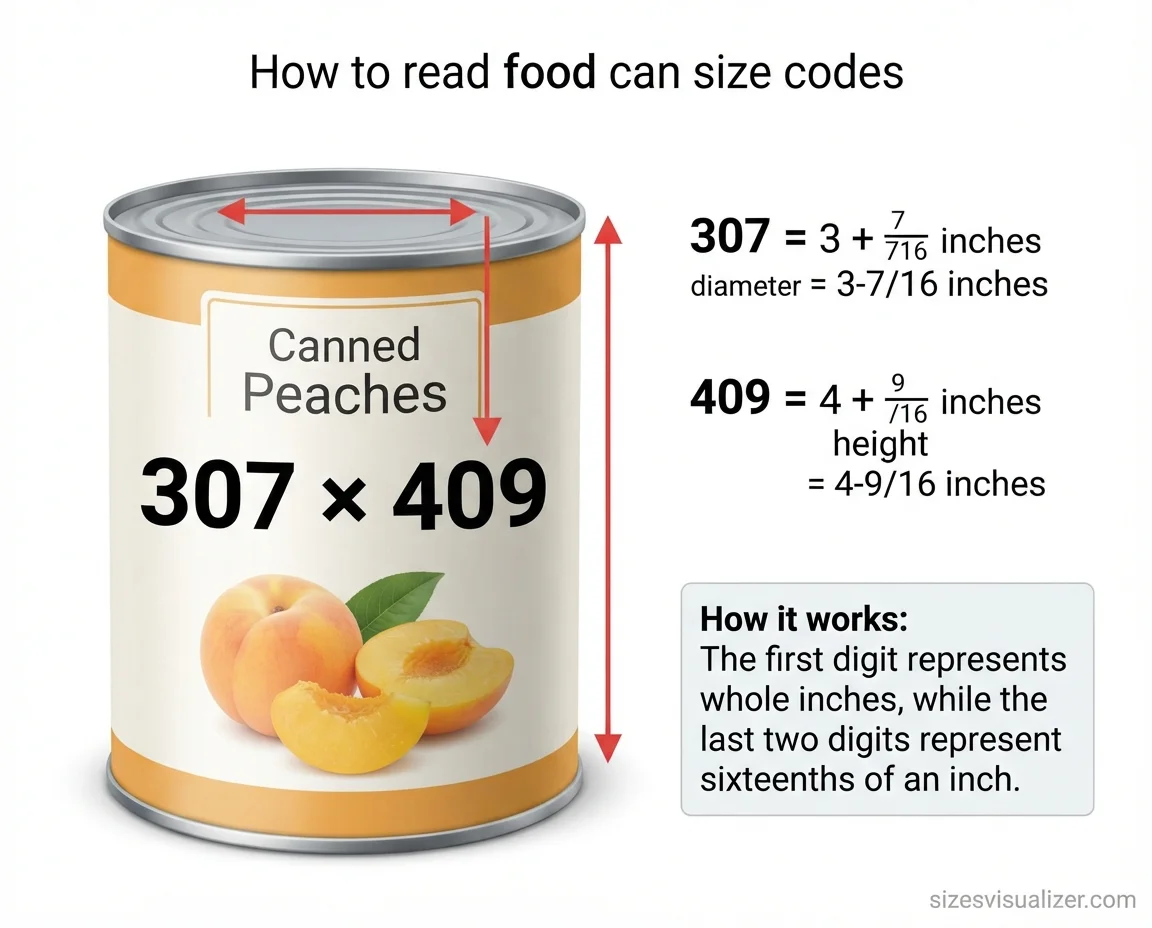
Each code is a pair of three-digit numbers. Here’s the rule:
- The first digit is the whole number of inches.
- The second and third digits are sixteenths of an inch.
So 307 means 3 inches plus 7/16 of an inch — a diameter of 3-7/16 inches. The second set, 409, means 4 inches plus 9/16 of an inch, or a height of 4-9/16 inches. Put them together, and 307×409 describes the classic #2 can.
This coding system isn’t just trivia. Canning equipment manufacturers use it to size the chuck — the part of a can-sealing machine that grips the can during sealing. Get the chuck size wrong, and the seal fails. That’s why every dimension on a production line traces back to this same three-digit logic.
How to Measure a Food Can’s Diameter, Height & Weight
Don’t have a chart handy? You can measure any tin can’s dimensions yourself with tools already in most kitchen drawers.
To measure diameter:
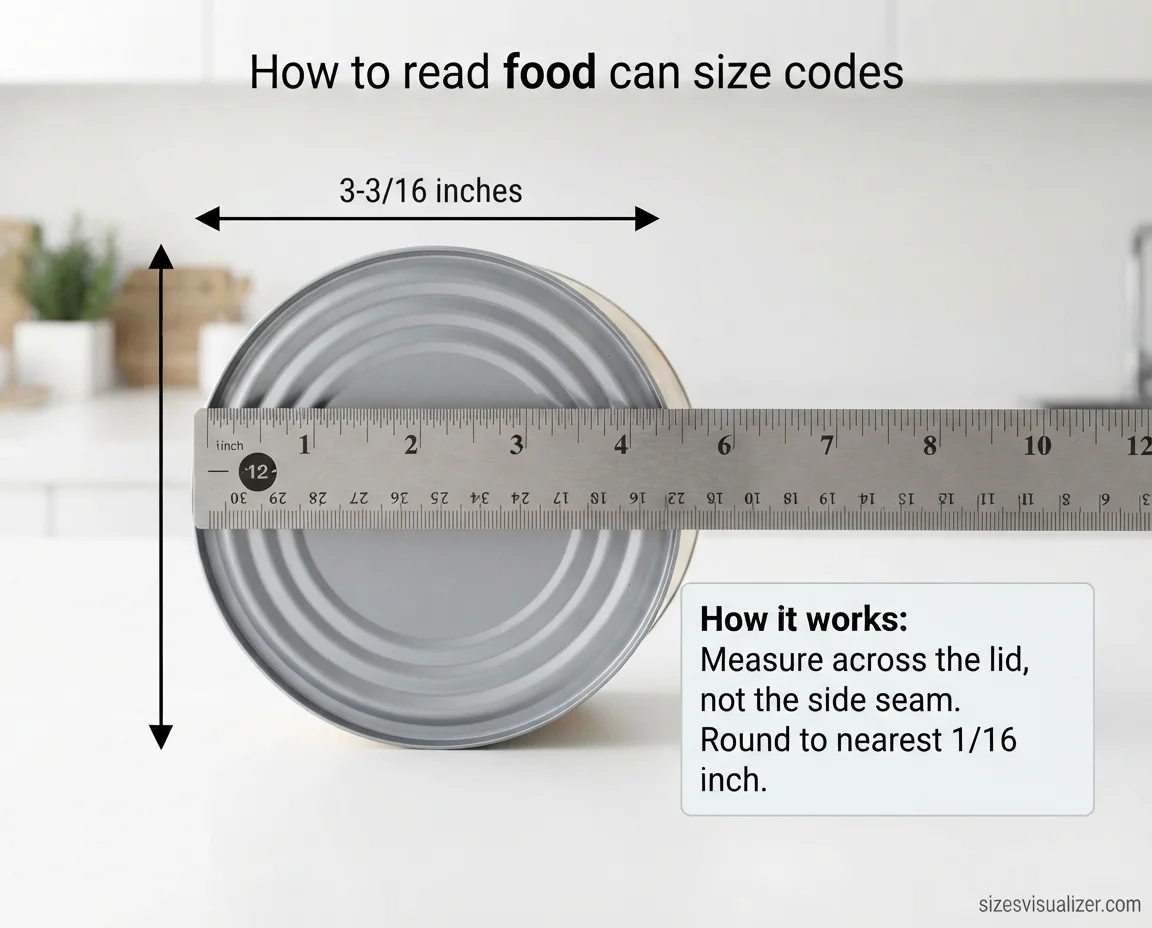
- Lay the can on its side.
- Place a ruler across the widest point of the lid, not the side seam (the seam adds a hair of extra width and skews the reading).
- Round to the nearest 1/16 inch — that’s the precision the industry uses.
To measure height:

- Stand the can upright on a flat surface.
- Measure straight up from the bottom edge to the top rim.
- Ignore any curve or dome shape at the very top; measure to the highest point.
To measure weight:

- Place the empty scale on a flat surface and zero it out (tare).
- Weigh the full, unopened can to get gross weight.
- Subtract the empty can’s weight (check an already-emptied can of the same size) to estimate net weight — the actual food content.
This same method is how quality control teams verify cans on a packaging line, just done with calipers instead of a kitchen ruler for tighter accuracy.
Must Visit: Aluminum Can Dimensions: Standard Sizes, Heights, Diameters & Capacity Guide
Why Food Can Dimensions Matter
Beyond trivia, can dimensions and sizes solve real, everyday problems.
Recipe scaling

Recipe scaling is the biggest one. A recipe written decades ago might call for a “#2 can of tomatoes,” a size that’s rarely sold today. Knowing that a #2 can equals about 20 fluid ounces lets you substitute two 10 oz cans, or one 15 oz can plus a splash of water, without ruining the dish.
Pantry and shelf planning

Pantry and shelf planning benefits too. Bulk buyers stocking a home pantry or a small food pantry program can calculate exactly how many #10 cans fit a shelf, since the dimensions never vary between brands using the same code.
Sustainability
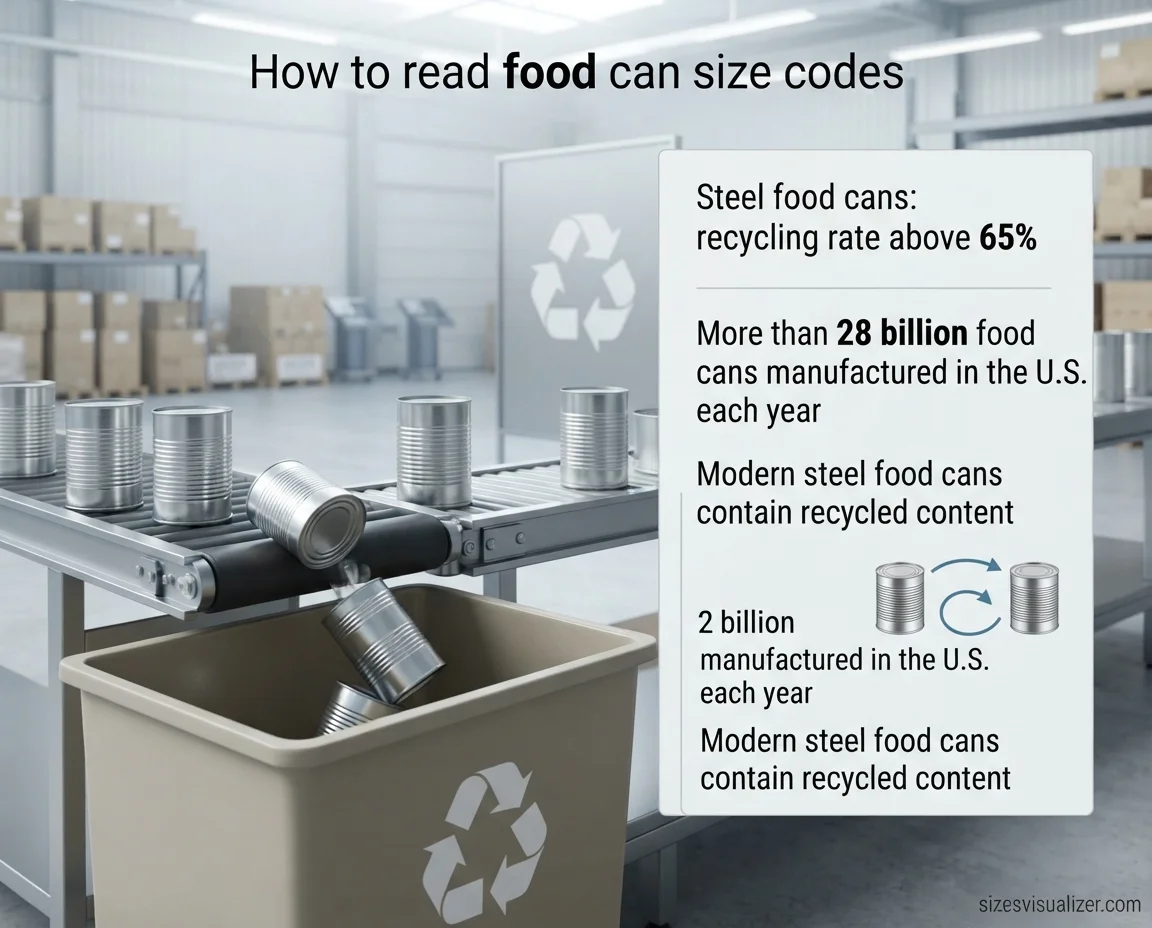
Sustainability plays a role as well. Steel food cans are among the most recycled packaging types in the country. Industry data from the Steel Market Development Institute puts the steel can’s recycling rate above 65%, higher than most other food packaging formats, with more than 28 billion food cans manufactured in the U.S. each year. Every steel can also contains at least some recycled content already, since modern steelmaking requires it.
FAQs
What are the dimensions of a can of food?
It depends on the size code. A common 15 oz can measures about 3-3/16 inches in diameter and 4-7/16 inches tall. Larger cans, like the #10, measure 6-3/16 inches wide and 7 inches tall.
What is the standard size of a can?
For home use, the #303 can (about 16 ounces) is the most common standard can size in U.S. grocery stores, used for vegetables, beans, and fruit.
What is the standard size of a tin can?
A standard tin (steel) food can typically measures around 3 inches to 3-3/16 inches in diameter and 4-3/8 to 4-7/16 inches tall, matching the #300 and #303 sizes used for most canned goods.
What is the size of a 10 can?
A #10 can measures 6-3/16 inches in diameter and 7 inches tall, holding roughly 6 to 7 pounds of food, or about 12 to 13 cups. It’s the standard bulk size for restaurants and cafeterias.
How wide is a tin can?
Most household tin cans range from 2-11/16 inches to 4-1/16 inches wide, depending on the size. A typical vegetable can (#303) is about 3-3/16 inches wide.
How big is a can of vegetables?
A standard can of vegetables usually holds 14 to 17 ounces, matching the #300 or #303 size, with a diameter close to 3 inches and a height near 4-3/8 inches.
Conclusion
Food can dimensions and sizes follow a consistent, decades-old standard, once you know the code. Whether you’re scaling a recipe, restocking a pantry, or just curious what “#303” means on a soup label, the numbers break down into simple diameter and height measurements you can check with a plain ruler. Keep this guide handy, and guessing at can sizes becomes a thing of the past.

Measurement Researcher, Size Comparison Writer & Content Specialist
Timmy Ahad is a dedicated content writer and research specialist at SizesVisualizer.com, where he focuses on creating accurate, easy-to-understand content about measurements, dimensions, size comparisons, and real-world object visualization.