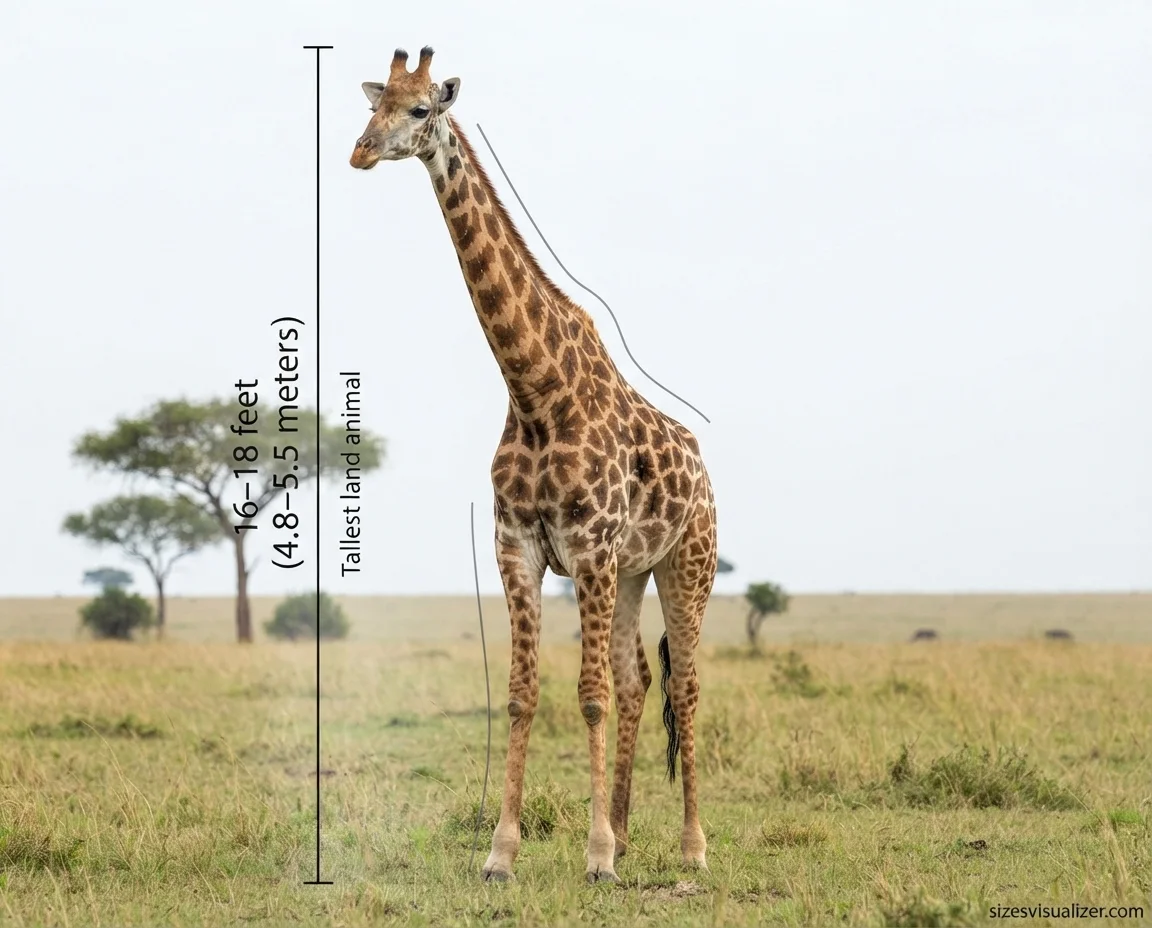
A full-grown male can top 18 feet (5.5 meters), making it the tallest land animal on Earth by a wide margin. Even a newborn calf stands taller than most adult humans within minutes of birth.
This guide breaks down exact giraffe height and weight by sex and species, compares giraffes to other animals (yes, even a T-Rex), and shares 15 facts most people never learn in school.
Table of Contents
How Tall Is a Giraffe? Average Height in Feet and Meters
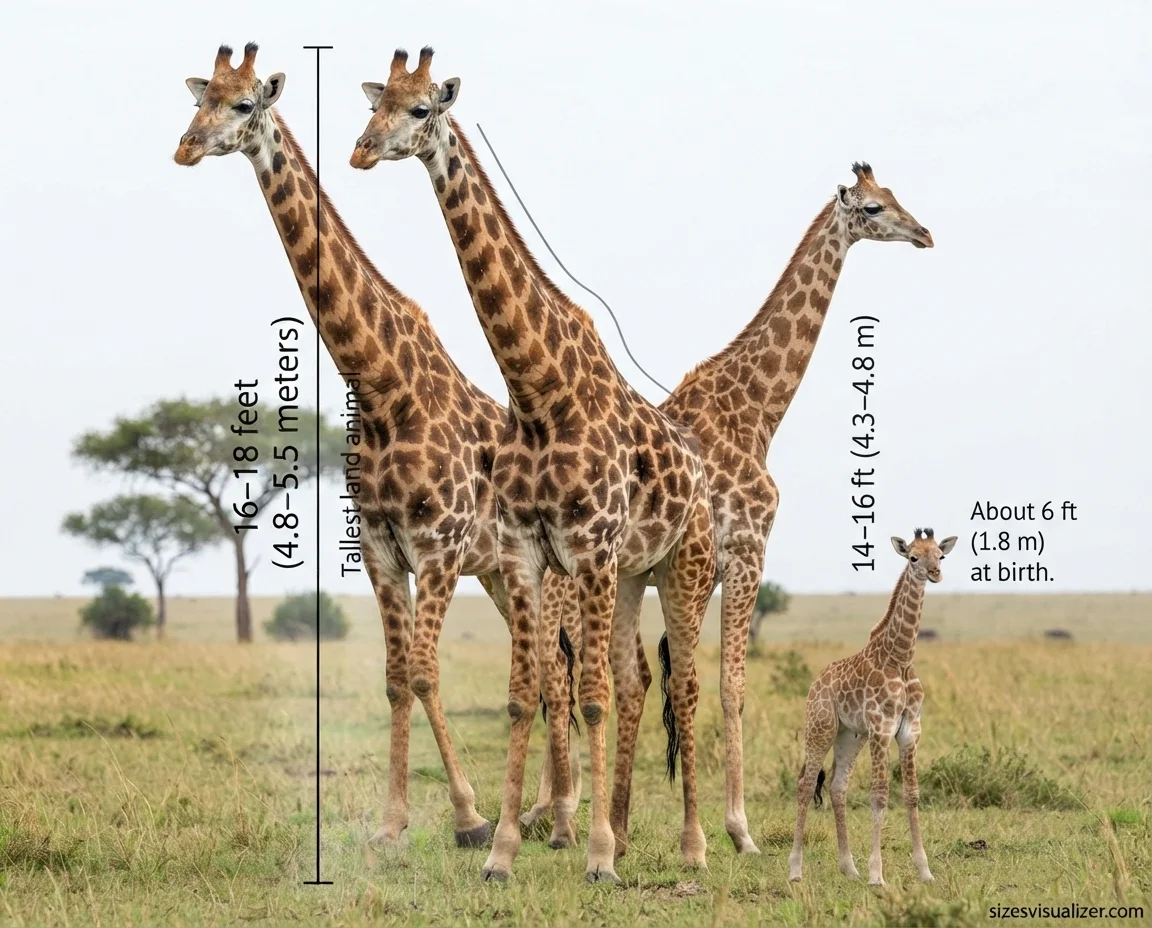
How tall is a fully grown giraffe? Adult males, called bulls, typically stand between 16 and 18 feet (4.8 to 5.5 meters) tall. Females, called cows, are shorter but still towering, usually reaching 14 to 16 feet (4.3 to 4.8 meters).
That height difference isn’t random. Bulls need extra size and reach for feeding competition and for “necking” contests, where males swing their necks like clubs to establish dominance.
How tall is a baby giraffe at birth? A newborn calf already measures around 6 feet (1.8 meters) and weighs roughly 100 to 150 pounds. Calves drop nearly 5 feet to the ground during birth, since cows give birth standing up, yet most are on their feet within 30 minutes.
The tallest giraffe ever recorded, a male named George, reached 19 feet (5.8 meters) during the 20th century. The current record for a living giraffe belongs to a bull named Forest, measured at just over 18 feet 8 inches.
Giraffe Size and Weight by Species
Giraffe size varies by species and subspecies, though every one of them still dwarfs nearly every other land mammal.
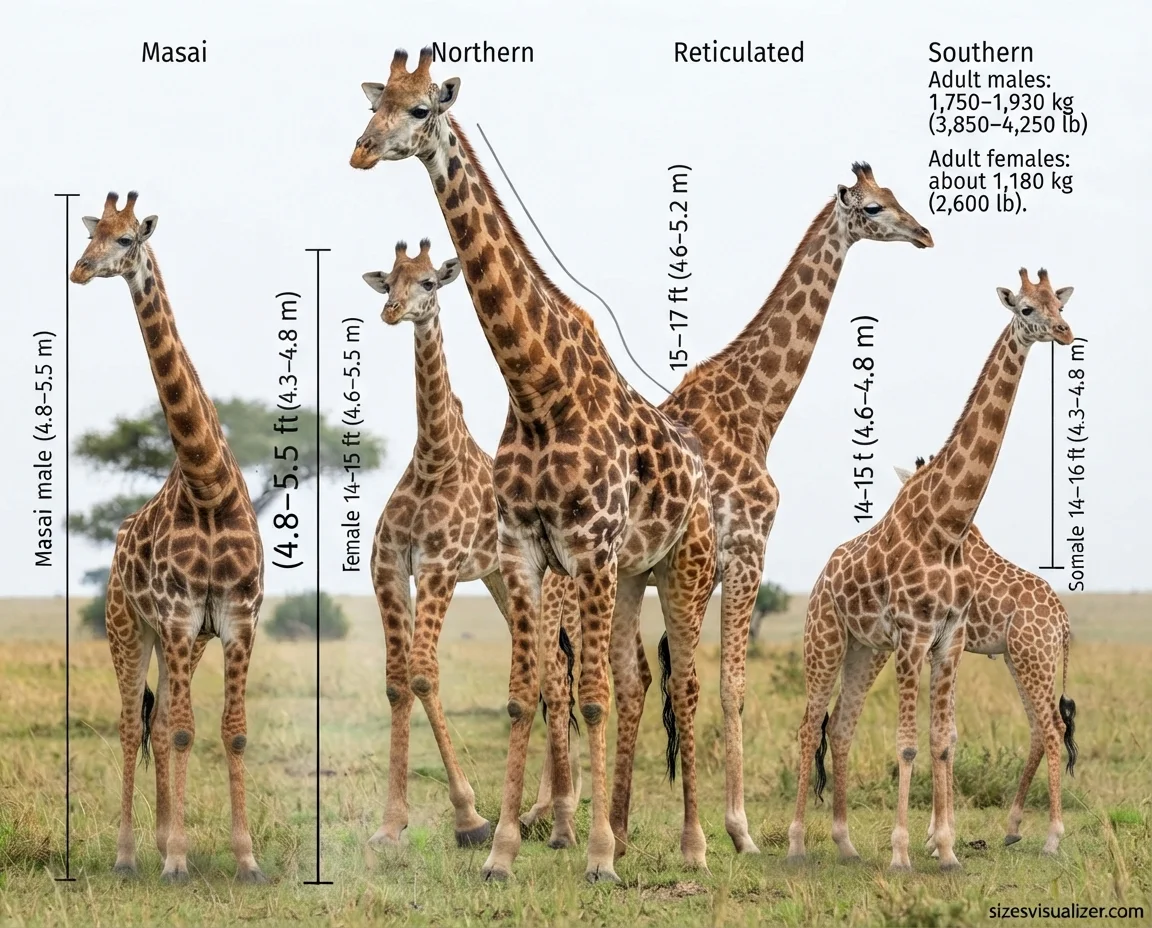
Adult males weigh between 1,750 and 1,930 kilograms (roughly 3,850 to 4,250 pounds). Females are lighter, typically 1,180 kilograms (about 2,600 pounds). Despite that bulk, a giraffe can gallop at speeds up to 37 mph (60 km/h) over short bursts.
Giraffe height by subspecies:
| Subspecies | Male Height | Female Height |
|---|---|---|
| Masai giraffe | 16–18 ft (4.8–5.5 m) | 14–16 ft (4.3–4.8 m) |
| Northern giraffe (Kordofan, Nubian, Rothschild’s) | 15–18 ft (4.6–5.5 m) | 14–15 ft (4.3–4.6 m) |
| Reticulated giraffe | 15–17 ft (4.6–5.2 m) | 14–15 ft (4.3–4.6 m) |
| Southern giraffe | 15–18 ft (4.6–5.5 m) | 14–16 ft (4.3–4.8 m) |
Much of that height comes from two body parts: the neck and the legs. A giraffe’s legs alone can measure 6 feet, taller than most adult humans stand in total. Its neck can stretch over 7 feet, yet it contains the exact same number of neck bones (vertebrae) as a human neck — just seven. Each giraffe vertebra, though, can be nearly 30 centimeters long.
Explore the Size Visualizer Tool to turn measurements into easy-to-understand visual comparisons and better appreciate an object’s true size.
Giraffe Height Compared to Other Animals (and a T-Rex)
Numbers are easier to picture with a comparison.
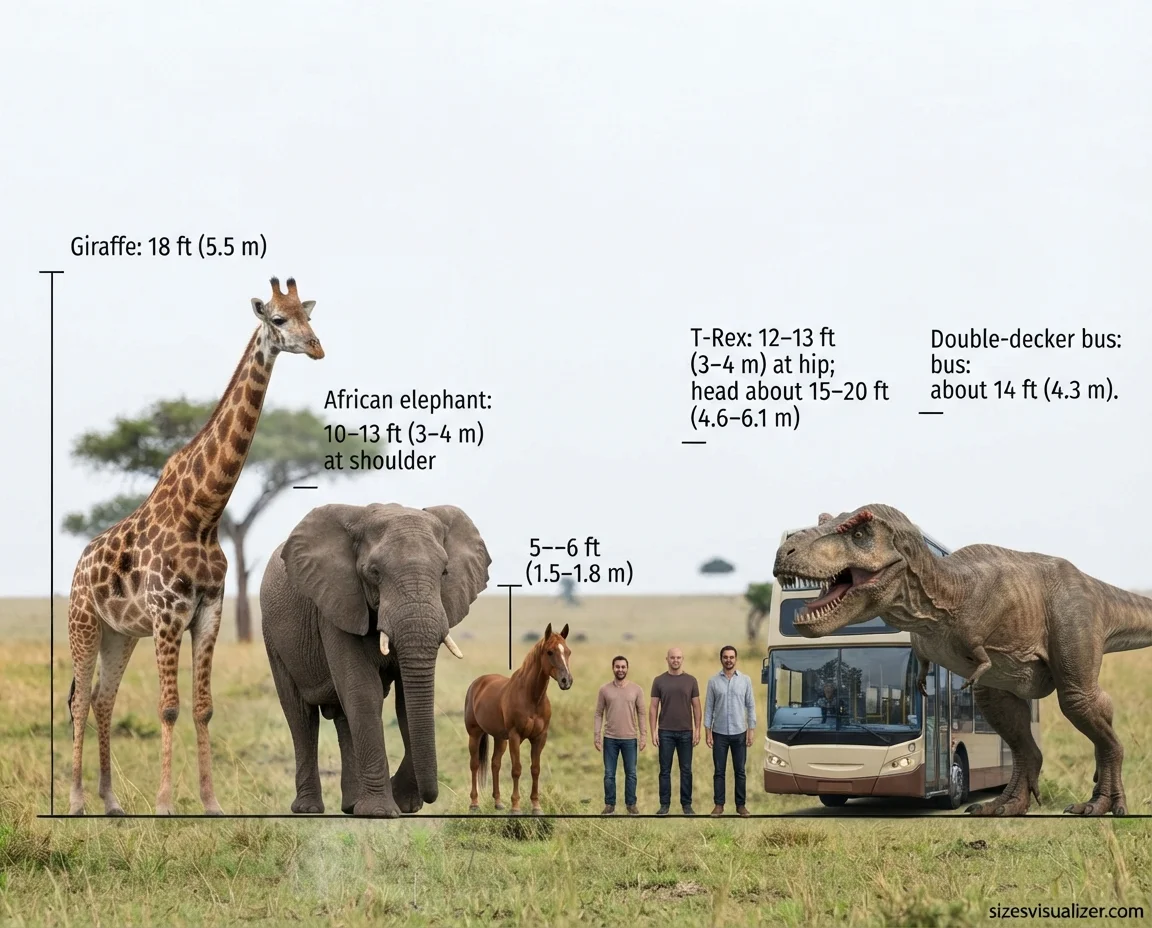
An 18-foot bull giraffe stands roughly as tall as a two-story building. Line up three average adult humans, and a giraffe would still edge them out. A double-decker bus, at around 14 feet, sits below eye level with most giraffes.
An adult African elephant reaches about 10 to 13 feet at the shoulder, making it the closest land rival in height, though still several feet short of a giraffe. A horse, by comparison, stands only 5 to 6 feet tall.
A Tyrannosaurus rex stood roughly 12 to 13 feet tall at the hip, with its head reaching about 15 to 20 feet when raised. That puts an adult T-Rex’s head height in the same range as a giraffe’s full height, though the dinosaur’s overall body length and weight far exceeded any giraffe alive today.
Even the tallest verified giraffe topped out just under 19 feet. Neck and leg growth is limited by blood-pressure demands on the heart, so 20 feet sits beyond what a giraffe’s cardiovascular system can safely support.
15 Fascinating Giraffe Facts
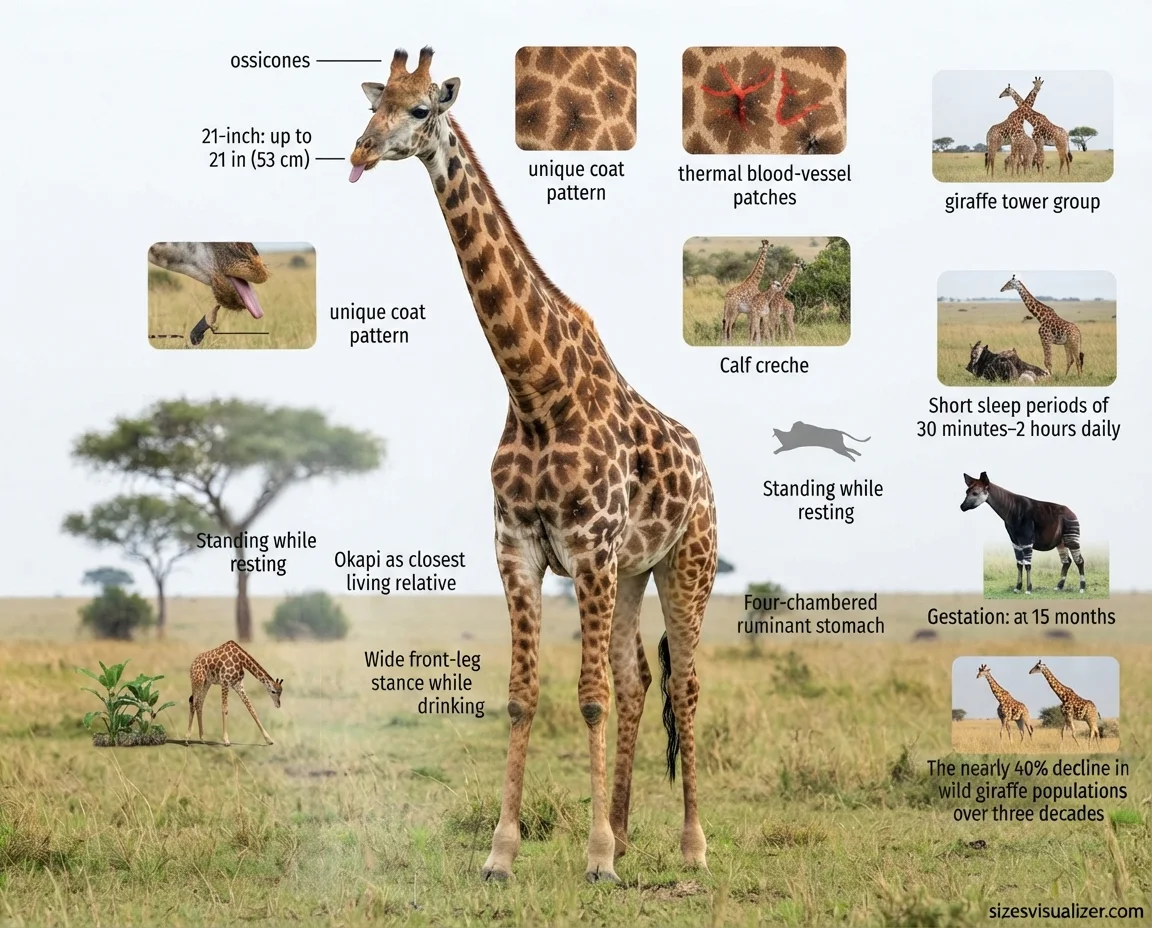
- Giraffes have ossicones — permanent, skin-covered bone knobs on their heads, not true horns or antlers.
- A giraffe’s tongue can stretch up to 21 inches (53 cm) and is dark blue-black to resist sunburn while feeding.
- Each giraffe’s coat pattern is unique, similar to a human fingerprint, and helps researchers identify individuals in the wild.
- Coat patches act as thermal windows, releasing body heat through blood vessels beneath each patch.
- Giraffes travel in groups called towers, usually led by a dominant male.
- Female giraffes raise calves together in group nurseries known as creches, taking turns watching young while others forage.
- Which animal sleeps 30 minutes per day? The giraffe. Adult giraffes often sleep for only 30 minutes to 2 hours total in 24 hours, usually in short naps rather than one long stretch.
- Giraffes rarely lie down fully, since standing helps them react quickly to predators.
- A giraffe’s closest living relative is the okapi, a shorter, forest-dwelling animal from the Congo Basin.
- Giraffes are ruminants with four stomach chambers, just like cows, which helps them digest tough leaves and bark.
- Drinking water is awkward for a giraffe. Its neck can’t reach the ground, so it must splay its front legs wide just to take a sip.
- Giraffes drink only once every few days, pulling most of their water from the plants they eat.
- A giraffe’s gestation period lasts about 15 months, among the longest of any land mammal.
- Giraffes communicate through low-frequency humming at night, along with grunts, snorts, and rare vocal bursts too low for human ears to catch easily.
- What is a sad fact about giraffes? Wild giraffe populations have dropped by close to 40% over the past three decades, largely from habitat loss and poaching, a decline conservationists call the “silent extinction” because so few people notice it happening.
Must visit: Bald Eagle Size & Dimensions: Length, Wingspan, Height, Weight and More
Why Are Giraffes So Tall? The Science Behind Their Height
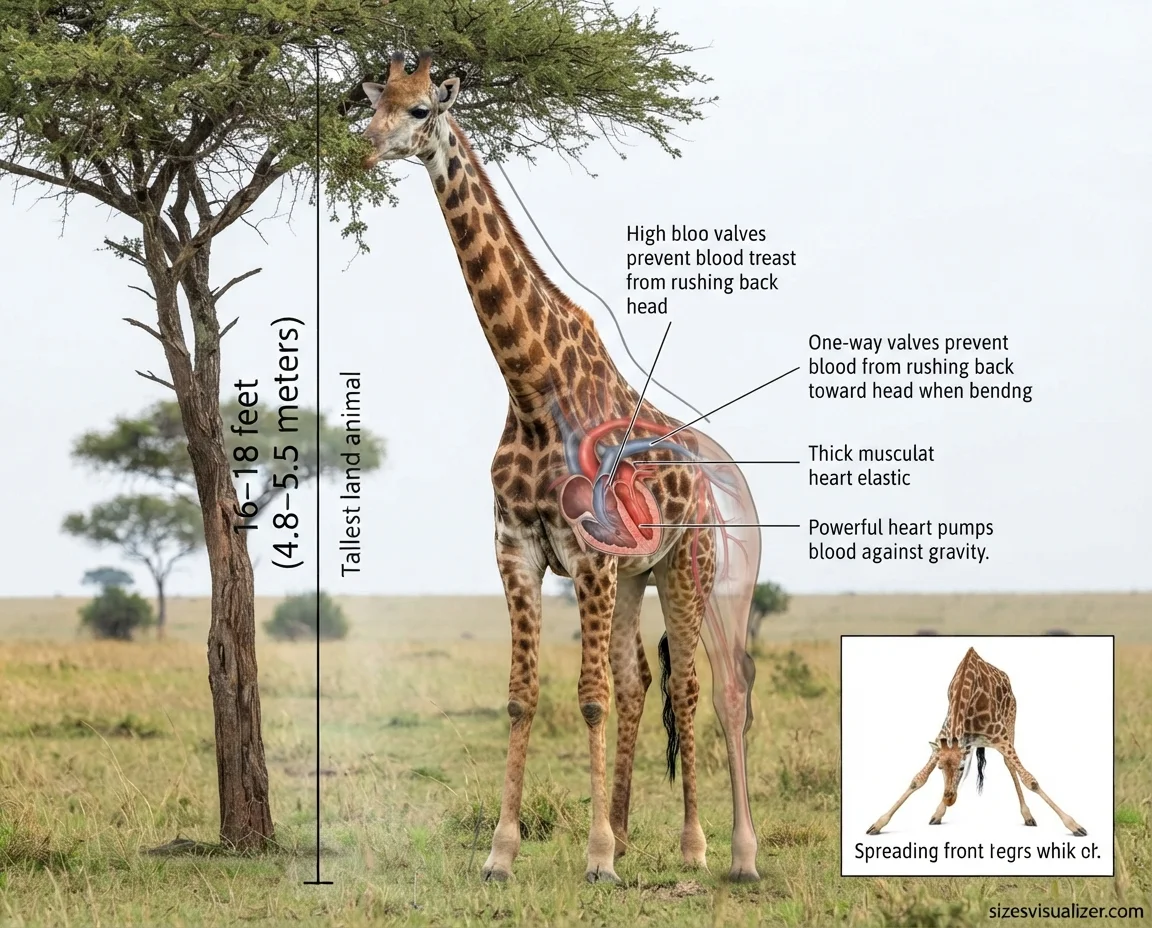
Giraffe height isn’t just a quirky trait. It’s a survival tool shaped by millions of years of evolution.
A tall neck and long legs let giraffes browse leaves nearly 20 feet up, food most other grazing animals can’t touch. That height advantage also works as an early-warning system, letting a giraffe spot a lion or hyena from a distance long before danger gets close.
Height creates a serious engineering problem, though: how does blood reach a brain that sits 6 feet above the heart? Giraffes solve this with a highly muscular left heart ventricle that pumps at nearly double human blood pressure, plus elastic-walled veins with one-way valves that stop blood from rushing back down when the head drops to drink. This cardiovascular adaptation is what makes a giraffe’s extreme height physically possible without fainting every time it bends over.
FAQs
Can giraffes be 20 feet tall?
No. The tallest giraffe on record measured just under 19 feet (5.8 meters). A giraffe’s heart and blood vessels can only support height up to a certain physical limit, and 20 feet exceeds it.
How tall is a fully grown giraffe?
A fully grown male giraffe stands 16 to 18 feet tall (4.8–5.5 meters). Fully grown females reach 14 to 16 feet (4.3–4.8 meters).
Which animal sleeps 30 minutes per day?
The giraffe holds this record among large mammals, often resting for only 30 minutes to 2 hours total per day, broken into short naps.
What animal is 12 feet tall?
An adult African elephant stands about 10 to 13 feet tall at the shoulder, making it one of the few land animals that comes close to giraffe height.
Who is taller, a T-rex or a giraffe?
A T-Rex’s head could reach 15 to 20 feet when raised, similar to a giraffe’s full height, though the dinosaur’s body was far heavier and longer overall.
What is a sad fact about giraffes?
Giraffe populations in the wild have fallen by nearly 40% in the last 30 years, a decline driven by habitat loss and poaching that scientists refer to as a silent extinction.
Conclusion
Giraffe height is more than a fun fact — it’s a finely tuned survival system built through evolution, from towering necks to a heart strong enough to pump blood against gravity. Understanding just how tall, heavy, and remarkable these animals are makes their ongoing decline in the wild even harder to ignore.

Measurement Researcher, Size Comparison Writer & Content Specialist
Timmy Ahad is a dedicated content writer and research specialist at SizesVisualizer.com, where he focuses on creating accurate, easy-to-understand content about measurements, dimensions, size comparisons, and real-world object visualization.