The Grand Canyon is one of the largest canyons on Earth. But how wide is the Grand Canyon exactly?
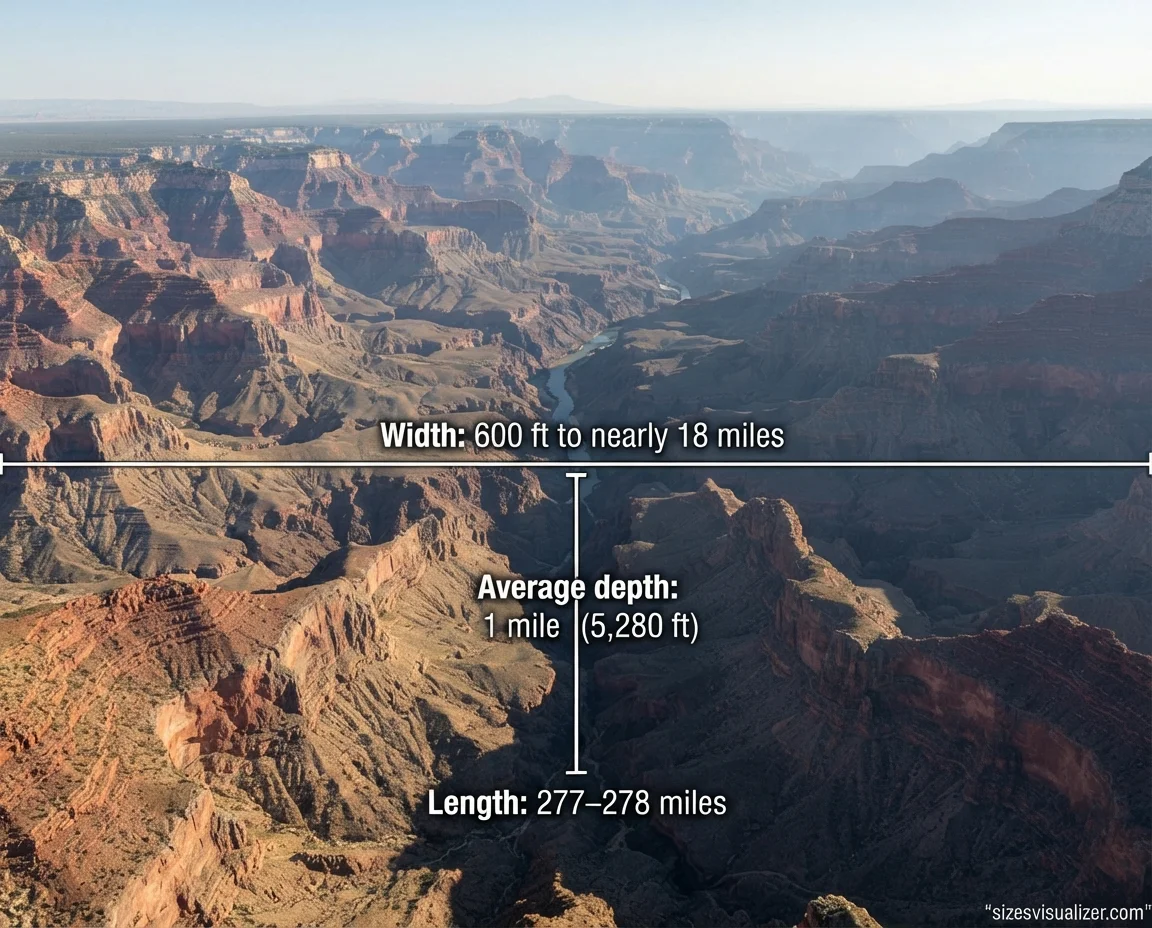
At its narrowest, the canyon measures just 600 feet across. At its widest, it stretches nearly 18 miles. That’s a massive range for one landmark. Below, we break down the real numbers behind its width, depth, length, and the facts most articles skip.
Table of Contents
How Wide Is the Grand Canyon? (Narrowest to Widest Points)
How wide is the Grand Canyon? The answer depends on where you stand along its 277-mile stretch. The canyon isn’t a uniform ditch. It bends, narrows, and balloons out depending on the rock beneath it and how the Colorado River carved through that terrain.
Use our Size Visualizer Tool to visualize and compare the dimensions of objects, spaces, and landmarks for a clearer understanding of their real-world size.
Grand Canyon Width at a Glance
| Measurement | Distance |
|---|---|
| Narrowest point (Marble Canyon) | 600 feet |
| Average rim-to-rim width | 10 miles |
| Widest point | Nearly 18 miles |
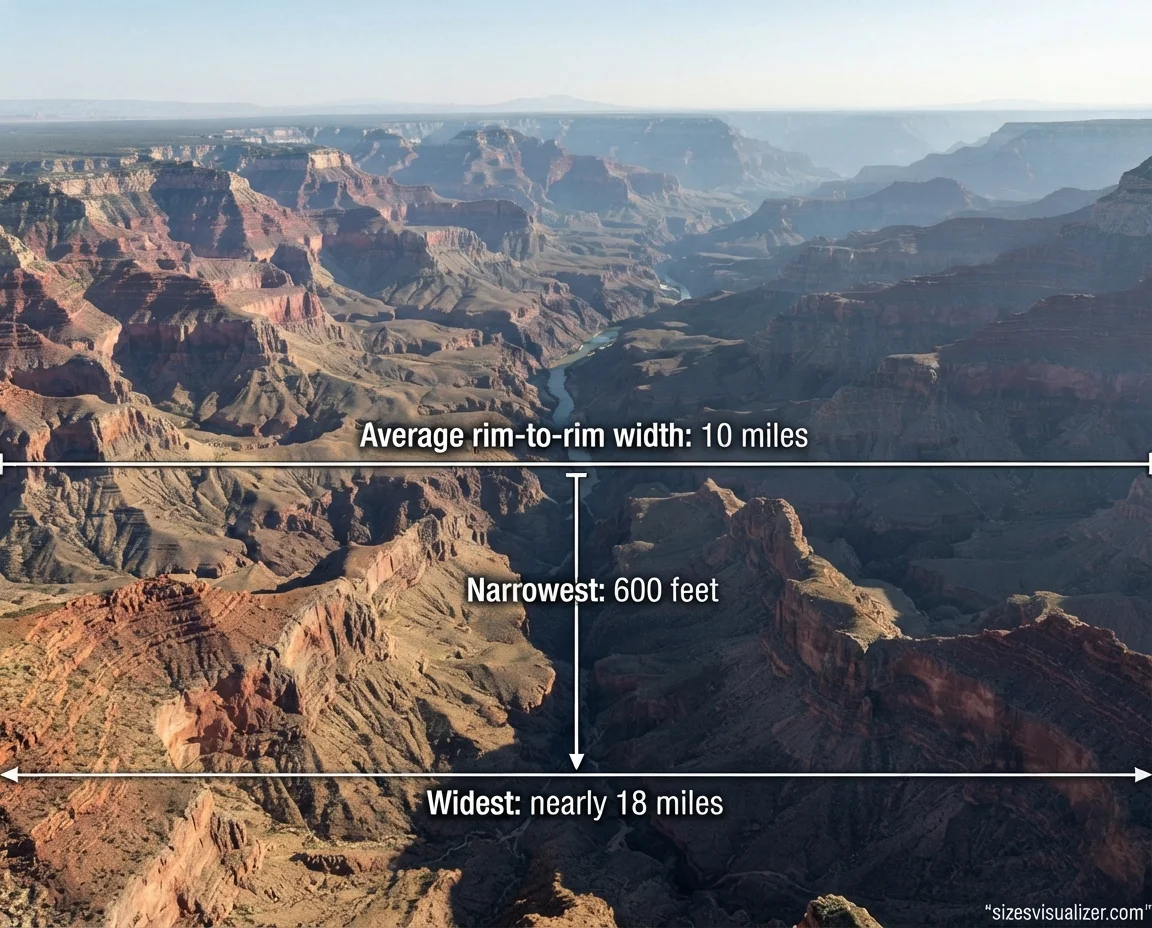
This data comes straight from the National Park Service, the official source for Grand Canyon statistics.
Narrowest Point — Marble Canyon

The tightest squeeze happens at Marble Canyon, near the park’s northeastern edge. Here, the canyon walls close in to just 600 feet apart. Rafters passing through this stretch often say it feels like paddling through a stone hallway.
Widest Point — Near the North Rim
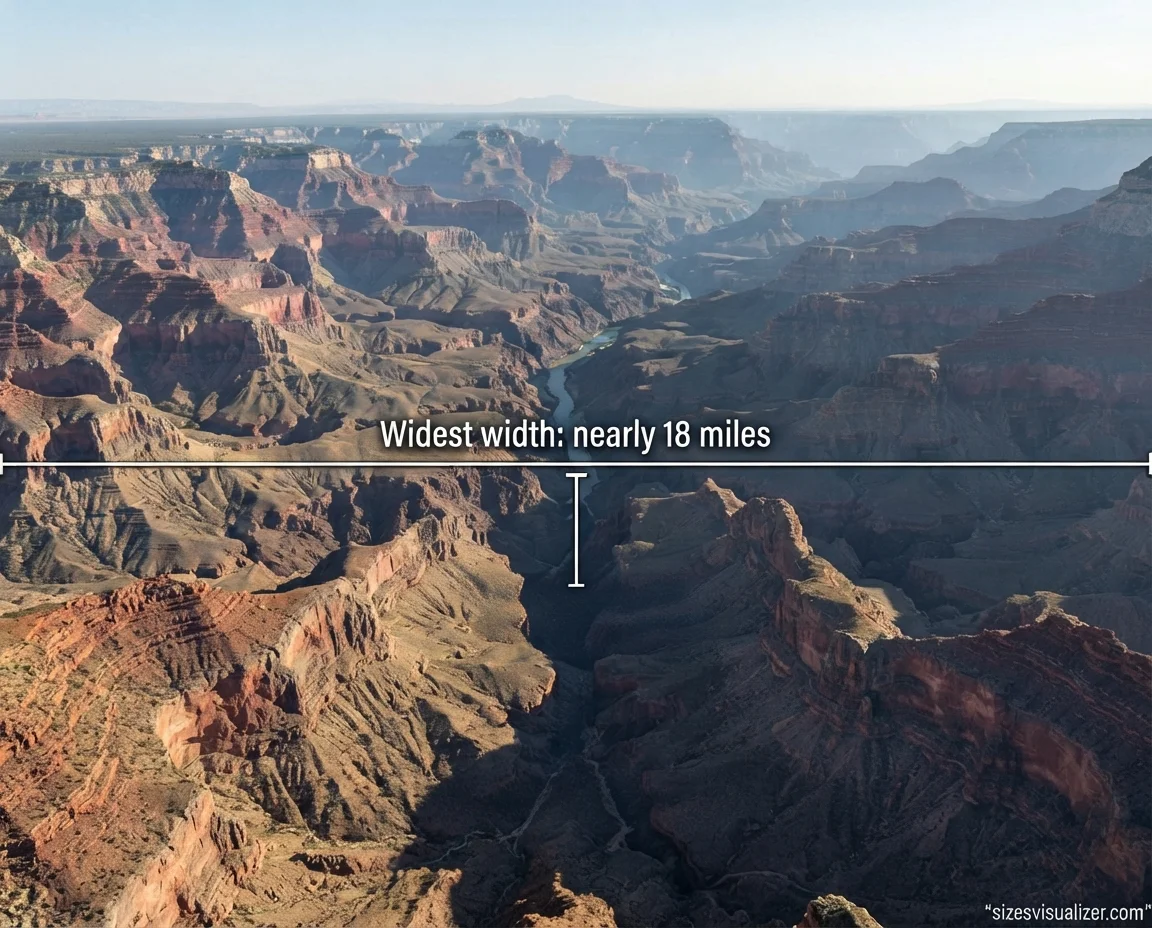
The canyon opens up to its full 18-mile width near Grand Canyon Village and the North Rim. Standing at the edge here, the opposite rim looks like a hazy smudge on the horizon. That’s how vast this gap really is.
Why Width Varies So Much Along the Canyon
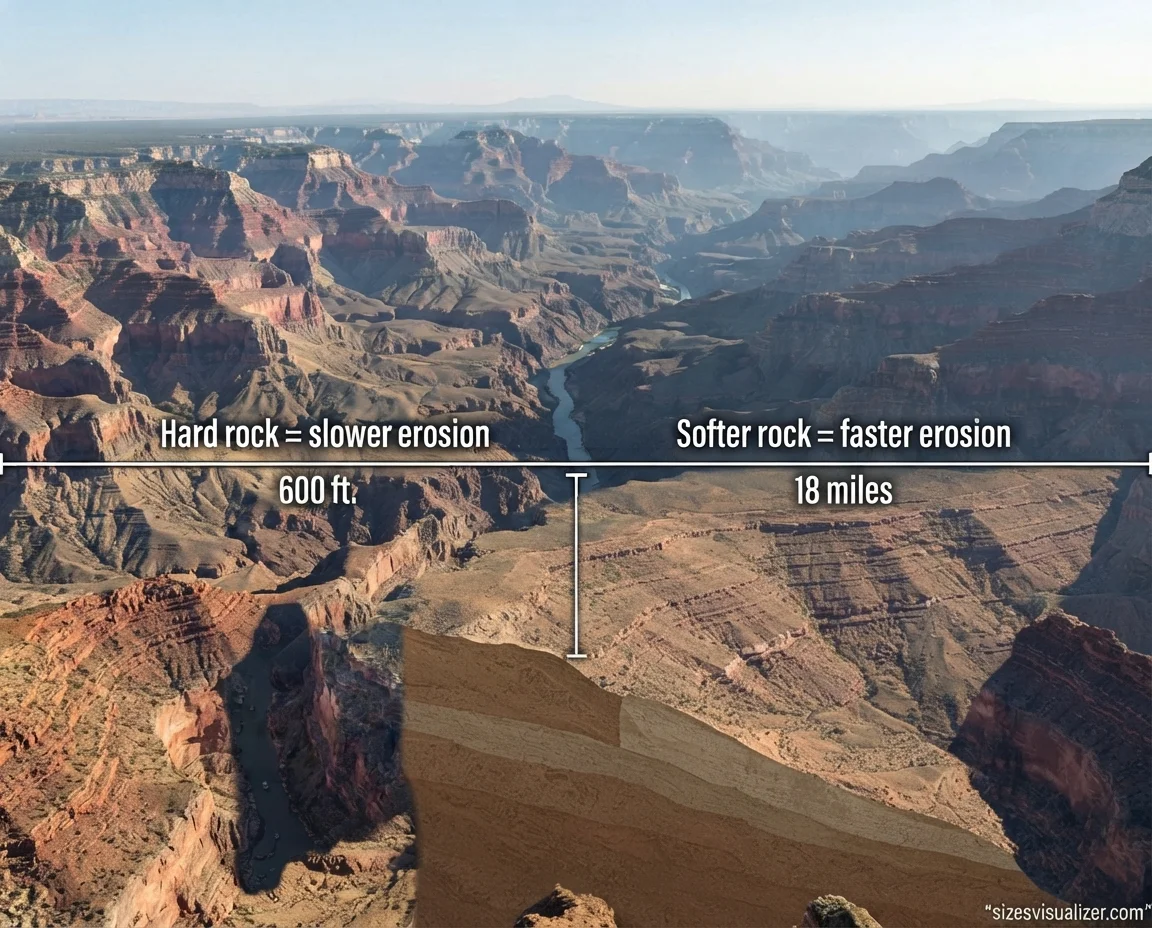
Canyon width depends on rock hardness. Softer rock erodes faster and widens the gap. Harder rock, like the limestone found near Marble Canyon, resists erosion and keeps the walls close together. This uneven erosion is why the Grand Canyon’s width shifts so dramatically from one section to the next.
How Deep and How Long Is the Grand Canyon?
Width tells only part of the story. How deep is the Grand Canyon, and how far does it run? Both numbers are just as staggering.
Grand Canyon Depth
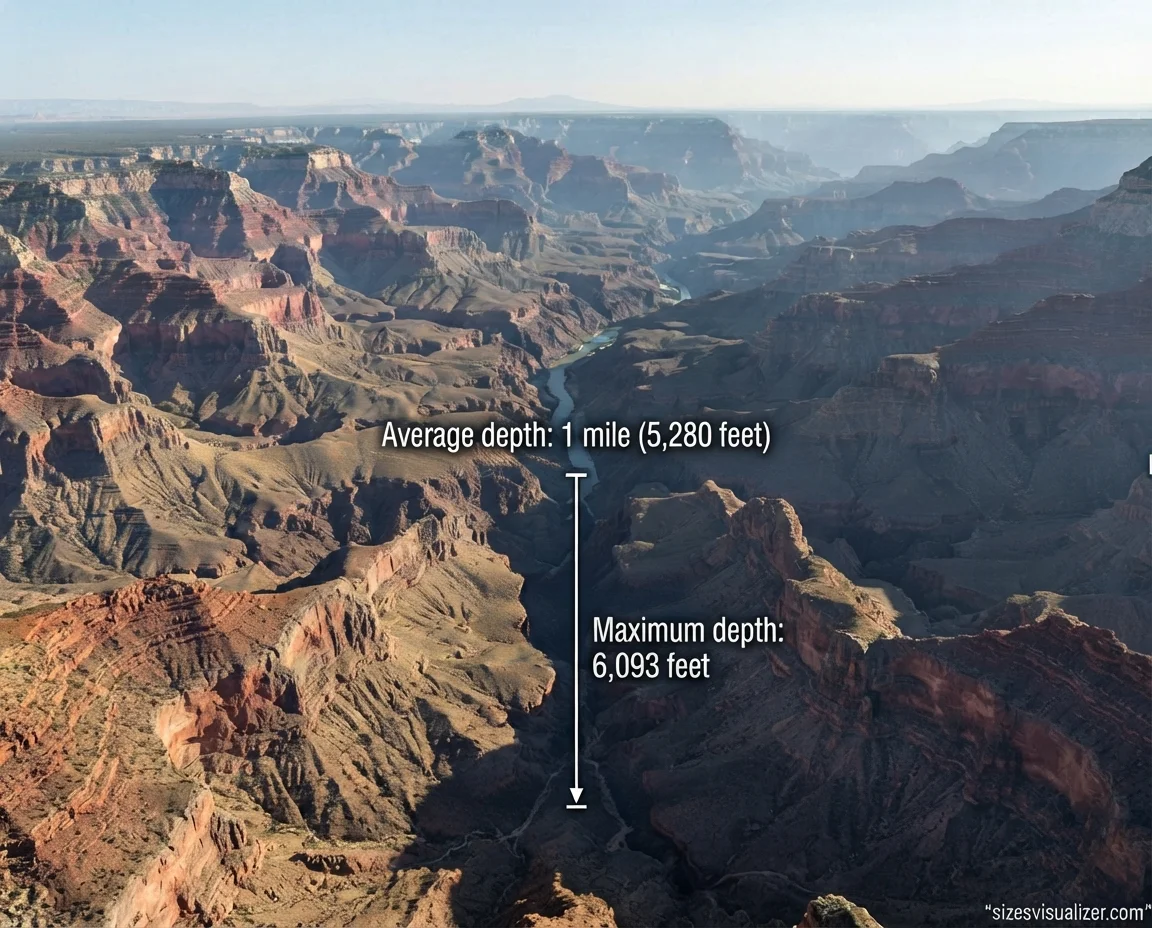
The canyon’s average depth is about one mile, or roughly 5,280 feet. At its deepest point, it plunges to 6,093 feet below the rim. For scale, that’s deeper than five Empire State Buildings stacked on top of one another.
Grand Canyon Length

The Grand Canyon runs 277 to 278 river miles long, tracing the path the Colorado River has cut through northern Arizona over millions of years. That distance is longer than the entire state of Rhode Island end to end.
Volume — How Much Space the Canyon Actually Holds
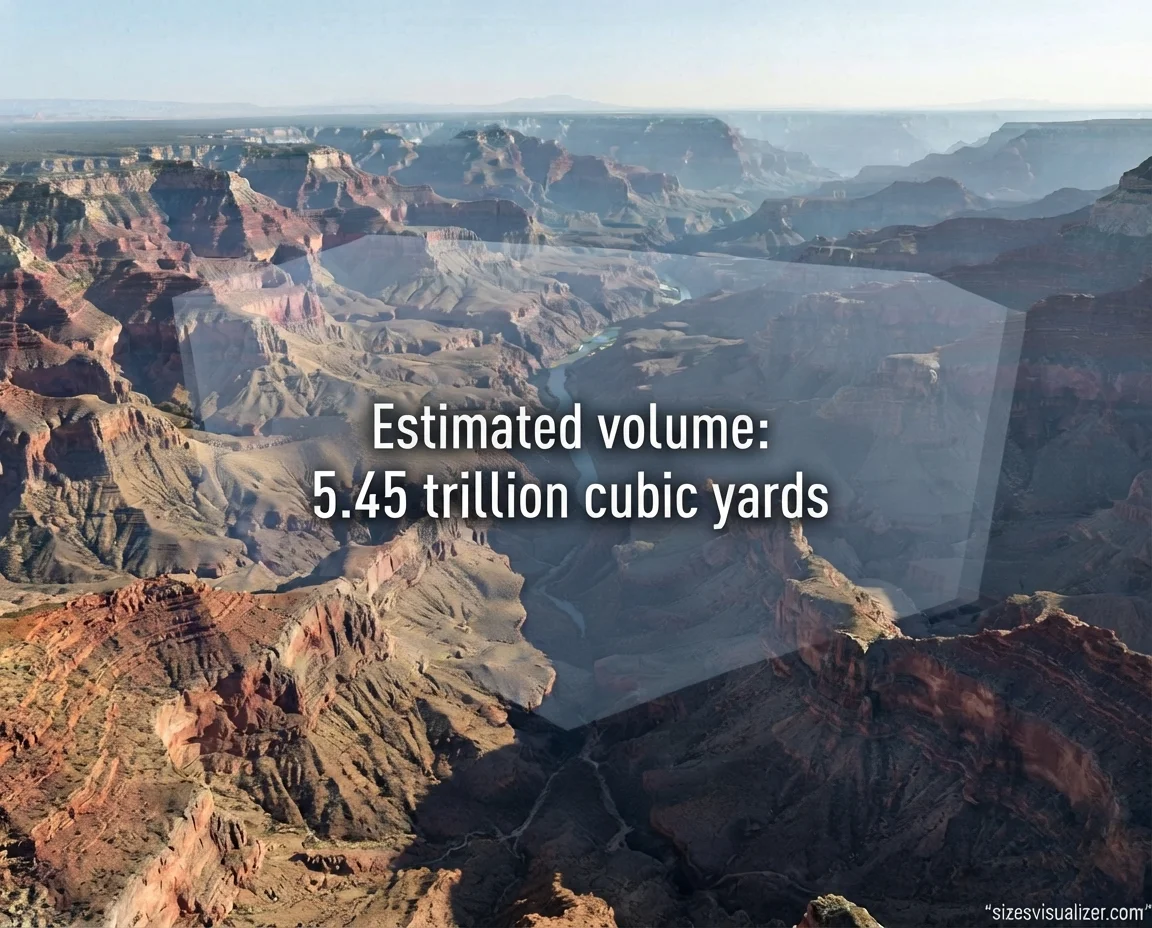
Here’s a fact rarely mentioned in most travel guides: the canyon’s total volume is about 5.45 trillion cubic yards, according to NPS figures. That number is almost impossible to picture, but it helps explain why the canyon feels so overwhelming in person. It isn’t just wide or deep. It’s a hollowed-out landmass on a planetary scale.
How the Grand Canyon Got So Wide and Deep
Understanding the geology behind the canyon explains why its width and depth vary so much across its length.
The Colorado River’s Role in Carving the Canyon
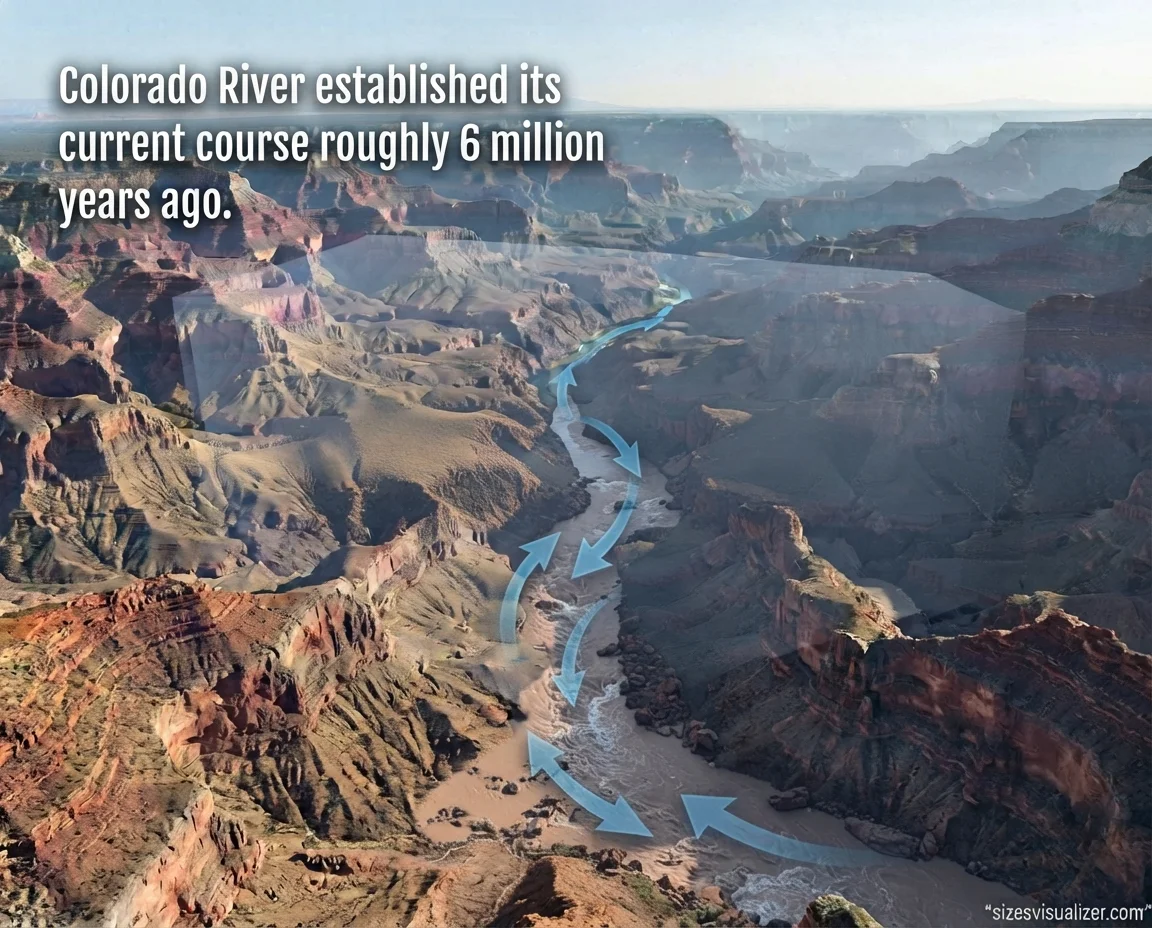
The Colorado River established its current course through the region roughly 6 million years ago, based on NPS geologic surveys. Since then, sediment-heavy water has ground away at rock layers, slowly widening and deepening the gorge. This process hasn’t stopped. The river is still reshaping the canyon today, just at a pace too slow for the human eye to notice.
How Old Is the Grand Canyon?
Geologists don’t fully agree on the canyon’s age. Most research points to the canyon forming over the last 5 to 6 million years. However, some geologic studies suggest sections may be far older, possibly up to 70 million years, based on rock evidence at the canyon’s edges. What’s certain: the oldest exposed rock layers at the bottom date back roughly 1.8 billion years, according to Britannica.
Rock Layers — Billions of Years of Earth’s History Exposed

Few landmarks let you see this much geologic time in one glance. The canyon walls expose sedimentary, igneous, and metamorphic rock spanning from the Precambrian era to more recent volcanic deposits. Each colored band you see from the rim represents a different chapter of Earth’s history, stacked in order like pages in a book.
Grand Canyon Size Compared to Other Places
Numbers like “1,904 square miles” are hard to picture on their own. Comparisons help put the Grand Canyon’s size into perspective.
Grand Canyon vs. Rhode Island and Delaware
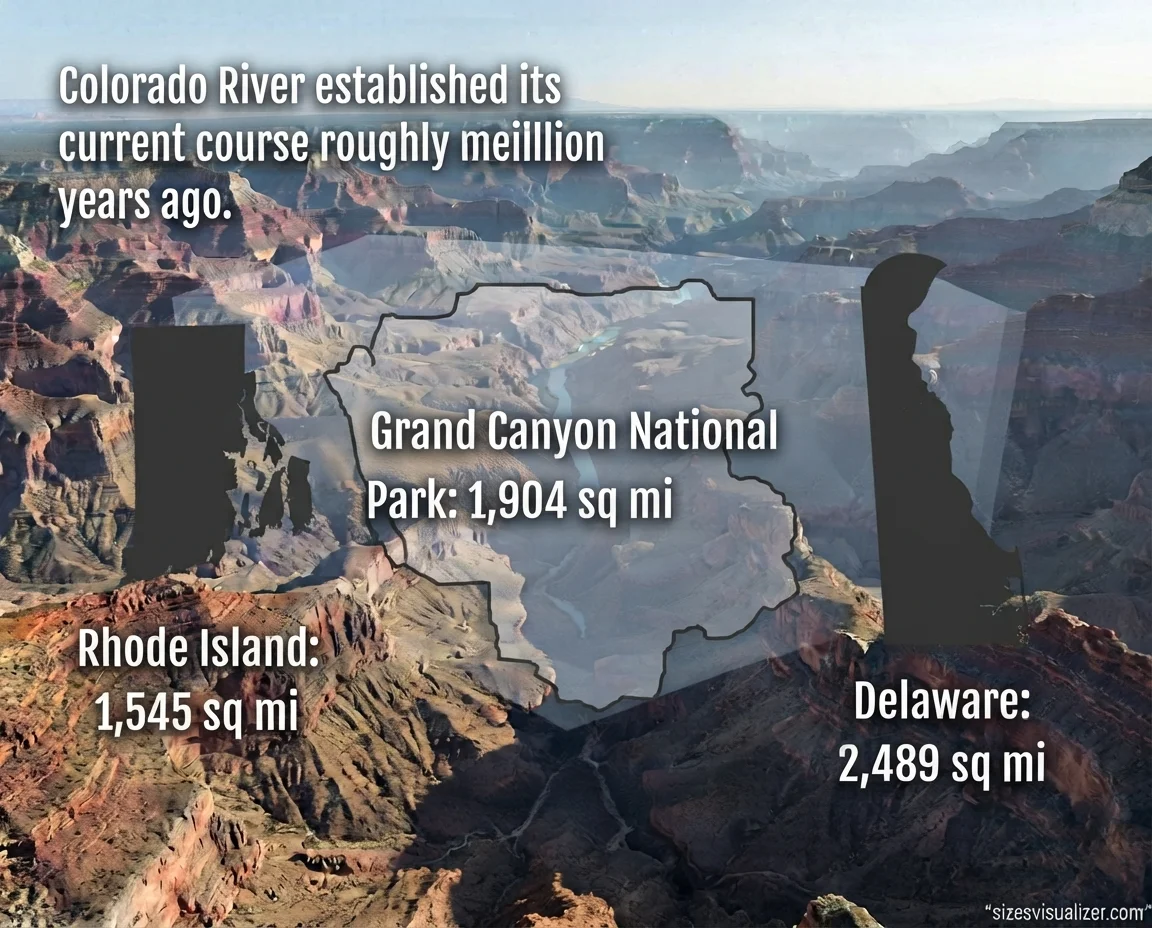
Grand Canyon National Park covers 1,904 square miles. That makes it larger than the entire state of Rhode Island and close in size to Delaware. If you tried to walk its full length, you’d cover more ground than a cross-state road trip back home.
Grand Canyon vs. Other Massive Canyons Worldwide
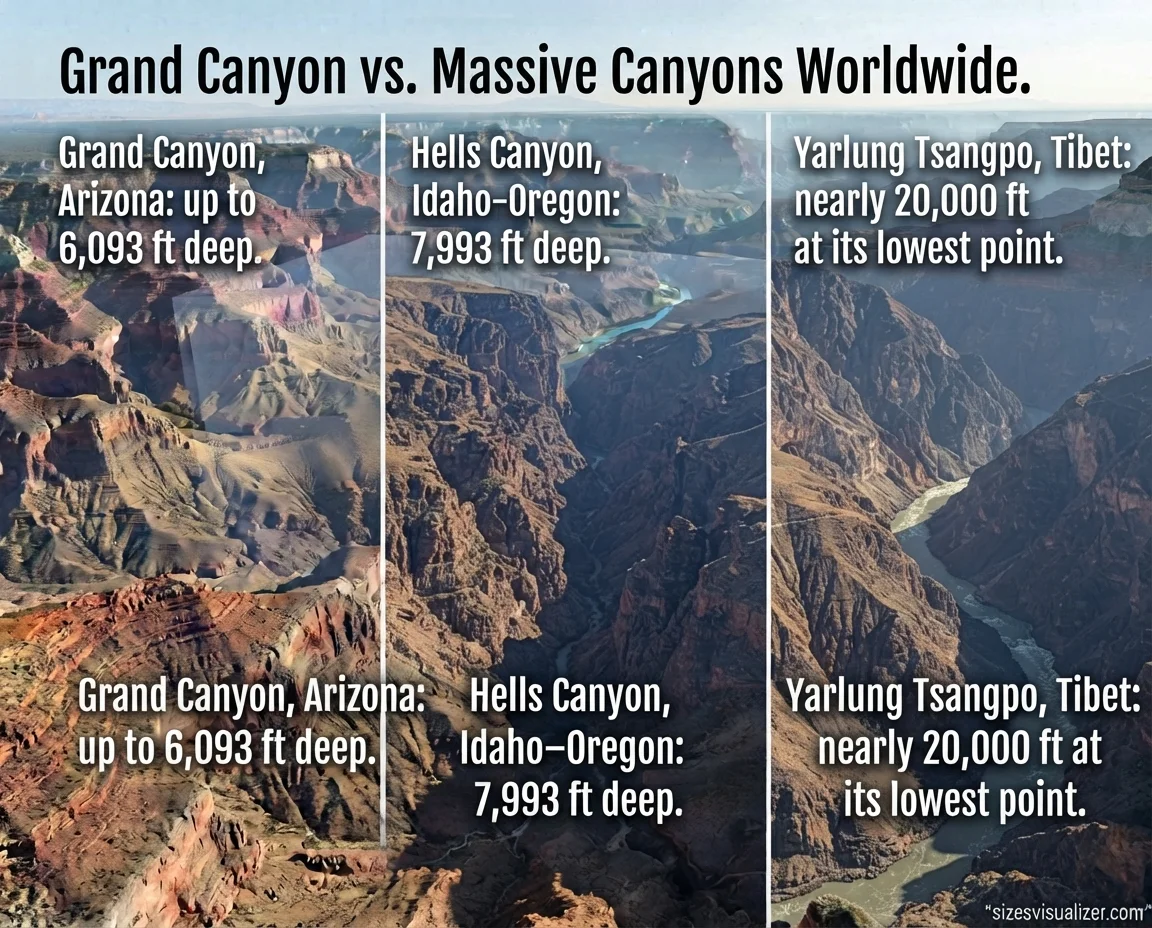
The Grand Canyon isn’t the deepest or widest canyon on the planet. Hell’s Canyon, along the Idaho-Oregon border, drops deeper at 7,993 feet. In Tibet, the Yarlung Tsangpo Grand Canyon dwarfs it in both width and depth, plunging close to 20,000 feet at its lowest point and stretching over 300 miles wide in some measurements.
Is the Grand Canyon the Biggest Canyon on Earth?
No. The Grand Canyon is famous for its scale, but it isn’t the largest by depth or width. What sets it apart isn’t raw size. It’s the combination of accessibility, exposed geologic history, and sheer visual drama that makes it one of the most visited natural landmarks in the world.
Must Visit: How Long Is the Amazon River? Length, Distance, Location & Fascinating Facts
Grand Canyon Facts Most Guides Leave Out
Beyond width and depth, a few lesser-known facts reveal just how complex this landmark really is.
Who Owns the Grand Canyon?
The National Park Service manages most of Grand Canyon National Park under federal jurisdiction. However, surrounding lands belong to 11 federally recognized tribes, including the Havasupai, Hopi, Hualapai, Navajo Nation, and Southern Paiute communities. Some of these tribal lands, like Havasupai territory, sit entirely outside NPS boundaries and operate under their own tribal government.
Why Is 90% of the Grand Canyon Restricted?
Most visitors only ever see the rim. Roughly 90% of the canyon’s interior remains off-limits or difficult to access due to steep terrain, protected wilderness zones, and cultural sites tied to Indigenous history. Areas like the Hopi Salt Mines and Furnace Flats are closed to preserve archaeological and cultural significance. Add in the sheer physical difficulty of descending thousands of feet on foot, and it’s easy to see why so little of the canyon gets explored firsthand.
How Many People Live at the Bottom of the Grand Canyon?
A small number of people do live below the rim. Phantom Ranch, situated near the Colorado River, houses seasonal NPS staff and concession workers. Nearby, the Havasupai Tribe has lived in Supai Village, inside a side canyon, for generations, making them one of the only communities in the country living within canyon walls year-round.
Grand Canyon by the Numbers
A few statistics rarely make it into standard guides:
- 4,430,653 visitors recorded in 2025
- 91 mammal species and 450 bird species call the canyon home
- 1,737 vascular plant species grow within park boundaries
- 11 search-and-rescue incidents reported monthly on average
- Only about 1% of visitors ever hike down to the canyon floor
These figures, sourced from the National Park Service, show a side of the Grand Canyon most travel content overlooks: it’s not just a viewpoint. It’s a living, biologically dense ecosystem.
FAQs
Why is 90% of the Grand Canyon restricted?
Most of the canyon’s interior is difficult or off-limits to visitors because of rugged terrain, protected wilderness areas, and culturally significant tribal sites. Only a small percentage of trails lead below the rim, and even fewer reach the canyon floor.
How many people live in the bottom of the Grand Canyon?
A small population lives below the rim, mainly at Phantom Ranch and Supai Village, home to the Havasupai Tribe. These communities remain isolated from the outside world, with Supai Village accessible only by foot, mule, or helicopter.
Is the Grand Canyon the biggest on Earth?
No. The Yarlung Tsangpo Grand Canyon in Tibet is both deeper and wider. The Grand Canyon in Arizona is best known for its accessibility, exposed rock layers, and cultural history rather than being the single largest canyon on the planet.
How many humans could fit in the Grand Canyon?
Given its volume of roughly 5.45 trillion cubic yards, the Grand Canyon could theoretically hold billions of people if it were somehow filled shoulder to shoulder. While no official study measures this exact figure, the scale illustrates just how massive the canyon’s empty space really is.
How many tourists have fallen into the Grand Canyon?
Falls remain one of the leading causes of death at the park, alongside heat-related cardiac events and flash floods, according to NPS safety data. Exact fall-related fatality counts vary year to year, but the National Park Service logs hundreds of search-and-rescue incidents annually tied to falls, heat exhaustion, and dehydration.
Who owns most of the Grand Canyon?
The federal government, through the National Park Service, manages the majority of Grand Canyon National Park. Surrounding tribal lands, including those belonging to the Havasupai, Hualapai, Navajo Nation, and Hopi Tribe, are governed separately under their own tribal authority.
Conclusion
The Grand Canyon’s width ranges from a tight 600 feet to a sprawling 18 miles, depending on where you stand. Combined with its mile-deep drop and 277-mile length, it’s easy to see why this landmark remains one of the most studied natural wonders in the world.
Beyond the numbers, what makes the canyon remarkable is what’s still hidden: 90% of its interior, its ancient rock layers, and the communities who’ve called it home for thousands of years.

Measurement Researcher, Size Comparison Writer & Content Specialist
Timmy Ahad is a dedicated content writer and research specialist at SizesVisualizer.com, where he focuses on creating accurate, easy-to-understand content about measurements, dimensions, size comparisons, and real-world object visualization.