Ever pulled a dollar out of your wallet and wondered exactly how big it is? You’re not alone. The US dollar bill dimensions are more precise than most people realize, and they haven’t changed in nearly a century.
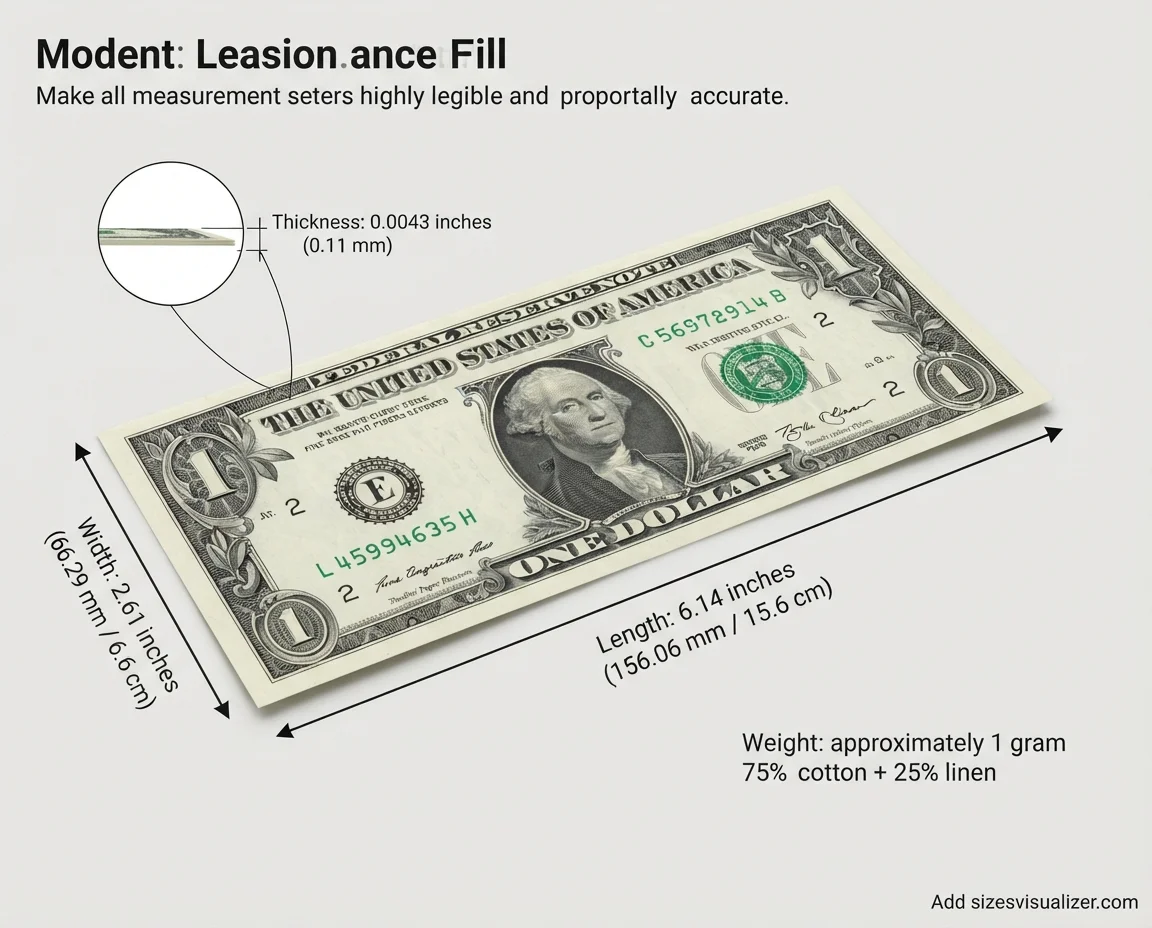
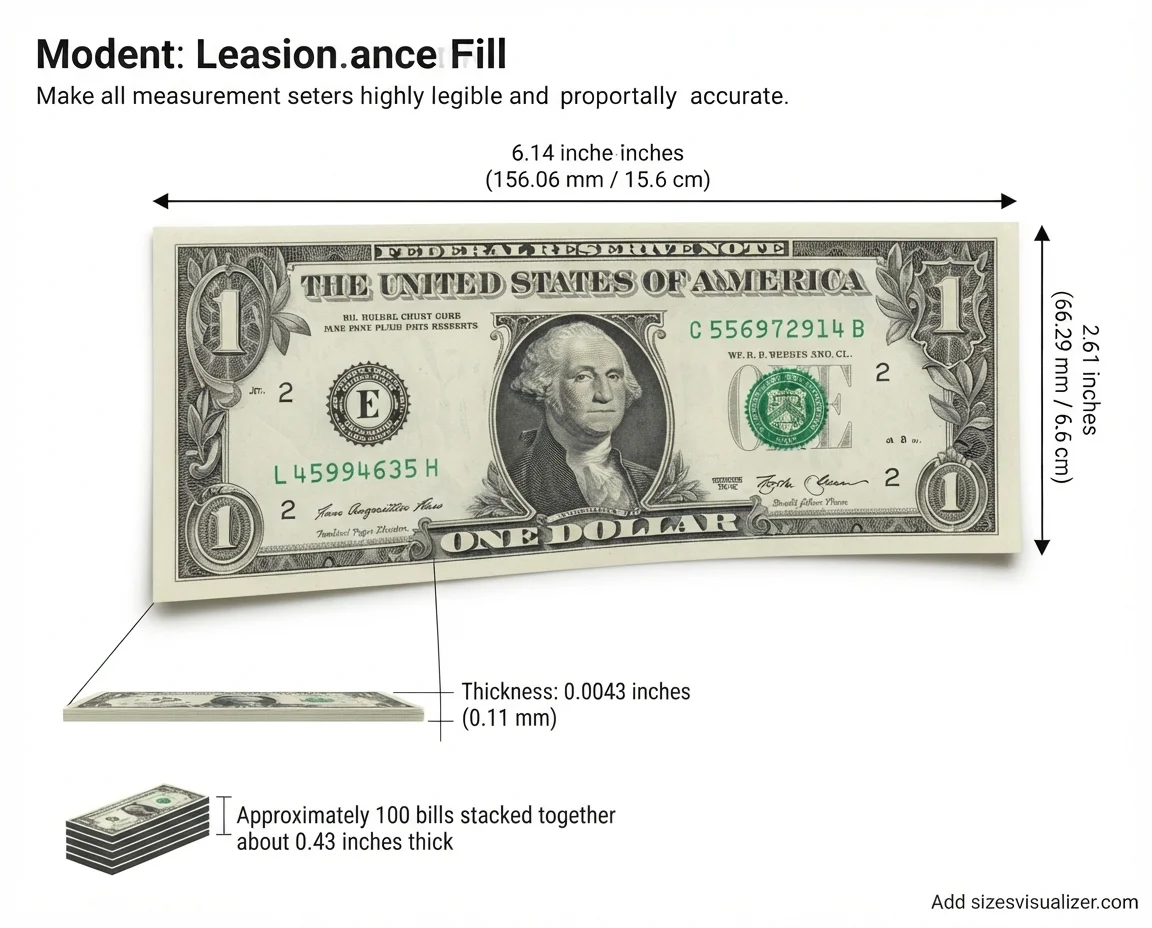
Here’s the short answer: every U.S. bill measures 6.14 inches long, 2.61 inches wide, and 0.0043 inches thick. That’s true whether you’re holding a $1 or a $100. Keep reading for the full breakdown, plus a few facts that rarely make it into the usual explainer.
Table of Contents
US Dollar Bill Dimensions: Exact Size, Width, Height & Thickness
The exact dollar bill size is set by the Bureau of Engraving and Printing (BEP), the federal agency that prints all U.S. paper currency. These numbers aren’t rounded guesses — they’re the official spec every printing press has to hit.
| Measurement | Inches | Millimeters | Centimeters |
|---|---|---|---|
| Length | 6.14 in | 156.06 mm | 15.6 cm |
| Width | 2.61 in | 66.29 mm | 6.6 cm |
| Thickness | 0.0043 in | 0.11 mm | 0.011 cm |
| Weight | ~0.035 oz | — | ~1 gram |
How thick is a dollar bill? At 0.0043 inches, a single note is roughly half the thickness of a sheet of printer paper. You’d need about 100 bills stacked together to reach half an inch.
One thing most guides skip: these figures represent a freshly printed note. A bill that’s been folded, crumpled, and passed through a hundred wallets will measure very slightly thinner or more worn at the edges. The BEP builds in a small manufacturing tolerance for exactly this reason — currency counters and ATM sensors are calibrated to accept minor variance without flagging a genuine bill as suspect.
The paper itself isn’t paper at all in the traditional sense. It’s a blend of 75% cotton and 25% linen, a fiber composition chosen specifically because it resists tearing and doesn’t disintegrate the way wood-pulp paper does when it goes through the wash.
Use our Size Visualizer Tool to compare dimensions visually and get a clear, realistic understanding of how different objects, spaces, and measurements relate to one another.
Dollar Bill Size by Denomination: Is Every Bill the Same Size?
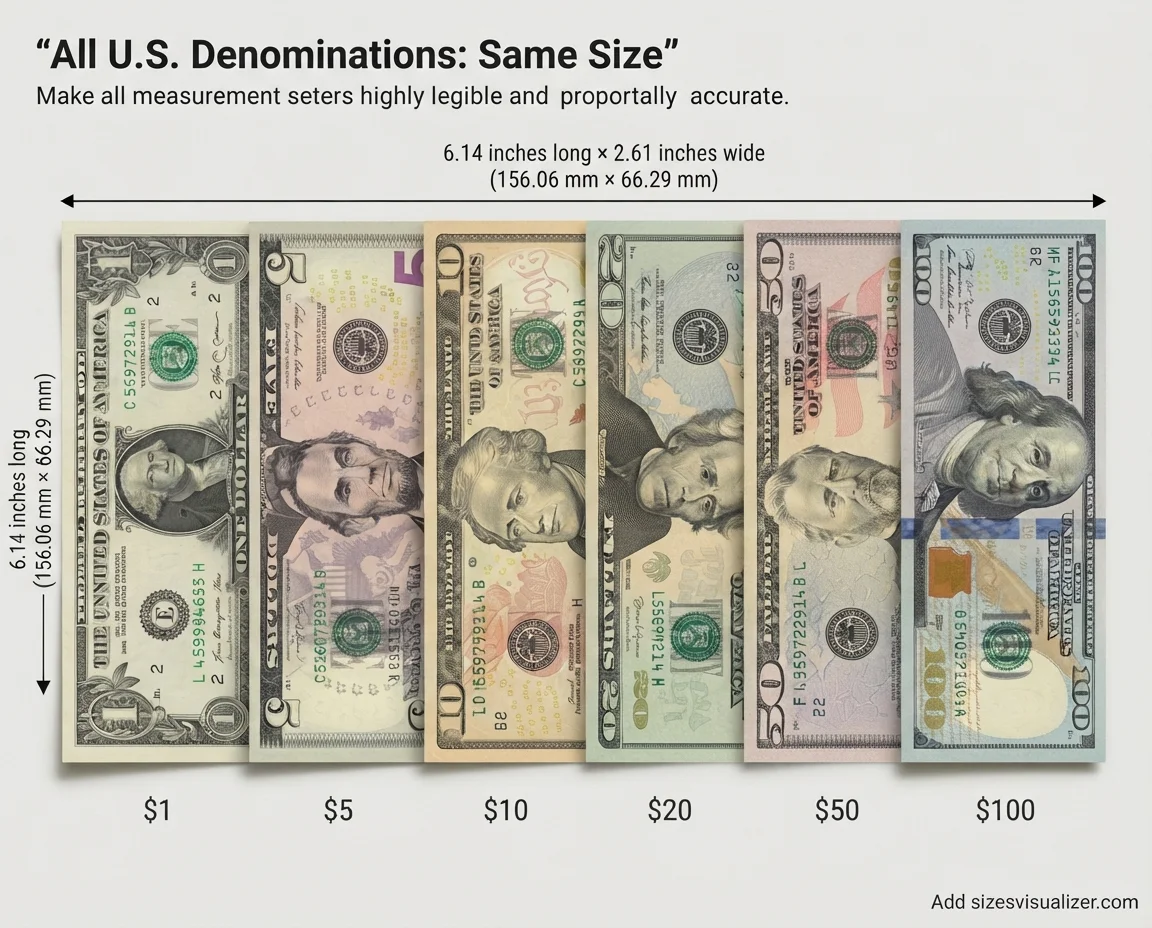
Here’s something that surprises a lot of people: every denomination is exactly the same size. A $1 bill and a $100 bill share identical dimensions — 6.14 x 2.61 inches, down to the fraction of a millimeter.
- $1 bill dimensions: George Washington on the front, the Great Seal on the back
- $5 bill size: Abraham Lincoln, Lincoln Memorial on the reverse
- $10 bill measurements: Alexander Hamilton — the only non-president on U.S. paper currency
- $20 bill dimensions: Andrew Jackson, the most circulated note in daily transactions
- $50 bill size: Ulysses S. Grant, U.S. Capitol on the back
- $100 bill dimensions: Benjamin Franklin, protected by color-shifting ink and a security ribbon
So what’s the size of a $20 bill? Same as every other note: 6.14 by 2.61 inches. Only the portrait, color accents, and anti-counterfeiting features change.
This uniformity isn’t an accident. Most countries scale bill size with value — a higher denomination is physically bigger, which helps visually impaired users and speeds up sorting. The U.S. took the opposite route on purpose. Fixed-size currency means one set of specs works across every ATM, vending machine, and high-speed bill counter in the country. Manufacturers don’t need to build machines that adjust for different note sizes, which keeps hardware simpler and cheaper. The tradeoff is real — critics have long pointed out that uniform sizing makes it harder for people with visual impairments to distinguish bills by feel, which is part of why the redesigned $100 note carries a raised tactile feature.
How the Size of a Dollar Bill Has Changed Since 1929
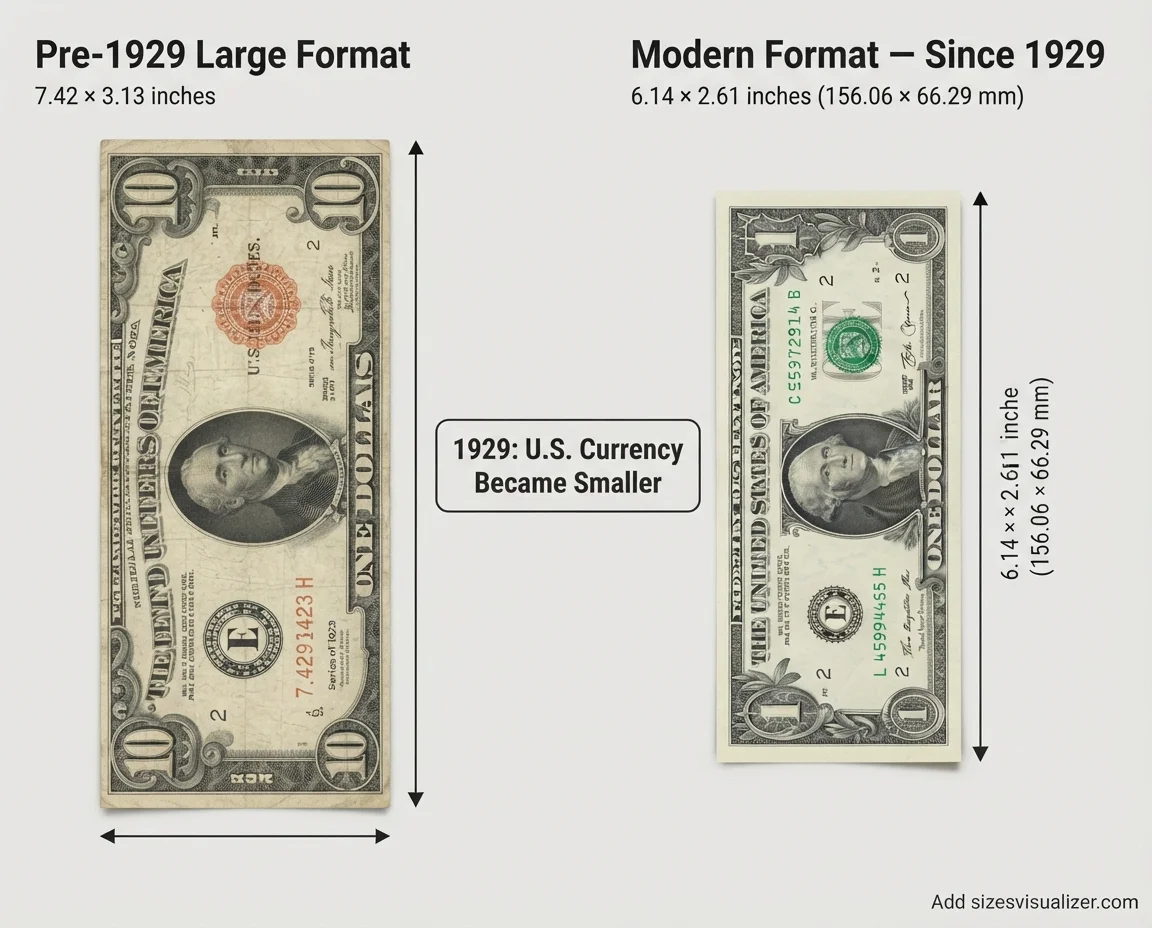
The current dollar bill size hasn’t always been standard. Before 1929, U.S. paper money was noticeably bigger — about 7.42 x 3.13 inches, nearly 30% larger than today’s notes. Collectors and historians nicknamed these older bills “horse blanket currency” because they felt bulky and awkward folded into a pocket.
The Treasury redesigned the entire note lineup in 1929, shrinking every denomination down to the 6.14 x 2.61 inch format still used today. The reasoning was practical: smaller notes cost less to produce, wore out less quickly, and took up less vault space.
What most articles leave out is that the paper formula changed too, not just the length and width. The cotton-linen blend was refined alongside the resize, giving the new smaller notes better durability per square inch than the older large-format bills. That mattered because a smaller note has less physical surface to embed security fibers and watermarks into — so the paper itself had to work harder. This pairing of a smaller footprint with a tougher substrate is part of why the modern note has held its size for nearly 100 years without another redesign.
Dollar Bill Weight, Thickness & Stack Height Facts
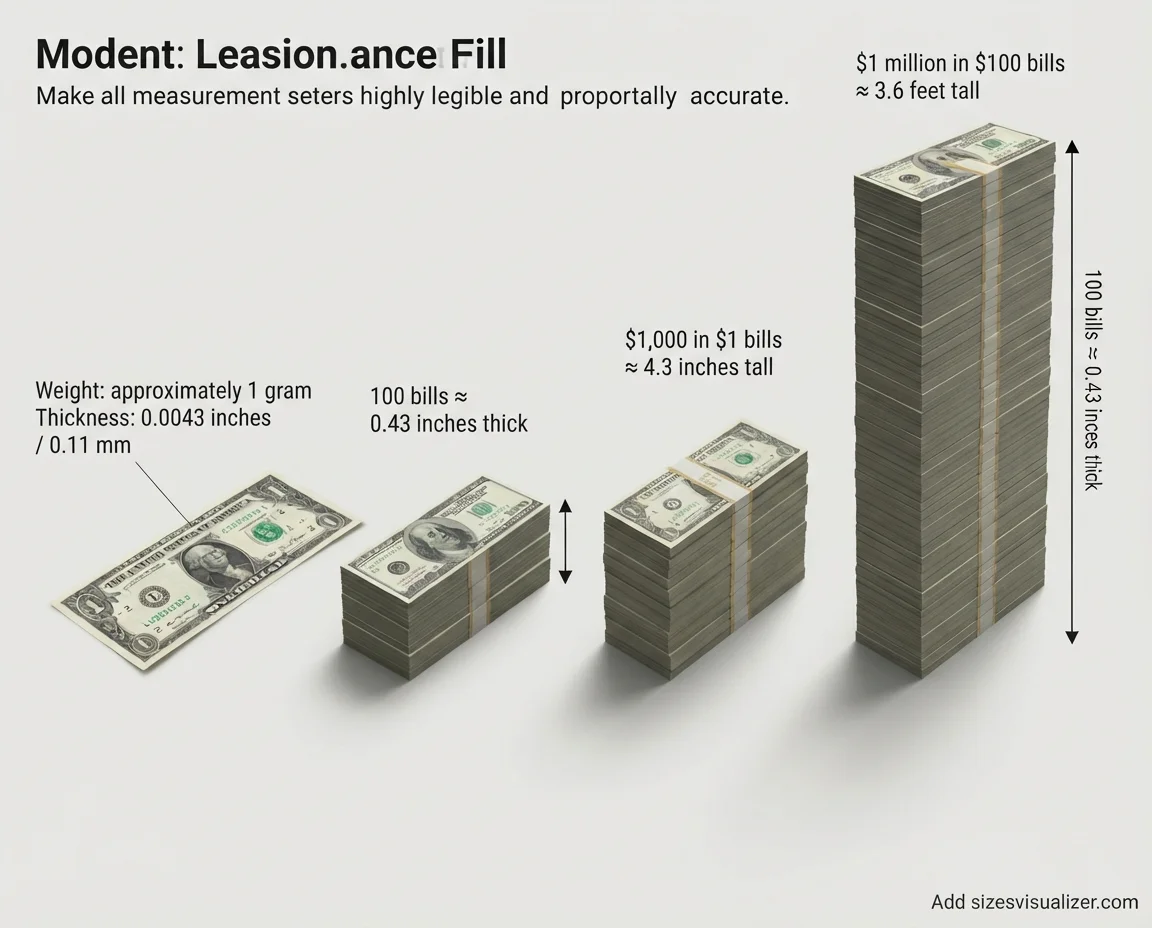
A single bill weighs about 1 gram, regardless of denomination. That featherweight number turns into something dramatic once you start stacking.
- 100 bills stacked ≈ 0.43 inches thick
- $1,000 in $1 bills ≈ 4.3 inches tall
- $1 million in $1 bills ≈ 358 feet tall — taller than the Statue of Liberty
- $1 million in $100 bills ≈ 3.6 feet tall — small enough to fit in a briefcase
That last comparison shows exactly why higher denominations exist: physical bulk drops fast as note value rises, even though the dimensions never change.
Durability tells its own story too. According to Federal Reserve data, a $1 bill circulates for roughly 6.6 years before it’s pulled and destroyed. A $100 bill lasts far longer — about 22.9 years — simply because it changes hands less often. Oddly, the $5 bill has the shortest lifespan of any denomination, wearing out in under 5 years on average.
Worn-out notes don’t just vanish. The government shreds and recycles about 90% of retired currency. Some of that shredded cash becomes roofing shingles or cellulose insulation. Some gets composted. It’s an unusual second life for something that started as a precisely measured piece of cotton-linen paper.
Must Visit: How Big Is a 75-Inch TV? Dimensions, Width, Height & Room Size Guide
Biggest & Rarest Dollar Bills: Size of Discontinued Notes
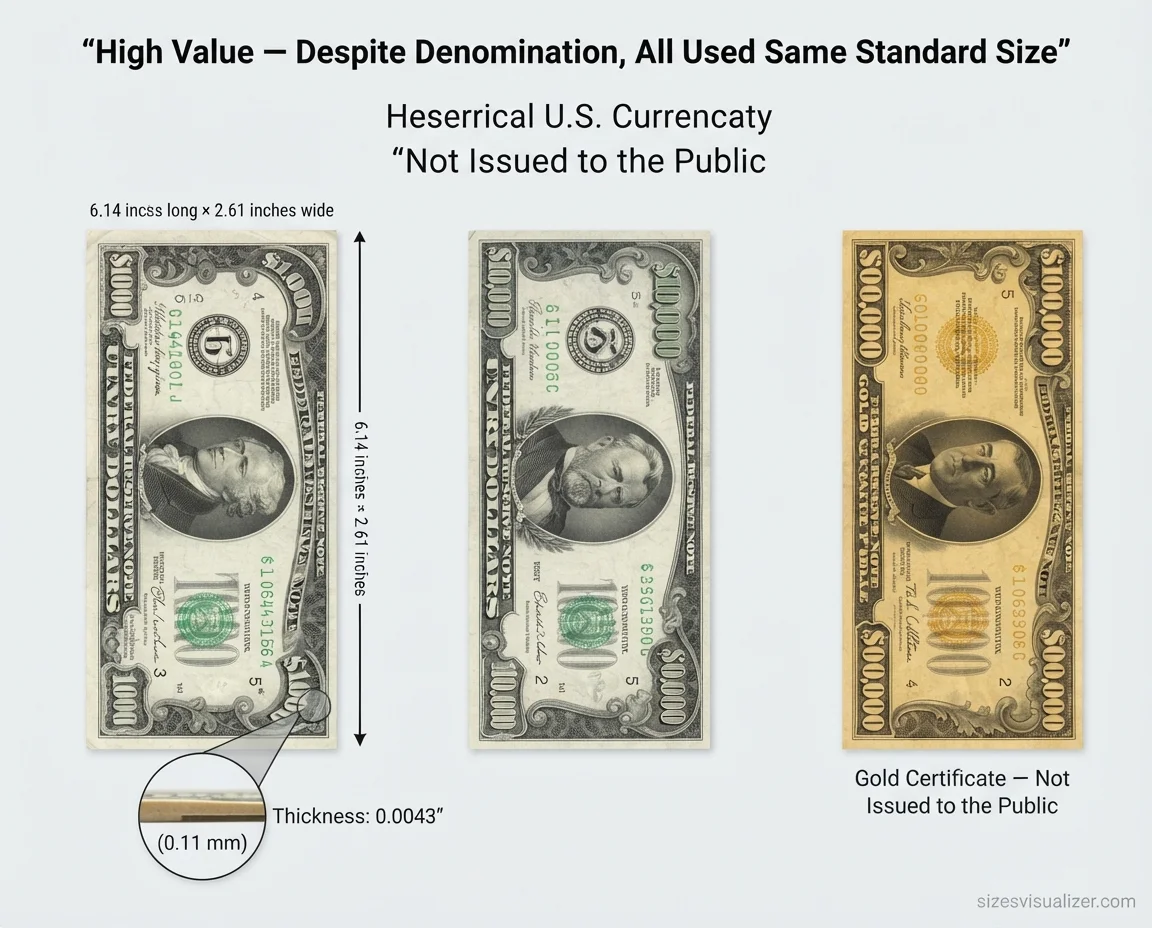
The rarest of all is the $100,000 gold certificate, featuring Woodrow Wilson. It was never issued to the public — it existed strictly for transactions between Federal Reserve banks. Even at that extraordinary value, it matched the standard note size exactly. No U.S. bill, no matter how valuable, has ever deviated from the 6.14 x 2.61 inch format.
FAQs
Is a dollar bill exactly 6 inches?
Not quite. A dollar bill measures 6.14 inches long, slightly over 6 inches, and 2.61 inches wide.
What’s the size of a $20 bill?
The same as every U.S. note: 6.14 x 2.61 inches. Only the design and portrait differ.
How big is the biggest dollar bill?
There isn’t a “bigger” bill by size. Even the discontinued $10,000 note matched the standard 6.14 x 2.61 inch dimensions.
How long is a dollar bill?
6.14 inches, or about 156 millimeters.
How big is a 1 dollar bill?
6.14 inches long, 2.61 inches wide, and 0.0043 inches thick — roughly the size of a slim credit card, only thinner and more flexible.
Is a $1000 dollar bill real?
Yes, it’s genuine, government-issued currency. It’s simply no longer in circulation, having been discontinued in 1969.
Conclusion
The US dollar bill dimensions — 6.14 x 2.61 inches, 0.0043 inches thick — have stayed fixed since 1929 across every denomination ever printed. That consistency isn’t trivia for its own sake; it’s the reason ATMs, vending machines, and wallets all work the same way no matter which bill you’re holding. Small measurements, but they carry nearly a century of design history behind them.

Measurement Researcher, Size Comparison Writer & Content Specialist
Timmy Ahad is a dedicated content writer and research specialist at SizesVisualizer.com, where he focuses on creating accurate, easy-to-understand content about measurements, dimensions, size comparisons, and real-world object visualization.